Excuse my ignorance, but is this module downloadable now?
Yes, from the github link in my previous post. But you need a (free) github account to access it.
If you don’t have a github account, then you can still see the page, but you won’t get the download link.
1 Like
I see. Thank you!
I’ve been playing with Compare 2 w/LEDs for a couple hours. I love the LEDs! They add much useful feedback for me. I also love having the added outputs for less than and great than the window and the output ranges is so helpful! I haven’t run into any issues at all. I just need to get my visual head around imagining sizing and shifting the windows around and also how the logic operators affect the outcome. Using a scope and trying to get used to it all. In a way it’s simple but there are an astronomical amount of outcomes. I haven’t tried audio yet but plan to now.
Thank you so much for this. It’s hard to believe how fast this came together!
2 Likes
Another couple hours of Compare 2 and am getting the most interesting results playing with the various logic operators. I’m mostly feeding Compare 2 with curves from Shapemaster Pro. I also tried a few audio files and it appears to work from what I can tell on the scope. Also interesting though I think I need to find suitable audio files and really tweak the settings to get the most out of it. I can’t help but wonder if there was a built in attenuverter with offset instead of range selections. Probably something I don’t fully understand that would not make sense maybe since I’m new to all this eurorack stuff. Super fun and seemingly infinite possibilities.
1 Like
I’m glad it is working well for you. I also have been having fun with it. I didn’t know it existed until your post asking if there was something like it in VCV.
The Range option only controls the output gate voltages. It has no effect on the input. I expect most people will use 0-10 for generating gates, and +/- 5 for audio outputs.
It would be nice to add attenuverters for the CV inputs, but I didn’t want to make the module any larger. The design where the knob and CV values are summed matches how the Joranalogue hardware works. I don’t want to lose that, so it would require 4 additional knobs to add the attenuverters.
1 Like
Yes, Doesn’t sound worth it. It already has many more options than the original module all in such a compact space (and so pleasant to sit and watch all the blinking lights)!
Glad to know about the ranges and what signals they are best suited for too.
this could maybe done by an expander module? @DaveVenom, what do you think?
Or simply use a separate module. For example, both Venom Mix 4 and Venom Quad VC Polarizer can independently attenuate 4 inputs in 5 hp. Actually the Mix 4 can attenuate 5 inputs with the Exclude button enabled.
The Grande VCA4 can attenuate 4 inputs in only 2 hp.
So I won’t worry about creating an expander.
3 Likes
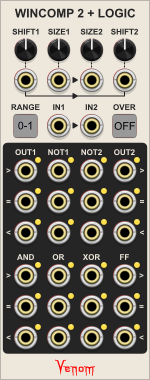
I have renamed “Compare 2” to “WinComp 2 + Logic”. The underlying slug name is unchanged, so existing patches will continue to work. I have also created the WinComp 2 + Logic documentation
More importantly, I have created the new “Wave Mangler”, my take on the Doepfer A-136 Distortion / Waveshaper Eurorack module., with many extra modulation options. Before creating this module I first created an A-136 Emulation from existing free modules.
Here is the Wave Mangler documentation. It was a beast to write. The concepts are not particularly difficult once you understand them, but I struggled coming up with words to describe them.
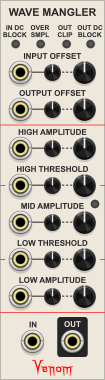
The new Venom 2.13 dev3 binaries are available for registered GitHub users.
Here is a Venomous Done V patch that features the new Wave Mangler.
Wave Mangler heavy modulation drone.vcv (5.7 KB)
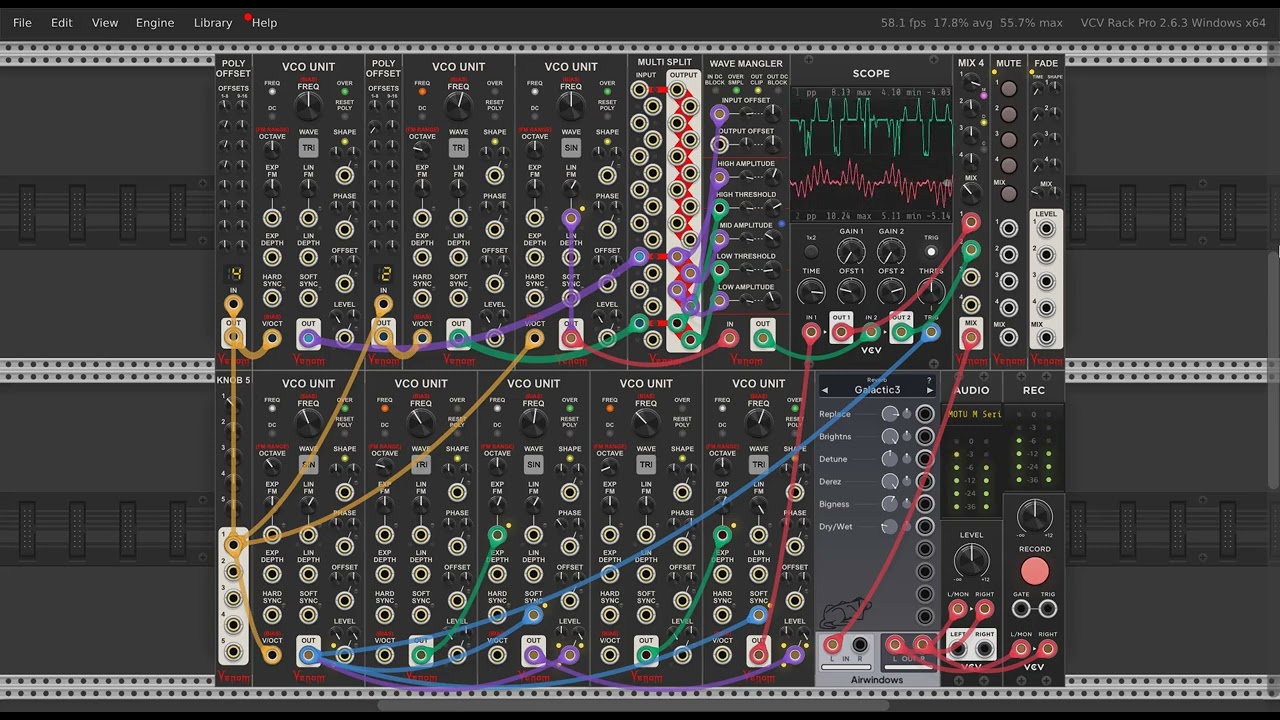
The patch actually consists of two drones running in parallel. The first one uses Wave Mangler.
In the second drone I use a bunch of ring modulation. I did this while exploring concepts for a new Venom VCO called XM-OP. It will be similar to the Bogaudio FM-OP except it will have an option to select the mode of operation:
- PM - phase modulation (what FM-OP actually uses and calls through zero linear FM)
- FM - true through zero linear frequency modulation
- AM - amplitude modulation (with option to rectify the modier)
- RM - ring modulation
I am still in the early stages for this project. I first have to build my first stand-alone envelope generator module. I can then apply that knowledge to XM-OP.
20 Likes
I like using VcoUnit as an operator already, just add envelope. Add a matrix mixer for quick algo patching and it’s on.
I would love another quirky envelope, can’t wait to see what you create.
3 Likes
Great sounds Dave!
1 Like
Dave these new hardware clones are crazy. It must have taken a heroic effort to pack that wavemangler patch monster into a module!
Also, congrats on the Wavemultiplier getting an epic Omri demo. Great sounds to be found there:
5 Likes
Here’s me having a little play with the Wave Mangler.
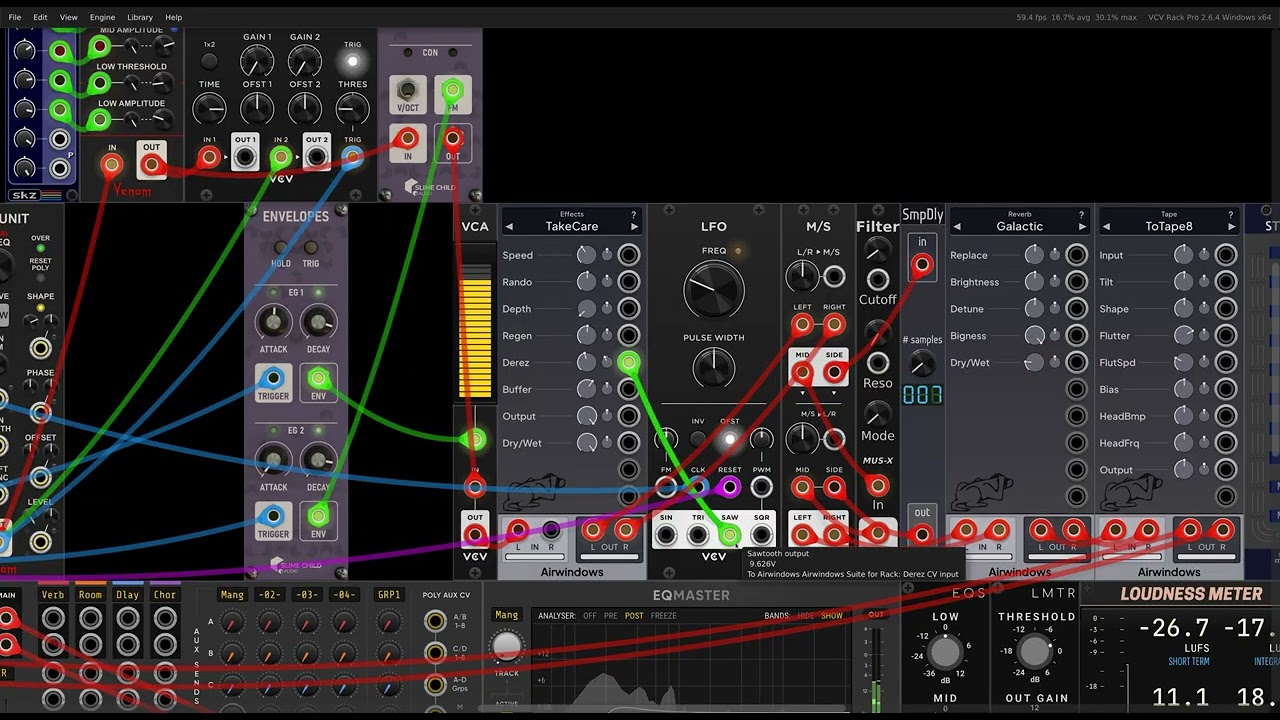
I don’t what I’m doing, but I am having lots of fun doing it. Thanks for all the new toys you keep giving us.
Uhh… I should probably mention I am not a youtuber.  … oh and the sound won’t start until 20s in or so.
3 Likes
Oh, nice!
I like the effect you get out of the Mangler on this one
1 Like
You are now. 
3 Likes
The math and programming is actually quite simple. The hard part was understanding how the Doepfer A-136 works (the functionality, not the electronics). The Doepfer manual only explains so much, and I found precious little on YouTube. Looking at some Reddit posts, it appears I was (am?) not alone in my confusion. I believe I (mostly) figured it out. Most of the heavy lifting occurred during development of my emulation with existing fixed modules. I am repeatedly finding that my existing Venom modules are invaluable for prototyping and idea exploration.
Then it was a question of what additional modulation I wanted to support, and what options. Finally there was the faceplate layout/design. I did go through a number of paper iterations. When I was finally satisfied, it basically took a day to implement. Then as I said, the documentation was a bigger chore than normal.
I think I will make one more change that I hope will make the functionality and documentation clearer - rename High/Mid/Low Amplitude to High/Mid/Low Amplifier.
5 Likes
OK, I have a new dev module to test, and I really like it!
AD/ASR Envelope Generator

Dev 4 binaries are available to users with a GitHub account.
I have often been frustrated with existing AD and ASR envelopes not offering the retrigger options that I want/need. This was particularly an issue when trying to emulate the SubHarmonicon EGs. I eventually got the results I wanted, but only with significant patching.
I believe this little beauty is extremely versatile. It emulates the SubHarmonicon EGs right out of the box, but it can do so much more.
Below is a summary of the features as listed in the documentation.
- Separate AD trigger and ASR gate inputs allow one envelope generator to support both behaviors simultaneously
- Wide stage length range: 0.24 msec to 3 min
- Stage lengths are precise with accuracy dictated by VCV sample rate
- V/Oct CV control over stage lengths with attenuverters
- Independent stage shape controls for Attack and Decay/Release: concave-up to linear to concave-down
- Envelope can be retriggered from current voltage level during Decay/Release stage
- Attack, Decay, and Sustain gate outputs indicate which stage is currently active
- Feedback from stage gates can block retrigger behavior and/or force ASR attack to rise to full value
- Loop option turns the envelope into a V/Oct LFO with CV control to start and stop the oscillation
- Fully polyphonic: All inputs and outputs are polyphonic with support for audio rates.
I believe the code is pretty solid, but there are a lot of features to test! I strongly encourage testers to read the entire AD/ASR Envelope Generator documentation to discover all the nooks and crannies that are available.
All bug reports and feedback most welcome.
There are only a couple additional features that I considered adding, but so far I have resisted. If anyone really wants any of the following, then I can probably be persuaded to implement it:
- Option to have retrigger restart from 0V, and allow AD retriggering during the Attack phase.
- Option to allow retriggering with restart from 0V while in Loop mode. (Basically a hard sync)
I haven’t implemented the first option because I don’t feel like it is very musical and I suspect it would hardly be used.
I haven’t implemented the second because LFO operation is a secondary feature, and there are already plenty of LFOs with hard sync.
But if the “masses” want it, then it can be done!
Some day I hope to create an extremely flexible ADSR (plus many other modes). But I am still thinking about the design and don’t have any immediate plans to create one. However I think I have gained enough knowledge to be able to program a simple ADSR to be included in my propsed XM-OP module.
18 Likes
Looks like another winner. The documentation is good work, easy to read and get a feel of behavior. I like the trigger/gate options when in looping mode, adds some rhythmic options not found in other env. I would respectfully request one more behavior perhaps available by right click. I would love an option to loop only on high gate with separate trigger to begin cycle. So I guess I’m asking for a looping mode that doesn’t loop until ii sees a high gate. AD trigger acts like regular AD, until gate a ASR allows and turns off cycling. This would be very intuitive in creating ratchets and other fun effects. As always thanks for the brilliant modules.
2 Likes
This looks great!
I will test it asap,
Thx, Dave, for this new addition to your modules.

1 Like