In June @trickyflemming published the Hetrick Amplitude Shaper module that is inspired by the Doepfer A-136 Distortion / Waveshaper Eurorack module. I had never heard of the A-136 before, so I looked it up.
The Hetrick module is similar to the Doepfer hardware, except the positive and negative thresholds are fixed at 0V. I thought the Doepfer module looked interesting, and I am interested in creating a Venom module that offers a superset of the Doepfer features. But before I do that I thought I should first try to emulate the Doepfer module with free VCV modules.
Easier said than done - the A-136 documentation is confusing, and in my opinion a bit incomplete. I could not find any good web content that really clarified anything either. But I think I finally have something that is very close. All user interaction with the emulation should be done in the top row. Do not manipulate the emulation implementation in the bottom row.
Doepfer A-136 Emulation.vcv (4.0 KB)
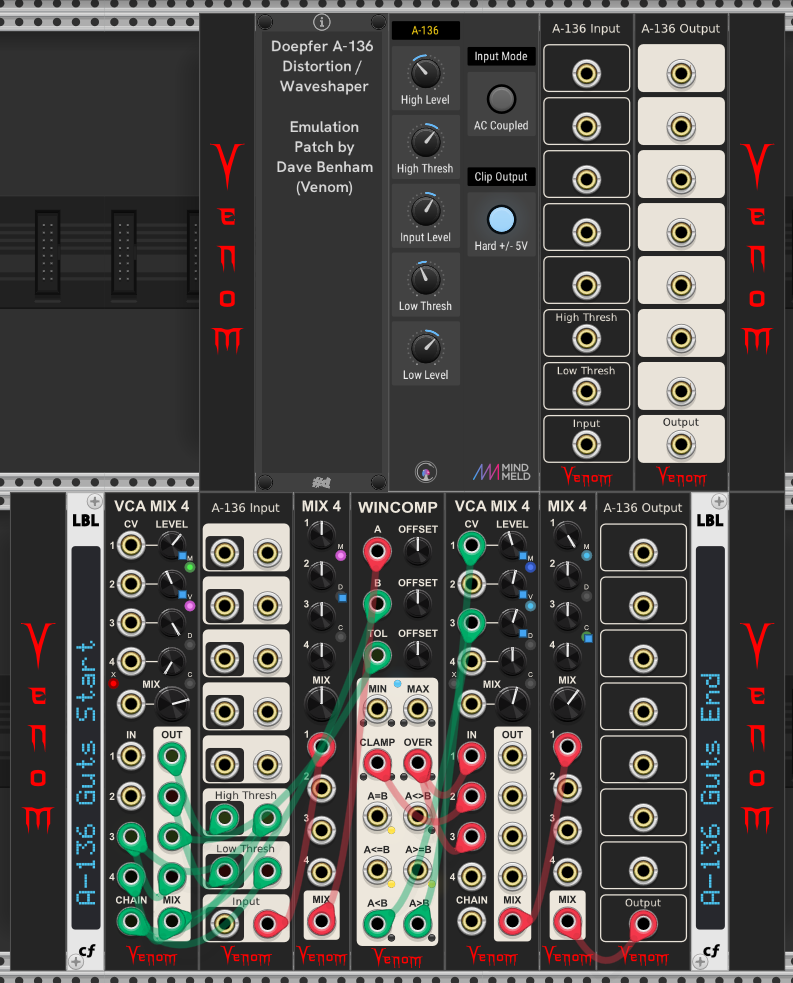
The Doepfer hardware has a preamp that leads to clipping of standard +/- 5V bipolar signals, but they also have a paper showing how to modify the module to eliminate the preamp. My emulation does not have the preamp.
The hardware by default has AC coupled inputs, with a jumper to make the inputs DC coupled. My emulation is DC coupled by default, with a switch to enable AC coupling.
The hardware has Pos, Input, and Neg Amplitude knobs, and Pos, Neg Level knobs. I renamed those controls to High, Input, and Low Level knobs, and High, Low Threshold knobs.
I suspect the hardware thresholds range from -5 to 5 volts, but my emulation is -10 to 10 volts.
I am pretty sure the hardware always hard clips the output ( at +/- 5V ? ). I make the clipping optional. That was needed to be able to reproduce some of the sample waveforms in the manual (more on that later). If I had implemented the preamp then I suspect I might not have needed the ability to disable the clipping.
The hardware documentation says it can do soft clipping, but I don’t see how, nor do I see any examples. Maybe their definition of soft clipping is different than mine.
The documentation says that unexpected results are obtained if the high threshold (positive level) is lower than the low threshold (negative level), but it doesn’t say what those results are. My emulation internally swaps the high and low threshold values when the high is below the low.
I would love to hear from someone that has access to the hardware and can tell me how I can improve the accuracy of my emulation.
Now for some video of the emulation in action.
In the video below I attempt to reproduce the sample waveforms from page 5 of the Doepfer A-136 manual. All the outputs are derived from a simple constant triangle wave.
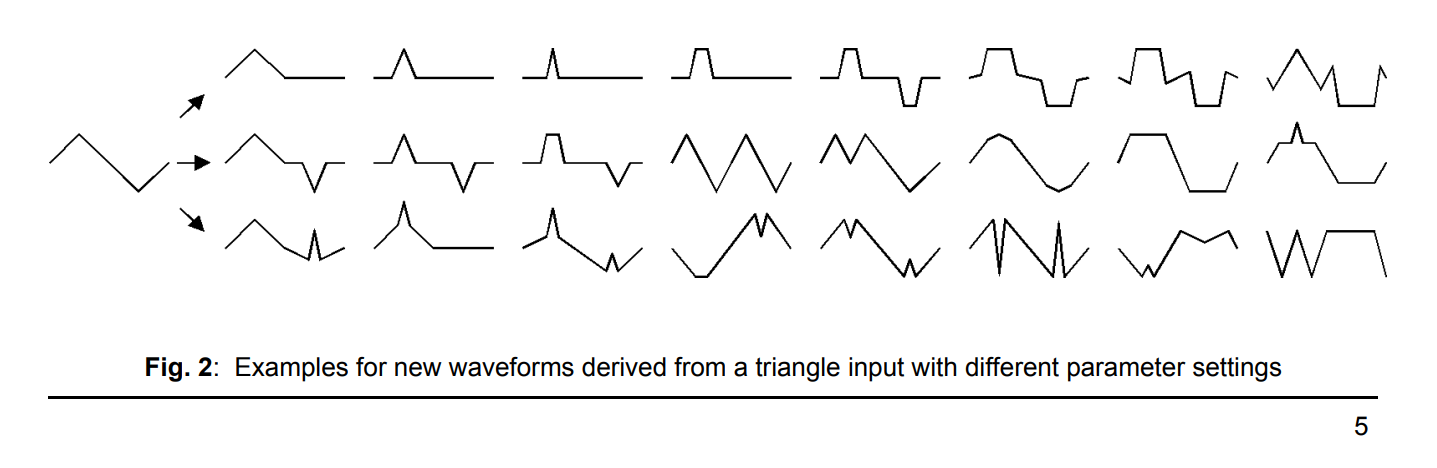
The video goes from left to right for the top row, then the middle row, then the bottom row.
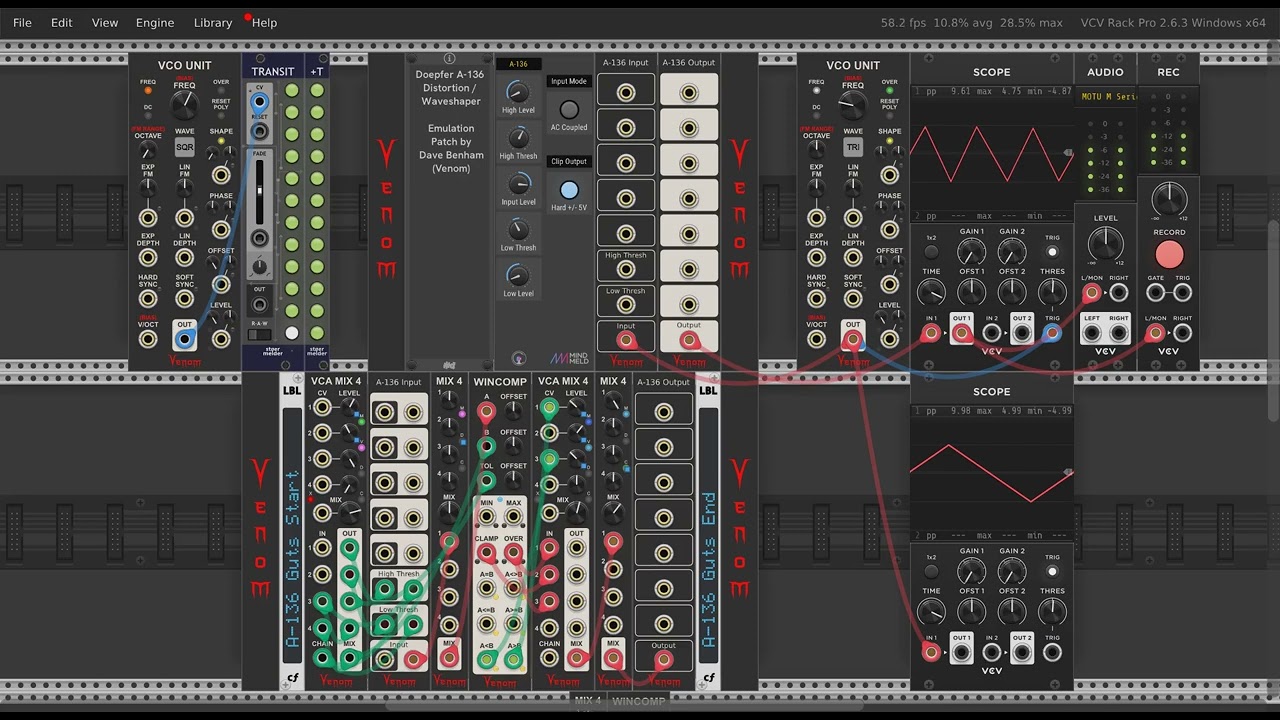
I think the results are pretty close, except for the middle row 4th waveform. The manual shows a simple doubling of the input frequency. But for the life of me I can’t fathom how that is possible, and I wonder if that is a documentation error. I show a tripling of the frequency instead.
I intended to publish the patch with all the settings programmed into the Transit module, but I accidently overwrote the patch, and I didn’t have the heart to reproduce it again. 
In the next video I show the effect of both audio rate and low frequency modulation of the high and low thresholds, again using a simple audio rate triangle input.
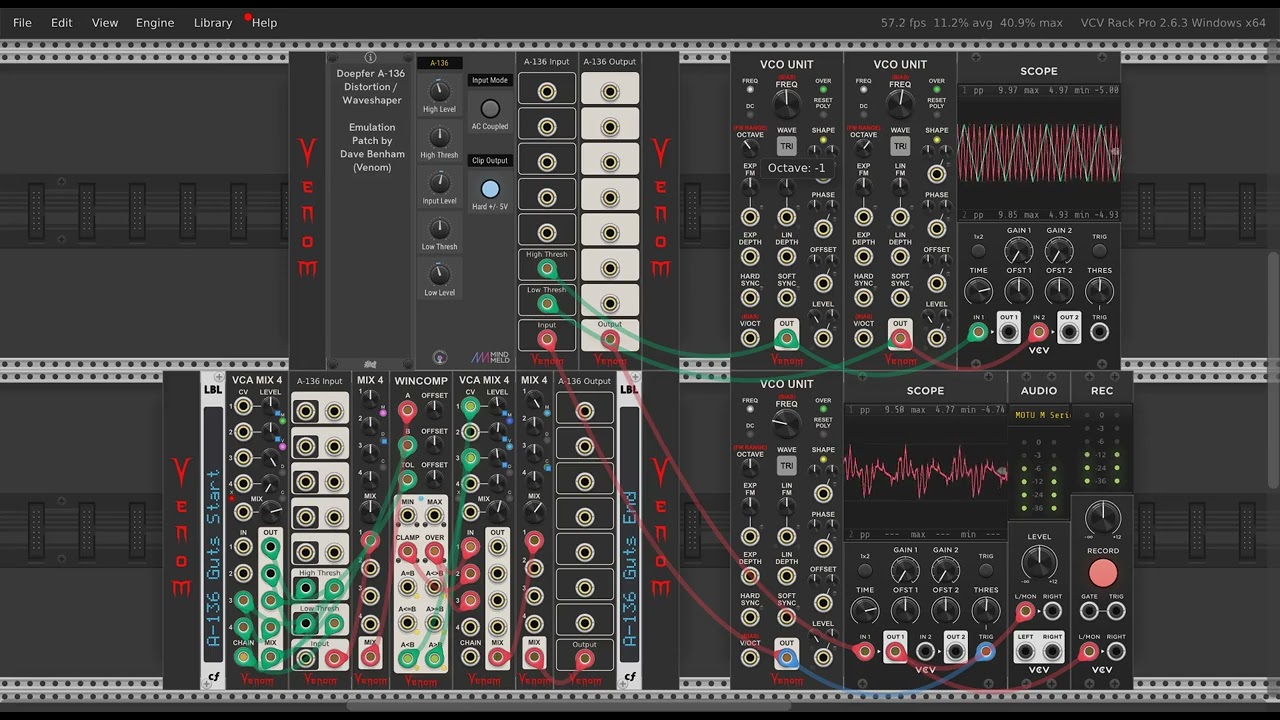
It is counter-intuitive, but if the level (amplitude) settings vary, then you can get non-zero output without any input. But if all the levels are the same, then there is indeed no output.
 thanks for the inspiration!