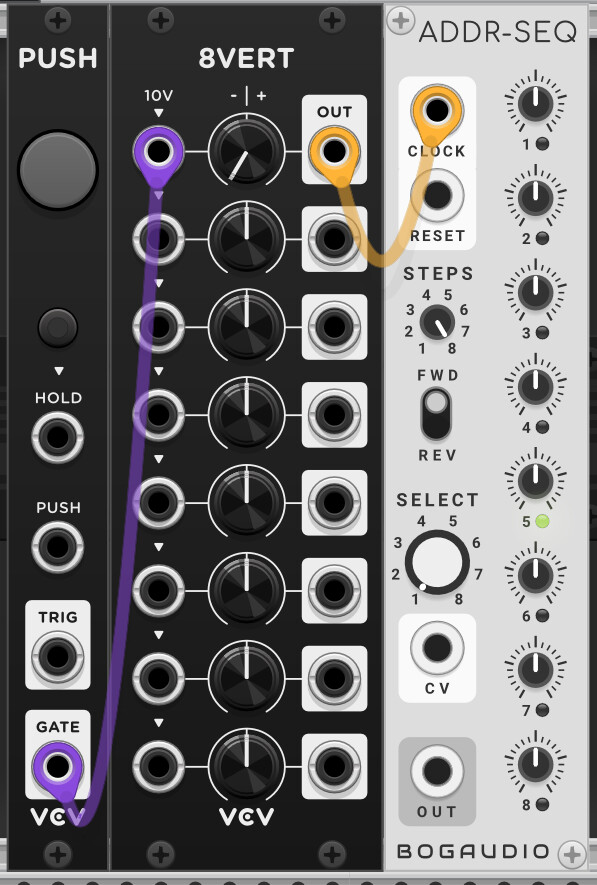
Great =) Oppresor and offset it is then.
Lets say i have a 9 step sequence with 3 low, 3 middle and 3 high pitched steps, then what i would want to is be able to (with a mixer maybe) emphasise and de-emphasise these 3 groups, so sometimes high pitch is in the front and sometimes low or middle pitch. How can i achieve this? Is it a good option to use a comparator?
In addition if it was possible to “scoop up” steps in a certain pitch interval what would be interesting to do also is to transpose them, So only to transpose the middle range for instance.
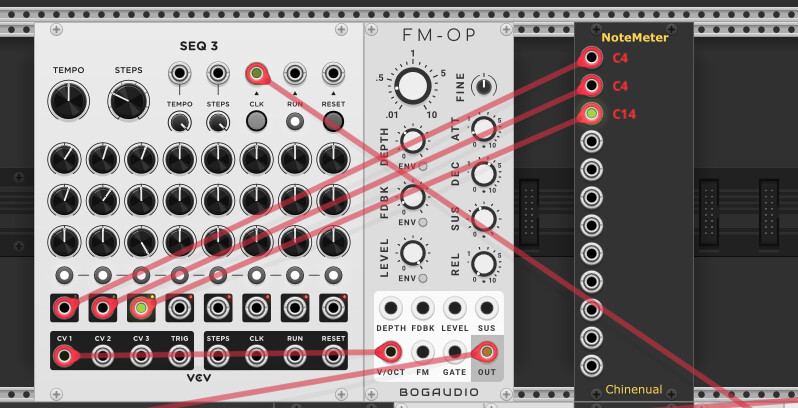
Those are gates, 0v is C4, 10v is c(4+10). You need the 3 cv outs.
alright yes. I moved the cable down to CV1 in the lower left corner. Now it shows correct pitches, the problem now is that it only displays one step at a time, Is there some way i can see all the steps? because when it switch so fast its harder to figure out what is what. 

I will step on it immediately.
This felt like finally crushing a slippery pimpel. 
The sequencers i tried have such small lamps, i understand that the userinterface intends to emulate the visuals of hardware, but that lamp is very tiney. Is there a way to see what step is active more clearly?

Nice. =)
Sorry i forgot, Is it possible to make the clock go backwords, or does this need to be done from the sequencer (actually i am using 2 sequencers and a switch, the Bogaudio 8:1)
Yes, and in particular: a windowed comparator would be helpful because you can set a range for which it outputs a high gate. So instead basic comparator logic like “if > C4” you can do things like “between C4 and G5”. Then you use that gate to control a switch and advance a secondary sequence, or whatever.
Venom WinComp can do this. By default the “A=B” output is only high when the A and B input are exactly equal, but if you increase the “TOL” tolerance amount, it creates a range for which “A=B” is high. I guess it is doing something like “if (A > B - TOL) and (A < B + TOL)”. So you can set B to the midpoint of the pitch range you want to target, and set TOL to half the size of the range. Then send your pitch CV to the A input. Something like that. Play around with it and see if it can do what you want. Maybe I can put a demo patch together later.
It is also fun to have a slow sequence that modifies the windowed comparator A/B and/or tolerance (AKA window size). You can create many layers of sequences for evolving melody patterns.
the problem is that the 8:1 switch has a reverse, when its acitvated the two ADDR-seq do not revers also, they continue to move forward, so in order to backword the entire system of 2 addr-seq and 8:1 switch i would guess that the clock needs to be reversed?
Shift masterclock back and forth? - VCV Rack - VCV Community
there is a thread but it seems as this may not be the solution: zzc’s clock can be synced from an external pulse and by using zzc’s FN-3 with a square with a diminished PW you can shift a pulse forward or backward in time relative to the main clock.
Thanks! i will try it out. Also i understand the first part of:
It is also fun to have a slow sequence that modifies the windowed comparator A/B and/or tolerance (AKA window size). You can create many layers of sequences for evolving melody patterns.
but not
You can create many layers of sequences for evolving melody patterns.
In what sence I am curious =)
Maybe “evolving” is not the right word.
It’s like at the start of this thread, you wanted to know how to have a “subsequence” where every time you are on a particular step, you are cycling through another sequence of pitches. Well, you can take that idea as far as you want and keep applying it many times in a single patch. One of the steps in the subsequence could itself have another subsequence. Back at the top-level sequence, you can have different subsequence on another step, but maybe you do not want to use this subsequence all the time. So you make a very slow sequence that enables a gate once in a while, and only apply the other subsequence sometimes. On top of all that, you can use one or more windowed comparators to transpose pitches, and maybe the transposition amount is sequenced too. It can just keep going and going as deep as you want. And you can add some randomness too.
At some point, even though every individual sequence is simple and easy to understand, the patch becomes too complex and it is hard to understand what is happening anymore. It keeps changing and surprising you. I guess this is what I call “evolving”. Sometimes I get lost in such a patch and randomly find positions of the knobs and sliders where it is making something very beautiful or interesting-sounding. I think it’s really fun! “Modular sequencing” is one of my favorite parts of modular synths.
=) I want to develope the concept further and use “evolving” for patterns that are kind of “polymeter” in its nature where the 8 step foundation does not really repeat itsel until around 128 steps and moving pattern when the the patch offers variation/improvisation for each cycle on top of a more or less intact foundation.
“Sometimes I get lost in such a patch and randomly find positions of the knobs and sliders where it is making something very beautiful or interesting-sounding.”
Yes i noticed these extra surprises the last couple of days. Its funny how adding only one sequencer to another you move from 1D to 3D. Also its nice when the number of steps on the switch are shorter (and odd) than on the sequencers, then really you get an extra dimension out of that (so now 4D).
Im looking forward to being able to transpose groups of notes within a pattern in a chord progression manner of lets say 5 cyles. Then you can say that the pattern will be moving like a Kosack Soldier Dance.
This is from the bogaudio manual:
If option “Reverse step on negative clock” is enabled, negative or inverted clock pulses (e.g. a pulse from 0V to -5V) will step backwards.
So you should be able to step the sequencers and the sequential switch backwards using an inverted clock.