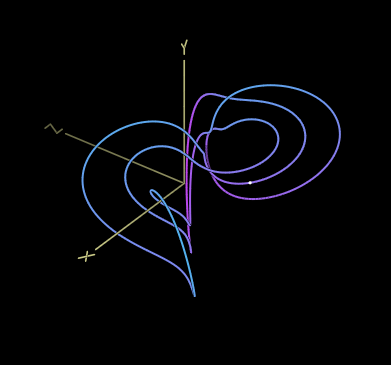
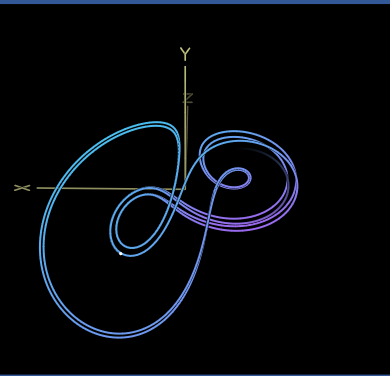
I didn’t respond to this before, but… YES!
I am extremely interested in learning more math to understand how to create chaotic attractors, or even formulas that make interesting loops or whatever.
My thought process: no matter where the particle is in space \bar{r}=(x, y, z), you want to point it in the right direction \frac{\mathrm{d}\bar{r}}{\mathrm{d}t}=(\dot{x}, \dot{y}, \dot{z}). I don’t think speed matters in terms of the shape you create. All that matters is the direction it points. Speed will matter to someone using the attractor preset, but I’m just talking about whether the shape is chaotic, periodic, divergent, etc.
Super simple example. Suppose you want the particle to move in a perfect circle in the xy plane, with z=0 always. I would start thinking about the point starting at (1, 0, 0). The particle is one unit to the right of the origin. I want it to move in the y direction, so that means the velocity vector could be (0, 1, 0).
You want the velocity vector to be at right angles to the position vector, in order to get circular motion. In general, if the particle is at (x, y, 0), the perpendicular vector is (-y, x, 0).
OK, I’m going to try this out while I’m typing this post. I’m going to use the following formulas in Zoo:
vx = -y
vy = x
vz = 0
And … BOOM you get a circle:
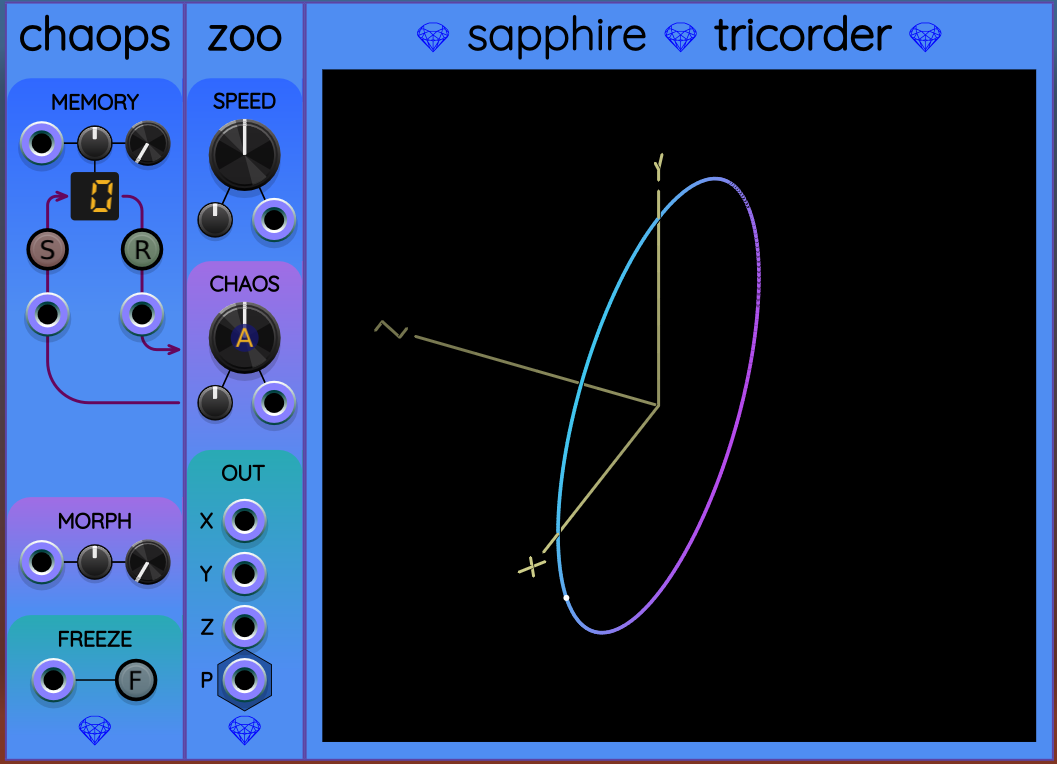
Going from circles to chaos is beyond my current understanding, but maybe this is the first baby step toward how you would think about it.
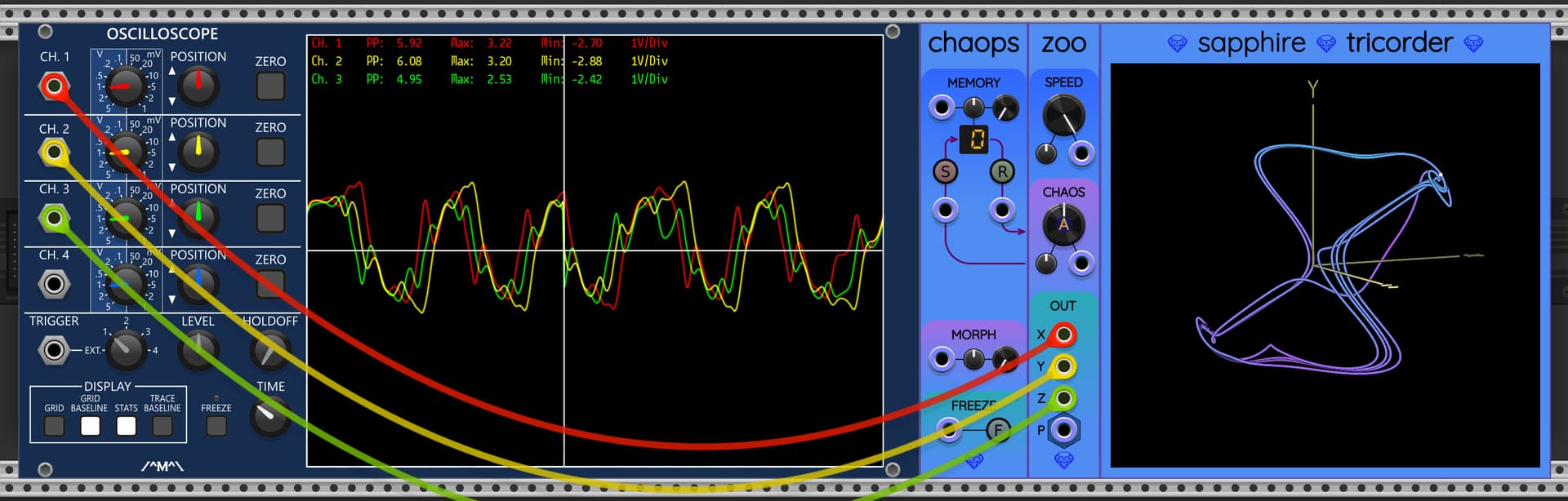
Anyway, as a side note, this shows that Zoo can be used to generate sine wave outputs! LOL.
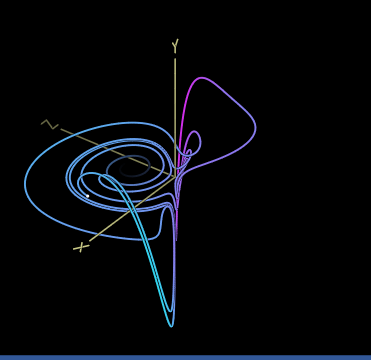

 (Maybe, it’s even not that difficult? And most attractors will have some kind of sonic character that makes them easy to recognize? I have no idea but it would be great if that’s actually the case, and make the different attractor presets even more valuable, aside from their beautiful display in Tricorder.)