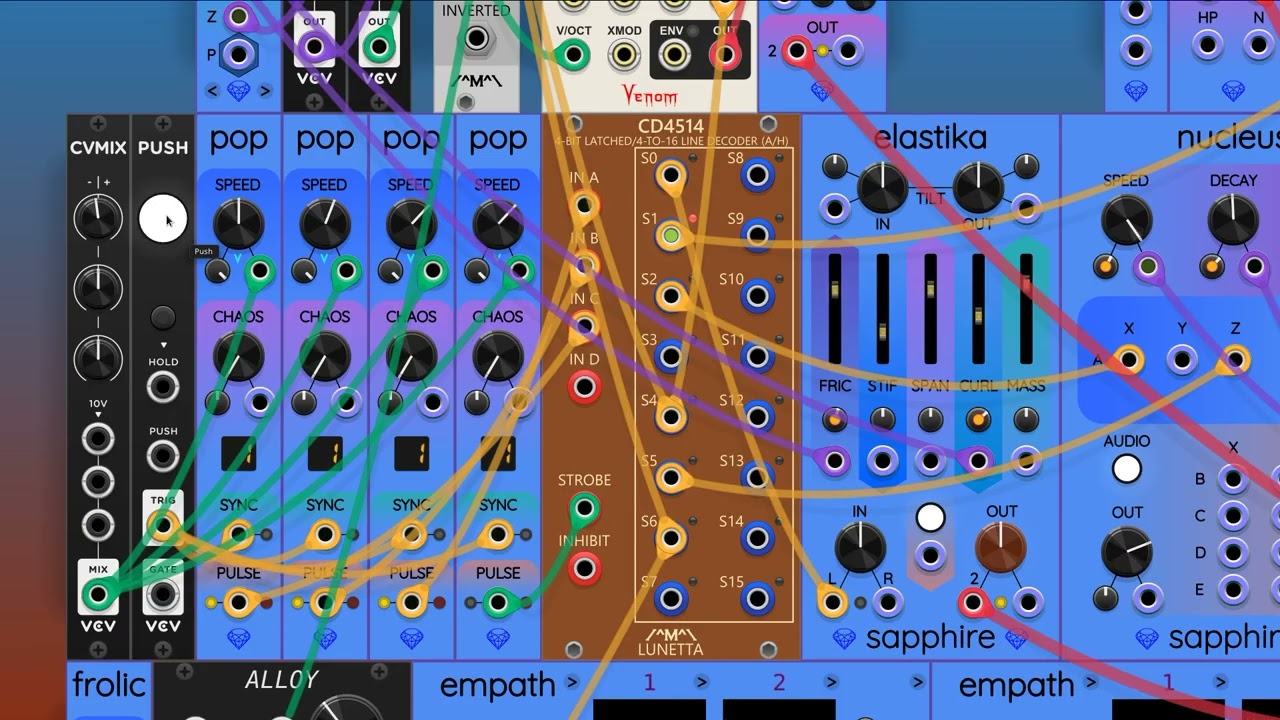
I had a fun idea. I used the Lunetta CD4514, which like a 4-bit address decoder that selects one of 16 gate outputs. I used only 3 bits to make an 8-step sequencer. I use square wave inputs (Sapphire Pop), cutting the frequency in half for each bit, so that they collectively count in binary from 000 to 111 in a loop. The fourth Pop is there to trigger the latch each time the 3-bit integer address increments.
The real fun is when you start adjusting the speed knobs on Sapphire Pop so that the binary counting gets a little “funky”. It makes for some interesting rhythms.
On the loading of commercial modules the user doesn’t have, maybe a “solution” might be if rack loaded the patch and put a variable width VCV Caution module as a replacement (yellow and black diagonal striped panel) keeping the connected cables (in some columns filled first grid, (width?)), but performing no function except outputting zero volts. Then at least things might be loadable, with some functionality. Just for the utility of it all and the chaos of modular. I’m sure a Caution right click could direct people to the module in question too as a UX improvement.
EDIT: Also bad module loading. If the loader had a try/catch?
Continuing on my quest for making custom sequencers from simpler parts, tonight I decided to focus on the Lunetta collection which @DaveVenom mentioned.
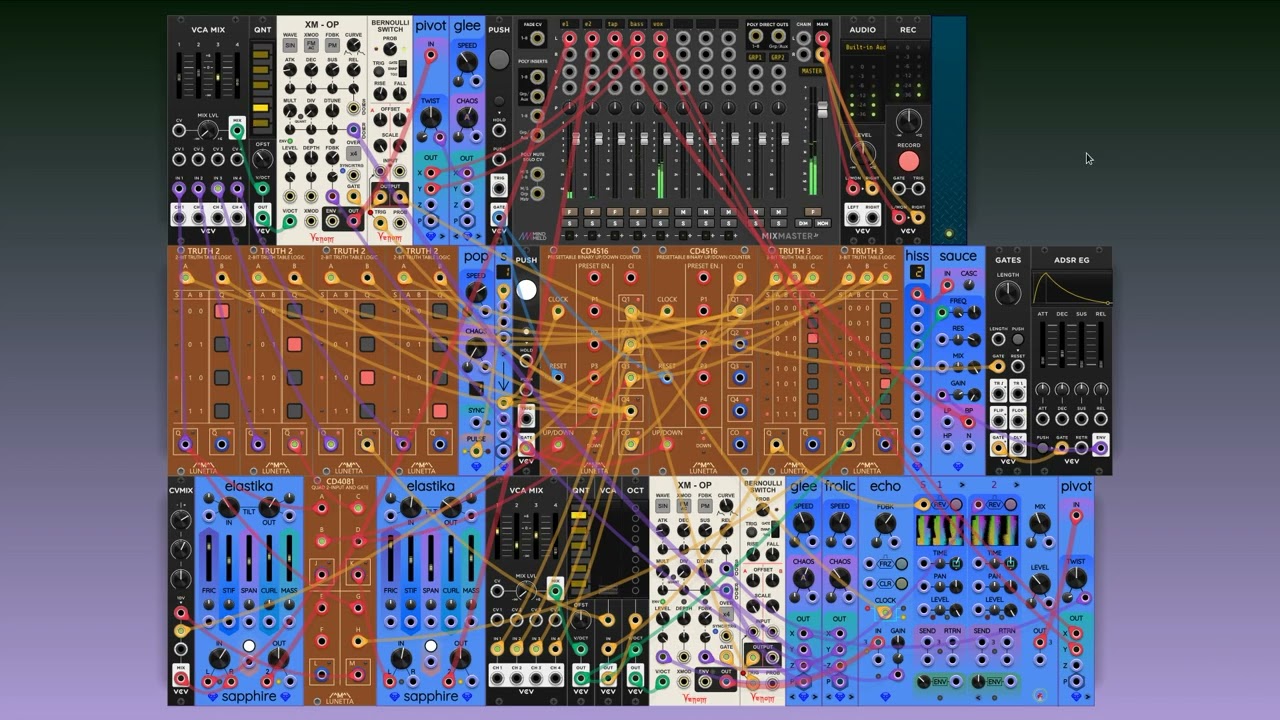
My favorite multi-tool right now is binary counters + truth tables. The counter is driven by a clock and sweeps through all possible binary values of your inputs. The inputs are fed through truth tables, sweeping through the rows of each one. You can even use one of the truth tables to choose a shorter cycle length by resetting the counter when it gets however high you want.
Here is tonight’s video where I felt like I can use this approach to make my own sequencer-like things anytime I want.
I also used the binary counter fed into a 4-way mixer and quantizer to have this melodic tuning control while performing the patch. Move some sliders around every now and then or people will get bored!
I feel like my next experiment will involve some polymeter thing with multiple parallel sequencers of mutually prime lengths. Stay tuned!
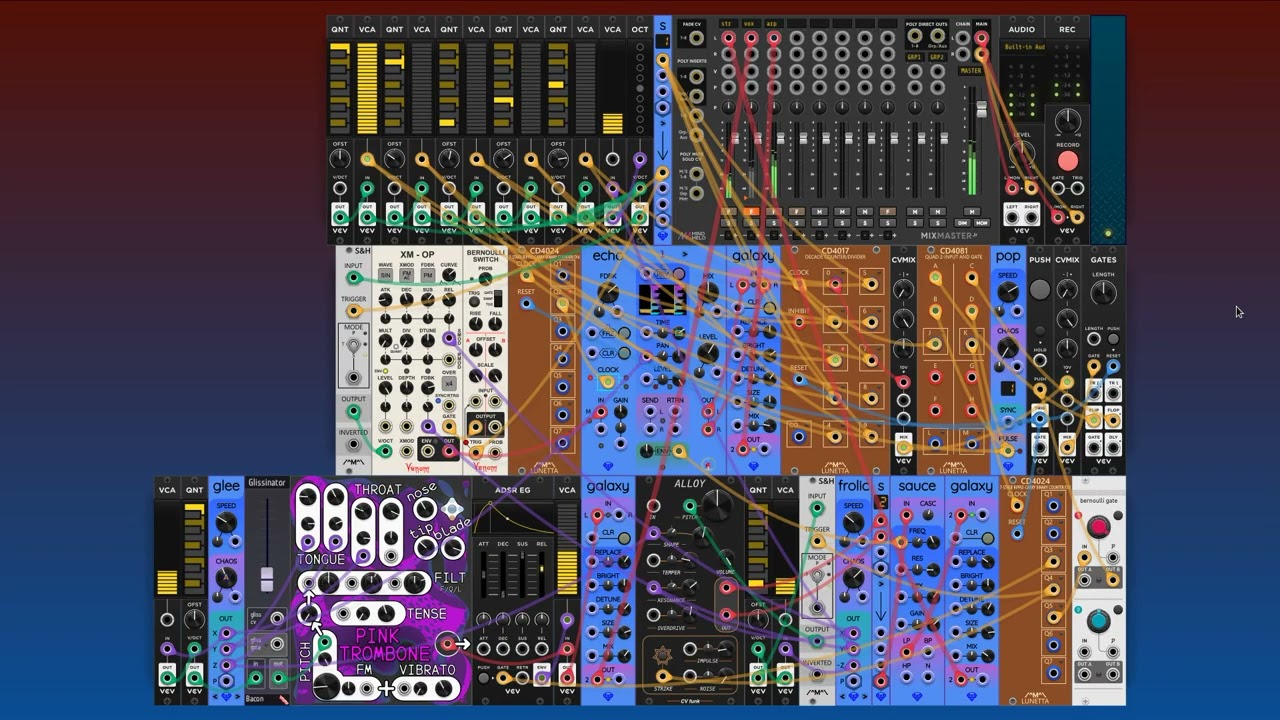
My fun creative thing for the night. I’m gradually going to build up more complicated multi-phase generative sequences. By that I mean, a sequence of different sequences that take turns playing. Each inner sequence can be different lengths, voices, etc, but should use a consistent clock and scale. Tonight’s example uses just two phases, but I intend to make a 4-phase patch soon.
Be sure to check out the end where you can hear Pink Trombone fed through deep reverb. That combination sounds amazing, and is one of my favorite go-to tricks.
I am continuing my exploration of making complex sequencers from simple parts. Tonight’s idea was to use chaos to vary when a trigger source is turned on and off, but keep the trigger firing at a regular rate.
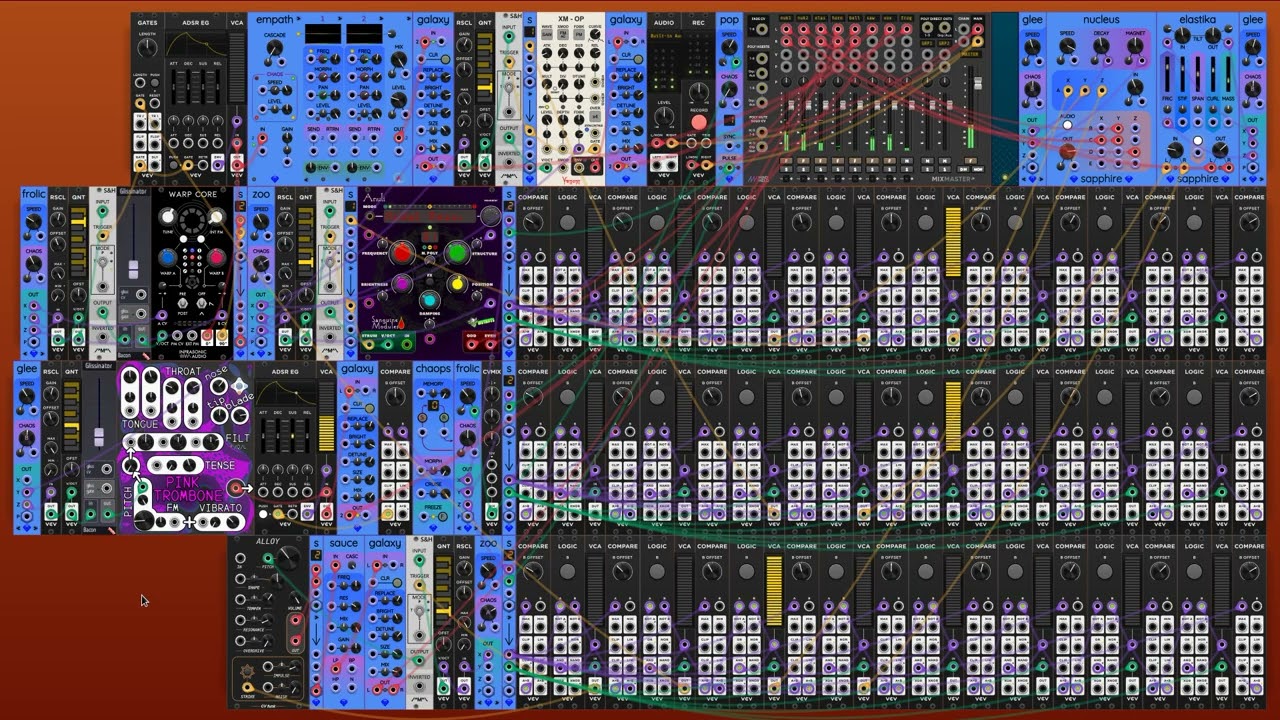
In tonight’s patch I used Sapphire Frolic to generate 3 low-frequency modulation signals (X, Y, Z). Each one is fed through a row of eight VCV Compare modules. Each one is tuned a volt higher with its B offset knob. Using AND gates, I can verify that, for example, the voltage at a particular moment might be between -2V and -1V. The output of the AND gate turns on a VCA.
The VCA by itself turning on doesn’t initiate a sound. Instead, it enables/disables the fixed trigger source.
The resulting intermittent triggers output to drive various audible events in the patch. Because each event only happens when a trigger fires, every event is within a regular rhythmic pattern. But the chaos means you never get the 3 voices repeating exactly what they are doing.
It’s fun to vary the SPEED knob on Sapphire Pop (the trigger source, with CHAOS=0 for equal timing between each trigger), or the one on Sapphire Frolic to vary the rate at which the “cursor” sweeps through the VCA rows.
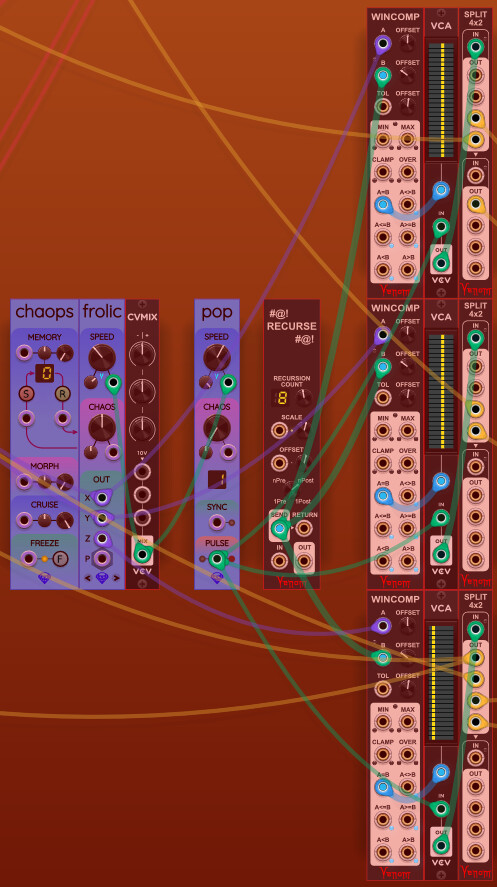
I have greatly simplified the patch by using polyphonic windowed comparators.
Each row of the Froliquencer now only uses a single polyphonic WINCOMP + polyphonic VCA + SPLIT.
The Recurse conveniently generates a polyphonic signal with integers from 0 to 7 going to the B input. The B Offset shifts the values by -3.5 to give -3.5, -2.5, -1.5, -0.5, 0.5, 1.5, 2.5, 3.5, the centers for the 8 sequencer voltage bands. The Tolerance is set to 0.49999 (could have used 0.5). The Frolic X, Y, or Z goes to the A input with 0 offset. Besides being much easier to patch, it also saves significant CPU.