Yes - there are some posts somewhere talking about v3, and one of the changes is elimination of cable sample delays by default. But this can interfere with how feedback currently works, so I believe there will be some kind of option to selectively preserve the cable delay? I didn’t fully understand what I read.
I hope the fundamental design change does not create complexity when migrating existing plugins from V2 to V3!
Of particular interest are the DO-1xx Digital Operators that have four inputs, four outputs, and up to 5, 10, 15, or 20 configurable operators per module that are chainable without sample delays. They support a rich set of operators with nice graphics. It is a bit ungainly to use, but quite powerful.
Submarine is a great suggestion for complex logic patching. I keep meaning to create some non linear equations with the arithmetic operators to use in feedback patching. There is also a great logic analyzer for looking at gates. Great collection.
On a mathematical basis not as (max - in) and and as (in1 * in2 / max) can provide a full logic basic for analog CV. Is max a standardized normalised input?
EDIT: Maybe max has to be derived from some exponential of a CV, to prevent division by zero errors?
I’m also thinking about something in a weird way: what if instead of avoiding gate delays, you lean into them? It would be fun to have some kind of NAND gate that takes an adjustable amount of time for its output to ramp between 0 to 10V, and time to ramp 10V back down to 0. Basically add slew.
If you let false=0V, true=10V, then you can implement NAND using arithmetic.
NAND(A,B) = 10 - A*B/10
Now everything is a slowly changing analog voltage, both going into each NAND gate, and coming out.
Given enough time, everything in a complex network of such NAND gates will settle on the correct output. But sampling various voltages in the network, and using them to modulate other things, might be interesting…
The VCA and the RSCL are the NAND gate. They perform multiply-and-subtract like I mentioned above. Here I feed the input gates through slew. The multiplication sometimes makes fun output as you can see on the scope. You get flat areas (0 or 10V), linear slopes, and parabolic arcs when both inputs are changing.
Yeah that’s really neat thinking and exactly the sort of thing submarine can do well. You can use plain equations like yours and input the variables as cable inputs. Like voodoo to me, lol.
That is very cool! Submarine sounds like a great way to prototype things like this. I will check it out.
It is interesting that Sapphire already has code to parse algebraic formulas and compile them into an efficiently-interpreted bytecode. That is the basis for Sapphire Zoo. All of the chaotic attractors were typed in by humans as formulas like “vx=x*y + z^3 - 1.1”. (You can read the formulas if you open the Sapphire Zoo preset files in your favorite text editor.)
Because the technology is already there, and it’s debugged and optimized, maybe it is time for me to create a more general purpose module that gives you a some inputs, some outputs, and a human-editable formula for each output based on the inputs.
I do not have time to create a video of it at the moment, but feel free to try it out!
It is free running, simply push RUN at the top left patchmaster module. Beware: the sounds can be quite loud and harsh. But I like the sonic fireworks it creates
Instead of all kinds of sensor inputs which were in the Moosack Machine, I made a combination of Caudal (in Fishtank mode) combined with Ochd LFO’s, which modulate Caudal and occasionally stalls. But for the rest I tried to follow the signal flow of the drawing.
The patch is quadraphonic, but uses the Killpatrick encoder to convert it to stereo.
Aw shucks - I want to give this a try, but the patch uses the premium Caudal-HW. Can you post a comparable patch with the free Caudal version? There are too many Caudal cables in the patch to figure it out on my own.
I have VCV pro, so I have the phaser. But others may not, so a replacement for that would probably be good. I can probably look at your original patch if I want to reinstate the VCV phasor
here is the same patch but with the free Caudal.
If one does not have the phaser of VCV, you can replace it with a phaser by taste (not so many cables as with the Caudal)
Cool - I see you used the Venom Widget Extender. I think yours is the first patch I have seen that uses it (other than my own).
I’m curious what features did (or do) you use? I browsed a few of the non-Venom modules in your patch and didn’t find any usage.
Just for fun I tried sending the final left and right outputs to two copies of the Vlippoo Box Audio In, and sent the Vlippoo output to Blamsoft Reverb. The Vlippoos were both 100% external audio, but otherwise had different settings. Very different result, but quite nice!
I use the widget expander as a “final” touch whenever I think a patch is finished. This patch still occasionally changes (started with it 2 years ago I think) and I did not use it in performance. So I did not use the widget yet. But the widget is staple, as is glue. I really like to use it as a port label, especially when revisiting a patch after some time. A major “quality of patch” it is.
This is a sort of historical patch, trying to sonify lost or hard to get patches. I bet the Vlippoo will sound fun! The “voices” are to be colored by taste of course.
I will try your patch the coming days and will open a new thread possibly. And to steer back to Sapphire: I can of course try to replace the Caudal with some great Sapphire Zoo’s!
Will come back to it in a separate thread.
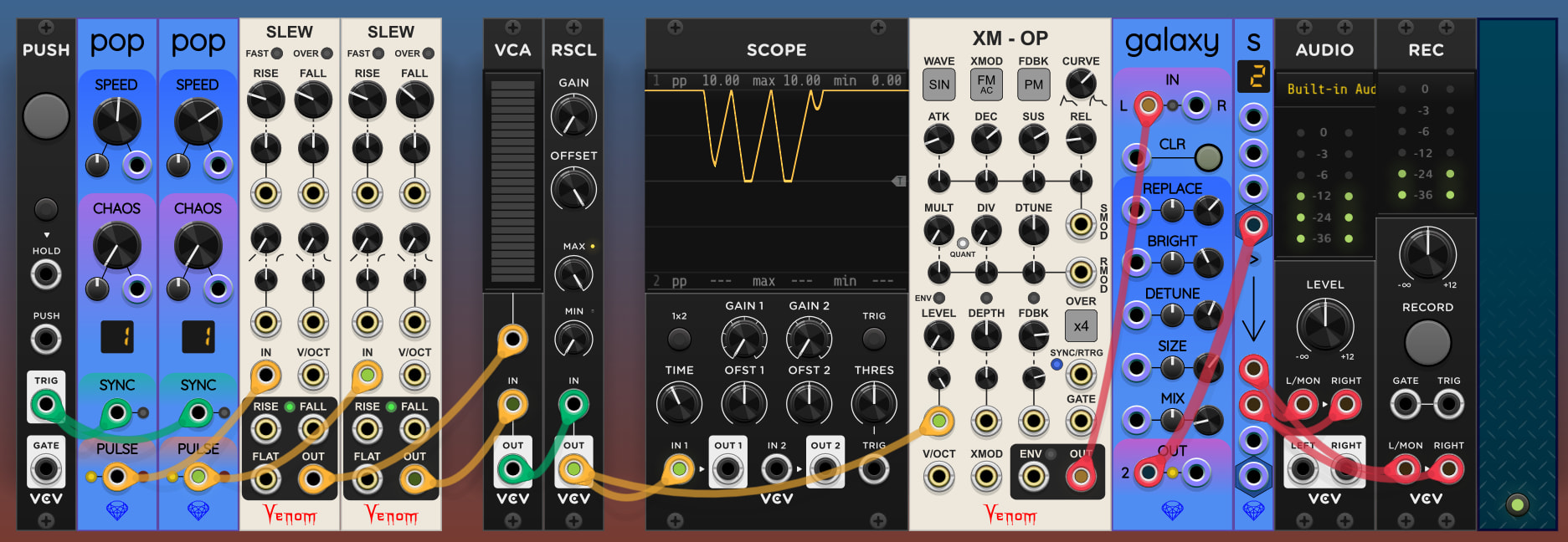
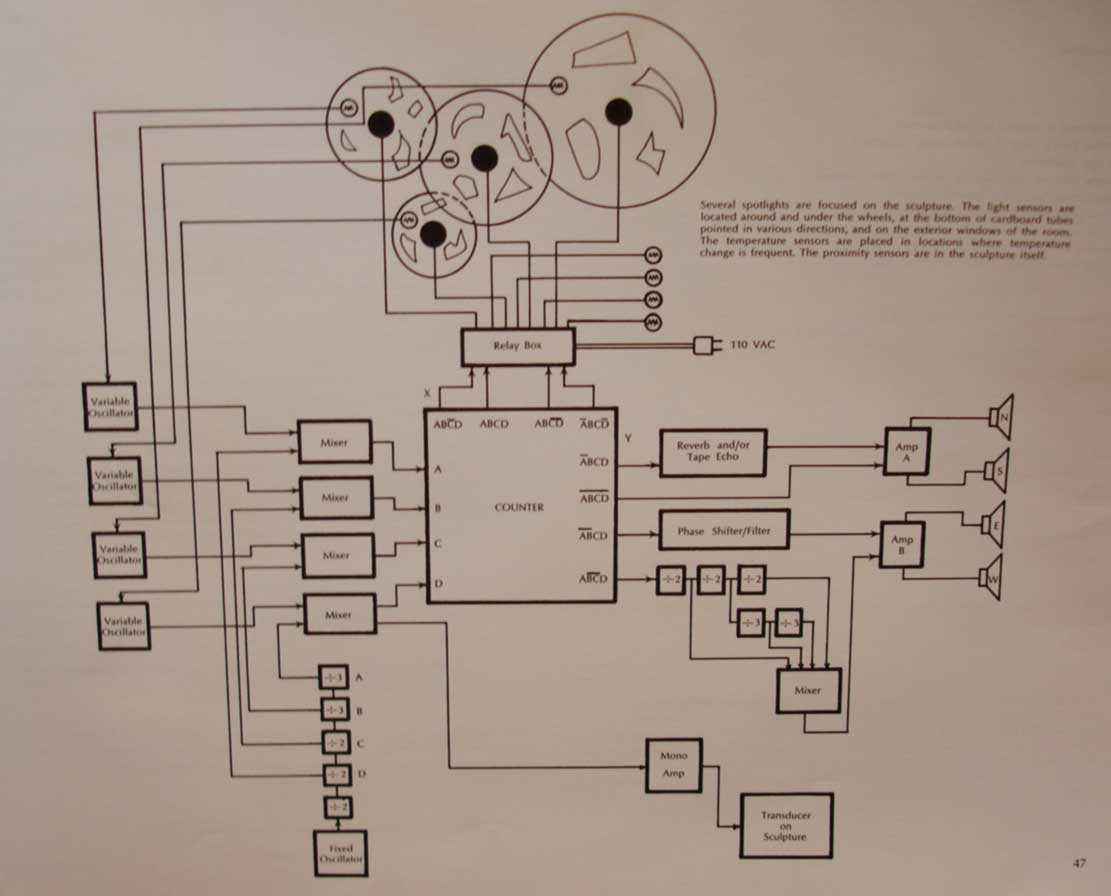

 Instead of all kinds of sensor inputs which were in the Moosack Machine, I made a combination of Caudal (in Fishtank mode) combined with Ochd LFO’s, which modulate Caudal and occasionally stalls. But for the rest I tried to follow the signal flow of the drawing.
The patch is quadraphonic, but uses the Killpatrick encoder to convert it to stereo.
Instead of all kinds of sensor inputs which were in the Moosack Machine, I made a combination of Caudal (in Fishtank mode) combined with Ochd LFO’s, which modulate Caudal and occasionally stalls. But for the rest I tried to follow the signal flow of the drawing.
The patch is quadraphonic, but uses the Killpatrick encoder to convert it to stereo.