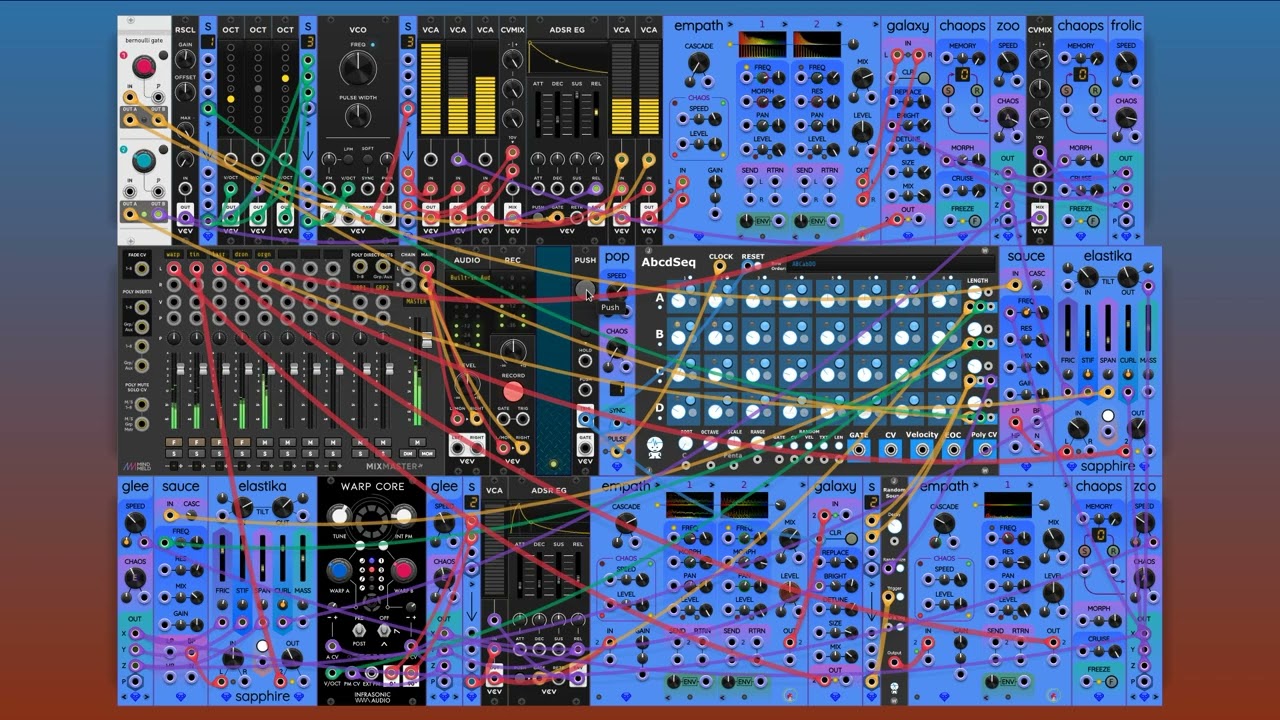
Happy New Year, everyone! I figured this was a good time to start a new thread for my Sapphire videos/patches. Here to get things started is “Radio Contact”…
The patch is available here:
Happy New Year, everyone! I figured this was a good time to start a new thread for my Sapphire videos/patches. Here to get things started is “Radio Contact”…
The patch is available here:
Video displays as private, unavailable.
Very great start!
Oops! I thought I made it public before I went to bed, but obviously I did something wrong. It is fixed now.
The music has an otherworldly feel like alien communication or distorted radio signals, with odd frequencies and unnatural rhythm. Also I hear static interference and distorted transmission.
I saw this video this morning and it immediately made me think of the Sapphire modules:

Check this one out too
Wow, sounds beautiful. I didn’t know about this. Thank you!
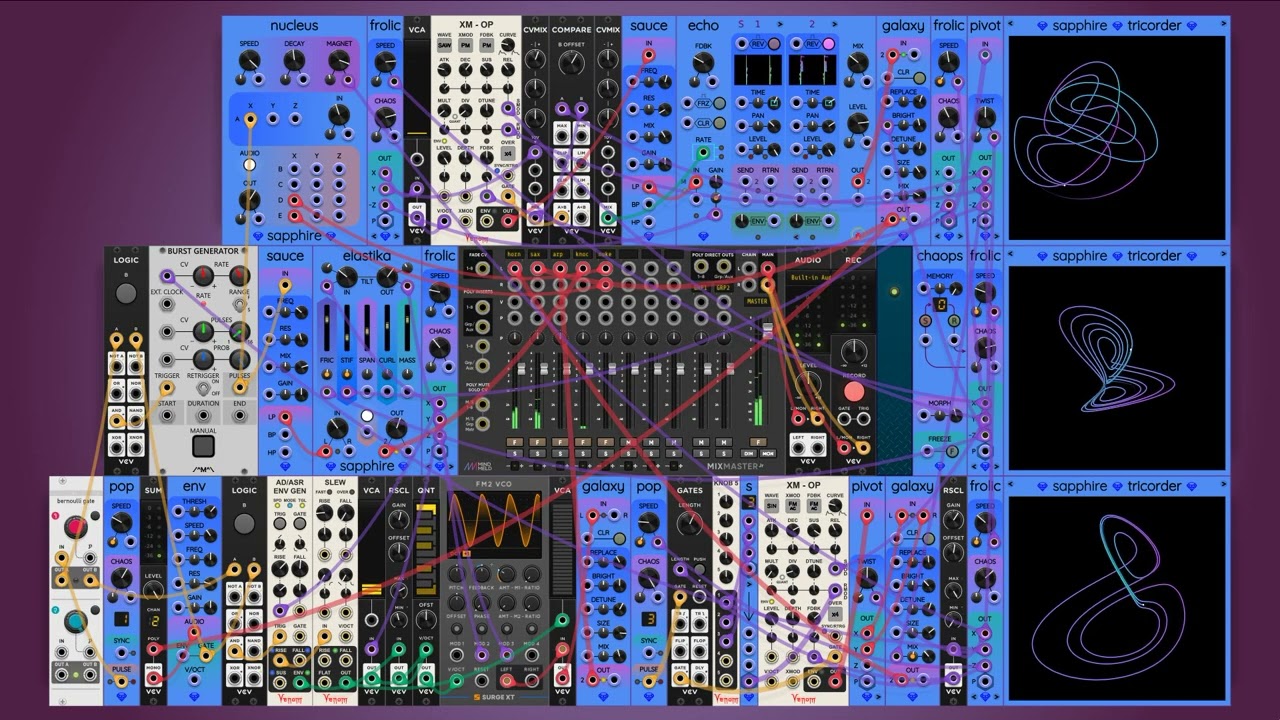
In this eight-track patch I use a combination of Venom XM-OP, CV Funk Alloy, and Pink Trombone to create a fun medley of contrasting voice textures. Using the inspiration of wind chimes, I limit the notes to a pentatonic scale.
Percussion comes from Sapphire Elastika (with high friction setting) and Sapphire Nucleus. I use Venom Bernouli gates to shake up the rhythm a little bit.

Here is the patch:
I have been thinking about how many sequencer modules there are in VCV Rack. I have a theory that the idea of sequencing in itself admits so many possible variations and creative possibilities that any single module has to be “opinionated” in some sense.
This led me to a creative/educational exercise for myself: I created my own modest sequencer out of simpler modules cabled together. I’m already getting ideas for how sequencers are constructed, how I tend to use them, and how I can optimize them especially for balancing musical sense with variation and surprise over time.
Anyway, for now, here is my first simple, working sequencer.
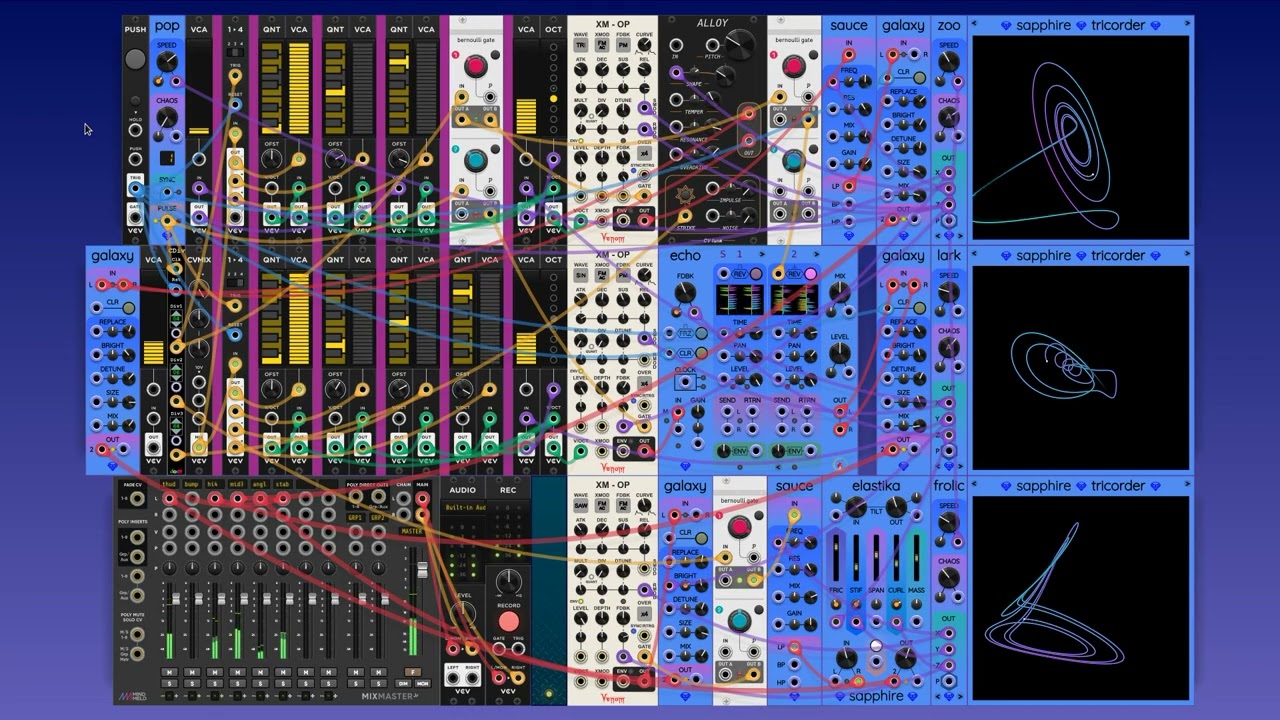
The patch is here if you want to understand better what I did, or experiment with it:
I had fun creating some synth textures in this patch, but the main thing that interested me was experimenting with using a series of integer harmonics as if it were a musical scale. Venom XM-OP makes this simple with its MULT control that features a built-in linear quantizer.
Here is the patch:
I like those scales and the patch has a nice atmosphere!
The XM-OP is nice because it allows a wide range of integer ratios (both numerator and denominator are integral).
If you only need integer multiples, or integer divisors, but not both at the same time, then the Venom Harmonic Quantizer (HQ) also works well and you can use it with any oscillator of your choice.
I am thinking of putting the integer ratio capabilities of XM-OP in a stand-alone module called RATIOS. That will probably happen in the next couple months when I return to free module development.
I like that idea! It would be great to be able to independently control MULT and DIV with separate CV inputs.
In today’s patch I’m using the VCV 4:1 sequential switch to make a sequence of 4 steps that change slowly with chaos.
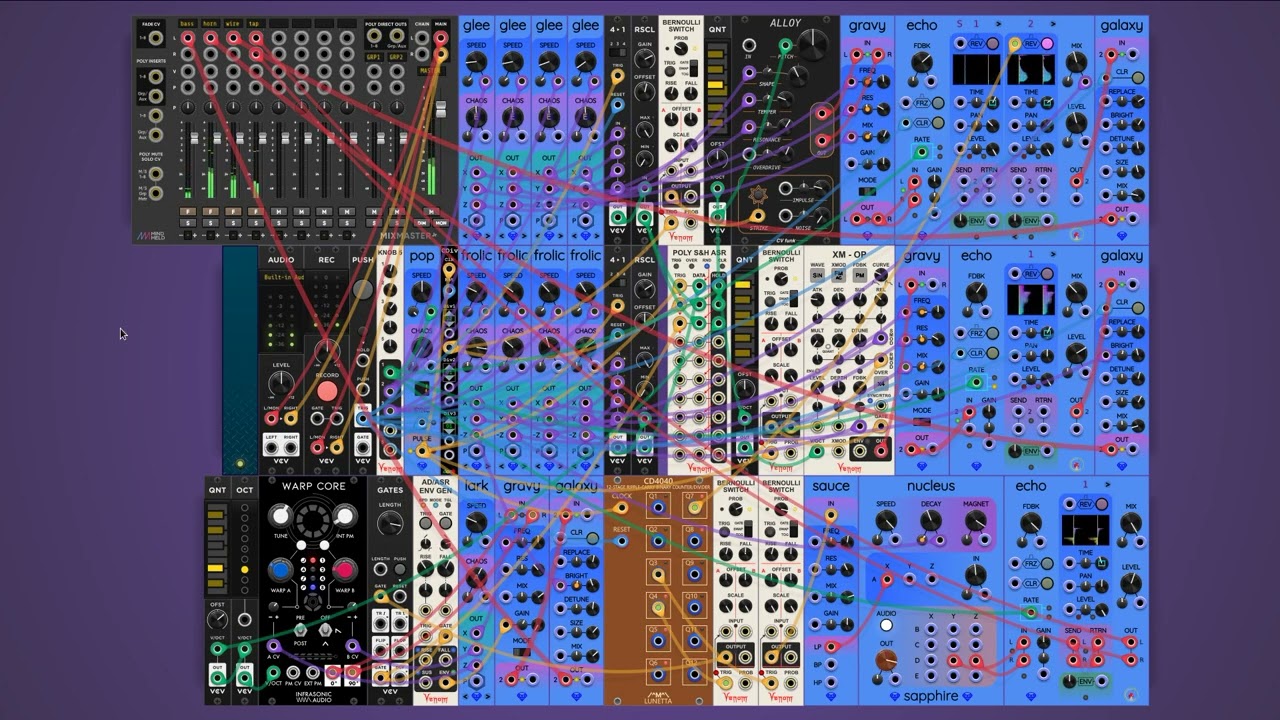
This is even simpler than my previous do-it-yourself sequencer idea.
It’s been a while… here is my creative effort for this evening.
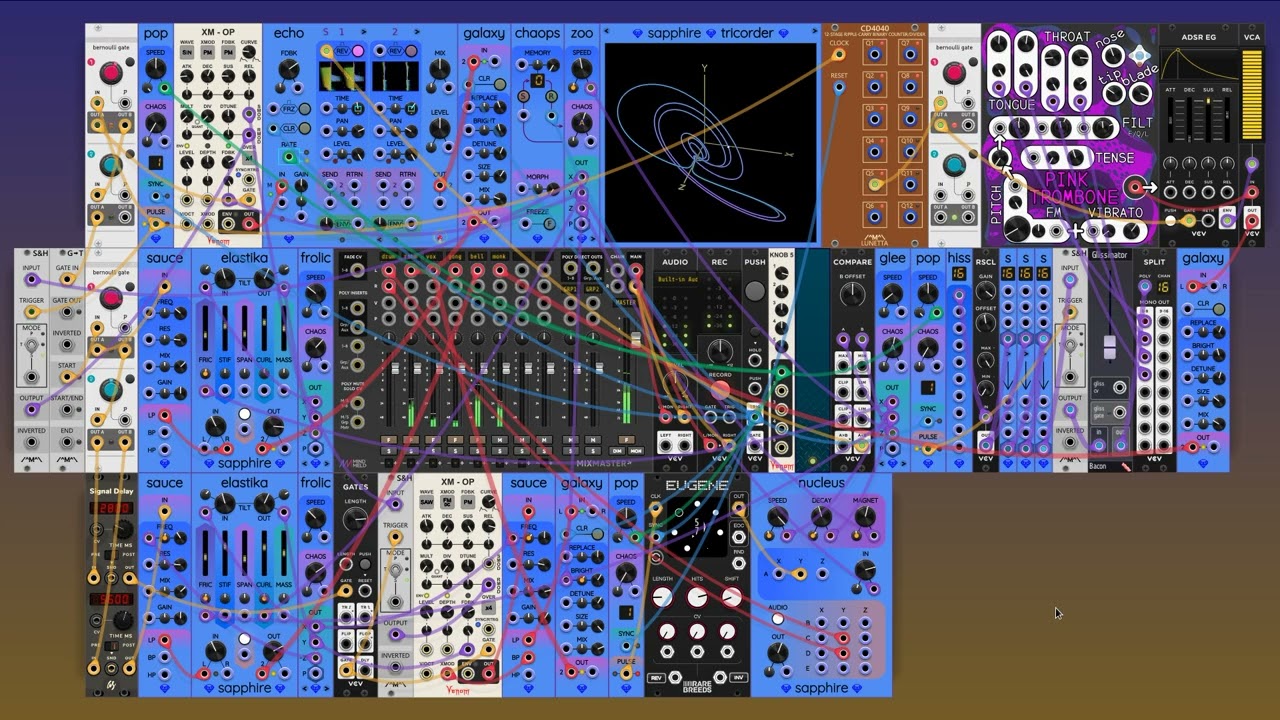
Oooh - I like it!
Sweetly creepy and ominous!
I’m learning a new idea for generating interesting gate sequences: a circular buffer of gate signals in a sample-and-hold array. Take different slots in this S&R, send them through some function like XOR, and put the result back into the S&R somewhere else.
There are endless ways to create structures like this, and I’m finding it’s surprisingly easy to make ones that are interesting. It’s like searching for something that already exists, more than creating something you envision ahead of time.
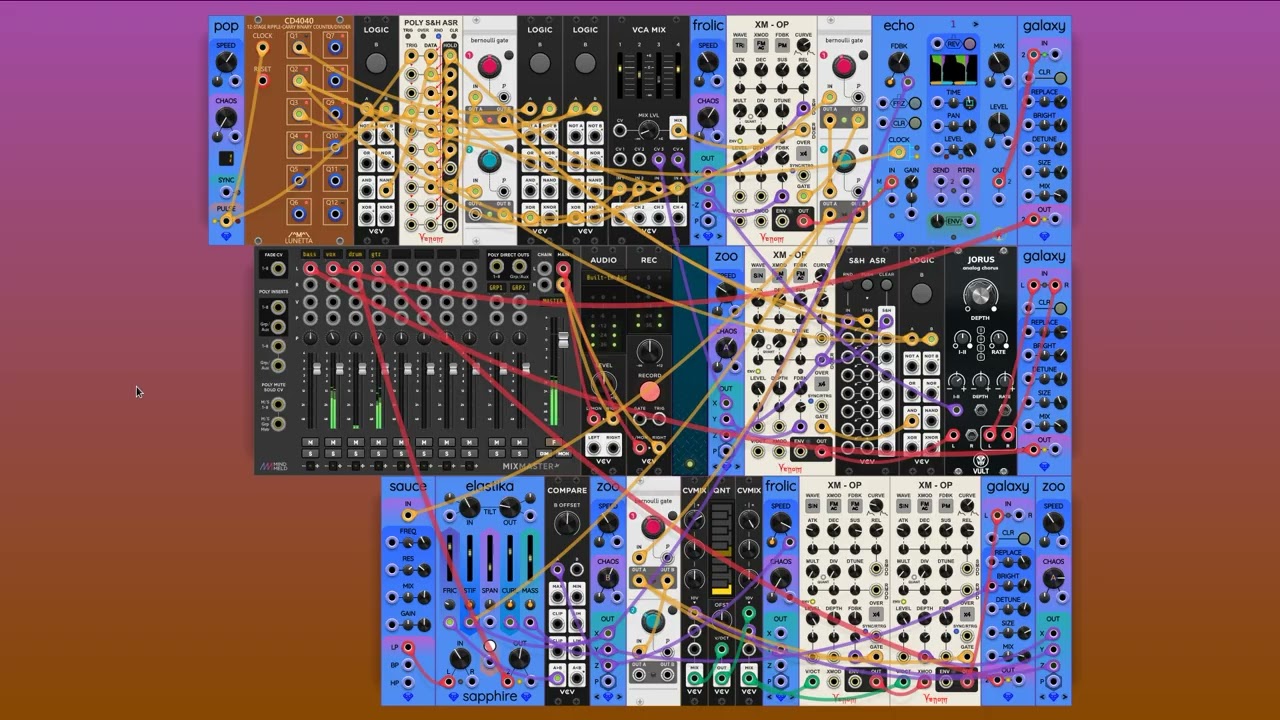
Great fun to play with, that patch!
Killer patching. Empath sounds so good and gritty in comb mode.