No need to get it from Github, Meander is on the library
Thanks! i did a quick search of “Meander” but it did not come up… maybe I had one of the tags on or something. Sorry for the trouble. 
Update: This module is freaking crazy. I love feeding it fm-op’s and modulating a few parameters. Its like an orchestra in a module. This might already be possible but the only thing I feel I’m missing is the ability to change the rhythmic pattern of the arpeggio function (Although Im assuming the primary way of doing so is feeding cv info to the “Note Length 1/”). Admittedly I’ve only skimmed the GitHub readme, and plan to do so in more depth here soon, but any tips would be appreciated. This module is super inspiring, keep up the great work!!
Glad you like the module! You are right, the only way to change the melodic arp pattern rhythm is by changing the “Note Length 1/” and number of arp notes. That works pretty well although it gets tricky to fit the arp pattern between the melody notes. As mentioned in this thread above, using the RJModfules RANGE LFO or RANGE modules is a good way to automate any of the Meander CV’s. Even so, you may need to use an adjustable CV with something like Hyperpower to change the parameter while watching the voltage with something like Volt Meter and write down the min and max voltages for the parameter range you want to adjust and put those values in RANGE LFO or RANGE module. Meander tries its best to sound good no matter what you put in. If you set the Melody Arp count and Note 1/ parameters such that the notes cannot fit between two melody notes, Meander truncates the notes that will not fit.
Here is my latest Meander creation. I tend to alternate my days between making music and studying theoretical physics. Believe it or not, the two fields work together very well and inspire me to mix the disciplines. This piece is based on group theory and symmetries of the Standard Model and string theory, cosmology and mathematical Hilbert spaces. A Hilbert space is a parameter space, that may be finite or infinite. In this case it is infinite due to the VCV Rack Meander module use of rational numbers. The degrees of freedom or dimensions in the universe can be space-like or time-like and change depending on the viewer’s reference frame.
This piece is a “Meander” over space and time, with intermingling of the several dimensions. The piece’s harmony part never varies from a Bb chord, but the scale meanders through all 7 of the church modes (Ionian, Aeolian, etc.) as well as meandering through the chord inversions and the octaves. The melody (and arp) meander through the Bb scales and chord notes and octaves. The bass stays fixed on Bb in a low octave. In this case, it is as if the song is stuck in one measure and all of the variations are in a space orthogonal to time. The minimalist composers sometimes described their music in these terms.
This is really interesting. Would you consider sharing the patch? I’m interested in modal music & would really love to see how this works (and tinker with it).
I see you’re using Arturia Pigments; are you using a preset, or is that a patch of your own creation as well?
I should say that while I’m keenly interested in the structure & mechanics of this patch, it sounds really nice as well.
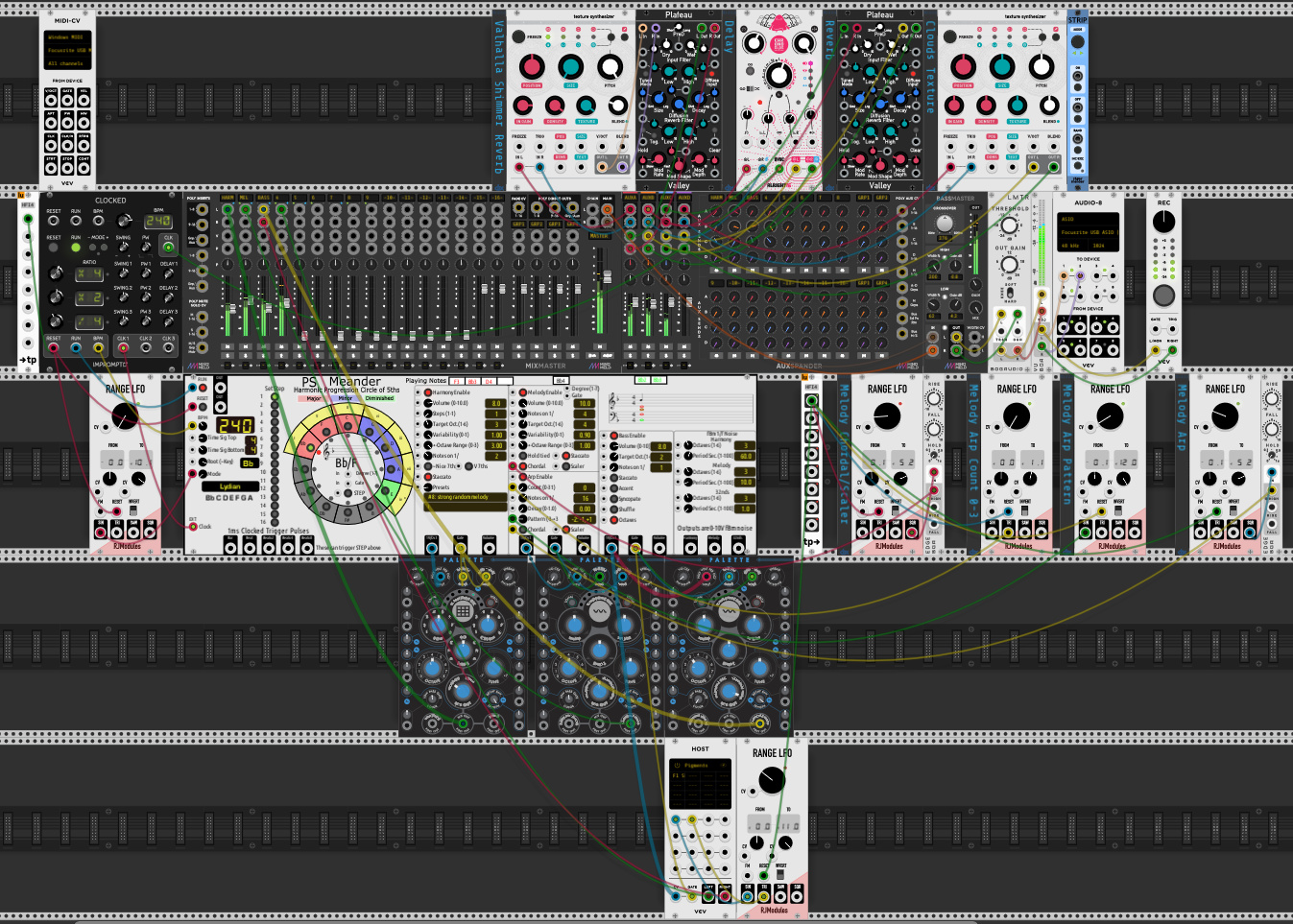
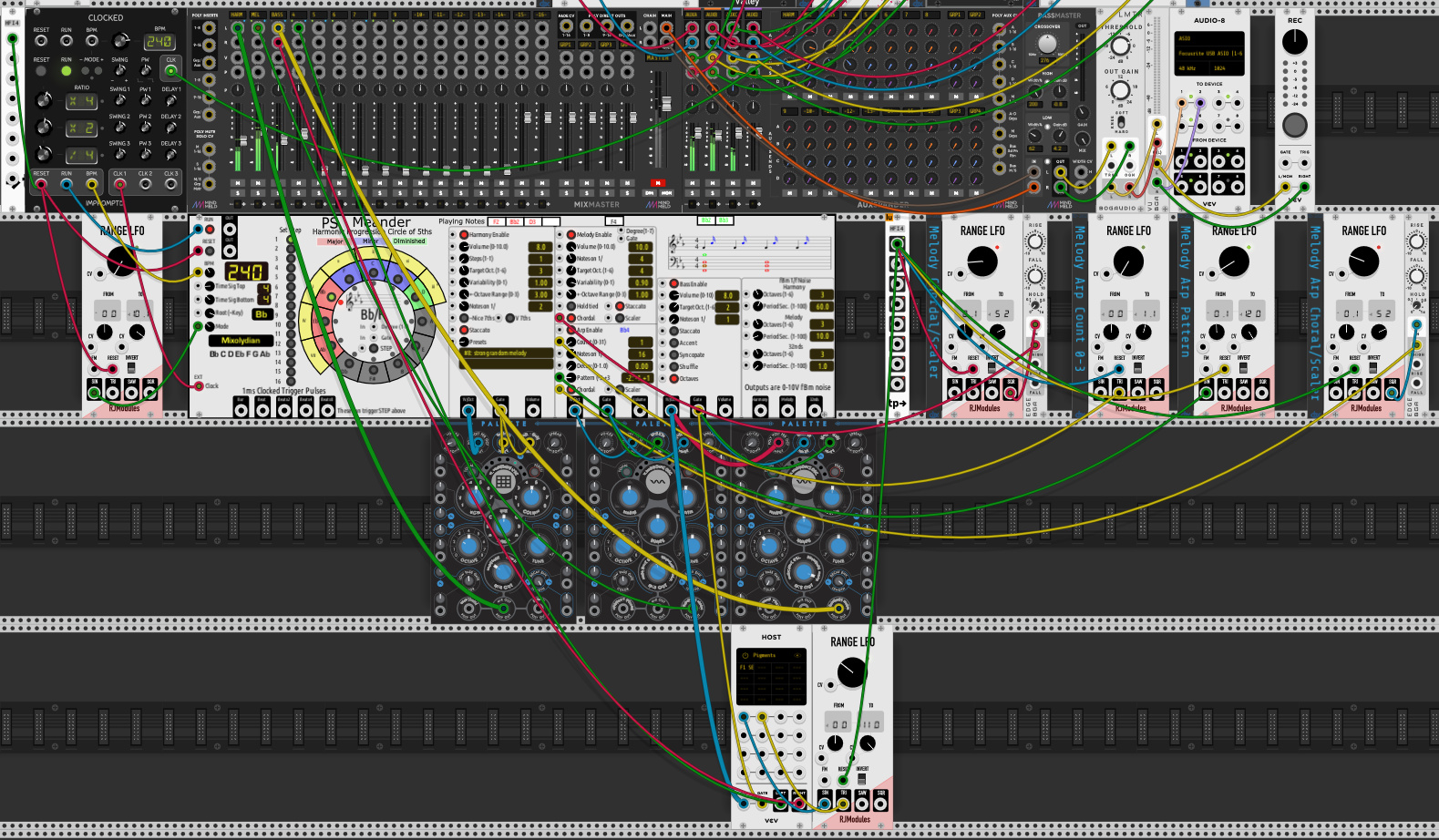
The Arturia Pigments “Barbarians*” patch is one of the bass modules I used, in addition to one of the Palette modules. Here is a somewhat zoomed in screen capture with the cables opaque for view-ability. This is a relatively simple patch, with my Meander module doing all composition and performance. If you have not read the Meander manual, I recommend that you do so. As mentioned elsewhere in this thread, Meander started out as a DOS/Windows program when I first wrote it in 1989. As such, it is very complex as far as plugins and modules go. I try to explain a lot of what Meander is doing in the manual. If you still have some questions after reading the manual, ask and I will attempt to answer. I do not upload my patches. They are meant to inspire what is possible with Meander as much as anything, as well as to share my SoundCloud music, almost all of which was made with Meander. Here is a link to my Cyberpunken SoundCloud page. Stream CyberPunKen music | Listen to songs, albums, playlists for free on SoundCloud
Ok. Thanks!
Hi Aria,
I am exploring adding Poly External Scales output/send to Meander. I’m wanting to add this with the least amount of work so I am thinking of adding one poly CV output port below the Meander scale display and then just reformat my scale to the 12 channel Ext. Scale format and send to the output port in the same section of code where I update this info on the panel. I will designate the root (tonic) note by the 10V output on that port/channel. Does this sound like all I need to do?
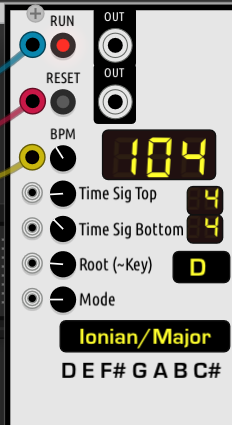
By the way, for historical perspective, the Windows Meander application supported ~30 named scales plus key transpositions. These were 5, 6, 7, 8 and 12 note scales. But, since Meander is is a harmonic progression based generator, forming chords in all of these scales was extremely problematic. So, for the VCV Rack incarnation of Meander, I decide to just support the 7 heptatonic “modes” and 12 root (~tonic) notes per mode, for 84 scales and support chords of types major, minor, diminished and 7th per the circle of 5ths interval rules. Actually, 7th chords are a kludge and very difficult to have sound musical.
Anyway, by limiting myself to the 7 modes, major, minor and diminished chords can always be easily formed and sound good, and the chords can be inverted easily. It would be nice to use other scales, but that is just very hard to keep sounding good in the Meander harmony engine.
Thanks

Yup, and the others should be 8V. The “standard” such as it is assumes that the voltage is a measure of importance/probability, but there’s no guarantee how the recipient module will choose to interpret it.
The current chord can already be turned into a Poly External Scale as follows (in the next update, Quale will assume that the first channel is the tonic, and Qqqq modules will forward it properly), so support is only useful for the scale:
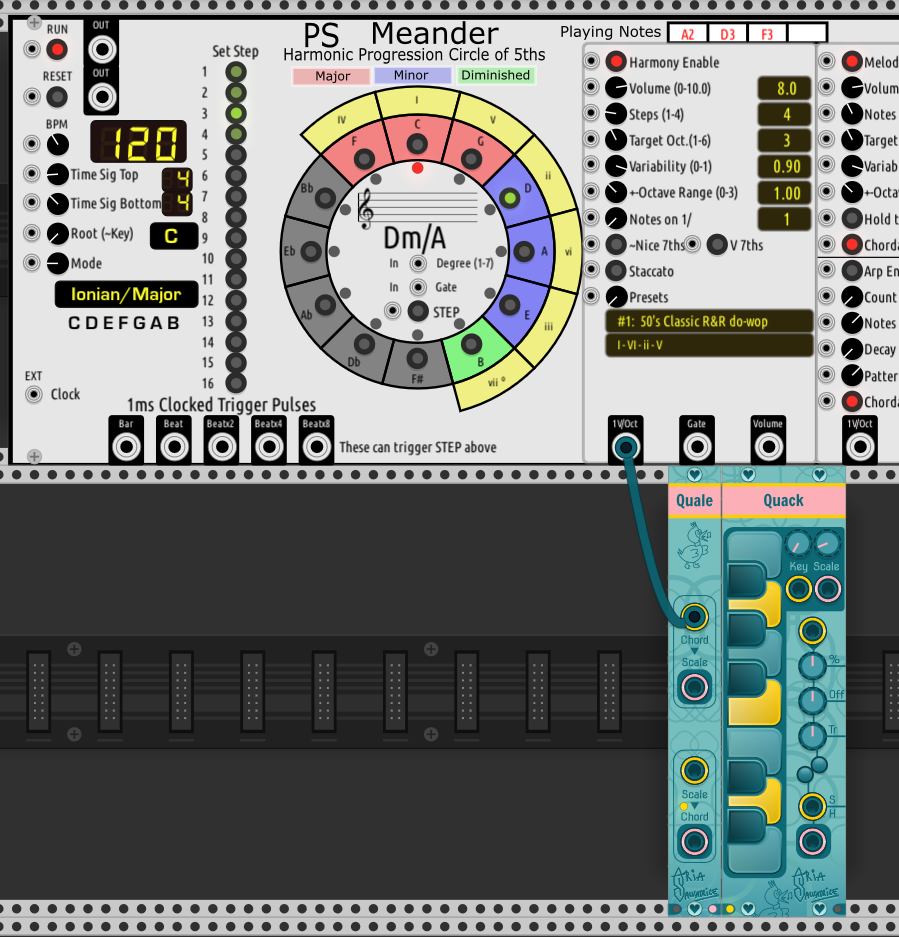
It definitely only makes sense to have Meander as a sender of Poly External Scales rather than accept them, for sure, because there’s zero guarantee the output it’d be sent would be a common scale rather than a totally random combination!
Thanks. I’ll have to try out the current chord to PES use case.
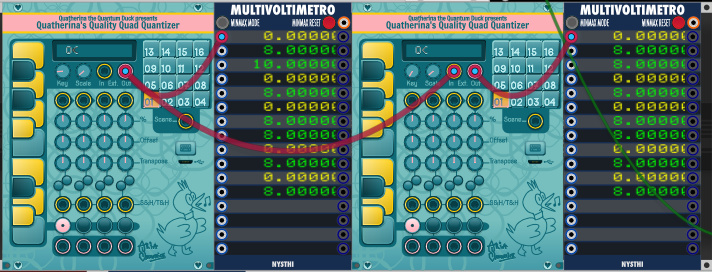
As I was experimenting with QQQQ, I observed the following behavior when I had one QQQQ send the PES to the input of the 2nd QQQQ. If you notice, the D tonic at 10V shows to be 8V after the 2nd QQQQ. Am I misunderstanding what should happen, or is this a bug? I noticed this when I was building my own scale manually with “FIXED VOLTAGE SOURCE” module and sending it to QQQQ and verified the issue by using the two QQQQs.
Thanks
Bug, will be fixed next version! There’s currently no module that consumes this info yet.
Ah, I should have read your GitHub issues page 
I’ll proceed anyway as the tonic designation is not absolutely needed in what I am doing.
Thanks
By the way, in Meander the first channel of the harmony chord output port is not always the tonic, due to chord inversions. I’m flirting with changing Meander to have the tonic on the first channel always. If anyone has a preference, please let me know here.
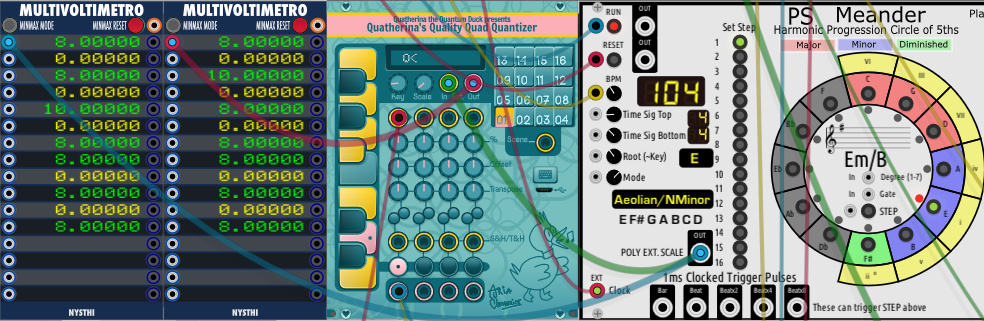
I have Poly External Scales output fully implemented in Meander now. I’m still doing some testing, but I will release to the library soon. As can be seen below, the only issue (as we discussed before) is that QQQQ is ignoring the tonic/root/key and substituting its key setting. Not as obvious is that QQQQ does not change its internal scale (name) setting when it receives an Ext Scale input, but it does change the keyboard displayed scale. This is a bit confusing. It would be my preference that if QQQQ receives a “Key” or “Scale” input, that it change the state of the knobs parameters, in addition to passing this info on to Ext Out. Otherwise, I am very happy with the results and think that this adds value to Meander.
It would be nice if QQQQ indicated the key/root/tonic on the piano keyboard display, somehow.
Yay.
Yeah, for now the whole format is a bit speculative! My collection does not do make use yet of the tonic when known, but future modules of mine definitely will.
By design, QQQQ is not meant to treat any note as special, besides forwarding the tonic once I fix the bug. Because QQQQ can be set up from multiple sources (expander, scenes, poly external scale), I opted against overriding any knob automatically. Besides usability (people expecting physical knobs not jump positions) it’d make a lot of other workflows impossible. Still thinking of various solutions to make things match people’s intuitions better without breaking existing patches.
(Currently this is what I’m considering: https://github.com/AriaSalvatrice/AriaVCVModules/issues/66 )
It does what my immediate objective was… have a way for a quantizer to be set by Meander. It would be difficult to set the scale parameter based on PES incoming data. Maybe QQQQ should display the scale name as "External’ in such cases. I have no problem with a module CV input changing parameter knobs, but I may be in the minority. I have a Fender Cyber-Twin guitar amplifier that has motorized knobs and most high end mixers have motorized sliders. There probably is no Eurorack module with motorized knobs and switches, but that is probably due to cost and space. As you have probably noticed, Meander allows CV inputs to change the parameter knobs in addition to the parameter text displays. If I had any knobs that were strictly CV input attenuator or gain controls, I would not adjust those knobs based on input. Some modules get around this by displaying CV controlled levels graphically around the knob or some such. Anyway, it is all a matter of personal preferences I suppose.
I’m happy! Thanks for advising me on this addition. The Meander update has been submitted to the library review queue.
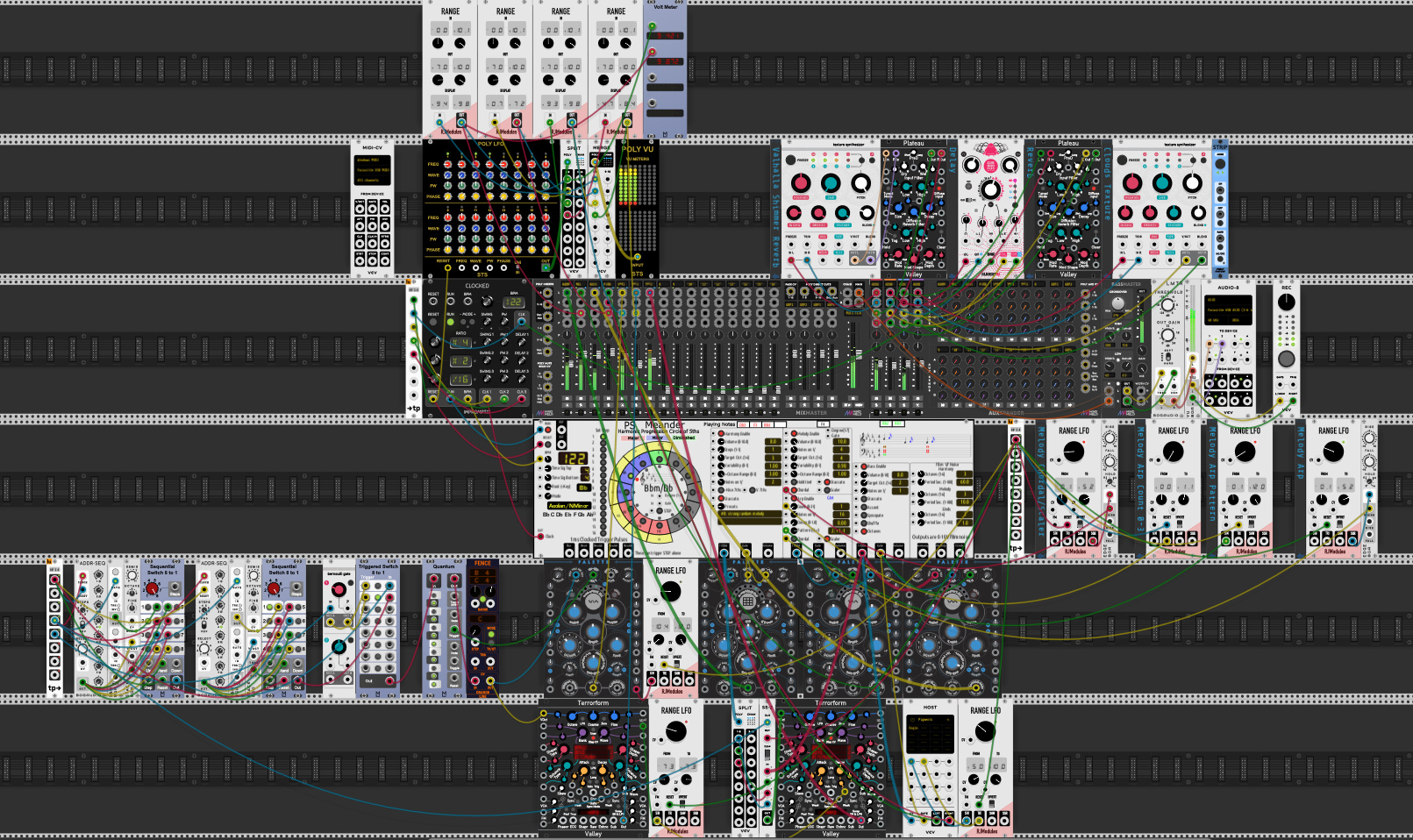
Here is my cinematic piece “A Well Tempered Meander”. This is my first piece made using “Poly External Scales” sent by Meander to the Aria Salvatrice QQQQ quantizer. Meander sent the Eb-minor scale to QQQQ in addition to playing the harmony and bass parts on two Organ Three’s. The Meander melody part is disabled in this piece and all melodic ostinatos are created by a couple of ADDR-SEQ’s and several sequential switches, triggered switches and a Bernoulli Gate for playing the two sequences forwards, backwards and randomized with some sequence permutations. This is fed to QQQQ which has received the Meander Eb-minor scale and then played by an Organ Three.
The PES ostinatos are soloed at the beginning and end of the piece.
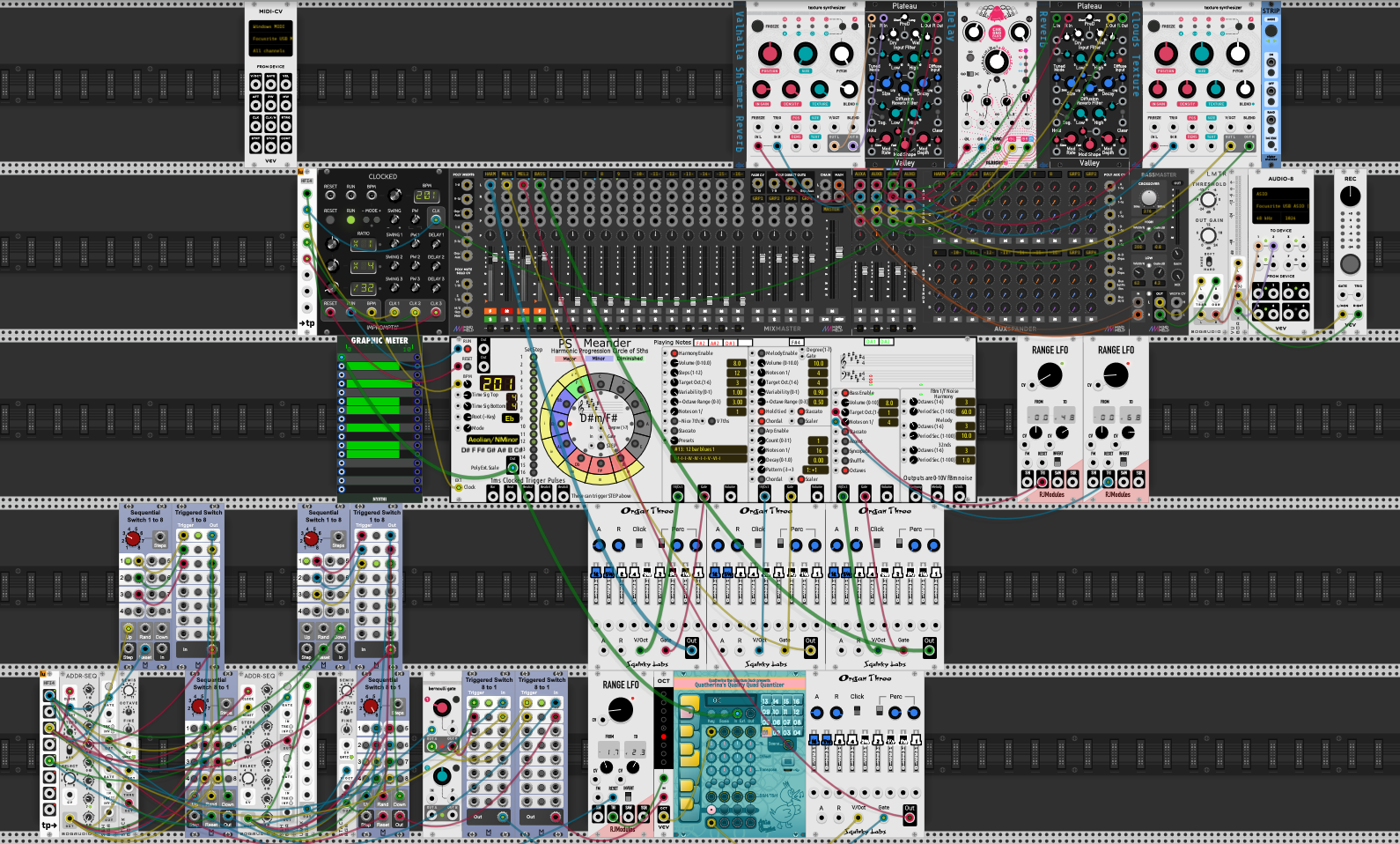
I am very happy with this piece and very glad I added Poly External Scales output to Meander.
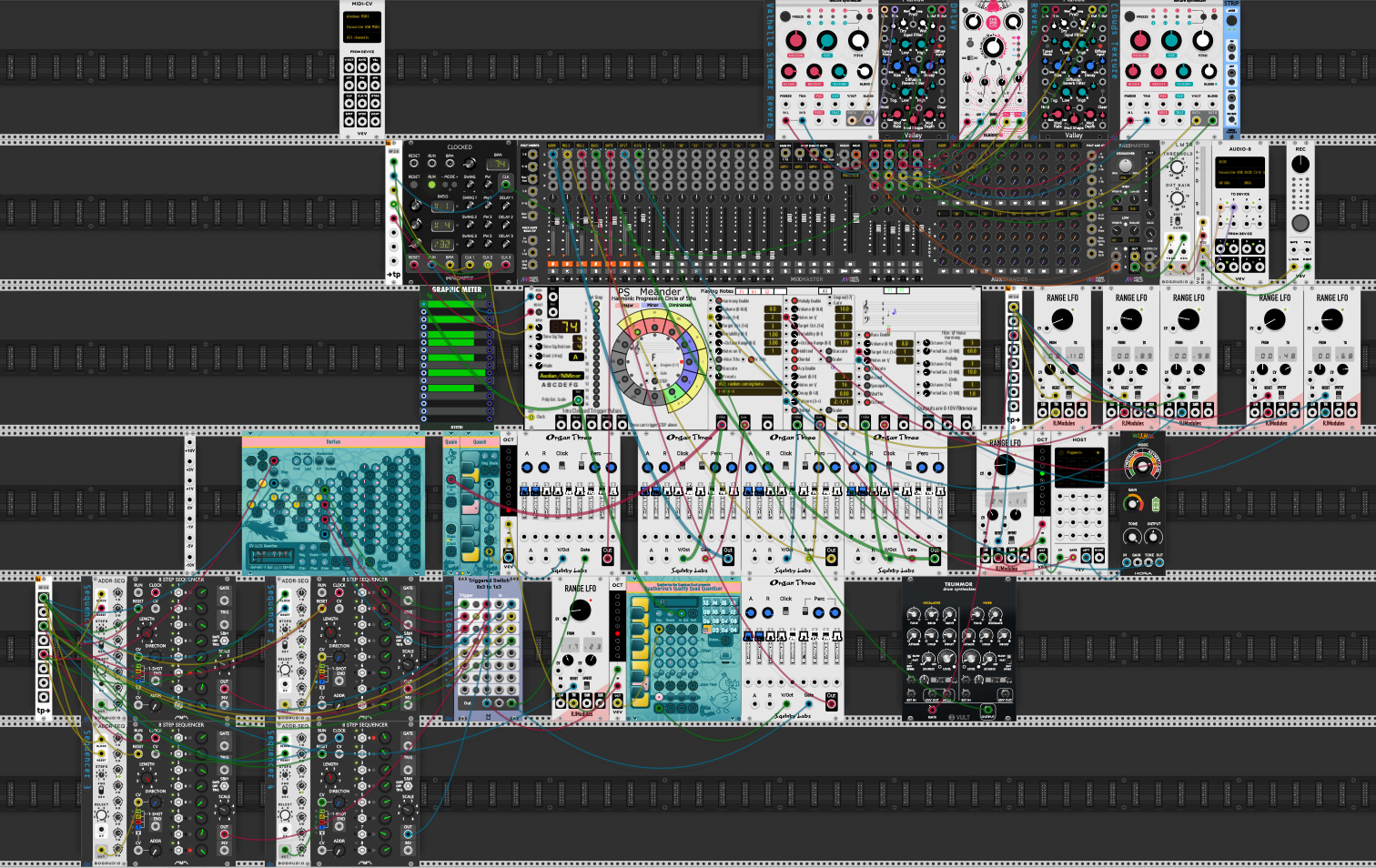
This piece is inspired by my favorite rock group of all time, PF. The piece is totally generative in Am, with me just clicking on the mixer fades and nothing else once record was pressed. But, it took me all day setting this up. The guitar is via HOST and Arturia Pigments “Guitar Lead” with more or less infinite sustain settings and going through Vacuumba for overdrive and distortion. The Meander melody and arp are playing the guitar, both in chordal mode for a harmonic melody line. All other parts are played using Organ Three’s except Trummor for the kick. All auxillary sequencing external to Meander was coordinated by 4 of Aria Salvatrice’s modules: Darius, Quale, Quack and QQQQ. Meander is sending the Am scale to QQQQ via Poly External Scales and the current chord to Quale via chord to scale. Scaler sequences are handled by the 4 “8 Step Sequencers” with 4 ADDR-SEQ’s controlling the 8 Step directions etc. with Darius acting as a 4 path Bernoulli gate. There is a lot going on.