Many thanks, this helps to understand. No processor problems with these many host instances?
Not for me, but I have a Dell Alienware Aurora gaming machine. The HOST modules show a very low CPU usage, but I doubt if that includes the VST plugin load.
It doesn’t get any better than this. I’m in heaven, and in awe of this achievement.
Here is my latest Meander ambient minimalist recording entitled “Meander Arps A Chord” . For this, Meander is only sequencing the harmonic progression of chords in Dmin. 13 arpeggiators then “arp the chord” triad of notes. There is quite a bit of phased automation to bring the parts in and out as well as change the FM-OP feedback setting and in a few cases change the octave of the arp. Some of the arps are stochastic within the triad.
Once again, this is only to hopefully inspire what is possible with Meander.
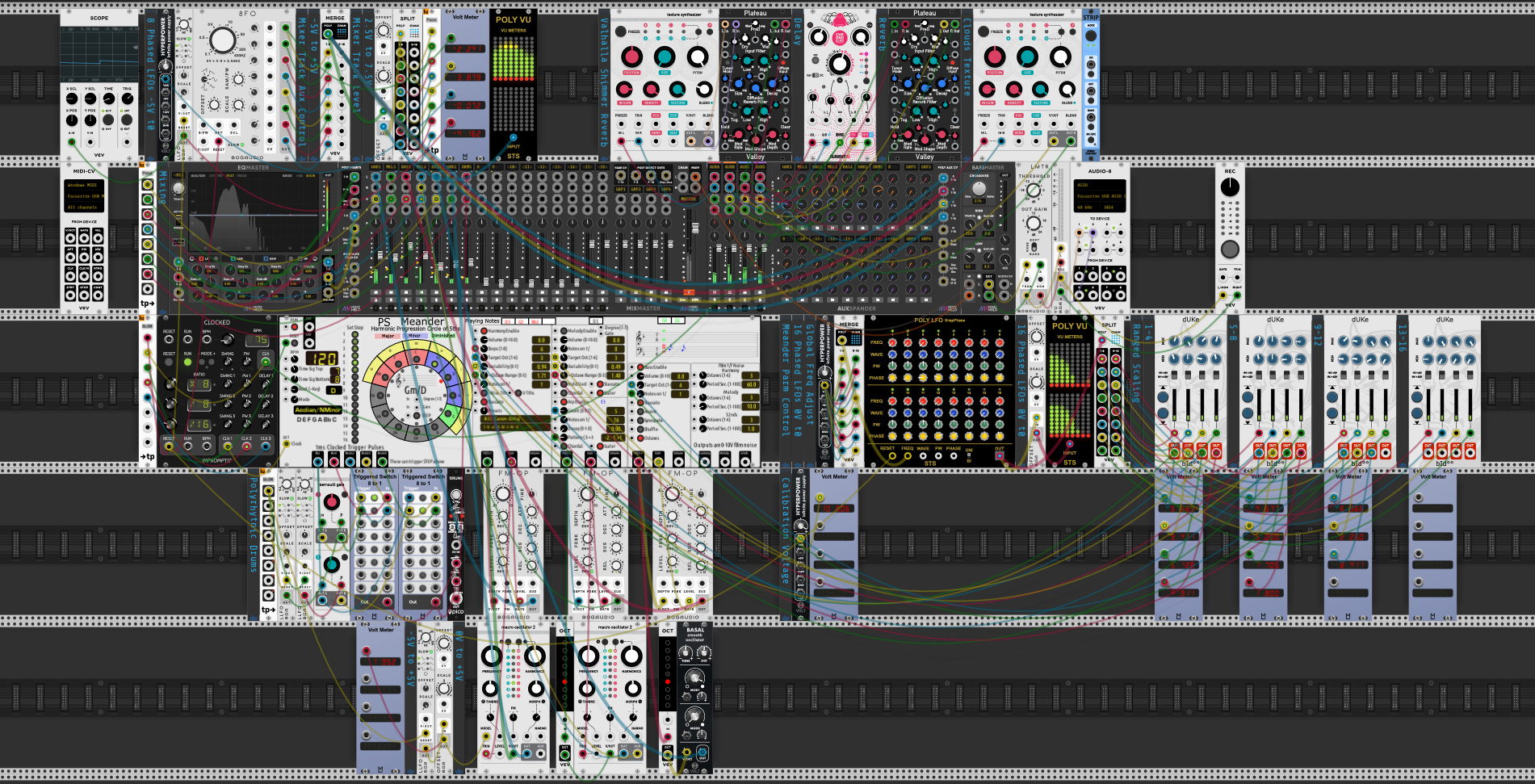
Here is my latest composition, Meanderaga . This is my interpretation of a raga in the Indian heptatonic scale DD#F#GAA#C# . Since Meander only supports “modes”, for this piece I used the Quantum quantizer to quantize to the above scale. Chords are not played in this piece since that is more difficult to do in this manner. This is a generative piece that does not use discrete sequencers. A lot of the Meander parameters are automated to provide variation and evolution. As such, there is probably not much repeating in this 30 minute piece.
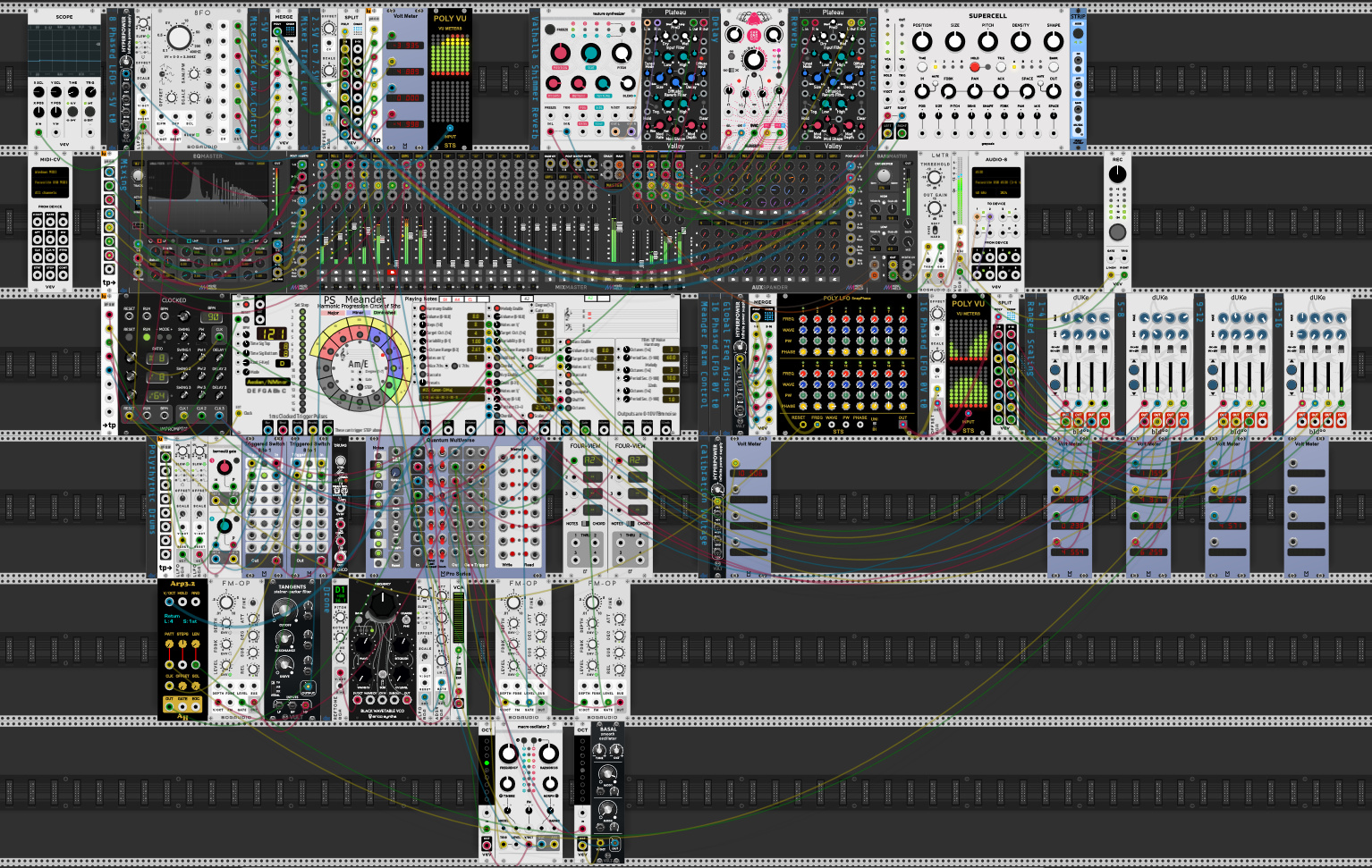
Here is my latest piece composed and performed within Meander in VCV Rack. This is a return to my musical roots in the early 90s doing extended meditative journey music. It is best listened to with headphones. For this, 27 Meander parameters were automated via CV, mostly from RJModules’ “RANGE LFO” module. The tempo BPM is also automated over time from 30 BPM to 300 BPM.
This is “Meander Days”, my take on time in the Pandemic, in A minor. The piece is totally generative in real time.
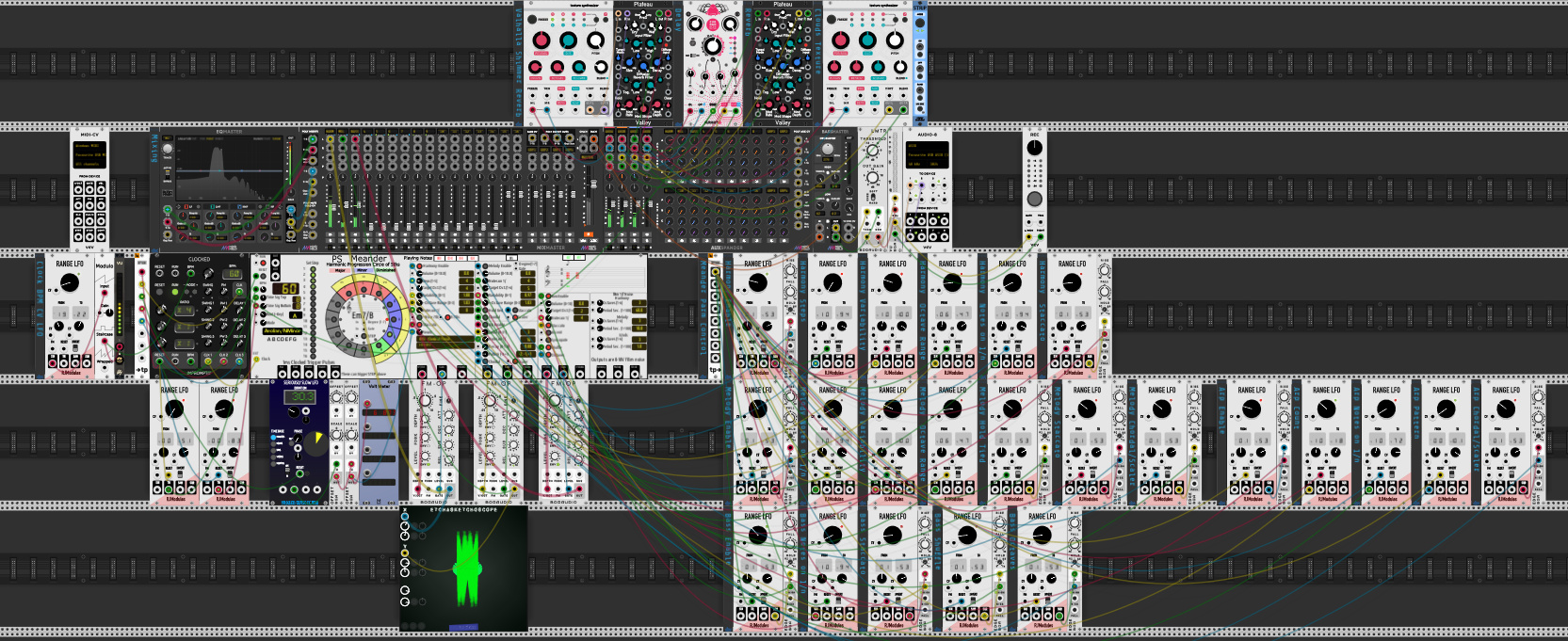
This is really nice - I tried something similar with LLFOs to modulate things, but couldn’t get it going. The Range LFOs look a better choice. I’m rebuilding this one 
I also started out using LLFO and an OFFSET or 2 (with scaling) for CV automation over a range. To give credit where due, I got the idea of using RANGE LFO from watching a @Huskendriller video where he automates Meander. with that module. It would be nice to have a phase param in RANGE LFO, but as it is is a pretty much complete solution.
this is really great 
I’m still trying to get something nice from Meander, but I’m getting closer 
Figured I’d try out something similar, using Meander with orchestral samples. Sounds come from Reason. I use a variety of generative tricks. Mallets riff is played on my keyboard once, then the neural network takes over and hallucinates variations on it.
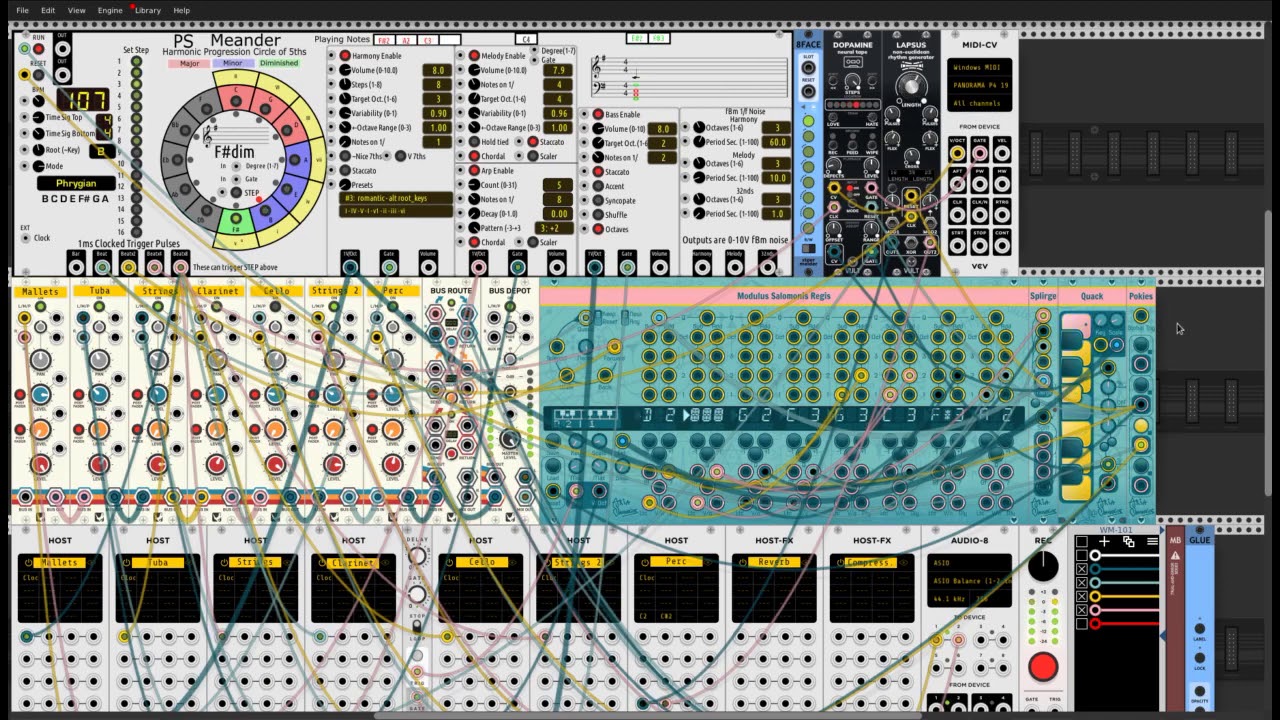
A lot of the logic is done in the Reason instances (not depicted in the video):
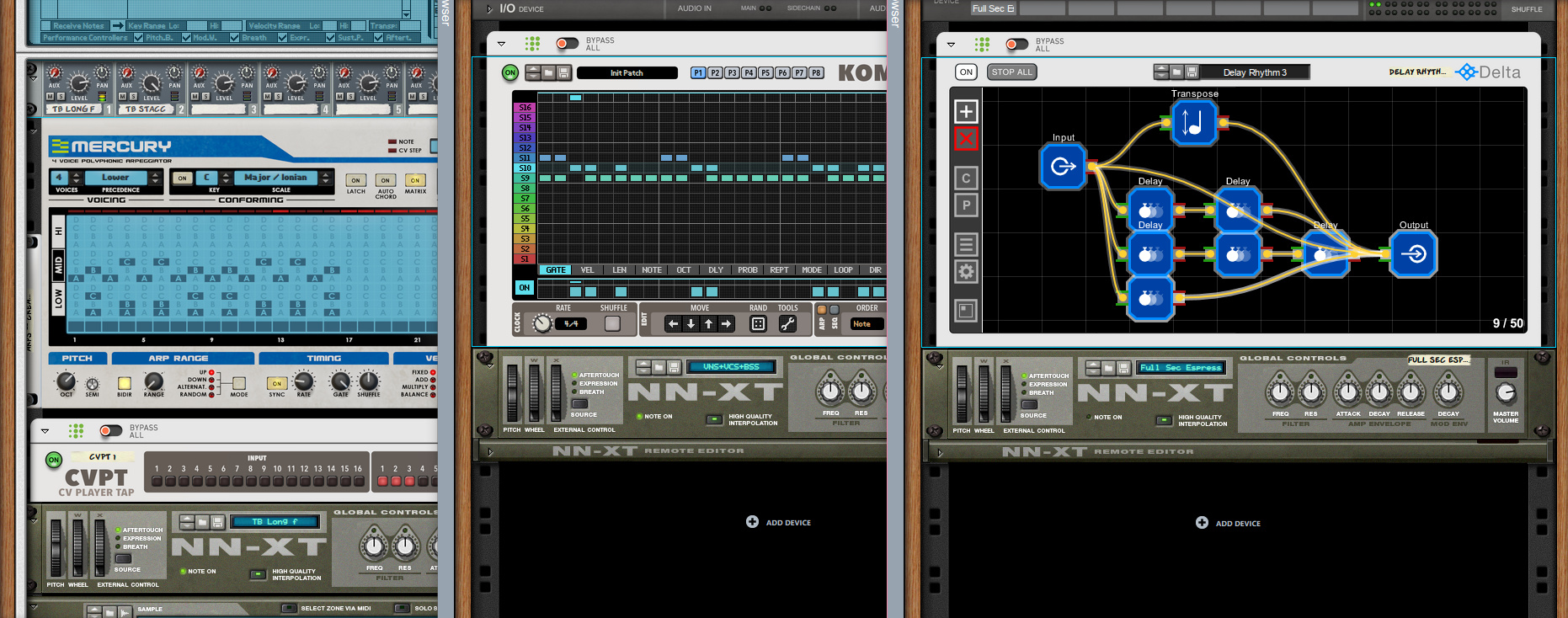
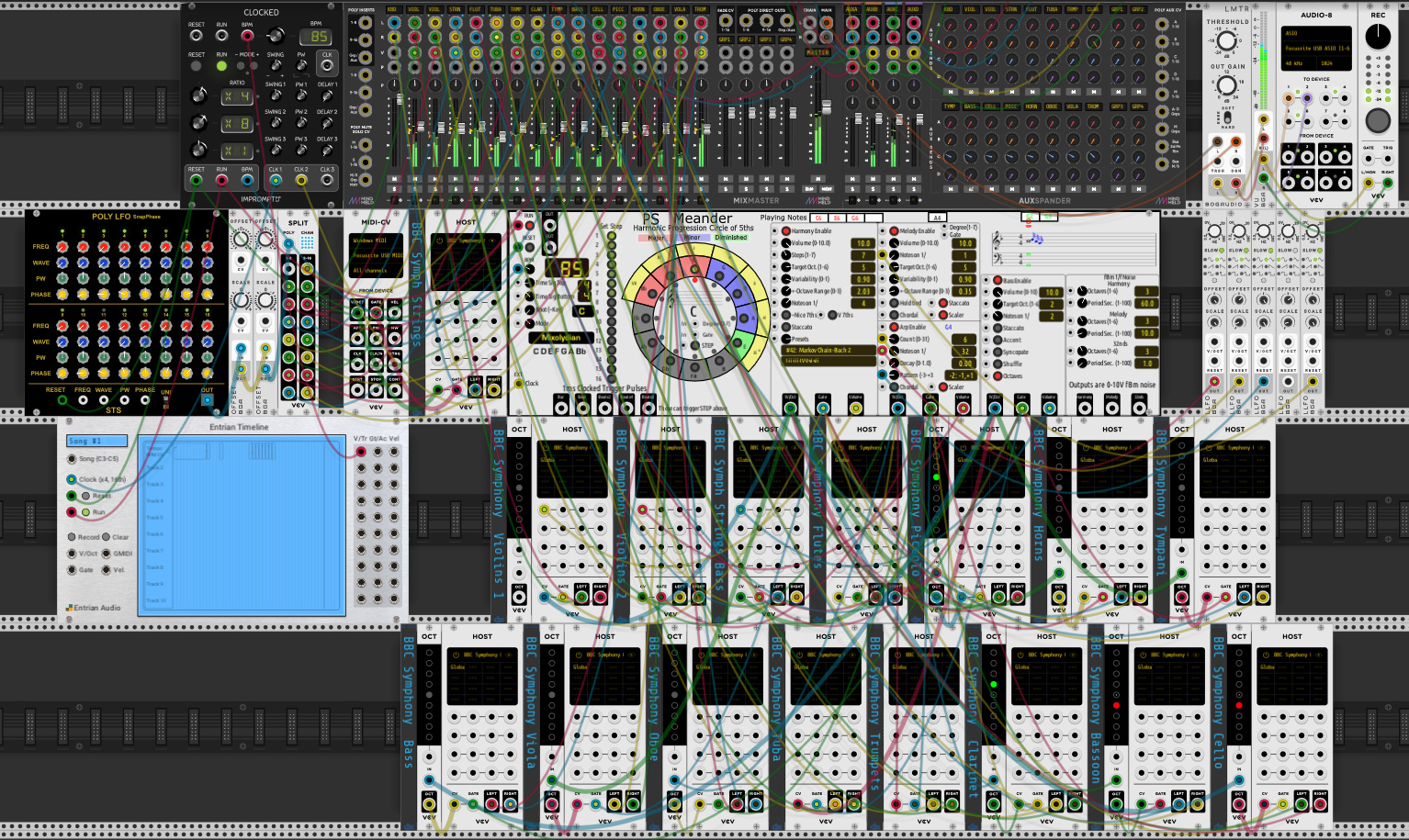
Hah, I forgot I already did that above, way back in… June
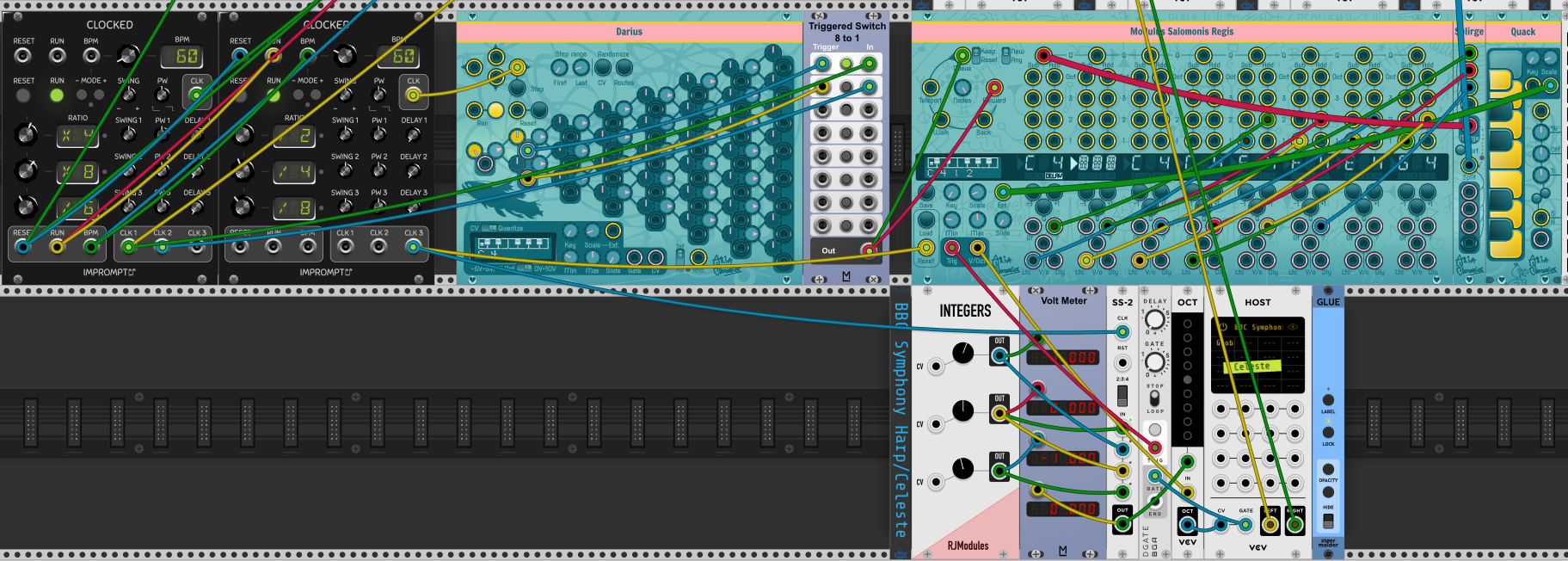
Your piece showcasing your modules with Meander and a symphony orchestra inspired me to do do something similar. This piece is using the BBC Symphony VST to create a ~complete orchestra and then Meander is generatively sequencing the piece using a Mozart style Markov chain harmonic progression in C Mixolydian. Your Modulus Salomonis Regis and Quack are set to the same key and scale as Meander and is sequencing a harp and celeste track. In order to better hear the Aria, at the beginning and end of the piece only the Aria part is playing. For the rest of the piece, 15 other tracks of sympony instruments are playing via HOST. I use gchoice to introduce one of 4 clocked triggers from Meander to Modulus Salomonis Regis stepping input, based on a time varying gaussian distribution of mean and spread of the 4 trigger inputs from Meander. I also use RANGE LFO and OCT to varying the harp and celeste parts octaves over time.
This was fun and sounds pretty good.
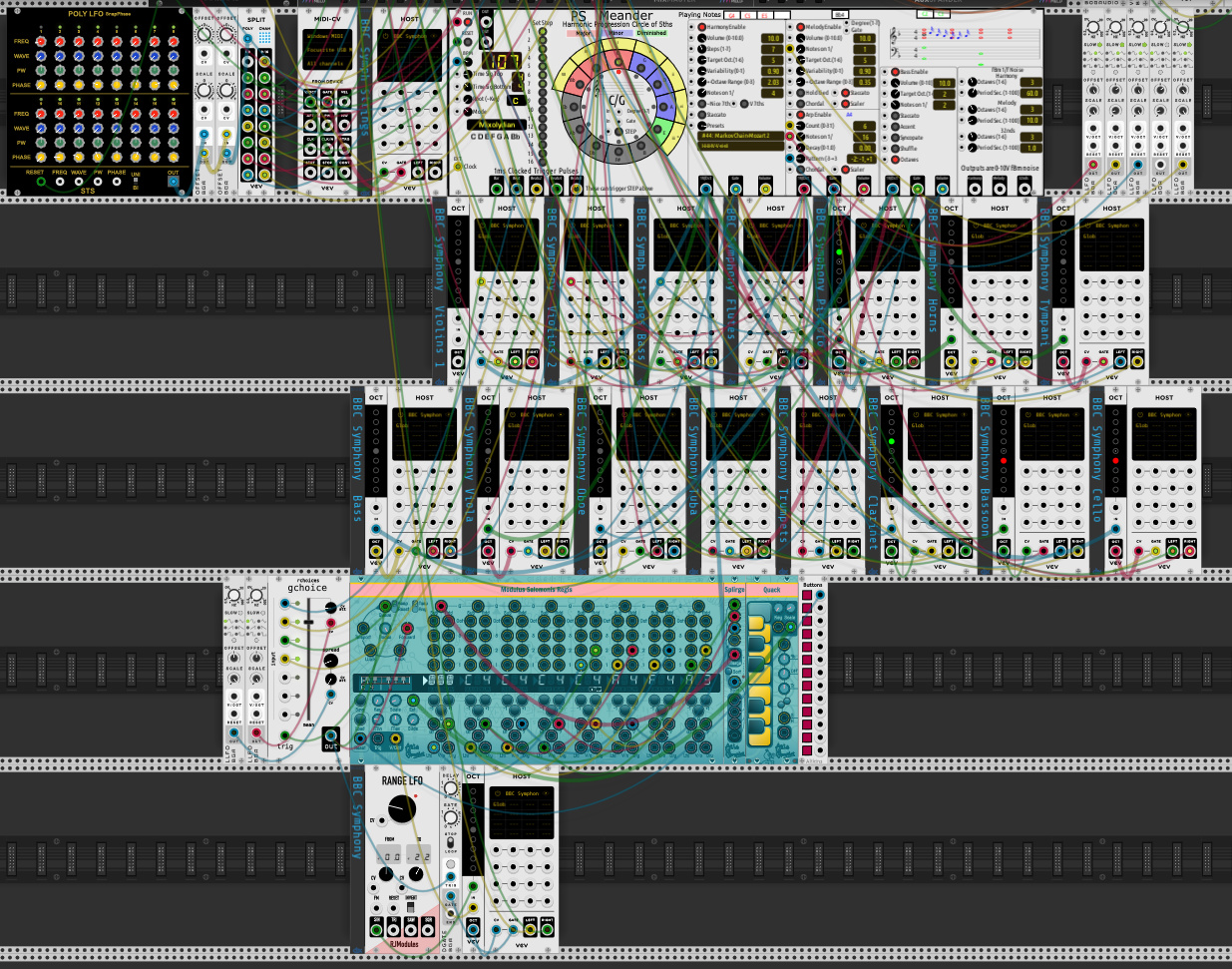
Nice, I really need to try out this technique of varying the speed of gates sent to MSR too, it’s giving great results!
I made some changes to my Aria/Meander patch yesterday that greatly improved the results. I’m no longer using the clocked trigger outputs from Meander but rather using CLOCKED clocks with the following setup:
- Two CLOCKED modules chained together, so I have plenty of high speed and slow clocks to work with.
- The 4X clock signal going to Meander Ext. Clock input.
- The X4 and X8 CLOCKED outputs go to the gchoice module where they are gaussian selected every CLOCKED /8 tick (every bar in 4/4 time).
- The gchoice out clock goes to MSR Queue and Forward inputs.
- The CLOCKED /8 tick also goes to the SS-2 sequential switch with changes the HOST octave each bar.
I think the above is correct. Even though I wrote Meander, I tend to forget how the clock relates to bars and quarter notes without working back through it. The gist is that I force MSR to only change step clock and octaves once per bar. By doing this via CLOCKED, everything stays in sync with Meander and things happen on the beat. At least that is the theory and this does sound better to me than using the Meander clocked trigger outputs.
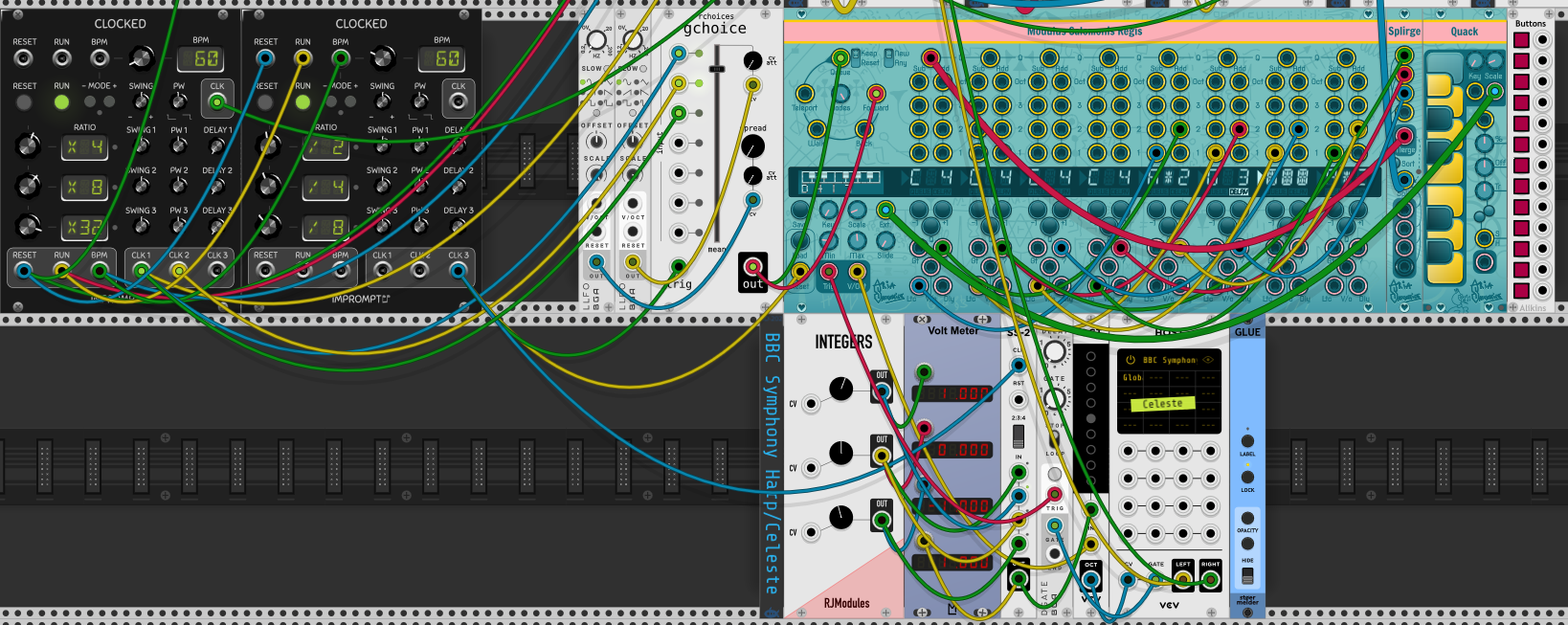
I modified my probabilistic clock input to MSR to come from Darius. In this example I am just switching between a 4X and 8X clock once per bar, with the 4x pathway having a higher probability than the 8X pathways. Works very well and has a lot of flexibilty. I think I will stick with this. Along the way I am learning about your modules 
If it fits the direction you want to take Meander towards, you should consider implementing Poly External Scales output for the current scale & chord!
It’s by no means a standard however, since I’m the only one implementing this format, haha.
I have been considering implementing Poly External Scales, at least the output of heptatonic scales from Meander. Your “standard” is very easy to understand and implement. Meander is a very extensive and complex program that does not totally follow VCV Rack best practices. I’m sort of waiting to do more development until I understand what it will take to migrate to V2. According to Vortico, Meander will probably require more than a recompile with the V2 SDK. How much more and of what nature and feasibility is my question.
Super intrigued. Sorry for the noobiness but how can I download this and try it as others above? I have used plugins not listed in the library before but the GitHub download link was displayed differently. Thanks in advance for any help. This project is amazing.