This thread (and your and @Aria_Salvatrice’s back-and-forth) makes me very happy. Just wanted to say so!
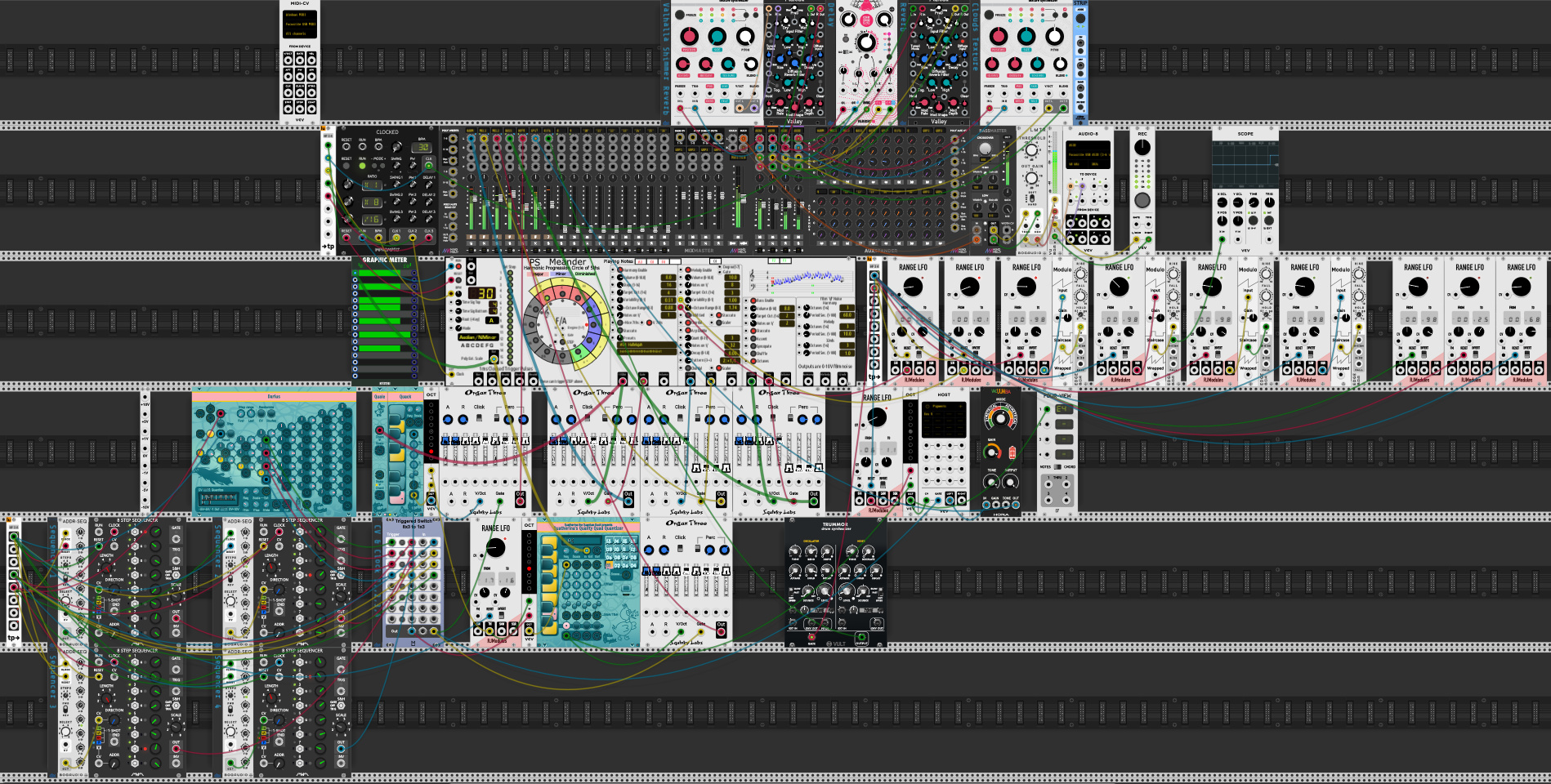
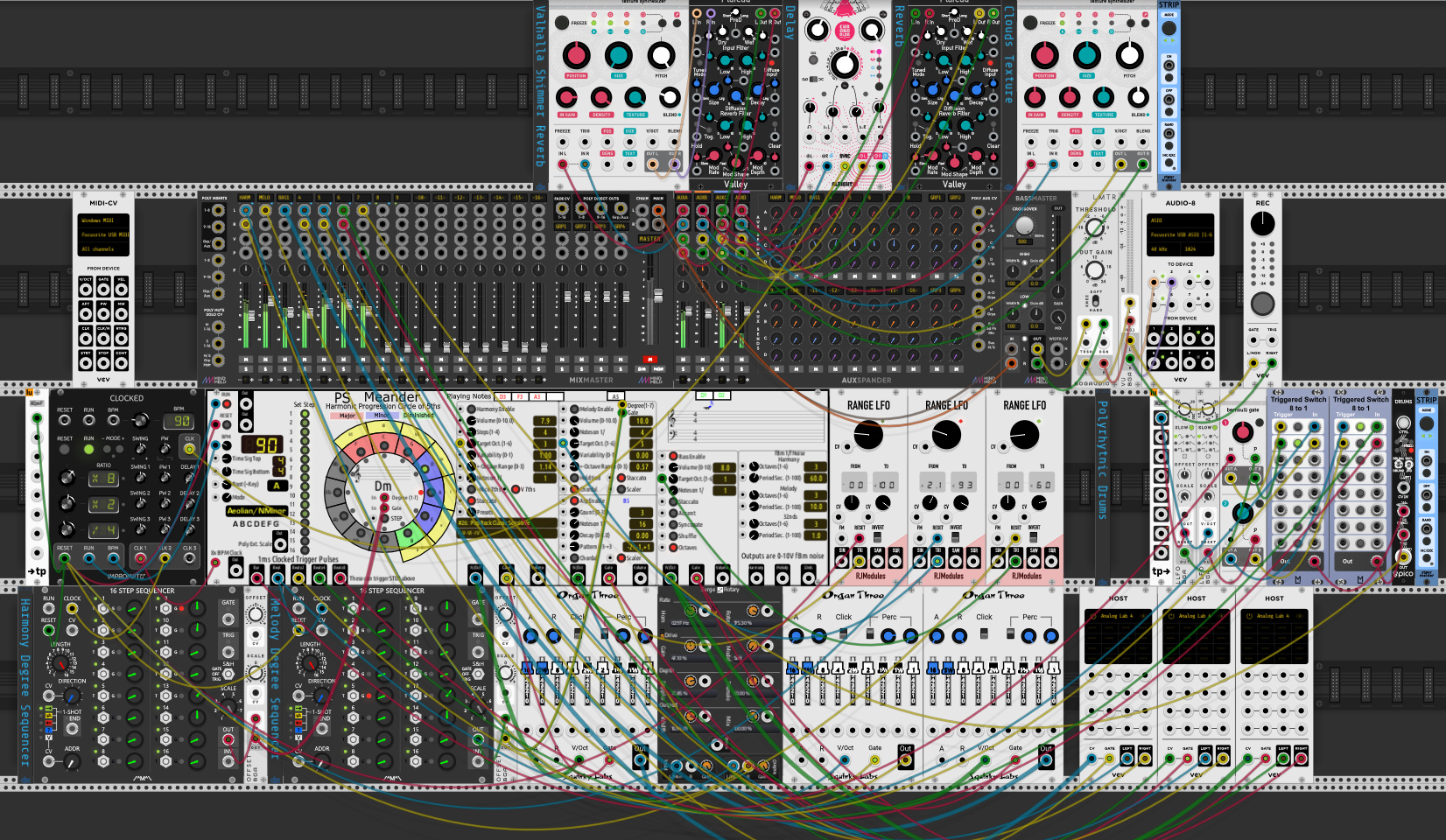
In my quest to see what all Meander can do, here is my latest, “A minor Meander”. This is a cinematic style with setup very similar to the previous song, but with different harmonic progression and tempo. Also, this one has the electric guitar but it is being sequenced by the auxillary semi-random step sequencers, which are conducted and quantized by the Aria Salvatrice modules. 8 tracks, once again all generative. Organ Three’s are still voicing most tracks. Again, a bit of parameter automation but less than the previous piece, so most RANGE LFO’s are not connected.
.
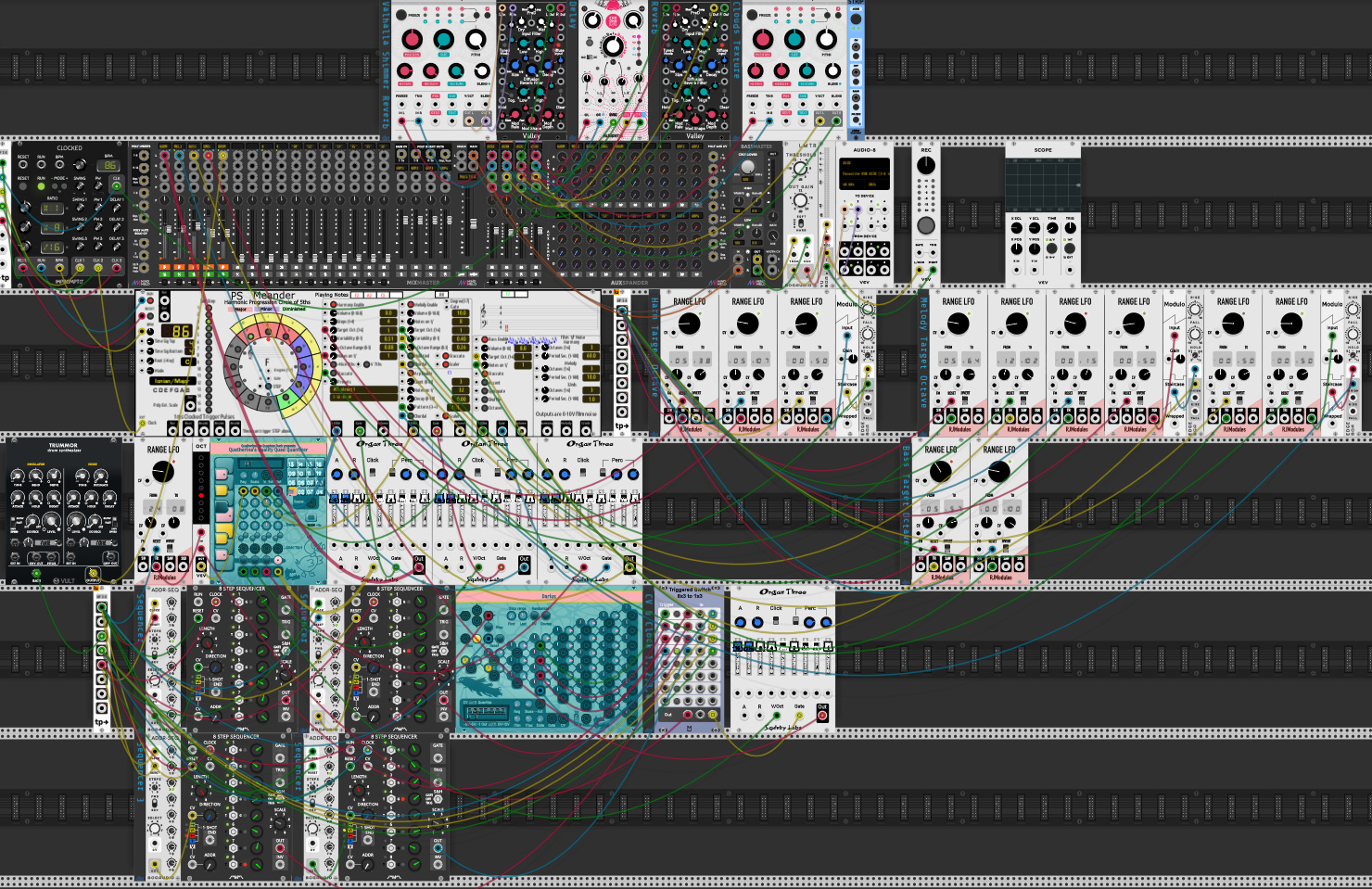
In this piece, I am pushing the limits of what is possible with Meander and the Aria Salvatrice modules. This piece is entitled “Fast Meandering QQQQuadrapolar”. All notes are being quantized by QQQQ set to a “A# Blues Minor” scale or Bb Blues Minor. So, Meander is sending harmony, melody and bass parts to QQQQ in C Major. Chords can only be said to be multi-note scale notes since the Blues Minor scale is hexatonic and the Major scale is heptatonic. But, it works… I think.There is a lot of Meander parameter automation going on also.
A minor meander is beautiful. I really enjoy the gritty stuff. It feels in many ways movie soundtrack ready. Its crazy how powerful meander is.
That is a really cool piece - nice one!
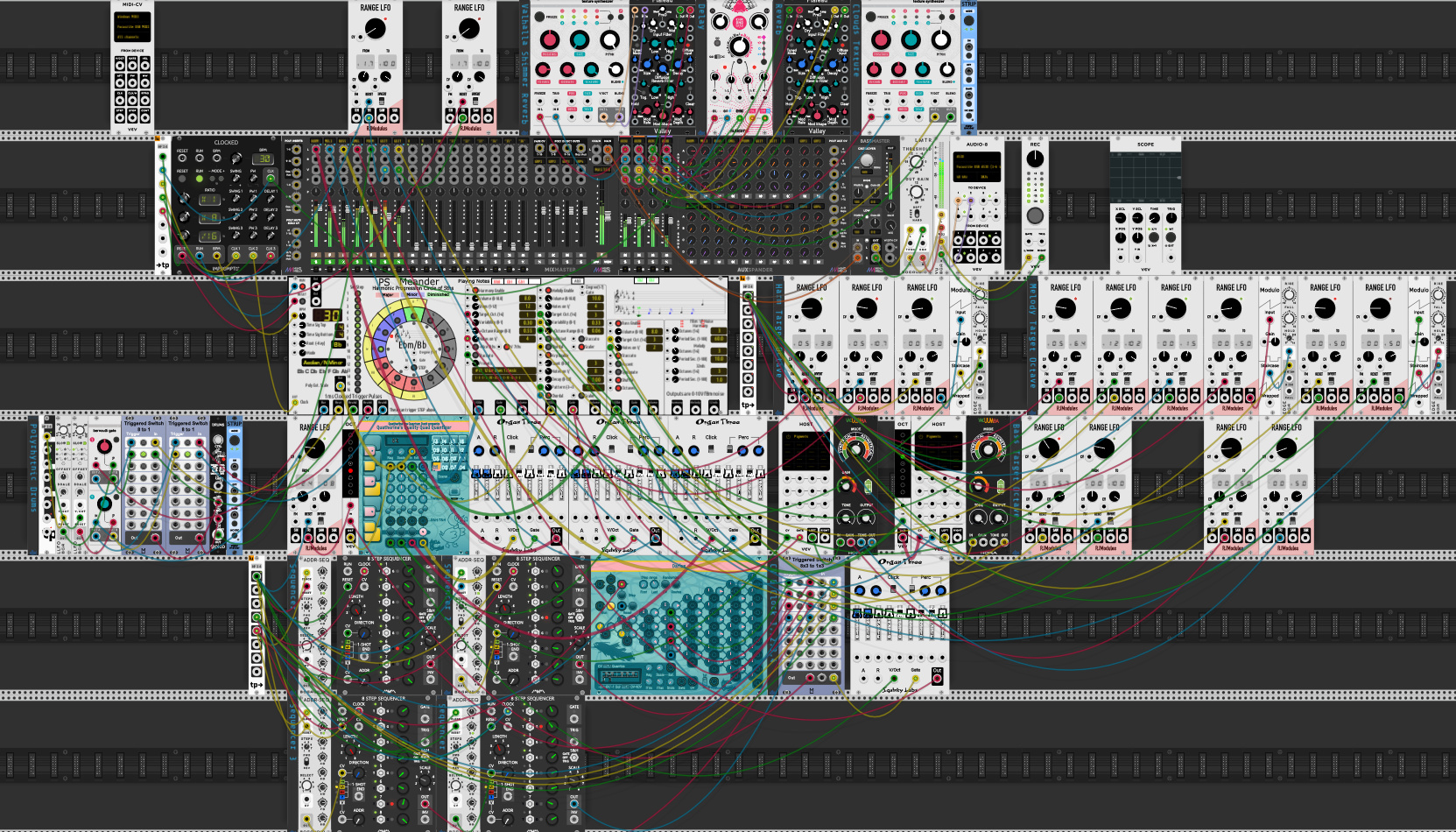
Here is my latest (and perhaps last for a while) demo piece using Meander, named “2020 Blues - it B-flat”. This is a 30 minute progressive blues rock trip. It is in Bb-minor with a 12 bar blues progression. As usual, QQQQ is following the Meander scale and quantizing several parts. There are 8 tracks in the mix. Totally generative once I click the mixer fade-ins.
In a lot of ways, Meander is an improvisation engine.
Hi Aria. I have now changed Meander to always put the harmony chord tonic note on channel 0 (the first) of the polyphonic output port. I think this was a good move since it is possible now to easily extract the tonic from the chord and use it for bass note purposes, etc. This works for triad and 7th tetrad chords. I will continue testing it for a few days before releasing a new version to the library.
Just to clarify, this change is for the Meander harmony chord output port, not for Poly Ext. Scale output port. The new version has been submitted and should show up in the library soon.
I have found a problem in Meander and corrected it and much, much improved the musical quality of the harmony, melody, arp and bass. Basically, instead of legato, I was playing all notes as staccato and instead of staccato, I was playing all notes as double staccato (whatever that would be called). Correcting this makes the legato sound much better as notes last 90% of the time between notes so sounds much less machine-gun-ish. Staccato notes now last 45% of the time between notes. I found this while trying to figure out why harmony (chord) notes did not sound right. Turns out the same problem was present for all parts. It is a fairly complex equation to generically determine the note length at any tempo(clock frequency) and time signature and note length as well as arp note lengths. I was off by 50%!
I will test this a bit more before doing a release to the library, since I have also added several new harmonic progression presets. There are now 59 progression presets.
Meander V1.0.10 has been submitted for library review and build. The Meander manual also has the change log as always but now also has an appendix with all of the Meander harmony part harmonic progressions listed and annotated by me with some context about most progressions. The annotation might be of use to anyone wanting to dig a bit deeper into music theory and practice. I’m no expert, so it may not be totally correct. It is also easier to browse through the whole list of 59 progression presets in the manual than to scroll through them one at a time inside of Meander. The manual changes are available now.
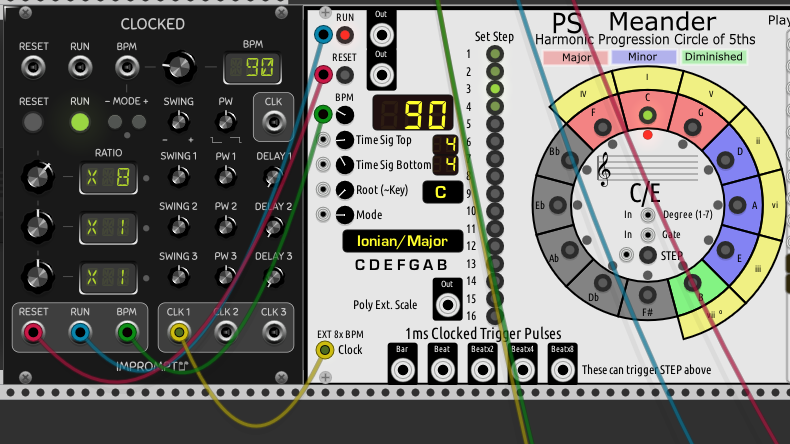
This version corrects the note duration issue I mentioned in my previous post. In order for this to work when connected to an external clock, the clock should be set to a ratio of 8X BPM. To fully work, the clock BPM should be sent to Meander along with RUN and RESET… and the 8X clock, This is needed so that Meander can understand the clock and can apply the time signature, note lengths and legato/staccato settings correctly. This is no small chore. Not all clocks can do all of this. You could use a non BPM sending clock by manually setting the BPM in Meander to exactly the same BPM set in the clock but there is no guarantee everything will work. The best bet is to use Impromptu CLOCKED, which is what I use and how I test Meander. Or Meander can use its internal BPM clock, but that is harder if you need to clock other modules also.
The recommended CLOCKED and Meander setup and connections are as shown here:
I see that I have some formatting issues in the manual appendix. I thought I had everything right. I’ll fix the formatting once this build is complete.
V1.0.10 is in the Library.
Manual formatting is fixed. It took me all day to find I had an extraneous space in the Markdown anchor and link lines. 
I’m close to committing the next Meander version to GitHub and submitting to the library. I still need to update the manual.
Over the past 32 years of developing Meander, it has always been to enable me to make interesting music. It is fun to be able to share it with the world via open source, something that has never been very feasible for me until now with VCV Rack. I hope you enjoy Meander 
As part of my software testing workflow, but also as an expression of my “art”, I like to create new complex patches that test the most recent changes to Meander and upload those pieces to SoundCloud. So, here is a new piece called “Seven Degrees of Bach Blues”. This piece is unusual because Meander is being sequenced via Count Modula 16 Step Sequencers and then Meander applies music knowledge and send notes primarily to 3 Squinky Labs’ “Organ Three” modules, one for harmony, one for melody and one for bass. Meander adds arpeggiation to the melody. There are also 3 instances of Host, each playing an Arturia Analog Lab “PianoStrings Ensembe” patch that are also playing the harmony, melody and bass. There is also a procedural drummer based on Erica PicoDrums.
The Count Modula sequencers are both set up with octal radix (degree.ocatve) voltages A nice feature of the Count Modula sequencer is that I can save the sequence as a preset in octal radix form and thus can then sequence Meander in any of the 84 mode and root combinations since “degrees” are relative. In this song, I have Meander set to Am.
In this case, both sequencers are were loaded with a 16 bar blues preset, the same preset. But, this I-IV-V pattern is interpreted by Meander as Am, Dm, Em7 for the harmony and A, D, E for the melody, so the melody is made up of the bass notes of the chords. For the bass part, Meander also uses the bass note of the chords. The arpeggiator is set to “scaler” so, some other members of the Am scale are used, adding melodic variety. There is also automation variying the octaves of each part…
As such, the piece could actually be played by a single organist on keyboard and pedalboard.
I’m very happy with how this piece turned out. Check it out at:
V1.0.11 has been submitted for build review.
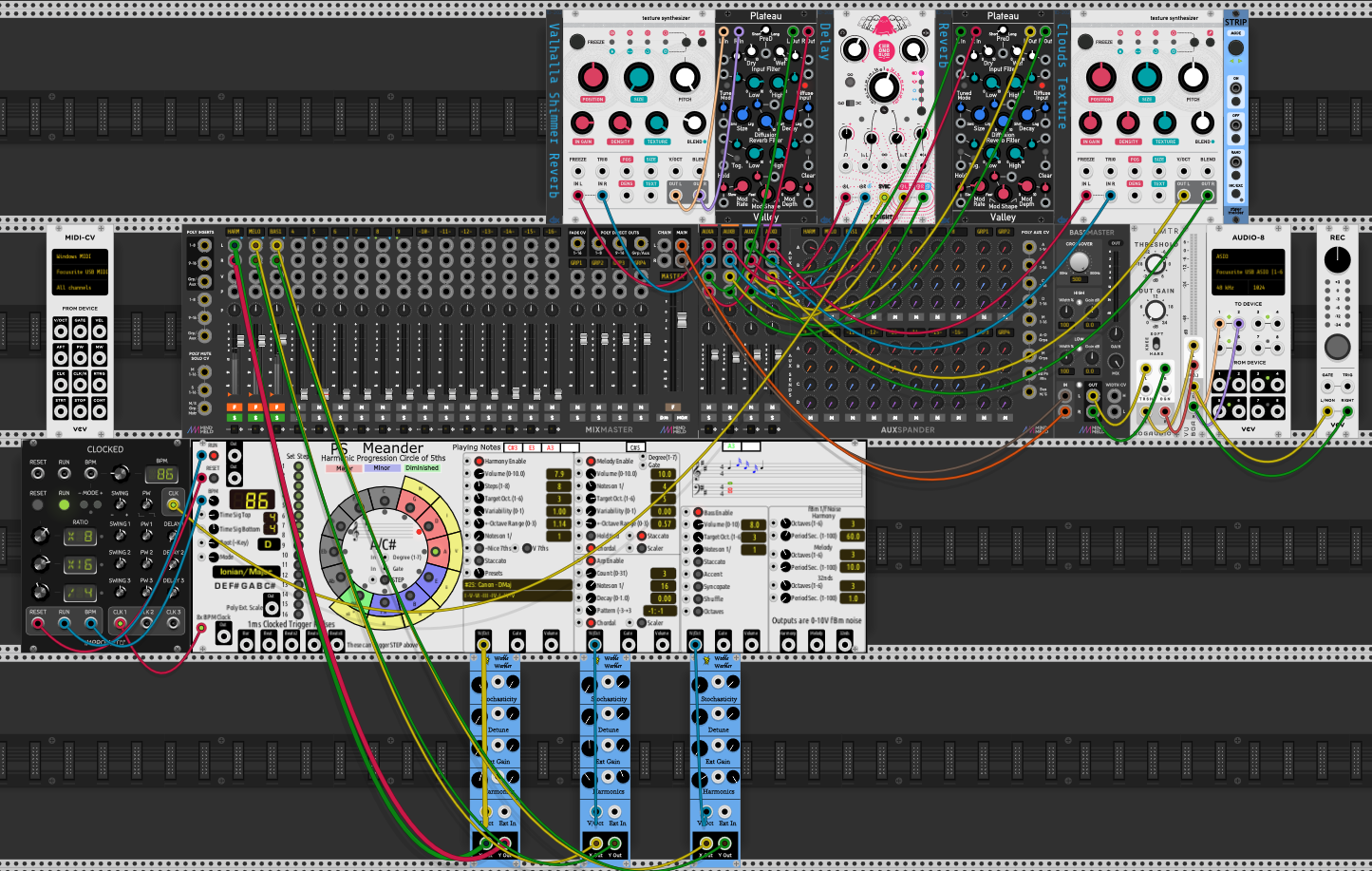
Here is Pachelbel’s Canon in Dmaj performed by Meander using 3 ZetaCarinae Modules WeebleWarbler’s. This is the #25 Canon-DMaj harmonic progression in Meander with Meander set to Dmaj and composing and performing a melody and bass to accompany the progression. The melody is in a “chordal” setting which means the melody notes are selected from and constrained to the current chord notes. The melodic arpeggiator is also set to chordal, so the arp arpeggiations are also selected from the current chord and relative to the current melody note. The WeebleWarbler settings were selected to sound like an organ. Some intense V.Shimmer-ish reverb was applied to the harmony part.
Here is the piece on SoundCloud: Stream Pachelbel Canon In Dmaj by CyberPunKen | Listen online for free on SoundCloud
Wow, with that reverb, it’s almost a vaporwave rendition (he said, appreciatively)! I also like the varied use of the Weebles. Impressive!
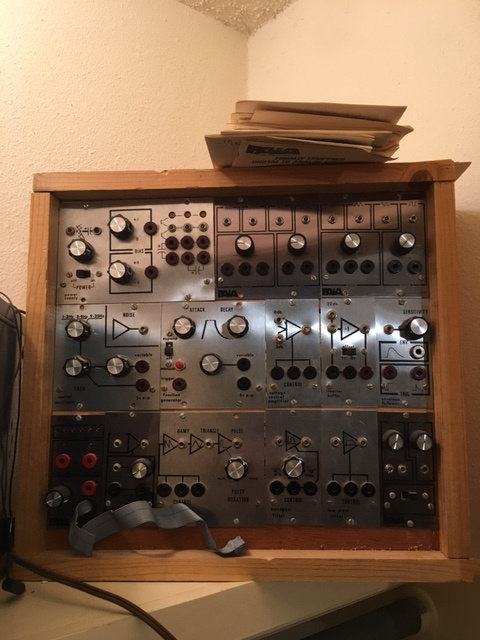
As I see so many people doing Halloween themed music in VCV Rack, I am reminded of Halloween 1973 in which I set up my PAiA modular synth which I had built the year before and ran it into a Bruce 200W bass amp cabinet with 2x15" speakers, aimed it at the front door and turned on a strobe light. It was very successful, if success could be measured by the fact that no parents let their kids come to our door 
The PAiA was great for making eerie sounds, but no so great at making music. Here it is still sitting in the top of one of my closets. My PAiA theremin is also up there. Several other generations and iterations of home built electronic music equipment are long gone.
Just cool !
Thank You for sharing 
I am suspending my public development effort for PurrSoftware’s Meander module.
Thanks for sharing so much here. I’ve really enjoyed meander. All the best to you and your future endeavours.