I’m excited to release the Pole Dancer filter, the first “beyond obnoxious” Zoxnoxious module to hit the Rack library. Library link here.
Pole Dancer approaches morphing filter design from a modular synthesis perspective. Rather than selecting a fixed filter mode, filter behavior itself becomes something that can be patched, crossfaded, sequenced, and modulated using standard Rack modules. The release includes four modules:
- Pole Dancer: a morphing 4-pole filter
- Personality: filter response generator and preset source
- Morphscope: live filter response visualizer
- Architect: advanced filter design and analysis tool
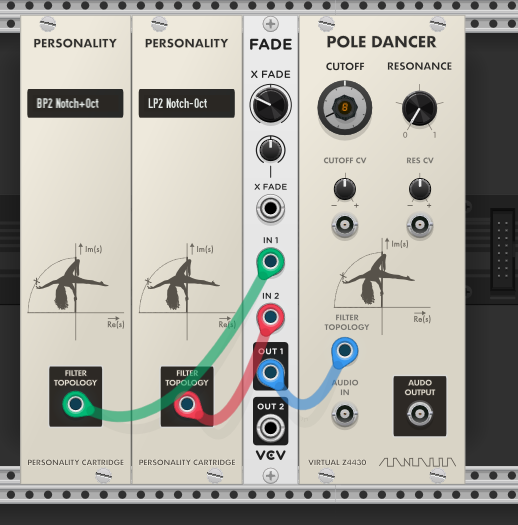
The core concept is a five-channel “Topology” signal carried over a polyphonic patch cable. Personality modules generate filter responses, while standard Rack utilities such as crossfaders, switches, sequencers, and slew limiters can manipulate them before they reach Pole Dancer.
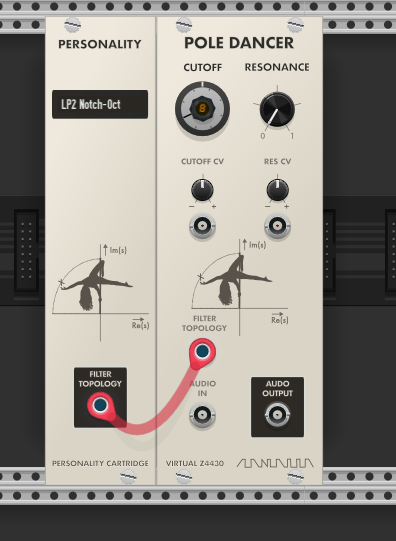
This enables workflows that are difficult or impossible with conventional multimode filters:
- Smoothly morph between lowpass, highpass, notch, and allpass responses
- Sequence filter behaviors as part of a patch
- Animate individual portions of the filter response
- Apply audio-rate modulation to filter topology
- Create evolving drones, animated timbres, and unusual spectral effects
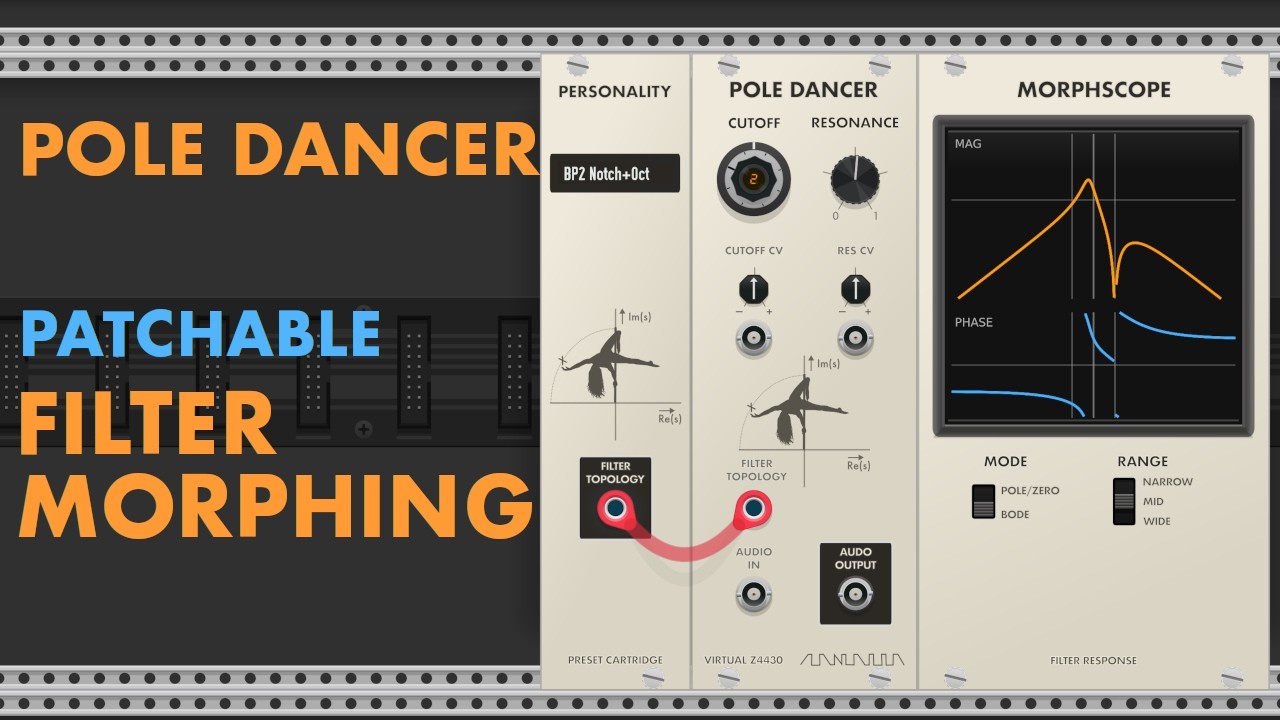
To help visualize what’s happening, Morphscope provides live Bode magnitude/phase plots and pole/zero displays. For users interested in creating their own filter responses, Architect allows direct control of the underlying filter coefficients and integrates with Personality presets.
The visual design takes inspiration from classic Nuclear Instrumentation Modules (NIM), including BNC-style connectors, turns-counting cutoff controls, and instrumentation-style hardware details.
Full manual on github. YouTube Demo here:
I’d love to hear what people create with these modules. Thanks a ton to the discord crowd for putting up with my updates along the way!
