Where's a good noise gate?

I need a noise gate, for performing live. I’m going to be processing a microphone live in Rack, and past experience tells me that without a gate, feedback can really screw things up.

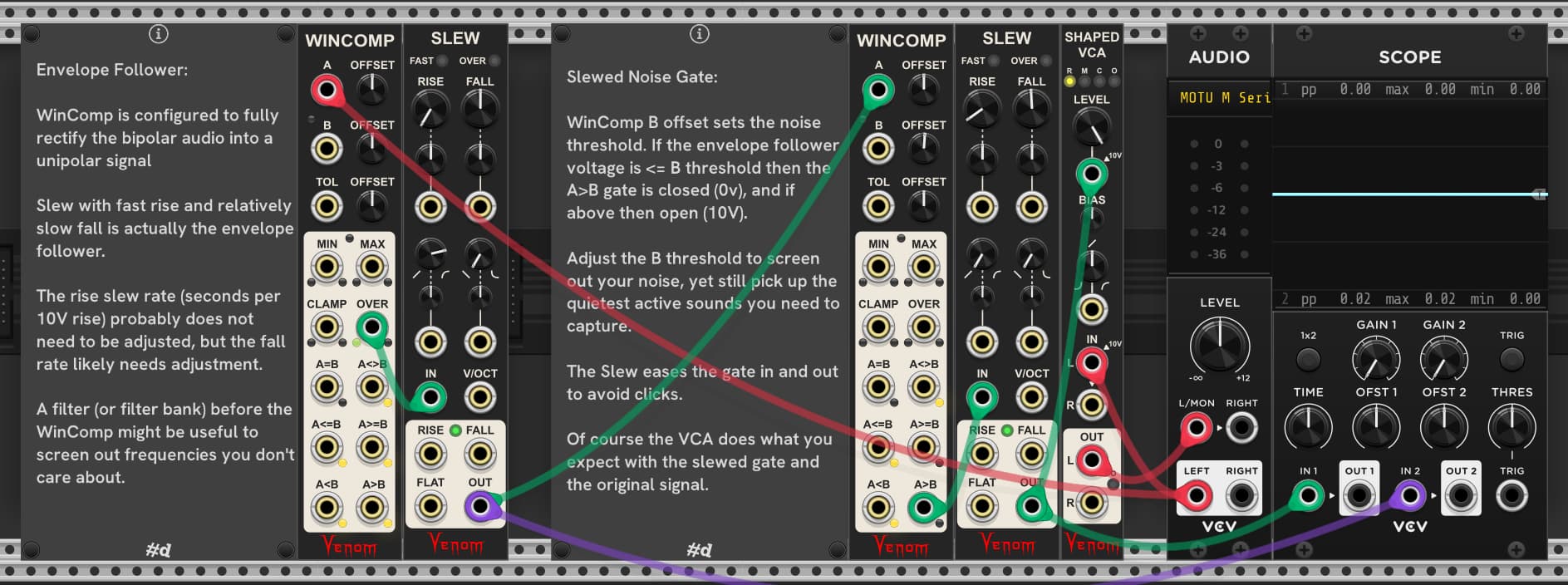
I haven’t found a noise gate. The closest is the Audible Instruments Dual Dynamics Gate. But that doesn’t have a gate mode, you have to add modules to use the envelope, using a VCA and a comparator, probably with a slewe limiter so it won’t click.

I don’t know 1. Why, if the dual audio gate has a Compressor mode, they didn’t add a Gate mode. 2. Why anyone besides BogAudio haven’t created one. The BogAudio one is problematic because it doesn’t have the usual gate controls, and it doesn’t have a display to show the gain change. When I try using it blind it’s either too sudden to open and close, or too slow, with no in between.

1 Like

I use a free plugin called Renegate, running in Host-FX.

That’s the second time I’ve mentioned Host-FX today, I don’t get commission but I honestly think it’s the best thing you can buy for standalone rack! :joy:

2 Likes

I wonder if an envelope follower like sapphire Env would react quick enough on the open. Will need VCA of course.

This is a complex question. Live sound guy for some decades (not any longer, thank god) here.

Typically we reach for EQ before dynamics to combat feedback. And we try to get the best optimum settings with all the sad notchy compromises that we can, during sound check. Do you get a sound check? I hope. And then that is at least a good starting point before the room fills up with water bags (humans) and changes the resonance.

If I were in your shoes flying solo with no FOH or monitor guy/gal, I’d have notch filters, a gate setup and limiter (compression can actually increase feedback, hard limiting can’t cure it but sets a ceiling at least) all in the mic chain and ready to implement. Assuming you have a free hand.

I can post one of my “feedback ferret” patches if it’s helpful, but since you’re a veteran VCV advanced fellow, I can just describe it. (I use this technique to tame resonance on feedback-y patches). (Feedback Ferret was an actual hardware Peavey device, then a knockoff by Behringer, that sort of did what it was meant to do, but in a very non-musical and destructive way.)

So you use whatever note-detect module you like (entrian Follower, sapphire Env, cvFunk Tuner) to get the spikey frequency. High pass or other filtering as needed. And then sometimes I end up using a +1 or -1 volt offset to nail it best. Generally you do best making the notch at the lowest octave possible.

And send that to a notch filter (Dave’s new multimode filter is all I’ve used for the past month for that!) obviously with your CV from the note-detect as the notch frequency. Certainly a slew limiter on the note CV so you don’t hear the notch bouncing harshly around (at the expense of a bit more ringing maybe).

Clever additions: multiple iterations or polyphony to notch multiple frequencies of feedback. Now you can really destroy your live sound with a heavy hand. Also, control the depth of the notch by another pathway determining the relative intensity of the bad frequency vs the full spectrum. I use a couple instances of Bog Follow for this – another tool here is Flag Oppressor Env.

That last is a paid module, which brings me to a quick n dirty solution – Flag Oppressor Pro. It has a duck mode, and 10 bands is not a full solution for real surgery here, but if I had 20 seconds to make an anti-feedback patch, that would be it.

And then with the gating – your frustrations with VCV modules slamming too hard/fast – start throwing slew limiters in the path. Also, like compression (and like my notch filter situation as described) it doesn’t have to be an all-or-nothing solution. I assume you’re familiar with ‘NY compression’ aka parallel compression. Same with gates; you can have a gate that’s more crude than you like and add dry signal to soften.

Equal parts art and science on this topic. Get 2 sound guys/gals talking about this and you’ll have 3 or more strident opinions! Good luck, good gig!

8 Likes

Thanks - That is wonderful to read! There is so much about filter DSP that I know nothing about, let alone don’t understand. I learned a little bit about digital state variable filter design, and feel really lucky and thrilled that my empirical experimentation has produced such a useful module!

I thoroughly enjoyed your writeup. It helps validate some of my assumptions about how things work (or don’t!)


A few months ago I had an interest in resynthesis methods, taking live flute input and deriving V/Oct and volume information to drive a synth patch. I experimented with building a crude envelope follower and noise gate to be coupled with a pitch detector (I did not attempt to build my own pitch detector)

I am surprised at how effective the following crude patch works. Whether it could be useful on a live stage - well I would be surprised if it could be that simple.

For my resynthesis I used the noise gate to attenuate the raw envelope follower. But for this application we just need the noise gate.

Noise Gate.vcv (3.0 KB)

3 Likes

It can be fun to patch one, but nothing in VCV is prepared for the job really. A quality mic noise gate should have metering where I can see the audio cross the threshold and make small adjustments to nail it. I proper one in an audio console will have features like lookahead modes that preserve transients by delaying the audio stream as it processes, possibly an accent mode to add some noise to the transient on drum mics for more zing and pop as they open, precise hold times for a more natural gate length, subchain inputs etc. Host and Kilohearts Gate is a good alternative with a few of those good features. Oh I forgot about this one, costs money but is so cool, a gig I work regular, a vocalist/guitarist brings his D’Addario Infa red mic gate. A doohickey that goes right on the mic, it works really good, it needs you to break the red light with your face as you get near the mic, perfect on/off.

1 Like

Infrared noise gate sounds an interesting idea!

I get a huge amount of noise recording guitar in front of a computer, so I always gate the guitar signal. The other thing that helps is a cheap DI box with ground lift, if you have XLR inputs.

I’ve got the Kilohearts free gate too, but I found the UI doesn’t resize properly running in VCV, so I can’t see or adjust the controls. Some plugins do that in Host, others are fine.