The musical scale wheel

As a beginning musician, I am learning basic stuff about chords, scales, etc. I am a visual thinker, so I like having physical/visual models to help me understand stuff.

Looking at “circle of fifths” diagrams online got me used to the idea of thinking of the 12 semitones on a circle.

I know that in the A minor scale (aeolian mode), the root note is A and you play it and every other white key on the piano up to G. To transpose this scale to a different root note, you use the same pattern of semitone shifts from that other starting point.

I decided to make wheels to represent this. Here is what I came up with.
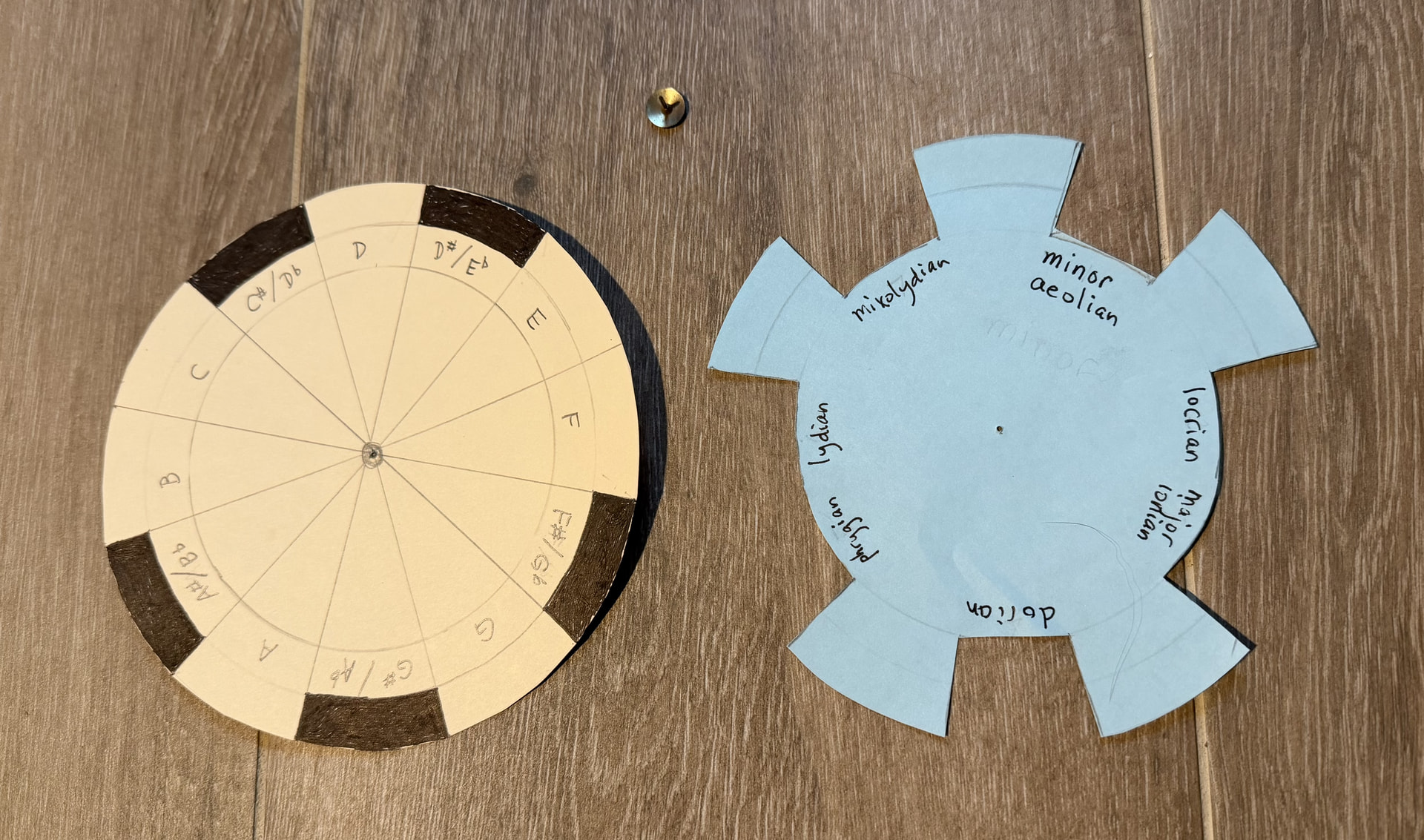
I have the circular piano keyboard, a mask pattern for all 7 musical modes commonly used in Western European music, and a thumbtack.

To use this thing, put the thumbtack through both centers, with the mask layer on top. (After taking these photos I found a tiny magnet I can put on top to hold the device together.)

Rotate to put the name of the mode on the desired root note. For example, to dial in D minor, put the slot labeled “minor/aeolian” on top of the D note.
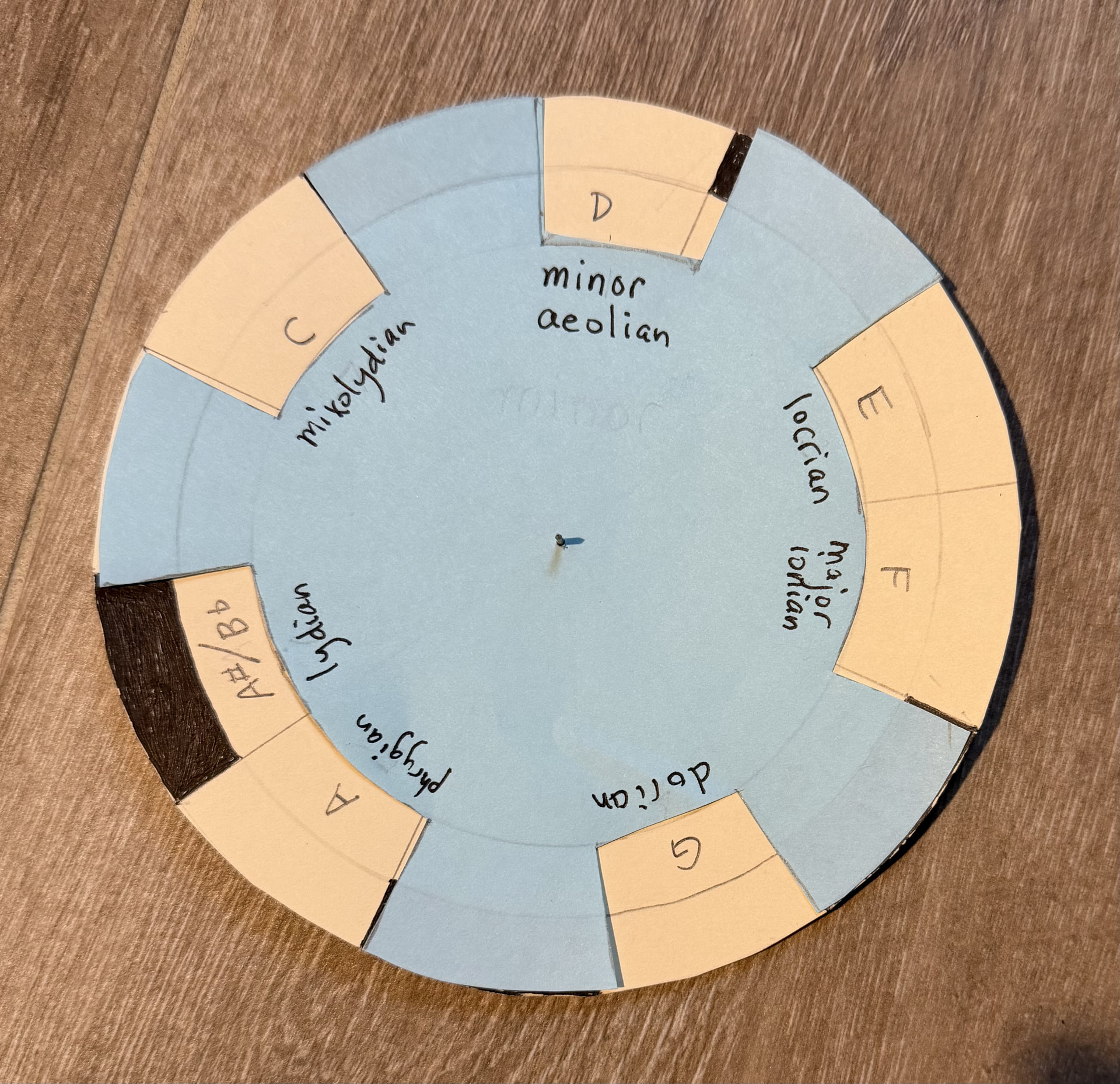
Then you can read the notes for D minor: D, E, F, G, A, B♭, C.

Or if you want G major, it looks like:
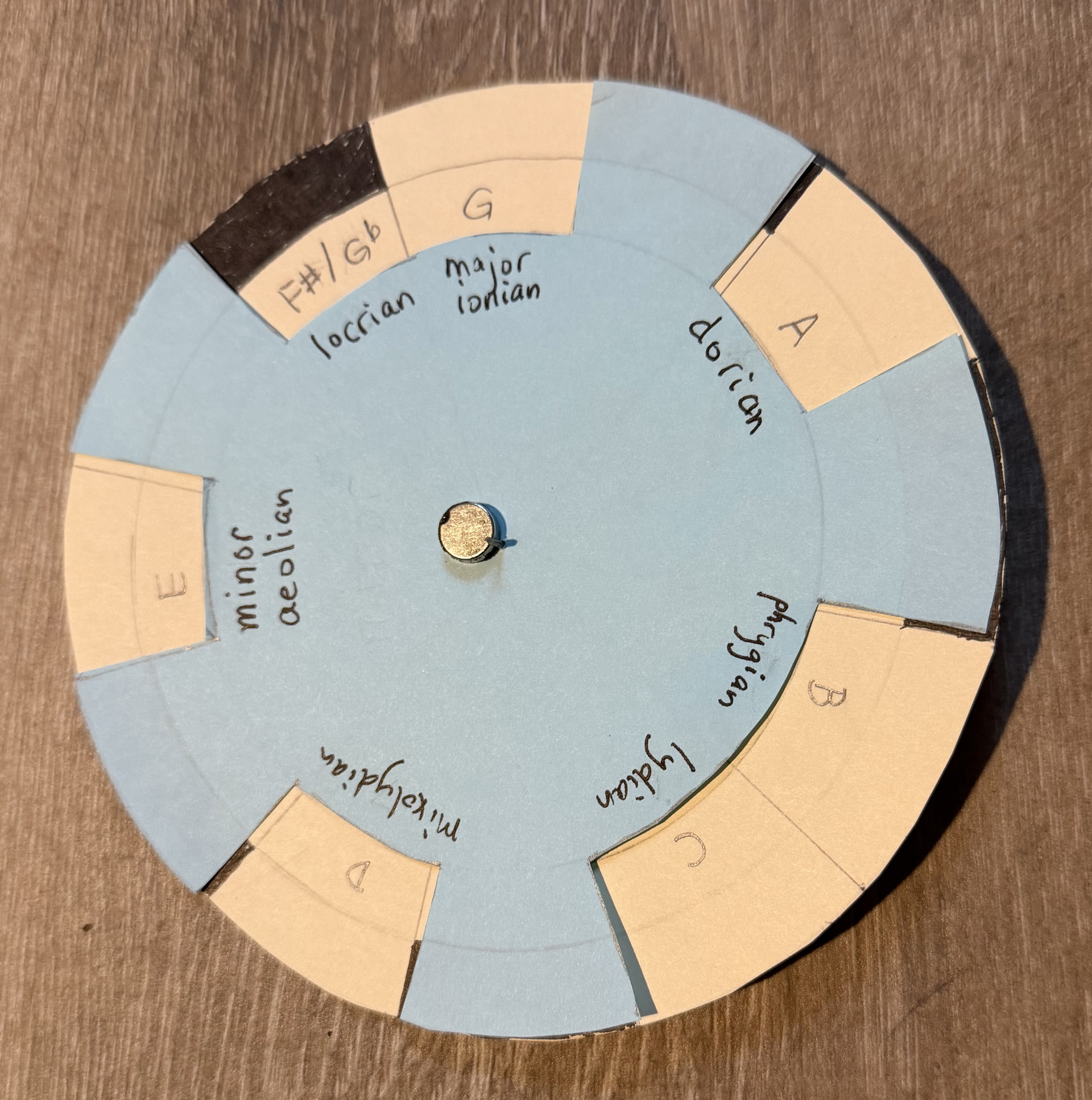
Which gives the note sequence G, A, B, C, D, E, F♯.

I know I don’t want to use this as a crutch forever. My eventual goal is to be able to intuitively transpose a melody from one key to another on the piano keyboard without even thinking about it. That may take me quite a lot of practice, but this will help me see patterns more quickly.

I also think it’s interesting that the circle reveals an axis of symmetry through the notes D and G♯. If you put both of your index fingers on D, and move your left finger left one semitone each time you move your right finger to the right by one semitone, both fingers will be on the same color note (white or black), every time. The same is true for the back key G♯.

I figure this means something special about D and G♯ on the keyboard, but it’s hard for me to articulate exactly. They are like symmetrical origin points for the pattern of black and white keys. Does it mean anything deeper? I would love to know…
3 Likes

Good on you. These kind of things are useful in sharpening what you know. The core thing is the intervals. You are lifting the intervals from one example of a major or minor scale and transposing them elsewhere. Good stuff.

Another task I recommend is getting a great knowledge of triads. Start with the most basic list, you should be able to rattle off the whole list of triads in C major. But spell them out.

CEG, DFA, EGB, FAC, GBD, ACE, DFA

Learn that cold, it never really changes.

Now really look at the circle of fifths with those key signatures written in.

C major/Amin = 0 sharps flats

Gmaj/Emin= 1 sharp F#

D major/B minor= 2 F# and C#

And continue around in both directions, Key of F has the Bb, Key of Bb has the Bb and Eb. Learn these things however you do it, your wheel will suss these all out easily. But try to organize these in your head a little at a time . So eventually you just know Ab has 4 flats and E has 4 sharps and like that.

Now the triads are still the same just modified to fit the key.

In Eb/C min I have an Eb, F, G, Ab, Bb, C, D.

So my list now goes

CEbG, DFAb, EbGBb, FAbC, GBbD, AbCEb BbDF same triads just with some flats.

And Dmajor has

C#EG, DF#A, EGB, F#AC#, GBD, AC#E, BDF# same with a few sharps

So if you can spell triads and remember key signatures, you can rule the universe for sure.

Ps for a bonus, your wheel actually hides 5 notes of the pentatonic each time you reveal 7 notes of the minor/minor scale, its a tritone relationship too, you hide Gb major pentatonic when you reveal C major. It always will hide the pent major a tritone away from the current major scale.

1 Like

Rearange this mode wheel so it’s ordered by the circle of fiths, rather than by semitones, and interesting patterns will appear…

This is a beautiful approach, Don, thank you for sharing your journey!

I am no expert in the field, but perhaps you can also draw some inspiration from Jim Fleser’s Chord Wheel.

It helped me to understand (and provide the much needed refreshment of) a few of the concepts.

1 Like

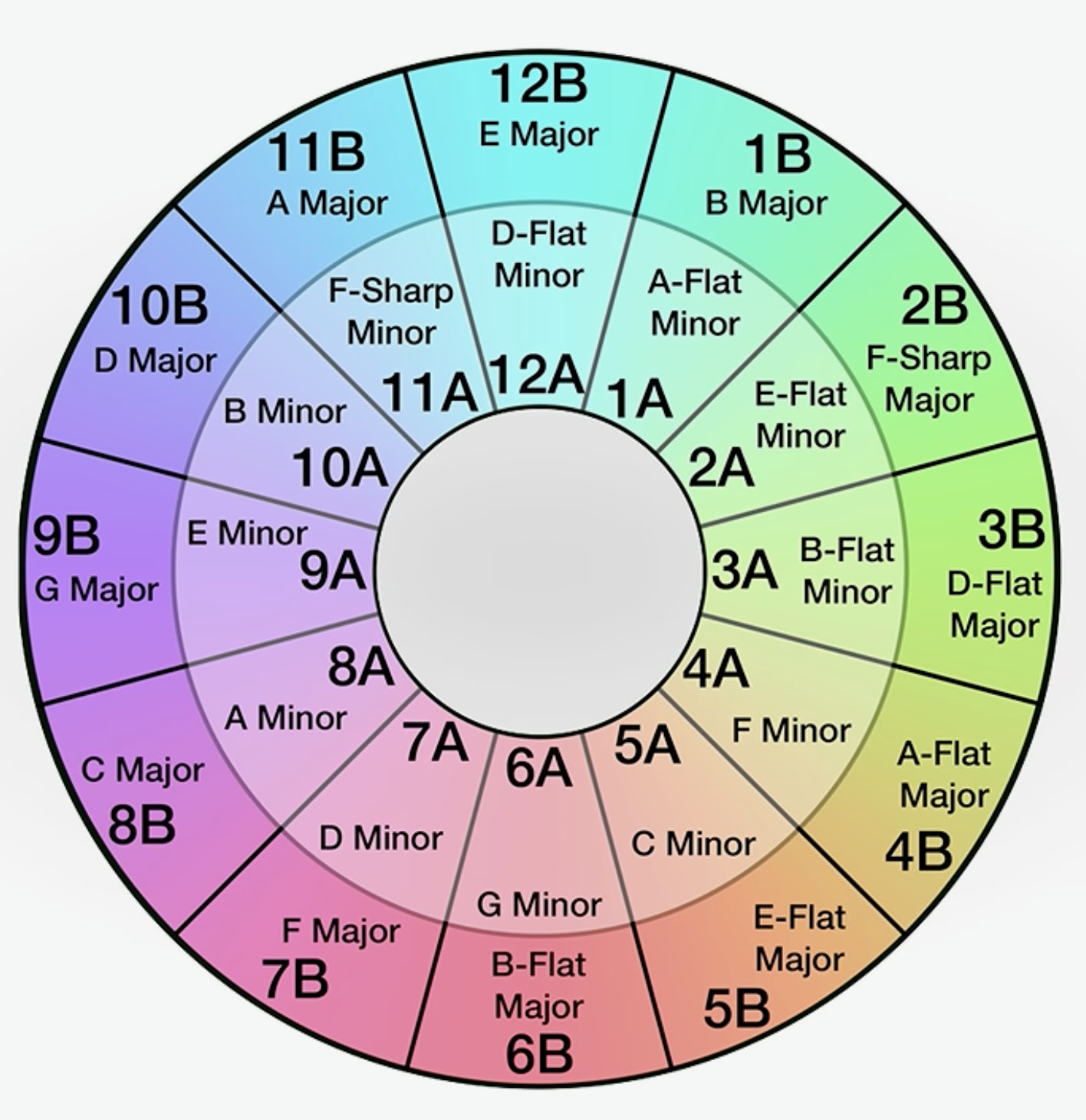
In DJ they have this thing called the ‘Camelot’ wheel system. It’s just the same circle of fifths with a numbering system that makes it so DJs that don’t know music theory can do harmony.

But! The system is kinda handy too, it’s somehow easier in the fly.

Edit: here’s the thing:

The idea is that you either switch from A to B, or increment/decrement by 1 number. You can also increment by 2 numbers or move diagonally if you want to get spicy.

3 Likes

I bought this VCV module - I like it.

2 Likes

Nice one Don. I have no theory what so ever, but it made a light go off in my head, so guess I’m a visual learner too.

I must say I admire the tenacity, thirst for learning, and desire to share that Don demonstrates (quite apart from his undeniable skills as a developer). Speaking of chord generation, I’d like to take this opportunity to promote my brand-new K-Arp module and its K-Scene extension. In addition to sequencing polyphonic chords, this sequencer / arpeggiator allows users to easily create arpeggios based on those chords—without needing to know music theory.

2 Likes

I just ordered one from Amazon… thanks! This looks exactly like the kind of thing that will help me.

1 Like

Oh cool. The Camelot wheel will help me figure out chord progressions. I will play with it!

Very handy when you play live, no thinking required when it counts most to stay in the flow.

Great!

Just a side note: The version I have from about 7 years ago has a translucent plastic disc that was attached to the paper with a central pin, overall a highly flimsy mounting that tends to break very, very easily :face_with_raised_eyebrow:.

I fixed it (more or less, less than more) by now holding it together with a makeshift paper clip. Just in case yours breaks, perhaps your magnet method may come in handy.

I’m sure you’ll figure something out.

1 Like

Hey Don, I can appreciate what you are doing. I began making the same journey to understand music theory in 1988, from a systems engineer’s and physicist’s perspective. The first step was to develop Meander for DOS and then Windows. I had quite a few wrong ideas at that time, but Meander evolved over the years to the Meander I developed for VCV Rack. I’m sure I still have some things wrong or not exactly correct, but if you want to focus strictly on the modal scales (often called the church modes) and the diatonic scales, Meander is a pedagogical tool that display the circle of fifths scales in any root on a standard treble clef set of staves as well as on an 88 key keyboard. In Meander, you can click on the 12 buttons inside of the annular ring to play that circle position chord, assuming you enable the Harmony Chords Enable button and attach a sound module to the Harmony output V/Oct and date output.

You probably know all of this, but, just in case it might help you or some others here, I wanted to share.

https://library.vcvrack.com/PS-PurrSoftware/Meander

3 Likes

Nice!

I’ve talked about this on this forum before a bit: If you want to get all your note names spelled “correctly” (conventionally would be a better word maybe) for each key, a long chain of fifths is more useful than a circle. The chain has note names FCGDAEB in that order, looping forever (or until you don’t care). And whenever you encounter a note name you’ve already found, you add another # (if on the right) or a b (on the left). That way for any key, your 7 note diatonic scale will have each letter name appear once, and never a mix of sharps and flats.

If you’re working in modern 12-tone equal temperament, you don’t have to care about that of course. But the history of the chain of fifths sorta relates to your question about D and G#! If you draw a chain like described above, you will see that it is symmetrical around the note D. From D, 3 steps right you meet the first sharp, three steps left you meet the first flat. The piano keyboard represents this too: the pattern of black and white keys is symmetrical around D.

The reason for this is that when this notational standard was established in medieval Europe, the Dorian mode was considered the “standard” or basic scale, sort of like the Major scale is today. When you stack fifths (and octave-reduce) to create a diatonic scale, Dorian is the mode that has the most symmetry. 3 fifths up and 3 down. The note name D isn’t what’s special, Dorian is.

Back then all the fifths and octaves were tuned pure to the overtone series. With that tuning, you start on D and stack fifths up and down until you have G# and Ab, those will not be the same note. They are close though. And if you put all your fifths out of tune by just the right amount. When you stack all 12 of them, G# will be == Ab. Voila, now you can draw your fifths in a circle.

Besides having adopted this compromised tuning as the standard, we have also come to see the major mode as more important than Dorian. Therefore we now tend to draw our circle of fifths with C on the top and F# == Gb at the bottom. But if you draw it with D on top, the symmetry makes way more sense. D is the “real” symmetry so to speak, that exists also on the untempered chain of fifths (from which this nomenclature stems). G#/Ab is the additional point of symmetry we have attained by tempering our fifths to create a circulating system.

7 Likes

a nice wheel to discover the connection between these relative keys

the real deal with chord progression is to understand harmonic function

harmonic function, it is how we hear music, though the chords and melodies, not the scales

best of luck with your musical studies

1 Like

For anyone that wants to dive in.

3 Likes

Interestingly, my Meander for Windows implementations treated harmony in terms of harmonic function. But as a physicist and systems engineer, harmonic function seemed like an alien language. Eventually I gave up on harmonic function and focused on pure harmonic progressions by providing 80+ harmonic progressions presets that are based on common practice, such as “12-bar blues”. But the Meander circle of fifths graphical dynamic display makes harmonic function patterns visible if one wants to better understand the foundations of harmony. It might be interesting to add an additional annular ring to the Meander circle of fifths and label each position as tonic, dominant, etc.

Do working musicians often think in terms of harmonic functions? I’m a strange case of having no formal music training nor have I worked as a performing musician. But, I have played music as a hobby for most of my 74 years. I’m the eternal amateur;)

You were asking cubistguitar, not me, but nonethless: not really. It’s hard to draw generalizations, but I’d say a lot of working musicians work from muscle memory above all else.

There’s a great scene in the U2 movie from the 80s where there’s a guest appearance by BB King…they’re rehearsing, and King says ‘okay, I can play that, this bit will fit in. But don’t try to make me play any chords, I don’t do that, just notes.’ To me that encapsulates the idea that most high-achieving musicians spend a lot more time X-ing out a very big list of “things I don’t do” and narrowing their focus.

I’d put deep dives on western harmony theories on that list of things that many musicians simply don’t bother with. Leading tones and scales, yes. But it’s not until you start song WRITING that you start questioning ‘oh, how does that work’ as you tease apart a song you’re trying to emulate/steal from.

Speaking from a rock/pop world, half the time you just throw out the manual and make a leap of faith to the next chord. If you can sing it and it sounds like an exciting interval, that’s all you need. The Beatles catalog is very full of this.

Currently I’m revisiting “Here You Come Again” which is one of a very few Dolly Parton songs she didn’t write. It’s a real harmonic workout with a lot of those ‘leaps of faith’ I’m trying to describe. You can just go with it as a song and it’s surprising and wonderful, or you can realize that Weil and Mann certainly are songwriters that were schooled in classical harmony.

But yeah, I think the “average” working musician just ‘goes with it’ most of the time, if that makes sense.

3 Likes

I’m a freelance musician today (but have also worked in other fields before), and have dabbled with jazz, classical and other styles before settling in the folk/trad scene here. I think Waldo is right on that it depends a lot on genre.

Jazz players all know this stuff in and out. Jazz is centered on improv, and said improv requires a type of musical “overview” which is easier to build if you conceptualize a bit. Functional harmony and related frameworks help with that. Great pro jazz players have existed who didn’t know what the words “dominant7-type chord” mean, but could still play a good solo over some chord changes. But they are nowadays few and far between.

Classical players it’s more of a toss-up. If you can’t improvise at all, you can still be a top-level classical pro. As long as you can sight-read really well and sound great on your instrument, you’re hired! The understanding of the larger harmonic structure can still be helpful, but is less necessary than for the jazz player. Fair amount of players still know their stuff though.

As Waldo said, rock/pop etc it’s also a bit optional. Pattern recognition is really useful to players of these styles, and some find the theory concepts help with that. Lots of players just know chord symbols though, and have no concepts for the relations between them except “lots of songs in D have G and A chords in’em”.

The folk/trad style I mostly play (european fiddle tunes mostly), you might be surprised how many of us use this kind of language. Many of the older tunes aren’t built up on those kinds of harmony at all, and so need a different approach (arabic Maqam works better as a framework there actually). But most anything from the late 19th century onwards, functional harmony is a super useful concept for us.

3 Likes