Submit Audio Development Updates for VCV Rack and MetaModule

Hi everyone,

I’m starting a new development thread for Submit Audio, my growing collection of open source modules for VCV Rack and the 4ms MetaModule.

I have recently submitted two new modules to the VCV Rack Library: React and Clang.
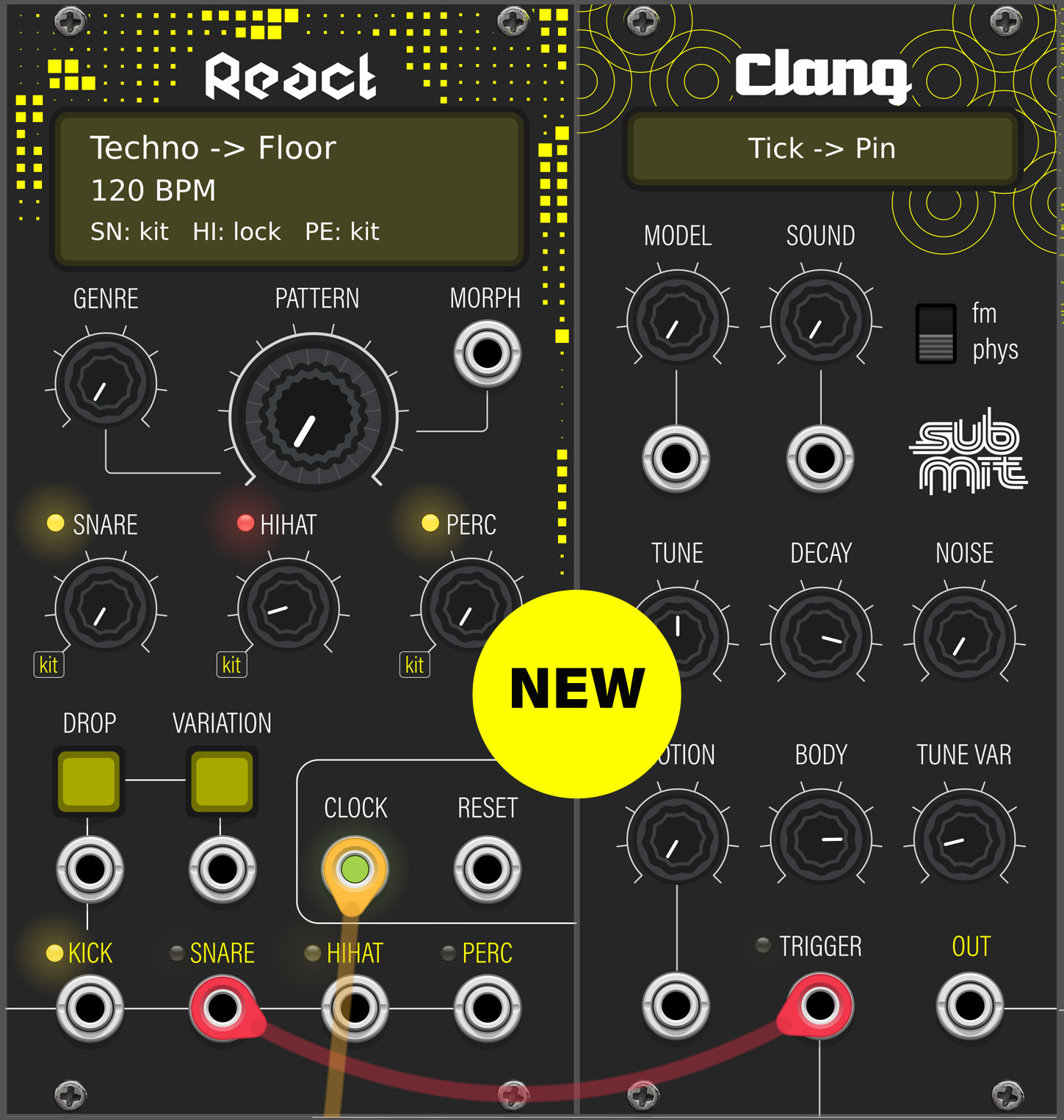
React is a rhythm generator that turns one clock into four related voices. Clang is a physical modelling percussion module for creating resonant sounds inspired by materials such as metal, wood and other objects.

I have also been working hard on a new Submit Audio website. It includes information about every module, manuals, tips, technical details, development stories and download links. I’m also preparing patch examples and videos, which will be added to the website soon.

You can visit the website here: https://www.submitaudio.nl

The current collection includes Drift, Chrono, Impact, Chain, Squeeze, Shape, Master, Gain, Sweep, Loop, Clang and React.

I’ll use this thread to share regular updates about new modules, design ideas, testing versions, releases, patches and development experiments.

Feedback, questions and patch ideas are always welcome. More updates soon! The modules are available through the official libraries:

VCV Rack Library: https://library.vcvrack.com/Submit

4ms MetaModule Library: https://metamodule.info/plugins

Over the past few weeks, I’ve been developing a new compact series for Submit Audio. Three modules with their own distinct functions, designed to work perfectly together in a clock-synchronised patch.

:three_o_clock: Sync The rhythmic heart of the series. Sync works as both an internal and external clock, providing synchronised ×1, ×2, and ÷2 outputs. Run and Reset give you full control over the timing of your patch. Everything follows the Submit Audio 1 PPQN clock standard.

:counterclockwise_arrows_button: Flip A stereo performance effect that reverses incoming audio in perfect sync with the clock. Flip continuously captures audio in the background, allowing reverse playback to start instantly and stay locked to the beat. Use Freeze to hold a captured fragment and Length to select rhythmic divisions of 1/2, 1/4, or 1/8. Perfect for drums, loops, vocals, and live DJ-style effects.

:ringed_planet: Orbit Orbit explores the rhythmic relationship between two signals. It detects where rhythms align, where new events can be placed between them, and where empty spaces occur. This creates four creative outputs: Align, Between, Gap, and Tension. Position, Window, Memory, Range, and Hold let you shape and capture this rhythmic relationship.

All three modules share the same compact 5HP format: minimal rack space with plenty of musical possibilities.

Coming soon to the Submit Audio Library for VCV Rack and the 4ms Metamodule. :rocket:

You have some very nice modules with some unique features. However, you must do something about the cpu usage on Clang. This plug-in uses more cpu time than any 2 plugins put together making it totally useless. I like it but…

Thanks for your feedback! We already addressed Clang’s high CPU usage in Submit version 2.16.1.

This update included several major optimisations:

  • Silent voices no longer run the complete DSP engine.
  • Only the sound components required by the selected model are calculated.
  • Unused noise processing is skipped.
  • Several expensive calculations are now shared between active voices.

These changes significantly reduced Clang’s CPU usage while preserving its sound and polyphony.

Could you please check which version of Submit you’re currently using? If you’re already using 2.16.1, please let me know your sample rate and which Engine, Model, Sound and Decay settings cause the high CPU usage. I’ll investigate it further.

I just updated and it’s much better. Thank you! :grinning_face:

I’ve been working on two new Submit Audio modules lately: Circles and SUB. They are still prototypes, which means I can let the idea grow step by step while playing with them.

Circles started as a simple, musical eight-step sequencer with a clear circular workflow. But I became especially interested in the idea of giving it a separate, slower sub line. Not just a copy of the melody, but a sub voice that listens to the same notes and scales, moves at its own pace, and creates a second musical layer.

SUB is the voice that goes with it: a compact bass module with a warm, growling drive character and an FM side for a deeper, more modern sound. The nice part is that you can connect Circles and SUB with just a few cables and immediately get both a melody and a foundation.

I’m still fine-tuning things: scales that can rotate, different sub notes for each scale, long sub gates, and per-step CV inputs for controlled movement. It is still work in progress, but it is starting to feel more like an instrument for minimal techno than just a sequencer.

The visual design will come much later, so please excuse the wonderfully ugly prototype panels for now, right now I’m focused on the musical behaviour and workflow.

If the foundation continues to feel right, I would like to share a first beta version soon. That way, other people can play with it too and help discover where Circles and SUB can grow next.

I’m always open to ideas, wishes, or things you would like to see in a combination of a sequencer and a sub voice. This prototype is growing through playing, listening, and exchanging ideas.

I’ve now started working on the panel design for Circles.

With this module, I’m not beginning with colours, illustrations or the final visual style. First, I’m building a precise working grid using circles, guide lines and the actual dimensions of all knobs, LEDs and connections.

Circles consists of several musical systems that should also remain visually connected: the eight-step sequencer, the Scale Chain and the slower sub section. This radial grid helps me explore how these elements relate to one another and where all controls can be placed in a logical and clear way.

I find it interesting to let the graphic design grow directly from the musical behaviour of Circles.

A small Circles update: I’m already another step further with the panel design.

The construction grid has now become a clear layout for the Sequence, Scale Chain and Sub Track. The main structure is in place; I still need to complete and refine the final design, but the character of Circles is already starting to appear.

Even the knob inventory needed an update… :wink:

I was getting a little tired of my old knobs. They felt almost as sticky as Elektron knobs and looked too dark on the Circles panel, so I immediately ordered a fresh batch!

The new knobs are flatter, brighter and fit the circular design much better. I’ve also removed the white outlines around all the knobs, which gives the panel a lot more breathing room.

Just a few more visual refinements to go, and then I’ll start preparing the first beta build. :grinning_face_with_smiling_eyes:

I agree the new batch of knobs looks better, but could you please order a batch with enlarged circle as the circle and line look disproportional this way :wink:

Ah, so you prefer the expensive one! :wink: But you know how it is with free, open-source products, we have to keep an eye on every penny. :rofl:

Well… I eventually gave in and bought the expensive knobs after all. The open-source budget may never recover. :wink:

The Sub module has now been given its own face as well, so Circles and Sub are starting to look like a proper pair.

The next challenge is the LCD screen in Circles. I still need to work out its visual style and how it will clearly display the current sequence, notes and active scale, while temporarily showing parameter values whenever a knob is adjusted.

Slowly getting closer to that first beta build!

Time for Zzzzzz

They have arrived! Sync, Flip and Orbit are now available in the VCV Rack Library. View Submit in the VCV Rack Library

A small detour before returning to Circles and Sub…

While designing Circles and Sub, a clearer visual language for Submit Audio started to emerge. So naturally, instead of finishing those two modules first, I decided to refresh the entire existing collection. :wink:

All modules now share the new panels and knob design. I also created a clearer distinction between inputs and outputs, making patches easier to read at a glance.

This became more than a visual update. I used the opportunity to carefully refine several modules without changing their original character. Drift has become more expressive, while Chrono gained richer feedback and a stronger Surge. Its former Break function has also been replaced by a much more useful momentary Dry button, with smooth fades to the dry signal and back to the current mix.

Squeeze, Master and Shape received extra attention in their compression, dynamics and EQ processing. I also tracked down a few occasional clicks and made several smaller performance improvements.

The entire 4ms MetaModule collection has been updated as well, including the new panels and the relevant functional and DSP improvements. I’m currently testing these builds on the actual MetaModule hardware before releasing them.

The complete VCV Rack collection has now been submitted to the VCV Rack Library as Submit Audio v2.18.0. The release and direct downloads are already available on GitHub:

Submit Audio VCV Rack Plugin v2.18.0

Now I can finally return to Circles and Sub… with the rest of the family dressed appropriately. :grinning_face_with_smiling_eyes:

Quick update: v2.18.0 is live! :tada:

Submit Audio v2.18.0 has now passed integration and is available through the VCV Rack Library. Simply use Library → Update all, then restart Rack.

The website has also been completely updated with revised manuals, clearer control descriptions, signal flows, patch ideas and technical details for all 15 modules.

Have fun with the update and please let me know what you create with it! :grinning_face_with_smiling_eyes: