I see you found another solution, but just in case it’s helpful for you, here’s a fairly minimal example of the phasor-based approach:
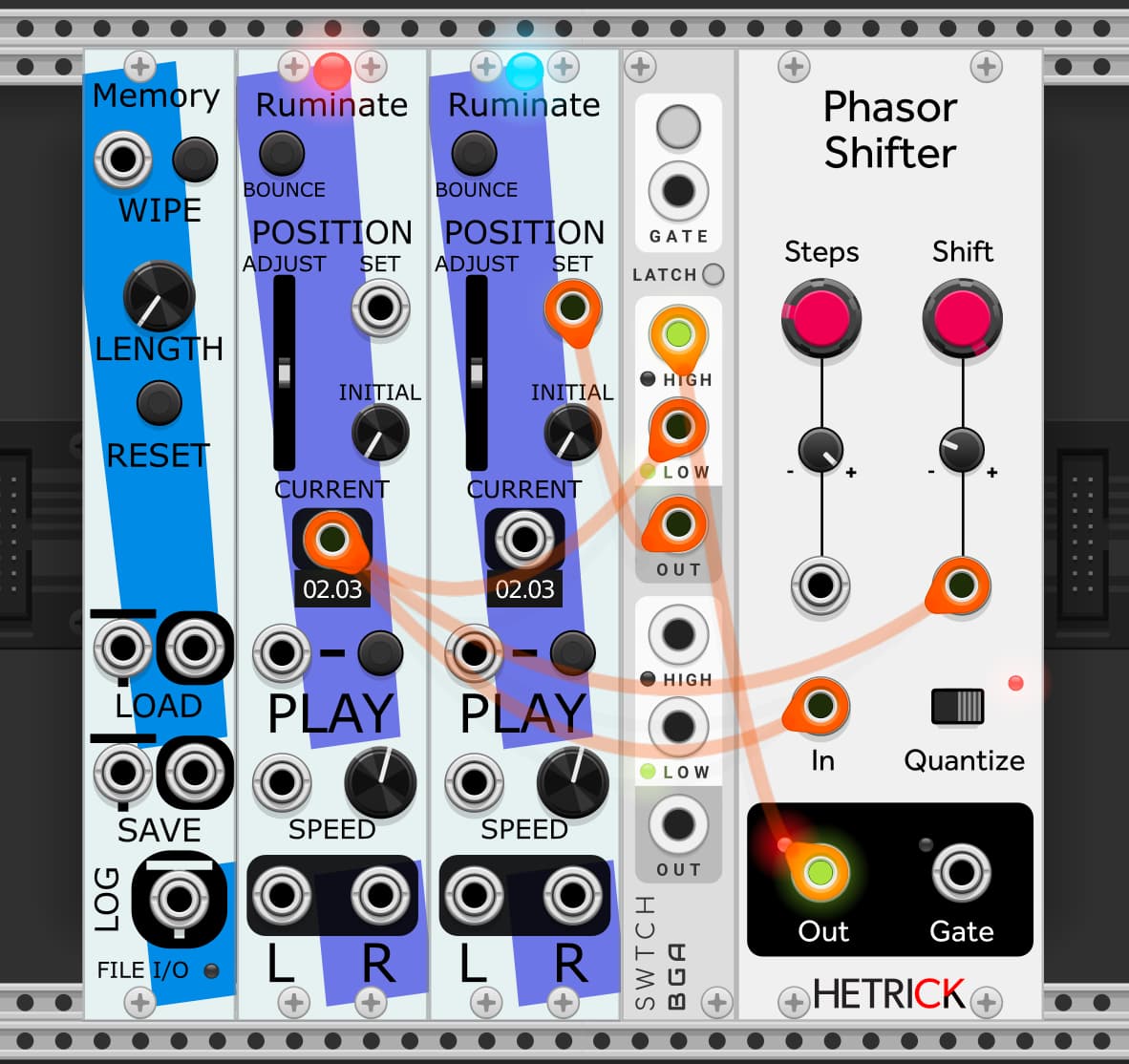
The left ruminate would not have its audio patched anywhere, it just plays the loop normally, providing a phasor perfectly timed inside the loop length. Without a gate to the switch, that phasor goes directly to the position input on the second ruminate (with “fade on move” disabled), so it also just plays the loop normally, bar two samples of latency from the cables. That second one is the one you listen to.
But it also goes to the phasor shifter, which outputs a phasor at the same speed but at a different location. The offsets are quantized to X steps. Set that to 16 for 16th notes in a 1-bar loop. Or 32 for a two bar loop, etc. The shift is modulated backwards by the phasor itself. At exactly half depth the result is a phasor that repeats the first Xth of the loop over and over!
Add a random offset to that modulation to choose which part of the loop gets stuttered. Slightly more built-out example here:
Phasor Stutter example.vcvs (11.6 KB)
The nice thing about Phasors is they always know their exact sub-step location. That opens up some possibilities that you don’t really get with clock signals. Hard resets can still be tricky sometimes. But one nice thing is tempo changes and such sync up on the next sample rather than the next clock count. Very nice for live stuff I find.
The Brainwash module is also a godsend, lets you record a loop to Memory and set the length perfectly immediately. Great for live beat-cutting.
Good luck! 