Based on @Omri_Cohen ’s famous ‘FM Piano’ but using Synthesizer.com modules, so a suboscillator and three FM operators.
I wonder if anyone ever did this on the original Moog System 55 …
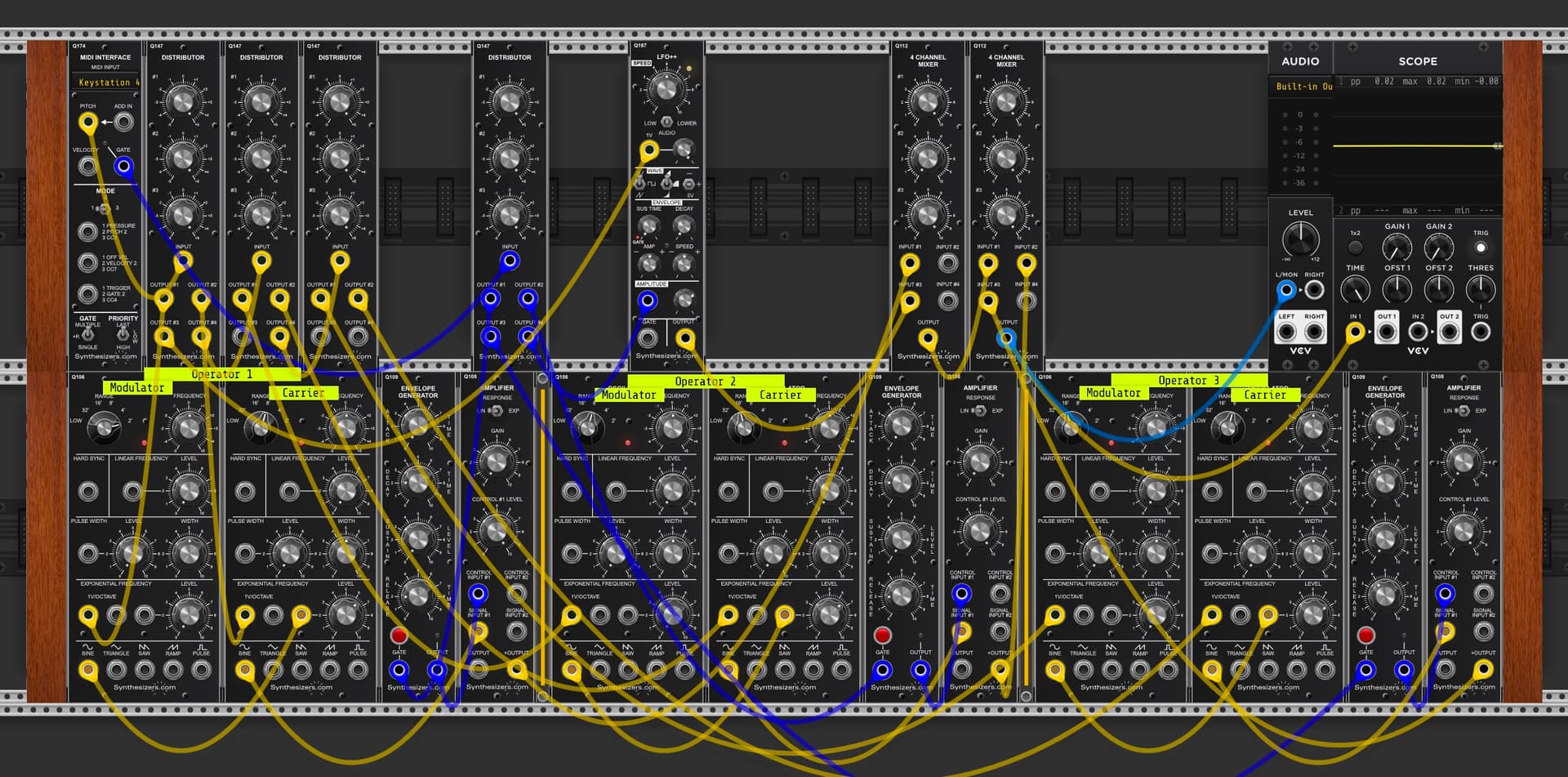
FM Piano.vcv (3.6 KB)
Based on @Omri_Cohen ’s famous ‘FM Piano’ but using Synthesizer.com modules, so a suboscillator and three FM operators.
I wonder if anyone ever did this on the original Moog System 55 …
FM Piano.vcv (3.6 KB)
Do the Moog Oscillators support linear FM? And I don’t know if “through zero FM” can be done in analog at all.
And do the Synthesizer.com modules support linear FM.
Just tried it with the synthesizer.com Q106 oscillator and it doesn’t work. The modulation input is exponential, not linear. This means that depending on where your notes are on your keyboard you get different timbres and most of them are disharmonic, even at a 1:1 frequency ratio between modulator and carrier.
But there is a linear frequency input, or is this different?
You have some options:
Venom:XM-OP: VenomModules/README.md at main · DaveBenham/VenomModules · GitHub
Venom:VCO Unit: VenomModules/README.md at main · DaveBenham/VenomModules · GitHub
Venom:VCO Lab: VenomModules/README.md at main · DaveBenham/VenomModules · GitHub
Instruo:Neoni: VCV Library - Instruō neóni
Probably more…
Yes thanks, I am aware of these and have used some of them, also Squinky Lab Kitchen Sink and as you said, there are probably more.
I was replying to the idea of doing FM with synthesizer.com or Moog modules.
And I don’t know if “through zero FM” can be done in analog at all.
It can, all TZFM is, is just allowing the frequency to go down all the way to zero, then reflect back up.There are many such analogue TZFM VCOs. Some examples:
Whether the Q106 has TZFM, I don’t know. In VCV it does seem to, but their website doesn’t say if the real thing does or not.
No idea whether the Moog System 55’s VCOs even have linear FM, but I would guess no…
The exact frequencies (and ratios) and exact phase really matter in Linear FM (or…most often…Yamaha/Chowning Phase Modulation). This implies that the oscillators need to be ultra stable and precise and in sync or syncable. Also, the exacts shape of the oscillators/operators matters a lot. Also a sine should be an exact sine, because FM/PM generates sidebands for all combinations of frequencies in the spectrum of both carrier and modulator, compounded in feedback or stacks. This is why FM/PM is generally done with sines only. The spectrum of any shape deviating from a sine contains more then 1 frequency and can soon generate many sidebands all over the spectrum, complicating controllability/predictability and sooner resulting in FM/PM noise. Complexity is instead created by creating networks of multiple intermodulating oscillators in series and/or parallel (incl feedback paths).
All this is very hard (impossible?) to achieve in analog and digital delivers this with ease. This is also why the revolutionary Yamaha DX7 was a digital synth.
Laslty, most of what is called FM is actually PM, also in VCV Rack. But as mentioned above in this thread, there are true FM modules in VCV Rack offering various FM types.
There is a simple test to tell whether a module does FM or PM: connect a constant control voltage (I use the synthesizer.com Knobs module) to the modulation input.
If the frequency of the oscillator changes permanently, while the voltage is applied, it is FM. If the frequency only wobbles a little briefly while you tweak the control voltage knob and returns to the base frequency once the CV is constant again, it is PM.
(One caveat though: if the modulation input is AC coupled (by means of a high pass filter to block DC) the modulation will be sort of between PM and FM, since the high pass partially differentiates the modulation signal, and that differentiation is what makes the difference between FM and PM.)
You’ll be surprised how many FM operator modules in Rack are actually PM. But so is the Yamaha DX7 that everyone thinks of as THE FM synth. For musical purposes PM is just fine and almost the same as FM.
When connecting the sine output of a Q106 (the modulator) to the Linear Frequency input of another Q106 (the carrier), then the sine output of the carrier should output the frequency modulated sine output. And it does…
But…
The modulation level seems to be scaled down at the input and even when modulation level is maxed out at +10, the FM effect is minimal. The good news is that you can just amplify the input signal by putting some up-scaler/amplifier in between and scale up the modulation signal before the input by several factors (to +/- several hundreds of Volts). This is not trimmed at the modulation input. Now you will hear the FM effect when turning up the modulation level. Higher levels of modulation make the pitch drift up, so it seems to be true FM (and not phase modulation).
You can use the Range knobs to set ratios. Or use a tuner/octaver to set octave and/or note/frequency.