This is maybe in the category of ‘simple on surface/weirdly complex on second glance’, but was wondering if anyone had any thoughts on modules in the vein of the Buchla 140 timing pulse generator/clock?
There’s a whole host of clock modules out there, but generally what i’m looking for is something 1) with separate gate/trigger in for starting and stopping the clock/pulse train and 2) ability to change tempo in terms of hz/ms rather than BPM.
Has anyone seen anything like this out in the wild? Alternate, I guess I’ve been thinking about ways to patch this up from scratch with some logic modules/re-sync’d LFOs, etc, but any thoughts on that route would be super appreciated too, esp if nothing ready made out there too.
Would be super grateful for any thoughts - thx so much!
Drive CvFunk Hammer with a VCO, it can go rate you want VCO unit can go very slow in LFo mode and crazy fast (16000 hz) in audio rate mode, Hammer can track it all sample accurate.
omg BIG tysm you both! @cubistguitar - great call - the Hammer still has me struggling with the separate on/off toggles, but so cool re: clocking externally from LFO/VCO -
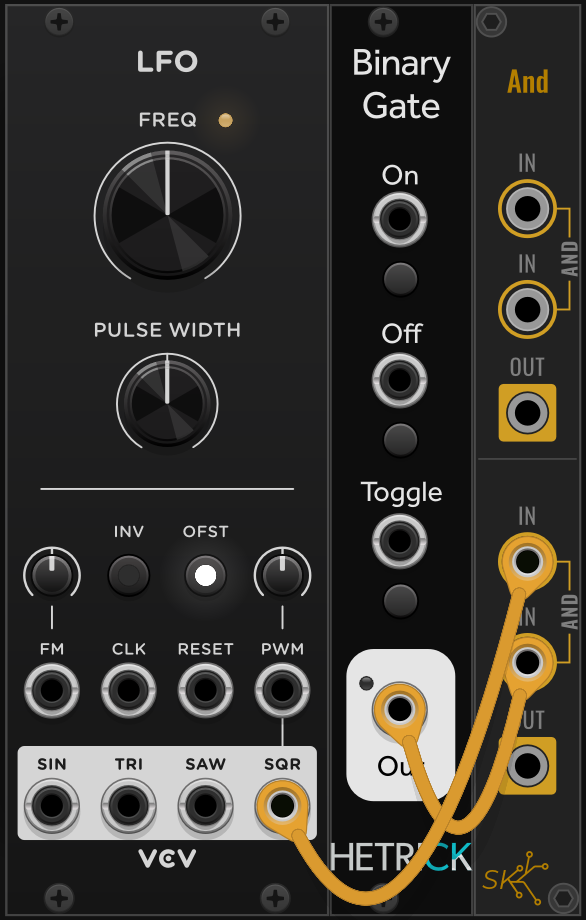
@goldtorizo - this is amazing! i had been doing the exact same thing with LFO/And logic, but this Hetrick Binary gate is the missing piece of the puzzle - brilliant!
Some oddball Silver Apples-esque CV-mix’d multi-sequencers incoming soon, no doubt!
Honestly the on switch is not perfect, but logic it like goldtorizo for a perfect on/off. But a great clock for unusual uses and usual ones. The rotate feature is fun too!
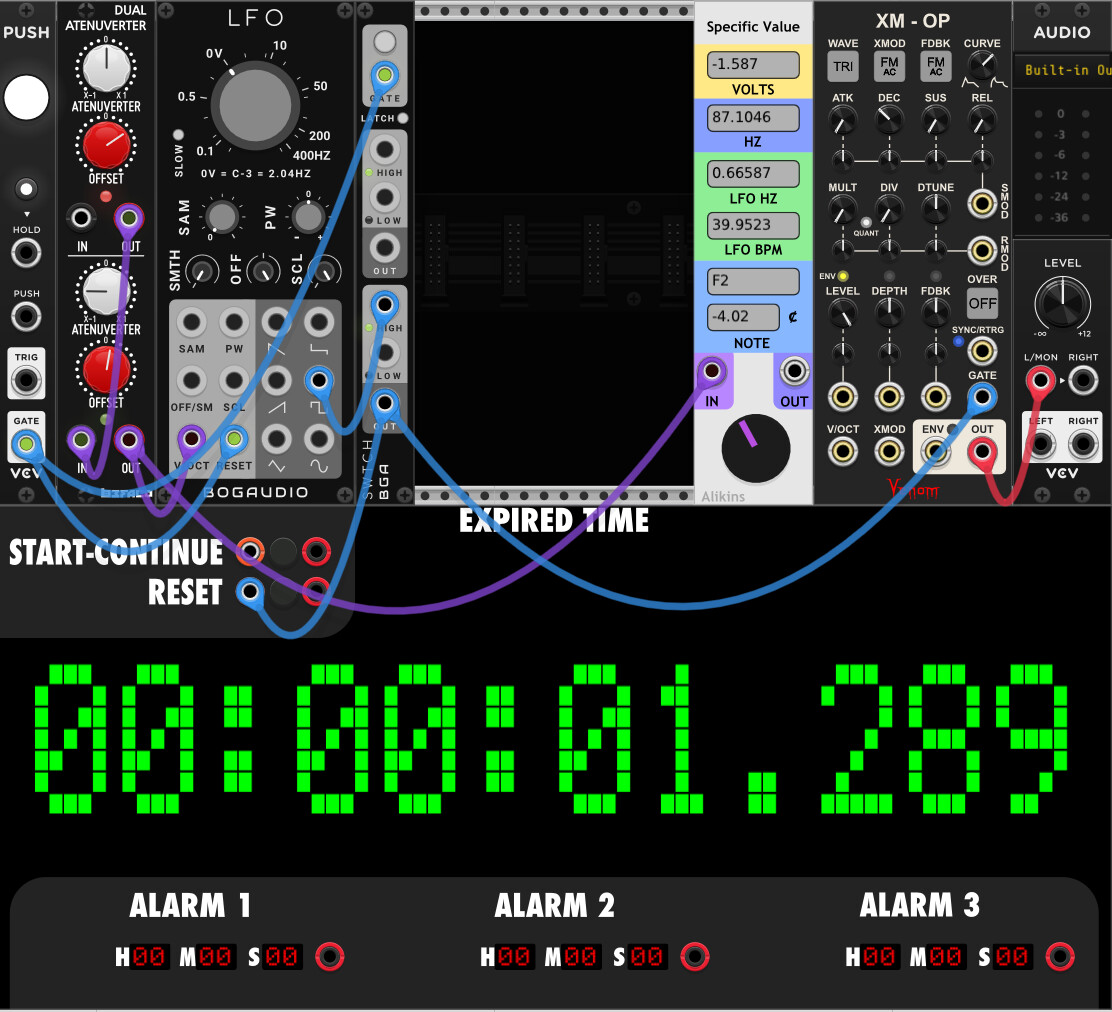
If you’re serious about wanting the period/frequency range of the Buchla 140 there’s no one module that will do it. But I have a solution for you below. Also, since the period knob on the module has quite an extreme range and is “backwards” compared to normal LFO’s, a bit of wizzardry is required.
The following patch will give you the features you’re after:
A way to start/stop the pulser.
A period range from min. 0.005 seconds to max. 20 seconds, going left to right, fast to slow.
It will also give you pulse length/width on the PW knob of the LFO.
Note that since the normal clocks cannot go to the extreme range you’re after, we instead need to use an LFO that can just about be pushed to do it. Those don’t have start/stop buttons so instead we need to emulate that with a latching switch.
You only need the four upper left modules of the patch, the others are just for visualization and sonification to check the result, and you need to connect the audio module to your actual audio interface for anything to happen, as usual. You use it like this:
The little Hold button on the Push module is your start/stop button.
The top (red) offset knob on the Dual Attenuverter is your period/speed knob, from fast to slow, like the Buchla.
The other three knobs on the attenuverter you should not touch. Dialing in the correct range is incredibly fiddly.
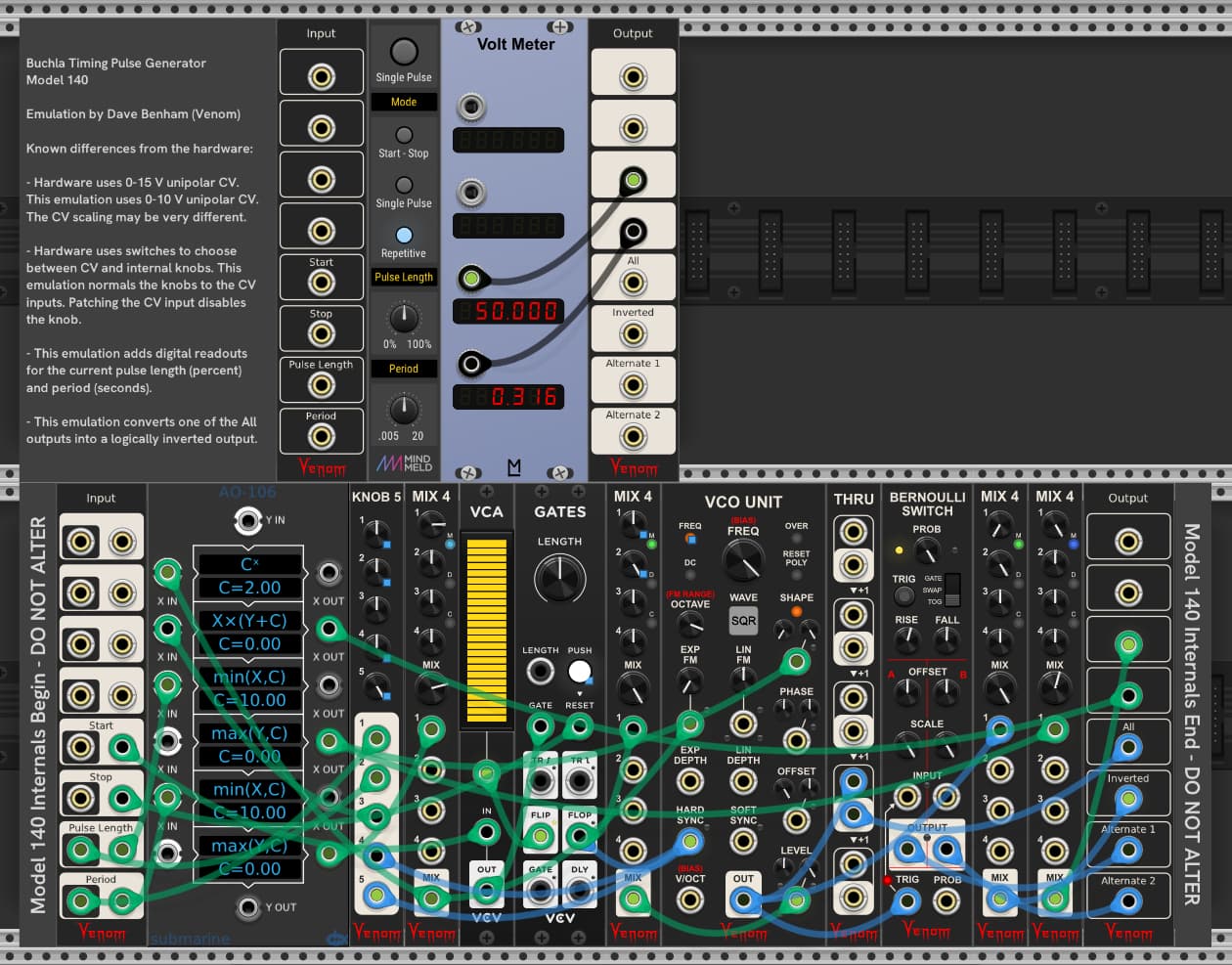
IMPORTANT - Always use the Stoermelder Strip++ module to import the selection in order to preserve the PatchMaster user interface mappings.
The top row is the entire user interface. You can manipulate everything there, except do not touch the black cables.
The bottom row is the actual implementation that should not be changed in any way.
The Venom VCO Unit has an LFO one shot, so it is easy to implement the single pulse. It also supports true 0% to 100% pulse width which I think is particularly important for the single pulse functionality. And of course it covers the full range of .005 - 20 sec (.05 - 200 Hz)
I have pretty much replicated the hardware features one for one, except for the differences noted in the info panel in the patch.
All of the outputs are synced down to the sample level.
The LFO is always reset (hard synced) appropriately
Start-Stop mode - resets on start
Single pulse mode - resets on button press
Repetitive mode - resets upon entry of the mode
I wasn’t sure how the Start/Stop CV input functionality is supposed to work. When in Start-Stop mode the clock starts upon receipt of a trigger or gate at the Start input. Additional triggers at start after startup have no effect. The clock stops upon receipt of a trigger or gate at the Stop input, or upon exiting the Start/Stop mode.
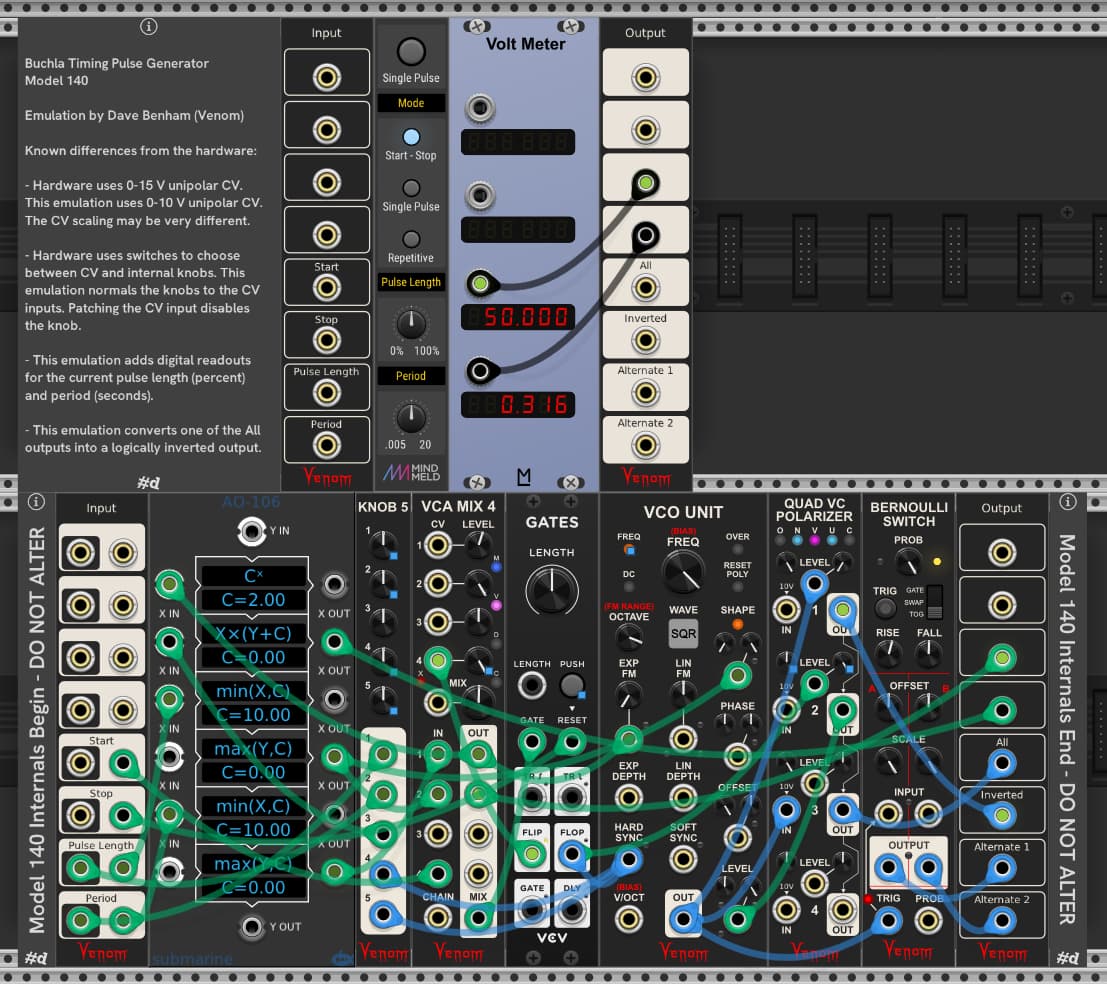
I found a bug in my original implementation. I believe the Start and Stop CV inputs should be disabled when not in Start-Stop mode. I had failed to do that.
So here is a revised selection that fixes the bug and also reduces the footprint. I replaced six 3hp modules with two 5 hp modules.
Belated response (apologies, been away from wiFi on the road), but omg absolutely blown away by the wisdom + generosity in this thread - BIG tysm yall!
Love all these solutions/thoughts (and @DaveVenom amazing to see a new module borne from a thread, ha!)
So much appreciated yall - diving in deep soon as im back in front of the computer proper - will have to post some fun clock/seq mangling soon, and hopefully maybe some of this stuff is useful for others, too!