I had the original Enzo, would not could track my playing, friend loves it, but he is such a different player, a strummer and I am a picker, could not work. I can rig up better tracking in vcv with cobbled together modules.
So… the product line has been plagued by such problems for a while now :s
I don’t think playing style should impact detection performance: an A as an A as long as the thing is in tune (even then, detection should offer some leeway, for a number of reasons).
Thanks for lettings us know 
No problem, review videos aren’t my thing but I might do a quick overview at some point and demo some of the sounds through VCV (including some Mutants!  ).
).
@cubistguitar that’s interesting that you had the same experience. I’ve also made V/Oct tracking patches in VCV to create basic guitar monosynths, the Enzo X isn’t much better than that, apart from it can track polyphonically. Sometimes!
Another issue is I get a lot of noise playing guitar near the computer, and I think that’s confusing the pitch detection. I’m thinking of getting some longer cables, drilling a hole in the wall and sticking my new Mac mini in another room. Seems worse than my previous PC for noise coming through the pickups, and any compression or preamp before the pedal just amplifies it (and you don’t want those things after the pedal, because synth sounds have a wider frequency range than guitars and wouldn’t sound good through a guitar pre-amp).
Polyphony for the Aestus family was also requested, so it is been worked on
At the moment, Temulenti is done (as with the Nebulae family, it was done first because the faceplate has more controls).
-
Polyphony is set by the V/Oct or Trigger ports, whichever has the polyphonic cable with the most incoming channels.
-
Every jack is golden, so every parameter acknowledges polyphonic CV.
-
Models, Modes and Ranges are flexible and can be selected, per channel, by sending CV to the new dedicated ports (they are black), none are really conducive to having their values modulated and blended, so simple, direct voltages can be used to select them, one voltage per channel:
-
Models:
- 0V: Tidal Modulator
- 1V: Two Bumps - Harmonic oscillator
- 2V: Two Drunks - Random walk
- 3V: Sheep - Wavetable synthesizer
-
Mode:
- 0V: AD Envelope
- 1V: Cyclic
- 2V: AR Envelope
-
Range:
- 0V: High
- 1V: Medium
- 2V: Low
-
-
The module displays information about a single channel at a time. The channel to display can be set using the context menu.
-
Two rows of lights beside the display show the number of active channels and their selected models using different colors. A full table of those colors will be available in the manual.
-
The faceplate has been reworked to accommodate the new polyphonic capabilities, Aestus will be similar.
-
The PLL/Sync mode makes lights and controls behave a little differently from the previous version:
- When PLL/Sync mode enabled, the LED in the “Syn” button switches between red and off, instead of Red and Yellow, this is closer to what the hardware does.
- When the mode is enabled, the Range button is ignored (this is what the hardware does) and its LED is off.
There have been a few changes and fixes to some of the other modules, you can read most of them in the changelog (Aestus family polyphony is not mentioned yet).
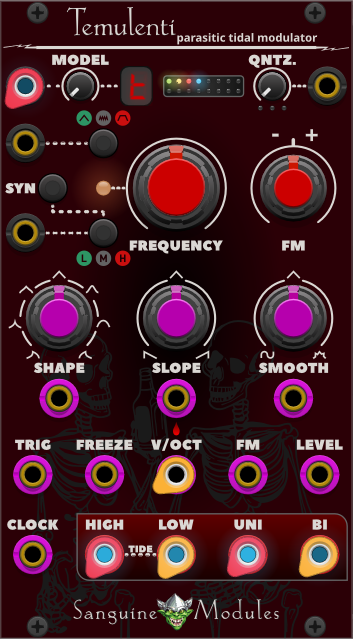
If you can’t wait to test the new features, get the latest Nightly build
If something is broken, do let me know
EOL
Been looking forward to this! 
I tried the Temulenti, but I get frequent crashes of VCV with it,
I just added the AS AtNuVrTr module to the Mode CV and the Modus CV
I’m on Win11 with VCV 2.6.3
Ahoy there! Thanks for your report!
I just ran a battery of tests with both my “poly_etesia_not_so_quick_test” patch available above using the new Temulenti as one of the LFOs, and, also with Temulenti by itself, while using a number of attenuverters and the like (Befaco’s Dual Attenuverter, Sanguine Monsters Kitsune, VCV’s 8Vert, Southpole’s Bandana and AS’ AtNuVrTr), connecting to the different inputs, sending varied voltages… even using Temulenti to switch voltages to itself (Kitsune + Denki can do that, as can Bandana) and I’m quite confident when I say “not our bug”: they only crash when AS’ module is added to the mix (looking at my log, problems arose with a few modules, not only Temulenti, after AtNuVrTr was added in the not _so_quick patch).
There’s a thread around here about another AS module also causing crashes and, indeed, that one can make it crash fairly quickly by itself and in the not_so_quick_patch (as seen in the picture, the not_so_quick_test patch is still going as I write this).
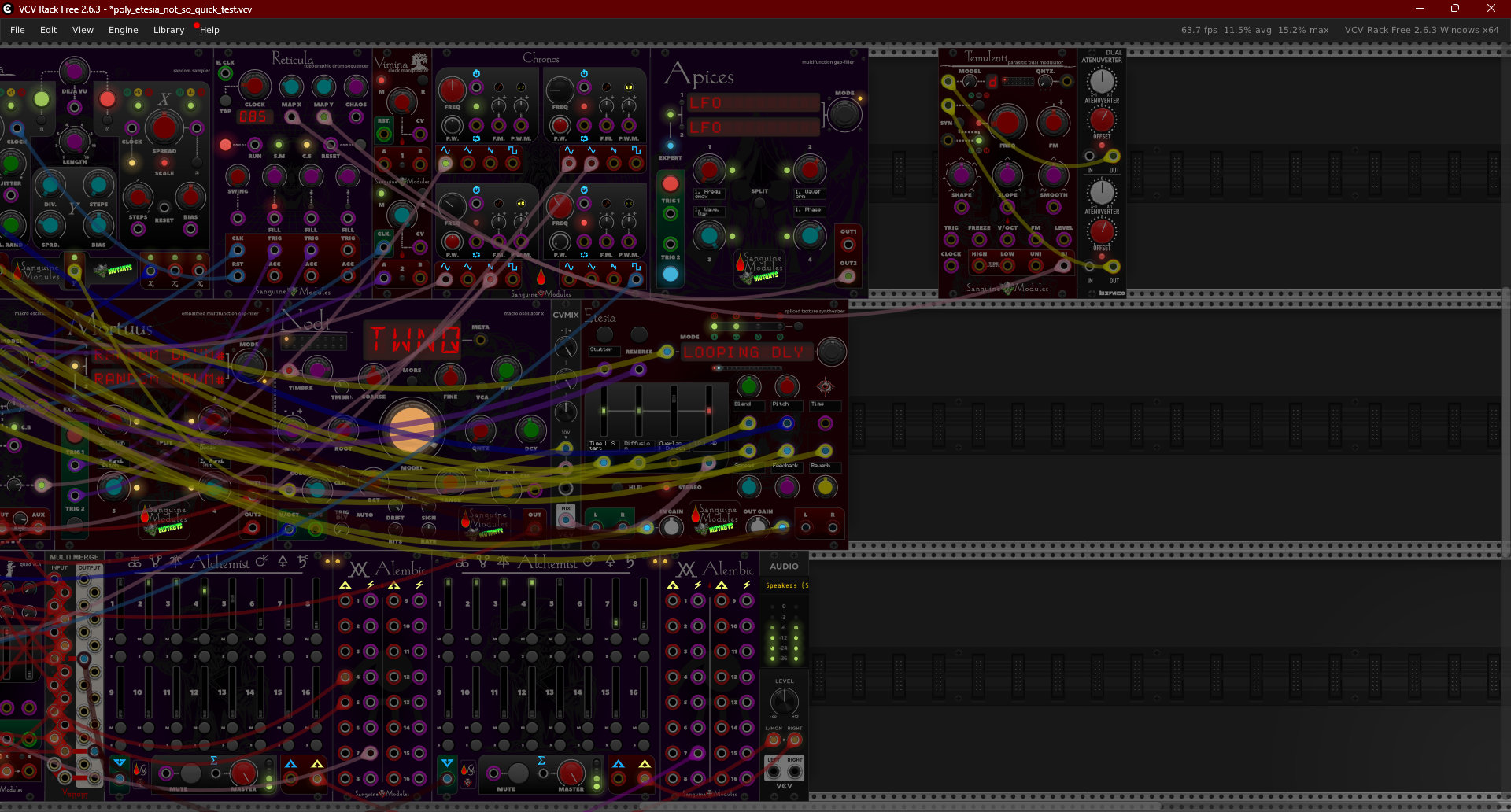
An attractive feature of the AS module is the ability to modulate it; what I can suggest as an alternative, available in the Library, is Sanguine Monsters Kitsune with its Denki expander: both the Attenuverter and the Offset parameters can be modulated; it is a quad module and it is polyphonic, I’m sure there are others; but I don’t know every Library module 
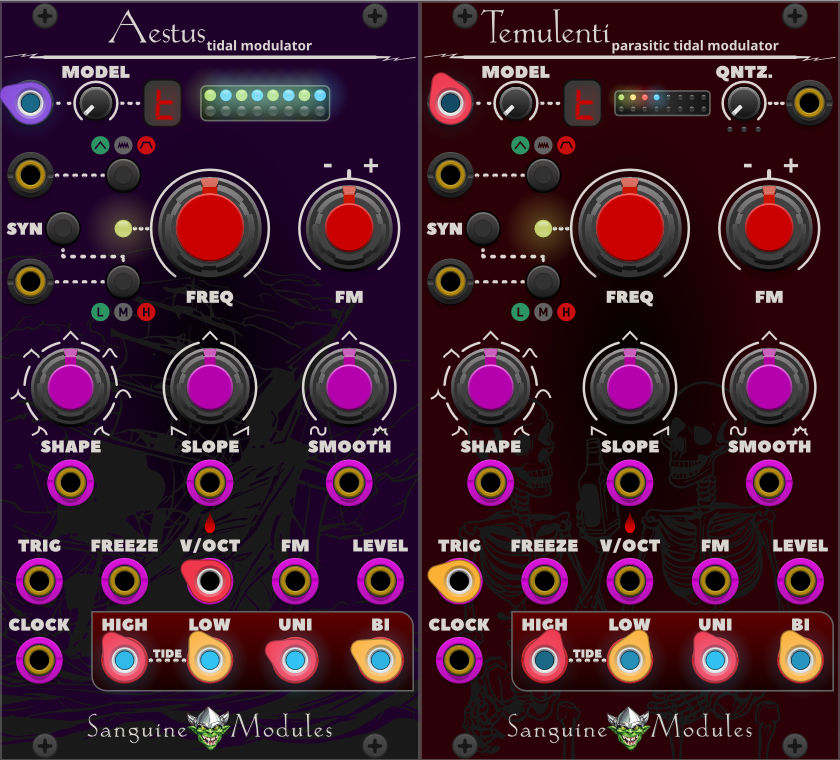
Aestus has been converted to a polyphonic module as well; this completes the request
-
Polyphony is set as per the above instructions for Temulenti.
-
Modes and Ranges follow the same rules as well.
-
Aestus offers only two Models (and an easter-egg not selectable using voltages):
- 0V: Tidal Modulator
- 1V: Sheep - Wavetable synthesizer
-
An important change: PLL/Sync mode is no longer activated automatically when Model is set to Tidal Modulator and the CLOCK input is patched, it has to be activated using the “SYN” button. This was necessary to support different Models per polyphonic channel. Sorry for the inconvenience if you relied on old behavior (just press the SYN button and your patch should work as it did).
-
Up to 16 channels of the peacocks easter-egg are possible as well, should that, for some reason, be desired.
The latest Nightly already includes the polyphonic version of Aestus, if you want to enjoy it ASAP
EOL
@Bloodbat Are Aestus and Temulenti modules based on OG Tides, and not Tides 2, where they can be multiple envelope / oscillator outputs instead of uni/bi/high/low outputs?
@auxmux Yep, original Tides, that’s what the Parasite firmware is for 
Versions of Tides 2 are possible in the future, though, I do recall there is at least one custom firmware.
Cool, sounds good for v2 in the future. Having a lot of fun with these polyphonically as is using Temulenti as oscillator and Aestus as primary envelope with a VCA = :chef’s kiss:
What I believe will be a treat to Nebulae (and its descendants) users has been cooking in the mutation vats!
You have probably noticed that triggers sent to the modules, if the pulse is long enough, behave as gates and not as triggers (I did, and I know someone in the Audible repository did as well… and reported it). That breaks what the manual claims about spawning single grains (and produces probably unexpected behavior when modes that use those triggers as clocks are selected).
We have addressed that and implemented more hardware-like behavior! Triggers can, optionally, behave as such and not as gates: the rising edge is detected instead of just detecting the voltage.
The new behavior can be selected using the context menu for every module in the Nebulae family.
In this case, and due to probable widespread use and familiarity, the old gate-like behavior is the default, if you want the new behavior, set it using the context menu.
If you want the new behavior to be the default, set the option and save the default preset for the module.
As usual, if you want to play around with the new behavior… get the latest Nightly!
EOL
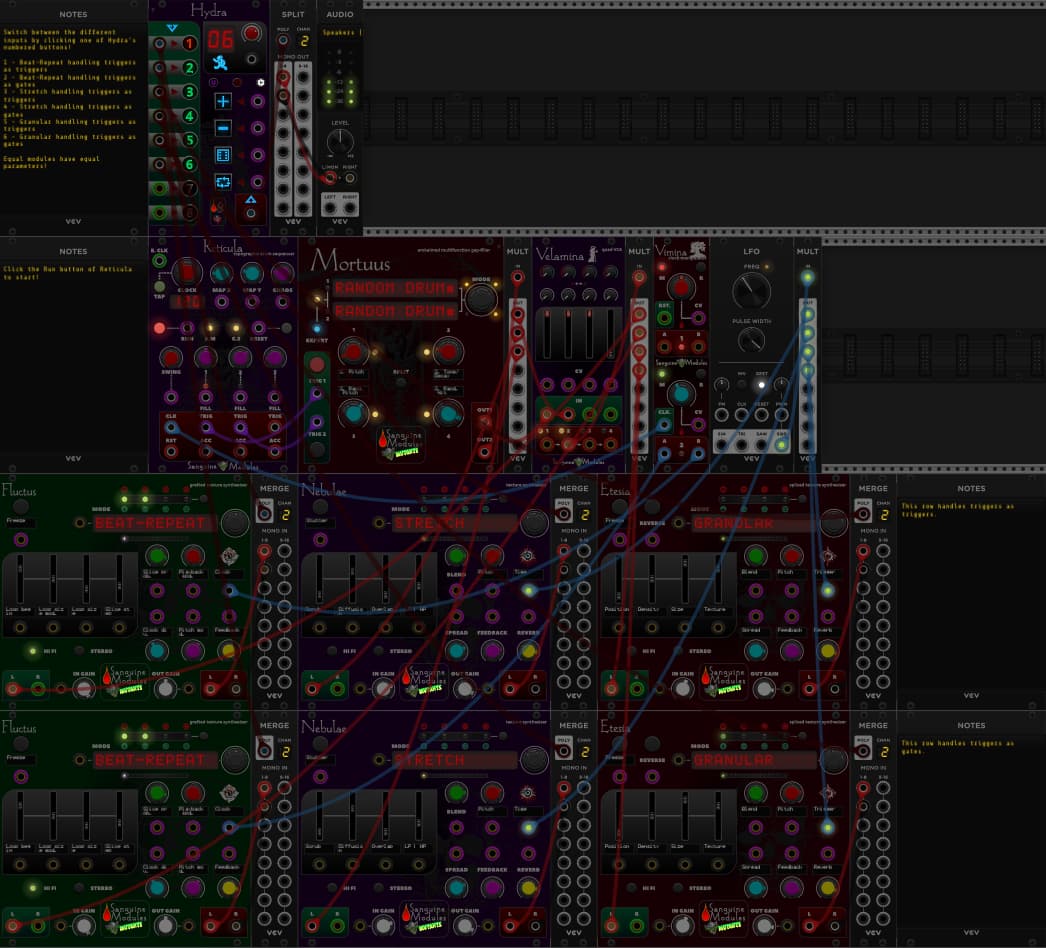
If you want a quick demo of how the new trigger mode is different, you can check this quick and dirty test!
nebulae_trigger_demo.vcv (3.9 KB)
Polyphonic CV selection for Anuli’s Disastrous Peace channels was requested… and it has been implemented
Selection uses direct voltages, rounds and ignores voltages out of spec.
- 0V - Formant filter
- 1V - Rolandish chorus
- 2V - Caveman reverb
- 3V - Formant filter (less abrasive variant)
- 4V - Rolandish chorus (Solinaish ensemble)
- 5V - Caveman reverb (shinier variant)
A new input was needed and the Note polyphony number display made the faceplate too cramped, so it had to be removed. The selected Note polyphony will still be shown in the knob’s tooltip and in the LED that follows the color conventions of the original module: those shown in the glyphs above the knob (just count the circles and remember that 1 + 2 = 3 )
The updated faceplate:
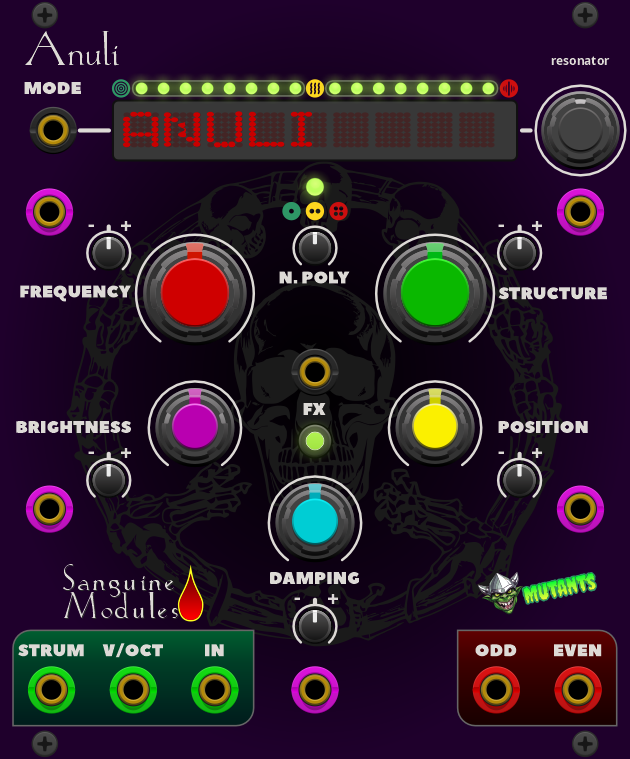
If you were craving different FX for Disastrous Peace channels in the same Anuli module… you can satisfy that thirst using the latest Nightly.
EOL
A patch using some of the new features and fixes, derived from the Aurora Borealis patch above… it can feel more adventurous and mysterious at times, if one listens close enough and is lucky… occasionally the voice and breath of the gods can be heard, as the armor of the fallen warriors glistens when they cross the Bitfrost bridge…
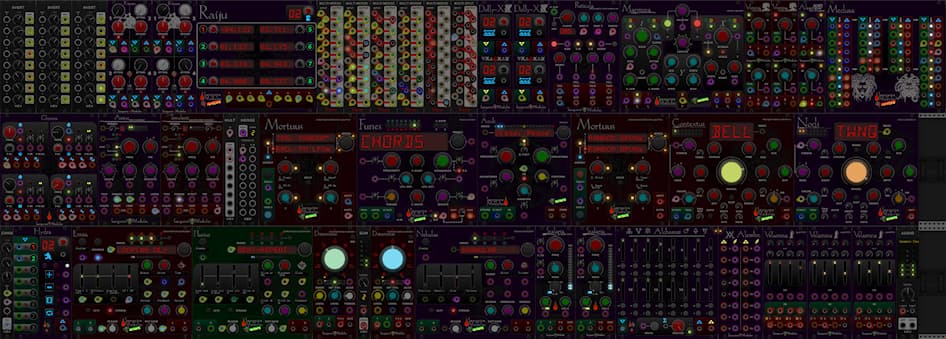
bitfrost_ambient_new_rings_fx.vcv (10.9 KB)
This patch requires the new Anuli with polyphonic CV FX selection from the nightlies.
The last addition for the next release has been implemented!
Nodi and Contextus are really powerful and versatile polyphonic Macro Oscillators; but something really useful was missing: polyphonic CV control for the Attack and Decay parameters.
That omission has been fixed! The Attack and Decay parameters can now be offset, per channel, using CV via the newly added, dedicated ports.
Voltage ranges are -5V to 5V; rounded (those parameters are integers with a range of 0 to 15), and out of range voltages are clipped.
I hope you find this addition useful
The faceplates sporting the new ports:
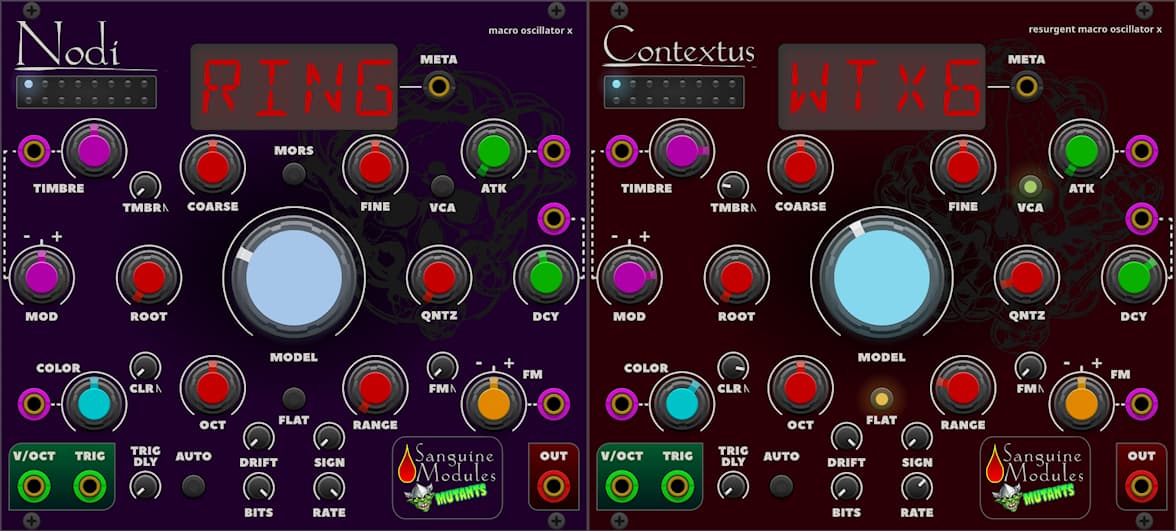
You can enjoy this addition, along with the latest tweaks, fixes and changes by getting the latest nightly.
EOL
I have to study way more in this thread. I think, what you are doing here is just awesome! 
Just a brief feedback about the polyphonic Nebulae: I’ve made a patch and video with it - and also with the new Funes - ( https://www.youtube.com/watch?v=5ZTE6D78Qsw , too long, weird, and probably boring for its length to listen to it completely, I’m afraid, but that’s my and not Nebulae’s fault), and it was running absolutely stable, no crashes, no glitches, everything was fine!
I discovered that CV inputs with a golden inner ring are polyphonic, the ones with a white ring are monophonic, is that correct?
The only thing I was missing for a moment was polyphony for the two LPG inputs in Funes. I could see some good use cases especially for a polyphonic LPG decay, but it’s not crucial and just a small nice-to-have from my side.
Thank you for your comments
I am one of your channel subscribers, and usually find your pieces enticing, also… I like weird , I’m listening to “Fog in a Zoo of Strange Attractors” as I write this.
I love music and it is a great boon when I see videos of artists using my little modules as part of their great creations
Regarding the ports: indeed, gold jacks are polyphonic and silver ones are mono, that is true for both Sanguine Mutants and Sanguine Monsters
As for your request: I know making the LPG ports polyphonic would be great; but, as I mentioned in the Mutants manual regarding that feature, it can’t be done without breaking existing patches due to the way polyphony for that module is implemented, sorry about the inconvenience  ; but not everything is lost: I’ve been toying around with the idea of making a new, separate Funes version with a different polyphony approach addressing that problem; while it could be handled following two different code paths and letting users select which version they prefer, it could end up being confusing, so a different module is best, I think.
Thank you! I was betting with myself that there’s a deeper technical reason why just the LPG inputs are not polyphonic but everything else, as far as I can see. Didn’t believe, you just “forgot” them.  Your documentation is super comprehensive, but I guess, the section with the explanation is the only one I skipped…
Seriously, I open it quite frequently as needed. For example, for this patch I tried to route the “End gate” output of the Count Modula Poly Gate Mod. to the Trigger input of Nebulae in hope of some cool effect, in particular for the poly channels in Stretch mode but I didn’t notice anything. I was then reading the doc to understand what I could even expect, but got confused by the “clock synchronized loop”, even though that sounds especially exciting! (I guess there’s some internal clock? Because Nebulae has no external clock input, or does it?) Anyway, I noted to myself, I will try that again and more systematically with a more controlled patch (also for the Looping Delay mode).
A second Funes module with poly LPG sounds great! (But please don’t feel pressured to do that just because of my request. The current mono input is not a deal breaker at all for me! )
I’m glad you find the docs useful, I try to make them as helpful as possible
Perhaps you didn’t miss the bit about the LPG: the docs keep evolving, and new versions are released at least once with each major plugin release (release numbers are shortened due to the required “2” for Rack, so, for instance 2.6.5 is: major release 6, revision 5 for VCV Rack 2, not a biggie: if I had the three numbers they would end up being major.revision.build).
The docs are sometimes updated more often than the plugin (at times things are suggested, errors or bugs pointed out… or I find something I either forgot to do or I re-read them and ponder “What was I thinking??”) The docs have their own version number; but I make an effort to have feature parity between the docs and the current Library release.
As I’m writing this, I just noticed the “Clock synchronized loop” is missing a crucial bit of information: Freeze needs to be enabled :P, for example, the next version of the manual will include that fix.
I keep a TODO list for the manuals as well
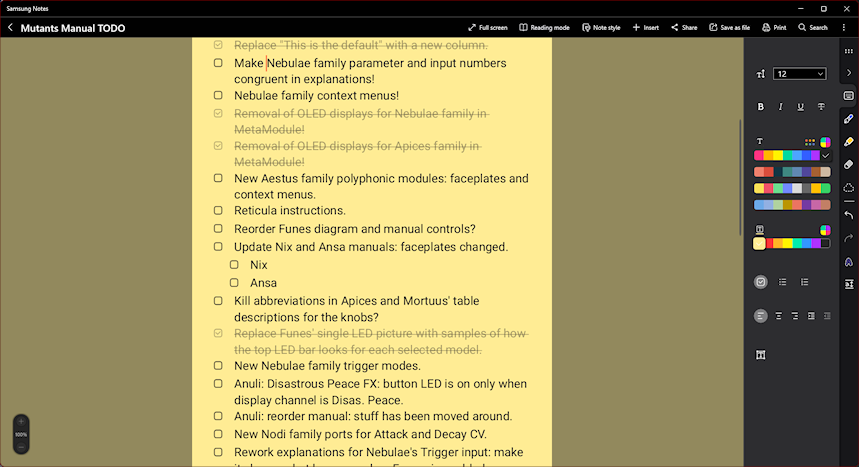
The function of the Trigger input depends on both the mode and the state of the Freeze parameter: Granular generates grains (on the Nightlies and upcoming release, how that works depends on the user selectable setting on how to handle triggers, when Freeze is active, grains come from the existing, looping, buffer; when Freeze is disabled, grains are created from the constantly renewing buffer; Stretch and Delay can create clock sync. Loops when Freeze is enabled; Stretch stutters when Freeze is disabled; Delay uses the pulses to set the delay time (as long as the delay is shorter than the buffer length); finally, Spectral madness always generates glitches.
I hope some of this info. Is useful
Regarding a new Funes, no pressure; but I want poly LPG controls for my own patches