Hi everyone,
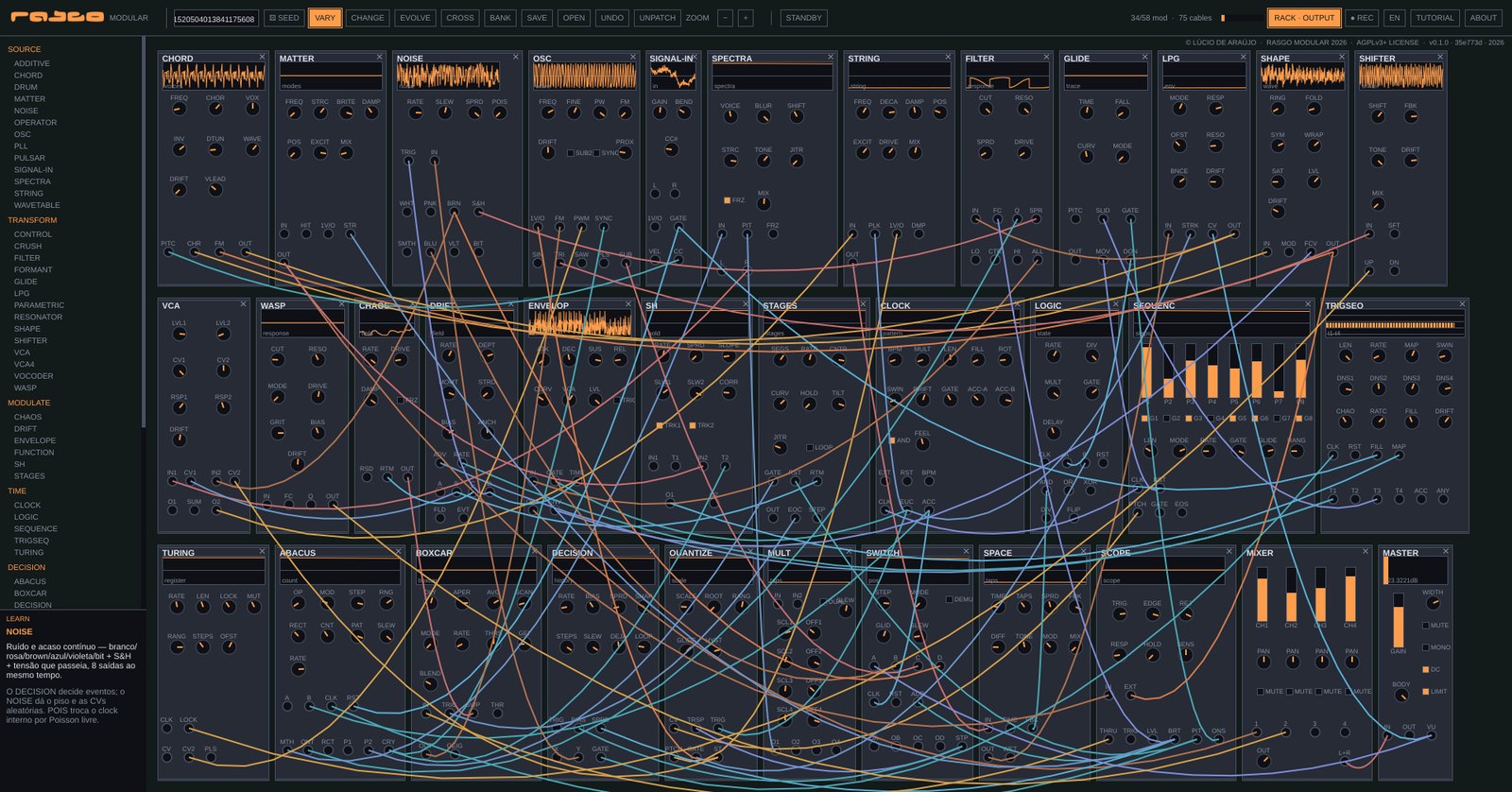
I’m Lúcio Araújo, an artist, musician and developer based in France. I’d like to introduce Rasgo Modular, a standalone, open-source modular instrument developed as part of my broader RASGO research into sound, composition and instrument design.
First, an important clarification: Rasgo Modular is not a VCV Rack plugin, fork or proposed replacement. VCV Rack is an important open-source reference, and the two projects share an interest in modular synthesis, accessible experimentation and open development. However, Rasgo Modular is being developed as an autonomous instrument with its own architecture, visual language and performance model.
One of its central ideas is to treat patches as starting points. Instead of always opening with an empty rack, the instrument can generate a deterministic patch that is already connected and sounding. The musician then plays from there — adjusting parameters, rewiring it manually, allowing controlled variation, transforming it, or removing every cable and building from scratch.
Another difference is that a cable is an object with its own state, not merely a wire. Connections can have properties such as gain and probabilistic conductance, allowing part of the composition to exist in the changing relationships between modules.
The current v0.1.0 includes:
- 58 modules organized into eight functional families;
- deterministic seed patches;
- patch mutation, evolution and crossing;
- stateful cables;
- integrated recording and score logging;
- an internal LEARN system in English, Portuguese, French and Spanish;
- standalone packages for Linux, Windows and macOS;
- source code under AGPL-3.0-or-later.
Linux has been tested on real hardware. The Windows and macOS packages have been built and tested through continuous integration, but have not yet been run on physical machines.
I am interested in interoperability, but I do not want to promise a VCV integration before understanding what would actually be musically useful. MIDI, OSC or documented patch exchange might eventually provide bridges while preserving the identity of both environments.
Project page and downloads:
Source code and documentation:
I would especially appreciate feedback from the VCV community on three questions:
- Does starting from an already sounding patch encourage exploration, or do you prefer an empty rack?
- Does a cable with playable state seem musically useful, or could it make patch behavior harder to understand?
- What kind of interoperability between independent modular environments would be genuinely useful without requiring one to become a plugin of the other?
Thanks for reading, and thank you to the VCV Rack developers and community for maintaining such an important open modular ecosystem.
