Hello everyone. Does anyone know if the VCV Rack library contains a bandpass filter with a Q factor greater than 20 ? Thank you for your help.
Is ∞ > 20?
And if you don’t want a brick wall, Dave’s MultiMode filter does a 96dB slope. Bogaudio VCF does 20-pole.
Not sure of the equations that correlate slope from dB to #poles to Q factor and I’m happy to remain that way since my instinct tells me Q factor is often mis-represented both here in rack and in other software/hardware. (Looking at you, Decline, where the default says 1.4 but sure sounds like a gentler .707 to me.)
Theoretically it is 6dB per pole. So my Multimode Filter 96dB slope is 16 pole. I probably should have used the number of poles for the parameter instead of slope. I have run some tests with sine waves 1 octave above the low pass cutoff, or 1 octave below the high pass cutoff. Assuming the Bogaudio Analyzer is accurate, my filter slope is actually closer to 11dB/Octave per every 12dB listed. So with the parameter at 96dB slope, I am getting ~88dB reduction 1 octave away from the cutoff.
The Bogaudio filter has up to 12 poles, not 20. Running the same test with sine waves the Bogaudio is more accurate - each 2 poles represents 12dB reduction one octave away.
2 Likes
Oh, right, thanks. Had the number 20 in my head because I seem to be getting a lot of aliasing lately with whatever oscillator/fun-filter combo I keep using. So my starting point on that VCF is 20kHz 12 pole which obviously doesn’t do anything for the aliasing spike at 20k.
Anyway! I’ve been curious about daisy chaining clean filters. First pic is your MultiMode Filter vs Bogaudio VCF at max slope, bandpass at 4k. Daisy-chained with 2 instances.
We can see that they behave very differently! The slope is muuuuch steeper with the Bogaudio and there is some real resonance. (Also gain drops way off, hence the Mix1 amp modules.)
Second pic is 6 daisy chained instances of MultiMode filter. Just the last 4 instances shown. We can see that the slope doesn’t really get a lot steeper, and a very small resonance develops at 1.5 octaves up.
I don’t bother with this kind of analysis very often – as the old live sound slogan goes, “mix with your ears, not with your eyes”. But I reckon I’ll be using your module for high pass at 18-20k for now on!
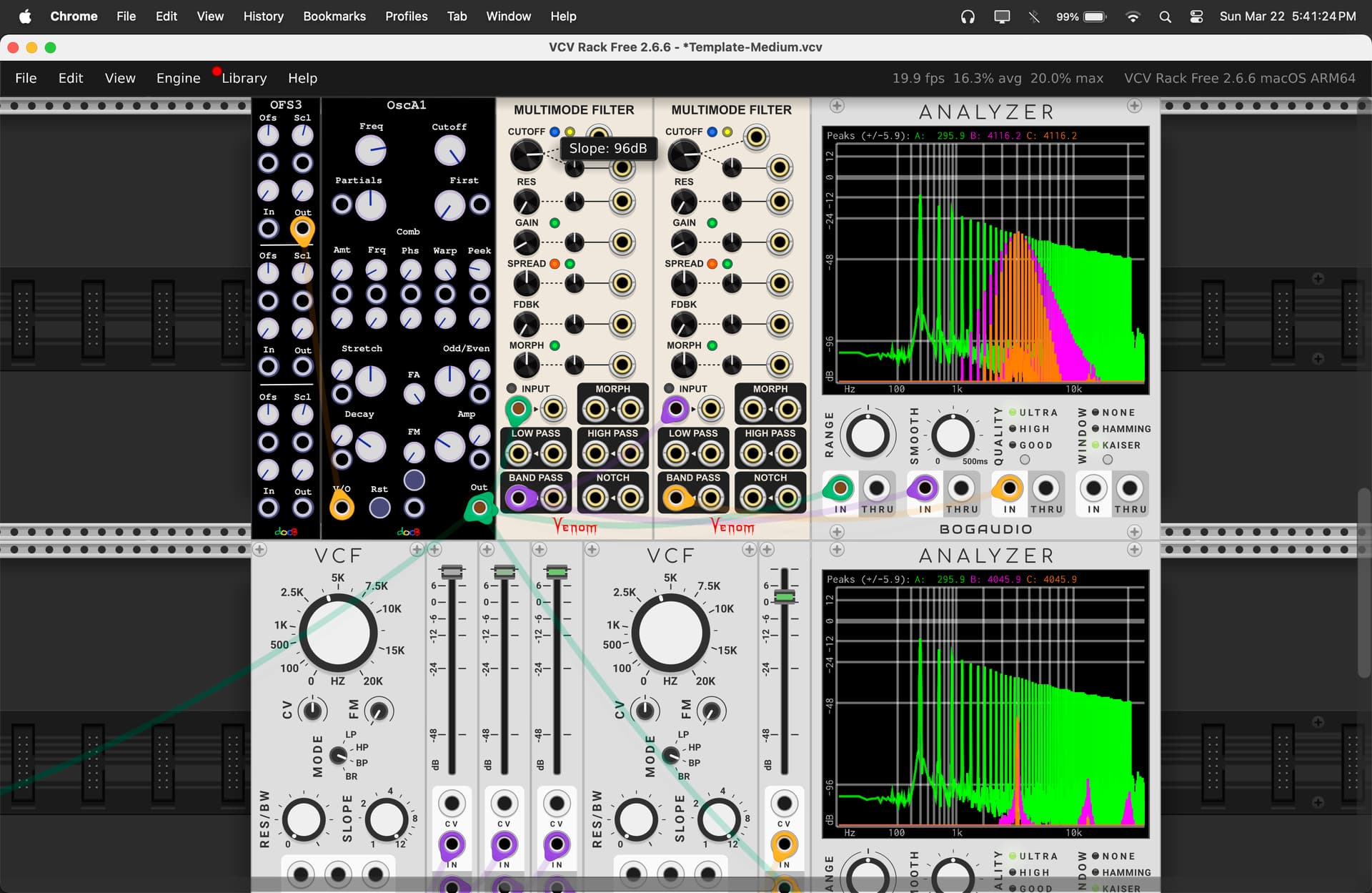
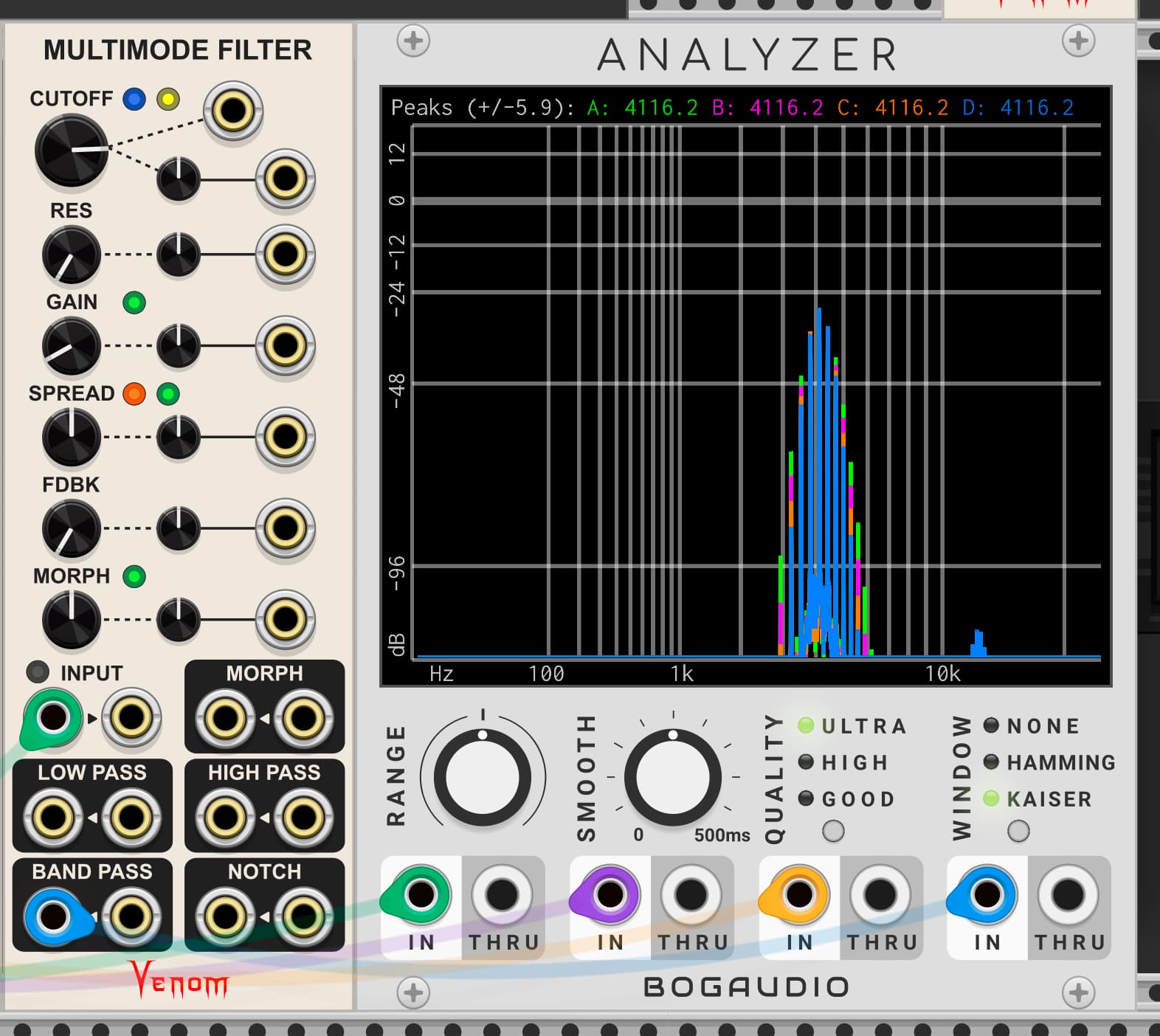
And to make this more useful than academic – back at OP here.
My quick and dirty experiments lead me to think that here is a good recipe for a very steep filter that isn’t a complete brick wall and sounds good without artifacts or odd resonances.
Venom Multimode Filter at a slope of 96dB into Bogaudio VCF at a slope of 2-8 poles (not more than that).
Seems to behave well in the typical modes (LP BP HP). Didn’t try Notch. 1k lowpass shown.
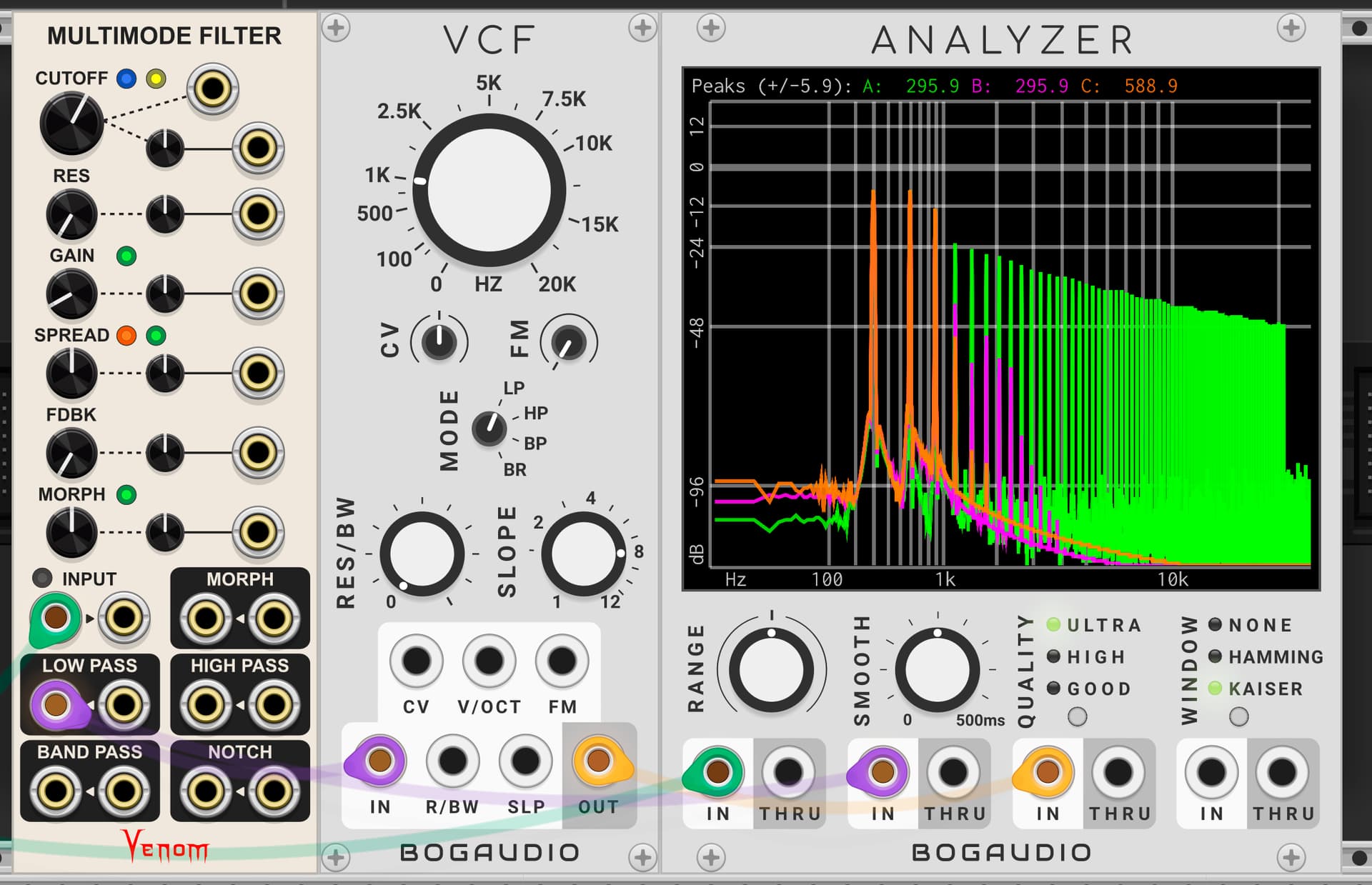
I think the resonance knob works in the opposite way when the bogaudio VCF is in bandpass mode, as you open it up it widens the bandwidth. It works similar to the Bogaudio PEQ modules bandwidth knob. I could be wrong though, I’m not at Rack at the moment.
I used to use the PEQ modules alot with noise for resonant chords, but now I just use the VCF polyphonically, it sounds the same to my ears
What are you trying to achieve? What problem to solve? What is the use case? There might be alternative solutions.
Here’s a generic solution: maybe use multiple bandpass filters in series? You can go as steep as you want.
VCV Rack Hacks | Supercharge your VCF
Jakub Ciupinsky
If it’s the bandpass filter resonance you’re after, maybe go modal. E.g. Prism Droplet or chowdsp ChowModal
Online, you can find tables specifying the formant values used to generate vowel sounds. Each formant is generated by a center frequency with a given gain and bandwidth. In the filters I’m familiar with, the bandwidth isn’t directly accessible, but it can be adjusted by setting the filter’s Q parameter (Q = Fc/BW). The problem is that some formants require a Q value greater than 20, and to date, I haven’t found a suitable filter.
There are several Formant filters and Formant oscillators and Resonators in the VCV Library that might help you your way.
Some examples:
Formant/Vowel filters
- Autodafe Formant Filter
- Squinky Labs Formants
- Frozen Wasteland Vox Inhumana
- Audible Instruments Macro Oscillator VOWL model
Formant oscillators
Resonators:
On Bandpass filters (that might also be used as resonators) and control over gain and bandwidth:
Generally increasing Resonance will increase gain (at that bandwidth/center frequency) and decrease Bandwidth. Up to a point that they could act as resonators. And there is always the option to use a dedicated (sub) mixer to control relative and overall gain levels.
1 Like
The Bogaudio VCF gives you direct control over the band pass band width, though I don’t understand the scaling, and I don’t think the filter gives you gain control. Maybe you can figure out how to make that work. Check out the linear option in the context menu. By default the band width is exponential, meaning if the high cutoff is 1 octave above the center then the low cutoff will be 1 octave below the center. The linear option lets you specify the width as an absolute frequency amount, so if the high cutoff is 100 Hz above center then the low cutoff will be 100 Hz below center. The Q factor is extremely high with the 12 pole setting and minimum bandwidth in linear mode, basically letting you hone into a single frequency.
I doubt any of those suggestions will help with the OP’s desire to make use of tabular recipes for formants.
The Frozen Wasteland Formal Dinner is a free take on XAOC Devices Sofia - more inspired by than a direct emulation. My Venom Sofia’s Daughter is a more accurate emulation of Sofia with a bunch of extra features, but it is not free.
Thank you for your interest in my problem. My goal is indeed to transcribe values from formant tables into a patch (and not to use a ready-made module). I had to abandon the filter approach due to the difficulty of obtaining Q factors with sufficiently high and easily accessible values. I therefore turned to parametric equalizers. Audible Instruments’ EqFilter does the job well: it offers bandpass outputs and knobs for adjusting Q values from 0.5 to 40, which more than covers my formant needs.
1 Like
Uh, have you actually patched and played with this module or just read the ‘manual’? Maybe the hardware version works, but the vcv implementation doesn’t work as advertised AT ALL. For your use case, the slope at EQ Filter’s alleged Q=40 is nearly the same as Multimode Filter at 24dB.
Sorry to be a wet blanket.
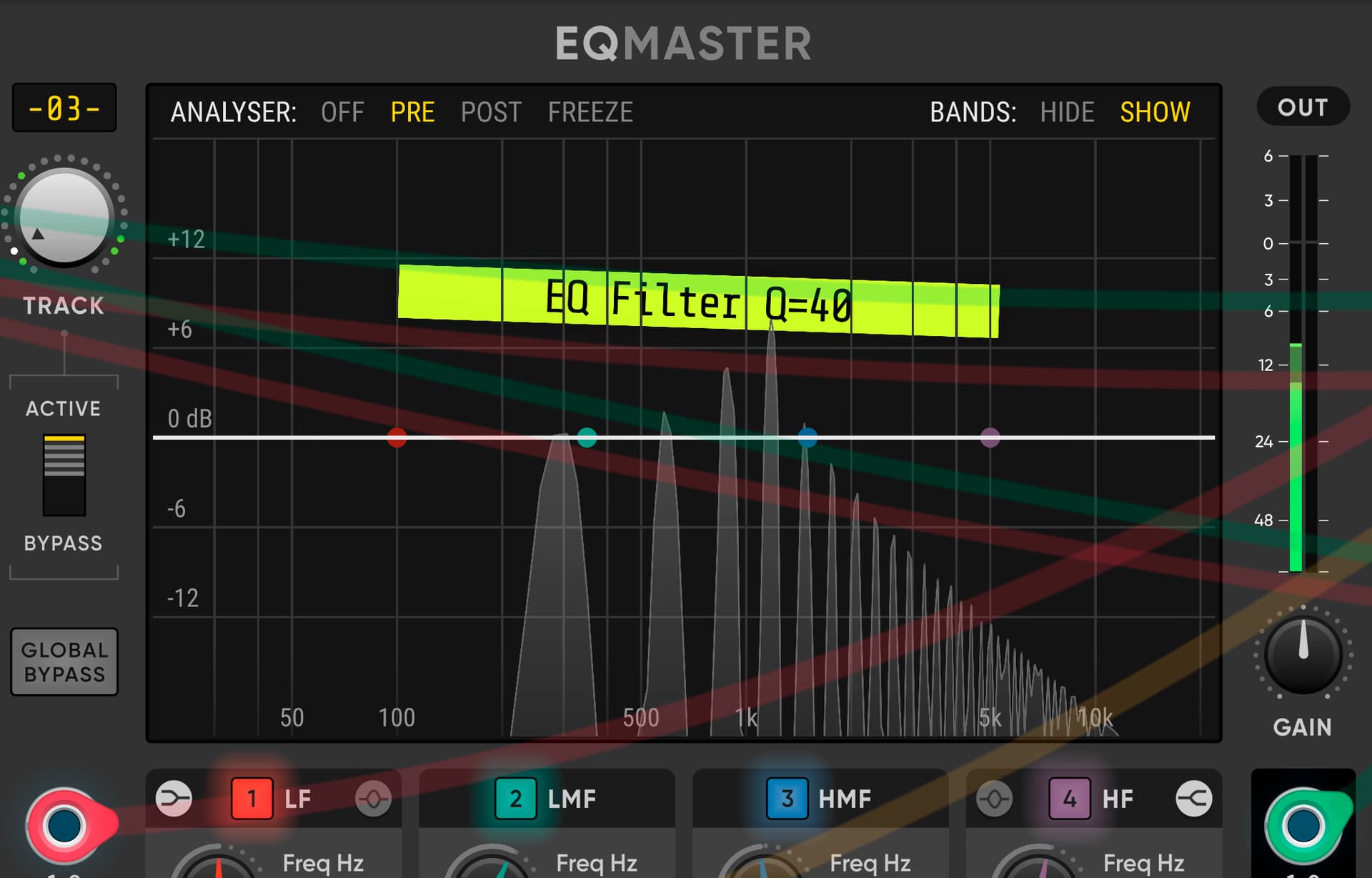
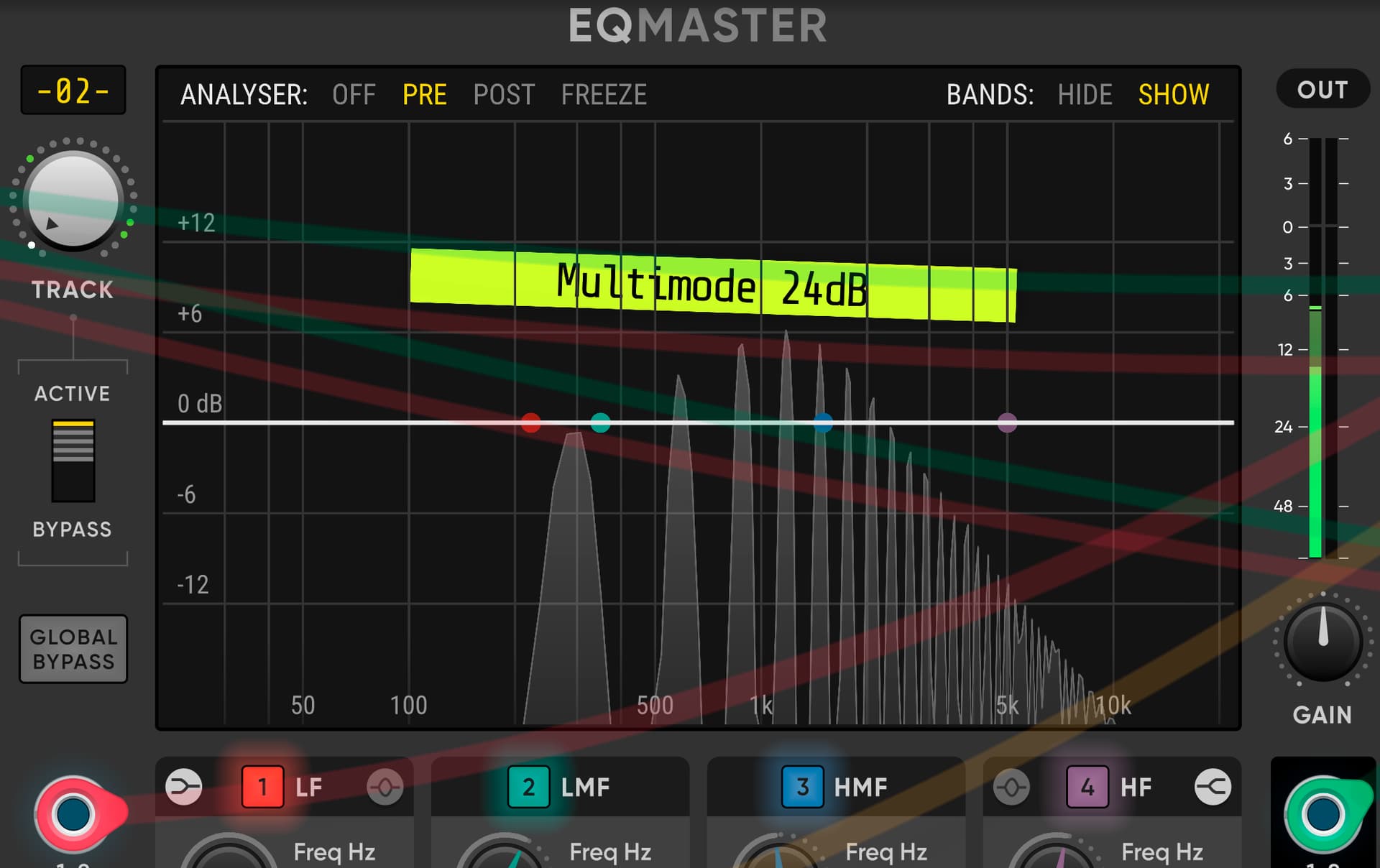
I’m currently fine-tuning my patch using several EqFilter modules. The vowel sounds it generates based on formant values from the tables already work perfectly. I didn’t quite understand the reference to the slope, but (unless I’m mistaken) this parameter doesn’t seem very appropriate for dealing with formants. Indeed, the tables associate each formant frequency with a bandwidth, which translates into a quality factor (Q = F/BW). And since the EqFilter module has buttons allowing direct adjustment of the desired Q values, that suits my needs perfectly.