I really would like to test it, but I need a compiled Win version, sorry
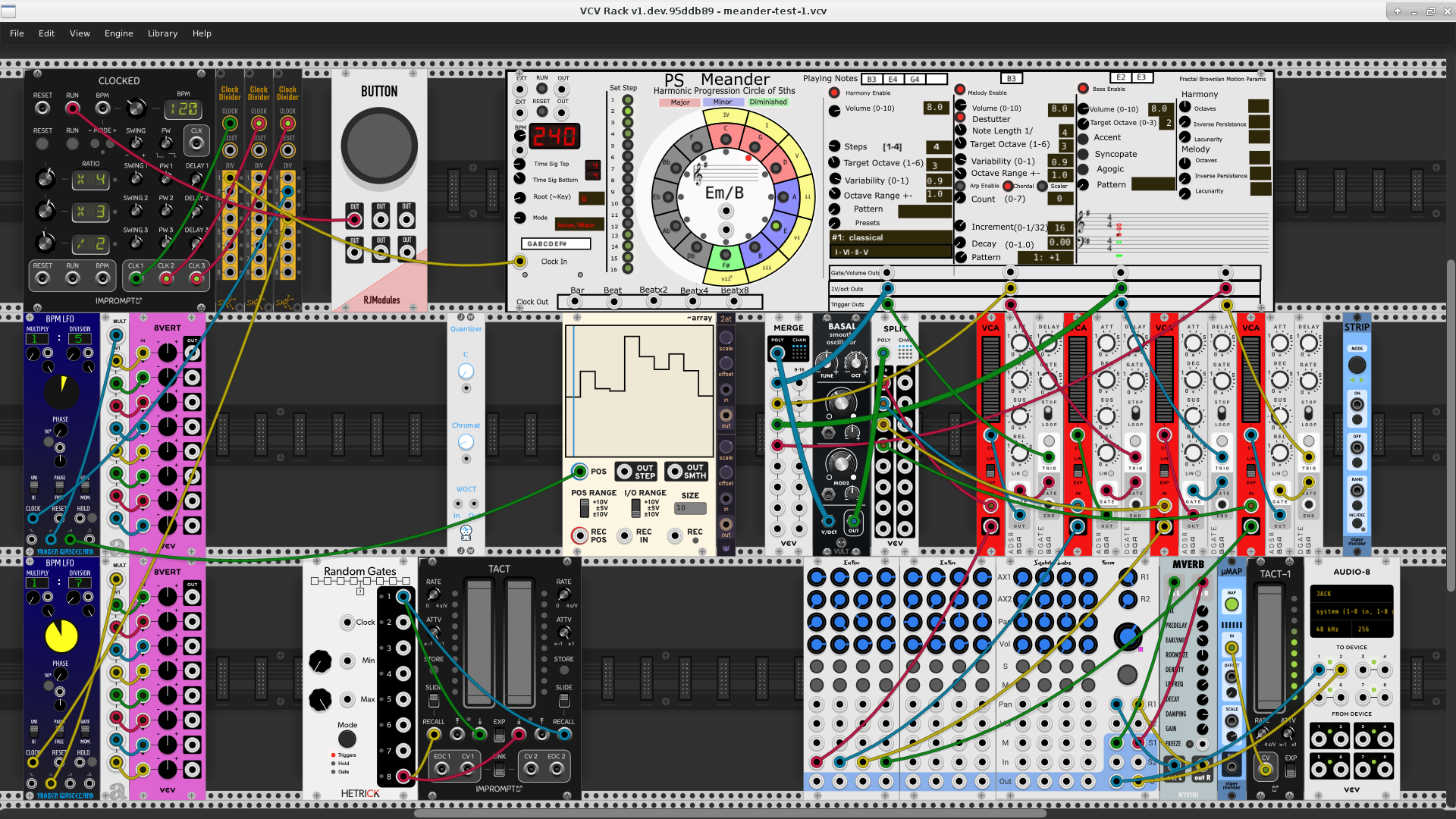
Good to hear. As you asked in your GitHub issue post, yes, I’m still developing the module. Most of the harmony and melody/arpeggiator controls are working. Bass is partially working. Drone has been removed, which means that the far right set of output ports are currently undefined and may be removed. A major feature remaining to implement is user editing of the harmonic progression.
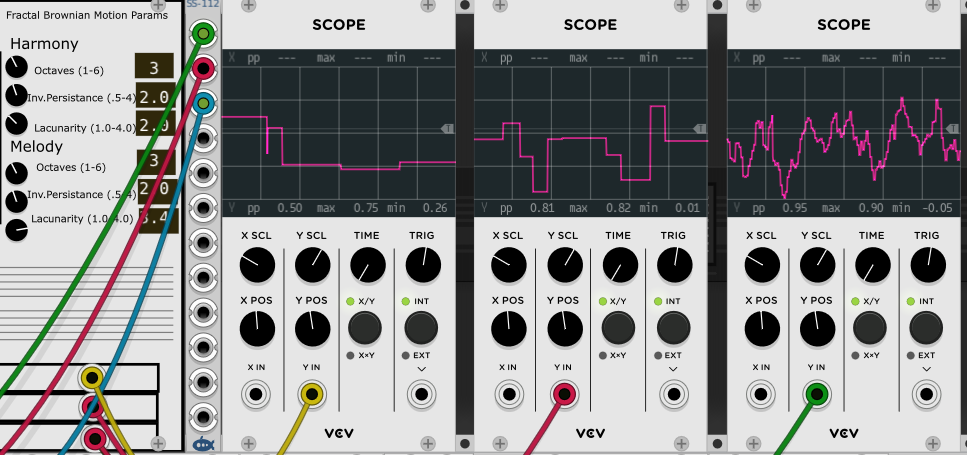
As I continue to finish up development on the alpha release of Meander, I will try to not post too much here, but I think what I added over the last couple of days will greatly expand the sequencer capabilities of the module. I have repurposed the “Drone” panel section and output ports for the “fractal Brownian motion” (fBm) parametric control for harmony and melody. fBm is fractal pseudo-random numbers (0-1.0) that has correlation over time. fBm has 3 parameters: number of octaves, inverse persistence and lacunarity as well as automatically taking the current system time as an input parameter so that the time correlation can be computed. Like all fractals, the shape of the output is similar at low and high “magnifications” such that there are smaller variations on top of larger variations, related to the number of octaves and the values of the other two parameters. I’m currently outputting the harmony driving fBm values out the top far bottom right output port, the melody fBm values out the middle such port and fBm calculated per 1/32 note out the bottom such port. These outputs can be used to drive other sound generators with fractal noise. The follow screen captures shows what the 3 outputs look like, for the set fBm parameters on the left:
These updates are committed to my GitHub repository.
Meander is coming along. About the only major feature to add is the user ability to create and edit harmonic progressions. Here is a progression that I manually added to the Meander source code. The progression and the Meander melody, arp and bass accompaniment should sound familiar.
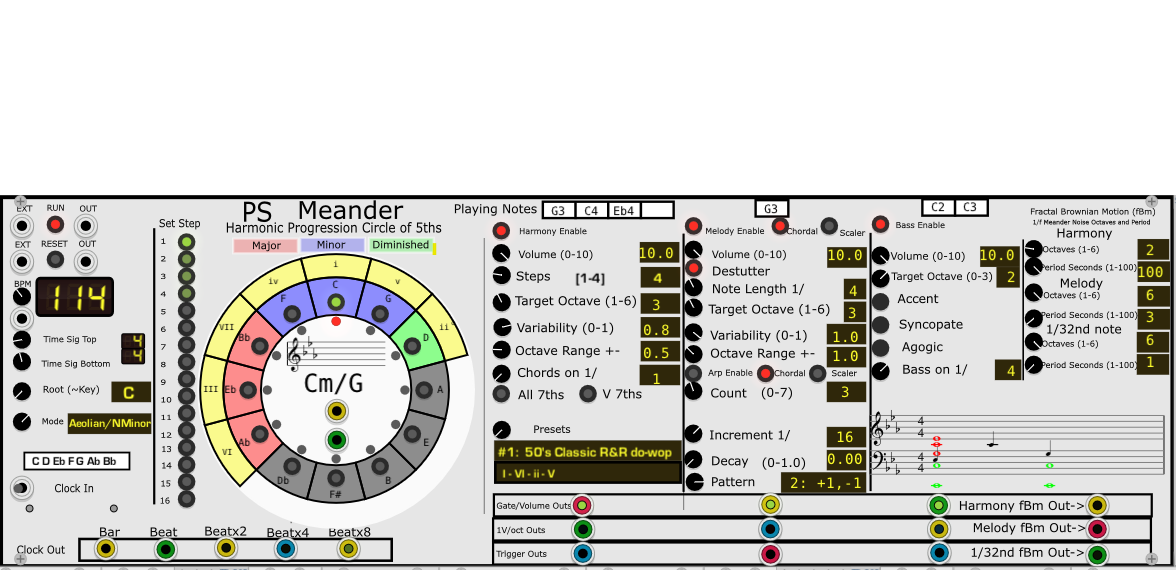
I totally redid the sequencer finite state machine, making the timings much tighter. I added multiple chords and bass notes per measure. I’ve also changed the Fractal Brownian Motion (fBm) noise to “1/f” noise, for which the lacunarity and persistence are both fixed at 2.0 and 0.5 so users will not need to worry about that. I also added a “period” to the harmony, melody, 1/32nd note fBm “meander”, which can be adjusted by the user between 1 and 100 seconds. The controls the time period of the fundamental frequency at which the notes “meander”. This really improved the meander:) All changes are on my GitHub.
Hi,
just in case anyone is interested in plugin binary - I forked the Meander repository and added Azure CI build. The Linux, Mac and Windows binaries can be downloaded from here. Just add the zip-file according to your OS into the Rack plugin folder. The plugin is in PS-PurrSoftware-xxx.zip. I try to update it from time to time.
Thanks for the builds Silvio. I was just able to check one out finally. Also, big thanks to @k-chaffin for actually making this!
I hope it’s not too early for feedback but after playing with this:
-
The red Mode and Key text is very difficult to read. Maybe a different color there or larger size. Light blue LED for instance?
-
Would be nice if there was an option to close the gate signals when a Reset signal is received. That way I could set up an instance of Clocked to send reset when run is turned off and close the gates on stop.
Really fun module. I can imagine a whole wave of super melodic modular music.
That is really cool. I started out my morning thinking I should really give the Azure Pipelines setup a whirl. Please be aware that since Meander is still in alpha development I make major updates on almost a daily basis. Over the past couple of days I added 1st order Markov chain chord transition matrices and 7th chord support.
@funkybot One of these days I need to do a cosmetic cleanup of the panel GUI. I’ll take a look at the 7 segment LED displays. I started out with blue but didn’t like that. I’ll take a look at it again.
I’ll take a look at turning off the gates. I think I still have logic in place for that as I was playing around with turning off ports etc. to keep notes from continuing to play if the module is paused. What is the most common way developers handle that in their modules? I tend not to notice so much because I always have an ADSR and VCA in the loop.
Thanks for the feedback.
Over the past few days, I have increased the number of harmonic progression presets to about 50, with almost all popular and common progressions included. What are your thoughts on user defined progressions? How important is that. Adding this will be a major undertaking.
@qno Please forgive my GitHub ignorance. I see that I am set up as a contributor on your Meander fork. Should I do commits of my source code and svg resource files to your fork? I just do “upload” commits to my GitHub repository since I really do not have a full GitHub local repository set up.
No, I’ll just pull your changes to my branch and merge it. Then Ci will build and publish automatically. We can try to merge my stuff back into your repo and you setup/enable Azure CI for your project, then it will build and publish everytime you push to Github repository and publish this in the releases of your repository. I could help you with this stuff.
You would than have just to choose if you use the CI setup from baconpaul with RACK-SDK or my version, as I use my own build environment. We can try both versions.
As a composer I’d love to add my own progressions, perhaps based on a 12-tone row or other modal/non-tonal source. But you’re giving me plenty to work with already, so it’s not my highest priority.
@funkybot how does this look. I think the yellowish text on black background looks the best. I also increased the mode and root font size just a bit. If you think this looks better, I will change all of my panel parameter text to this font color and size.
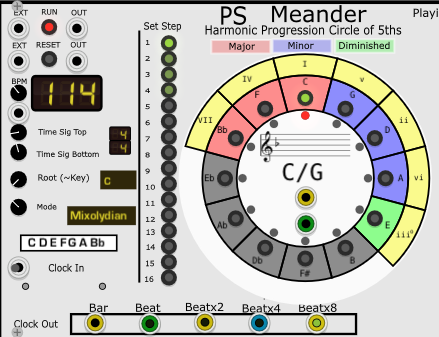
For my eyes it is much easier to read! Really great module! Thank You!
Silvios thing is really neat; but there are a couple of advantages of setting up your own azure pipelines in addition to his thing.
First you get pre-builds on a pull request. So in surge land we build all three platforms (and throw away the result) on all proposed code changes before we merge to master (that’s what the ‘-pr’ does at the top of the azure pipeline). If that’s something that’s useful to you you would still probably want an independent azure.
Second as he mentioned he is using a different build system than rack standard. While that works great and all, the azure-pipelines-per-plugin-project approach is closer to (but not identical to) the rack plugin manager builds. (It is not identical because the rack plugin manager builds in a windows cross compile from linux environment; and the azure pipelines build on windows; and so case problems can pop up). I don’t think it has ever occurred that ‘you build in Silvio and don’t build in the plugin manager’ though so this is far less important.
Whether you choose to activate the binary distributions or not is a separate choice all about workflow, as is whether you use your own pipeline. If your goal is just to give people an option to have a binary which tracks but slightly lags your master branch what you have now is great, and neat! But if you also want PR checks and the like you will need to set up azure on your own repo.
And of course, I don’t have a particular point of view as to a right workflow - what works for you works for you! Just wanted to make sure you had the full picture, since it can all be a bit confusing at first.
Best
Thanks @baconpaul . I was starting to realize that I really did not understand this. It is cool having a binary download for all platforms from Silvio’s repository for now, but I agree that I need to get Azure Pipelines set up for my GitHub account. There is still so much I do not know:) Thanks for taking the time to explain this to me. I’m sure I will ask for your guidance when I start playing with the Azure Pipeline configuration.
Blockquote Would be nice if there was an option to close the gate signals when a Reset signal is received. That way I could set up an instance of Clocked to send reset when run is turned off and close the gates on stop. Blockquote
@funkybot , I made a change that when a reset occurs, if the module is not “running” (i.e., paused) all of the gate output ports are set to 0V. Is this what you had in mind, or did you want the ports actually disabled? When run is re-enabled, the gates return to normal gate (volume) operation.
I added now Azure CI definition that builds with the Rack-SDK and publish the Artifacts to the release section of the repository itself. It is based on the pipeline definition from @baconpaul.
@k-chaffin if you want you can merge this, but you would need to setup Azure CI for your github repository before that.