Harmony will generate the right notes in the mode you select. It’s just that the rules it applies don’t all make sense in non major modes. But that may be just fine.
1 Like
Hello, Meander is an exceptional module for generative music with all its modulation inputs. I was wondering if it was possible to add an “end of cycle” output for the chord progressions in a future update ? Some chords progressions have different lengths (4, 8, 12 bars…) and it would be great to triggers some events with it (I realize the panel is already very crowded)
Thanks for this great piece of software
1 Like
Hi. That’s a great idea. I have no updates planned for the near term, but I will consider adding this the next time I work on the module.
3 Likes
Hypothetically speaking, at which point in time would you expect the “end of progression” (EOP) to occur in time? I can imagine it occurring at the beginning of the gate rise for the last step or at the beginning of the the next step gate. Or it could occur at the end of the last step gate. Internally, Meander does things like this in between common musical intervals, essentially at an off-beat time. It is very difficult to do things like this in a way that would work for whatever any user might dream up to use the EOP trigger output for.
My original 1988 version of Meander for Windows was a “discrete event simulation” (DES) scheduler and processor. Since VCV does not have a timeline structure, I have to implement such for myself in Meander so that the time signature and BPM and specific note durations all work together without introducing any types of timing glitches.
2 Likes
i would say, it is the falling edge of the last step gate.
another idea i miss or what i don’t discovered until now is:
possibility to output pause instead of notes. or is it already possible?
Each of the Meander panel parameters is CV controllable. For example, you can enable and disable chords, melody, arp and bass independently. In general, the internal timeline will still be respected if you use these “Enable” CV input ports. That is the only way to pause output.. There is no way to skip a progression chord . Meander does have a lot of trigger outs that can be used to to do whatever the user might dream up to do using the logic of other modules.
2 Likes
Usually, I modulate with a s&h the choice of progression But I need to predefine a bar interval for each change My idea came by imagining being able to send a trigger to the S&H before each cycle to have a new type of progression for each cycle. The ideal would be one or two samples before the start of the next cycle. It’s a purely theoretical idea, I have no notion of software development to apply it
Looking at my code, when Meander receives a new progression CV value, it schedules the actual change to occur at the end of the current progression cycle but before the next, i.e., on an off-beat or rather between beats. So, it appears if I implemented an EOP output signal, that could drive the new new progression switch which would not actually occur until the end of the current progression. Is that what you have in mind to occur?
Do you ever sequence progression switches using a sequential switch and the CV eigenvalue for that progression or do you just grab random progressions with the s&h. I am probably an odd-duck when it comes to sequencing any module. I have a sheet of printer paper for each module I like to use and I manually determine the CV required to result in the parameter state. This is a tedious process but only has to be done once. For example, if I send 1.625 volts to the Meander progression type CV input, I get progression #13, “12 bar blues 1 traditional” preset but not until the current progression ends.
You can also use multiple instances of Meander with each slaved to the master for BPM, mode and root note. This does not work via the expander standard but rather Meander can send each of it’s primary parameters out via cable to another Meander instance parameter CV input.
I was trying to find a way that Meander can do now what you have in mind but, there is probably no way. I think it would probably be possible with an EOP CV output trigger signal, but I cannot know for certain without trying it.
2 Likes
Yes that’s the idea, but if it’s impossible, I totally understand
I usually pick some random voltage from the S&H every 16 bars (more or less) to select a new chord progression, here are some tracks made with this principle
2 Likes
I have added an EOC outport to both Meander and ModeScaleProgressions modules. Next I will see if I can actually output an EOC trigger that makes sense in regards to timing . I will wait to see if I actually release this, but thought I would mention that I am working on this.
By the way, I mentioned that I began developing Meander for Windows in 1988. The astute older developers (like me) will recognize that Windows was not released at that time, as far as I remember, so the initial Meander was for DOS. I ported it to Windows at some time after a stable release of Windows came out. I cannot remember the year on that.
1 Like
Great news, thank you.I’m curious for the next update
Wow Meander is a long time project, the modular environment is well suited for this kind of sequencer
I have the EOC working very well, but not absolutely perfectly. If I crank the BPM to 300 and do 8 chords per bar, I sometimes get a slight stutter in the sequence. I think there is just so much going on that it is very hard to do a reset between notes. Every time the progression is changed, I have to do a reset on the module automatically to get everything set up for the new progression. I am doing all of this on the first step of the progression as doing it on the last was causing problems. So, the EOC trigger occurs on the first step of the progression. The EOC can be run directly to the S&H trigger and the S&H Out run to the Meander “Progression Presets” CV input via a cable
I’m curious as to what tempo you tend to use and the number of chords per bar (the Meander “Notes on 1/n” setting.
1 Like
By the way, I got my start in synthesizers with true modular in 1973, When I wrote Meander for MIDI in 1988, I had so much more control than with true modular. Now, I have so much more control with virtual modular and without the MIDI complication. My extensive hardware studio seldom gets powered up these days;)
3 Likes
I use some mid tempos from 70 BPM to 130 BPM
Yes, the infinite possibilities of a virtual modular environment is really inspiring
Fun fact, I was born just before you stared modular synth, it’s nice to feel like a beginner suddenly (I started with Reaktor around 2000 and had my first eurorack case 10 years ago)
This request is proving to be more difficult than I anticipated. I’m sure it is possible, but may take a bit of time. I am reverting to doing the EOC at the end of the progression rather than the beginning. Doing at the beginning did not fix the root problem and introduced others.
One of the outstanding issues is that the module can get stuck in a Markov process progression. I will add logic to break out of the Markov progression after a fixed interval of time.
I regret having to do this, but, I am abandoning the effort to add EOC to my PurrSoftware modules. Meander and friends are not designed to handle EOC and all of my efforts had problems and was running the risk of messing something up that I might not discover for a while and might not be able to easily repair. The safest thing was to restore my backup and be back to where I started this effort. Sorry, I hope you can still use the method you have been using for changing the progressions in use.
It may be more effort than what you want, but you would have better results if you determined the eigenvalue CV’s for the progressions you want to switch between and then use a sequential switch to sequence those few. I usually use AS Triggers MK1 to send CV to the target module CV control and observe the voltage which produces the progression you want and then use that voltage in a sequential switch. Here is a snippet from the screen.
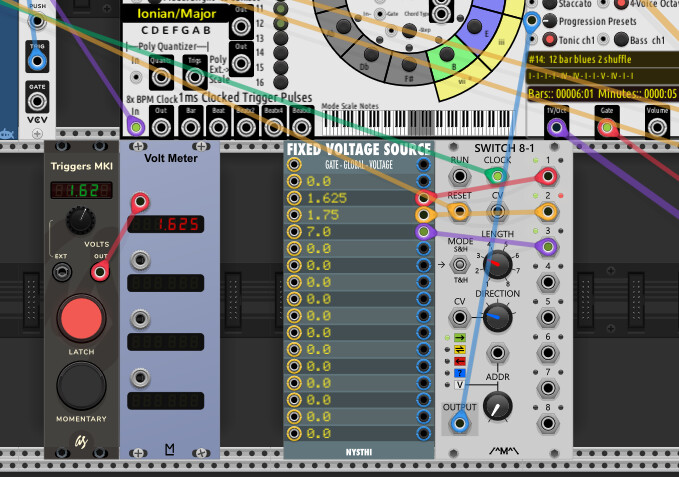
In any case thank you for trying, I will continue to use Meander as it is, it’s anyway one of my favorite sequencers
I will try the trick with the sequential switch
1 Like
I added the chord progression selection input CV eigenvalues to my documentation, so, you can refer to that for voltages if you would prefer that to mapping them yourself. This is towards the end of the manual and the CV value follows the progression number and description.
2 Likes