Marc, thank you for adding the new BPM CV out to option in CLOCKED. That works great for controlling CLOCKED via an external BPM clock but CLOCKED controlling Meander BPM via a BPM CV.
Hopefully others will find other uses of this option.
Marc, thank you for adding the new BPM CV out to option in CLOCKED. That works great for controlling CLOCKED via an external BPM clock but CLOCKED controlling Meander BPM via a BPM CV.
Hopefully others will find other uses of this option.
My pleasure Ken!
It works like a charm now… you guys rock.
edit: Actually, the clock is randomly jumpy. But I blame myself. My input is P4 and the output is x8. I feel like if my clock in was 24ppqn the x8 out would be more stable. I’ll be working on a solution.
I’m glad to have helped. By the way, I mocked up a 24 PPQN patch and that worked fine for me. In my experience, tracking down the source of clock jitter in a complex scenario involving hardware and multiple software apps can be difficult. I wish you good hunting though.
I switched to a Pam’s x24 → Clocked and the things appear much more stable.
That’s great! Glad it worked out.
Just a tease here… I’m working on new features for Meander. Specifically, I am adding the ability for Meander to be a poly channel quantizer, quantizing externally generated notes to the current mode and root in Meander and then outputting those externally. My main reason for doing this is that there are no longer any quantizers for V2 that accept the “poly external scale” format to “program” the quantizer scale. I am retaining the “Poly Ext. Scale” out port for now, but not much can be done with that without a lot of discrete modules logic.
As I mentioned in my previous post, I am working on the next update to Meander. I have implemented a simple quantizer in Meander that allows an external module to send notes to Meander to be quantized to the Meander current mode and root heptatonic scale. I also added a root output from Meander as 1v/oct. Turns out there is one quantizer in the library that uses the ~“poly external scale” protocol and accepts a root input at 1V/oct, which is what the Meander update outputs. Be sending a poly external scale (a chromatic 12 semitone scale) for the current mode and root as well as sending the root from Meander, the Grande Quant module can take these inputs directly and quantize to the current Meander mode and root scale.
Is anyone aware of any other quantizer modules that accept a poly external scale and root? As a reminder, the “Poly External Scale” ‘standard’ was implemented by Aria Salvatrice in her QQQQ and related quantizers, but which has not been ported to V2. At that time, I also added poly external scale output in Meander and had a lot of fun sending that to QQQQ and allowing external modules to quantize to the Meander mode and root scale.
I’m experimenting with having an option to export some pentatonic scales (as poly external scales) as subsets of the current Meander heptatonic scale, for use with an external quantizer such as Quant to do melodic pentatonic minor and major scale runs etc. But, that is a work in progress.
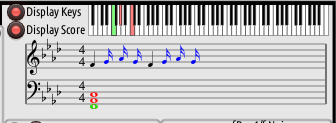
Another tease of the upcoming update, Meander now has an 88 key piano keyboard on which the harmony, melody (and arpeggios) and bass notes keys show the playing notes, color coded to other displays in Meander. This keyboard is above the score treble and bass clef staves. There are now buttons to turn the score and piano keyboard displays on and off, if desired. The follow screen capture missed the melody notes on the keyboard due to frame timing.
Correction: For Meander “poly external scale” output to properly control the Grande Quant quantizer, the Quant “root” input should not be connected to the Meander root output. This means that Grande Quant should work with the current library version of Meander 2.0.12, since root out of Meander is not needed. Root out will be included in 2.0.13 for other purposes.
Does Aaronstatic do what you’re after? I feel like it might.
Not quite. It is limited to heptatonic diatonic modes scales. The AS quantizer is part of ScaleCV. I could be wrong, but I have tried all sorts of approaches but cannot send a scale from Meander to the AS modules and then have AS quantize other notes to that scale. The root works correctly from Meander, but Meander has no “mode” output. Since I am experimenting with sending pentatonic scales from Meander as modified subsets of the heptatonic scale, I need to be able to send a chromatic poly external scale to the receiving external module. The nice thing about poly external scale is that it allows any possible chromatic (12 semitone) scale to be sent, regardless of the number of intervals in the scale from 1 to 12. Thanks though for suggesting it.
I have submitted Purr Software’s Meander module V2.0.13 to the library build request queue.
Meander Change Log Significant Version Changes (Changelog)
V2.0.13 (February 2022)
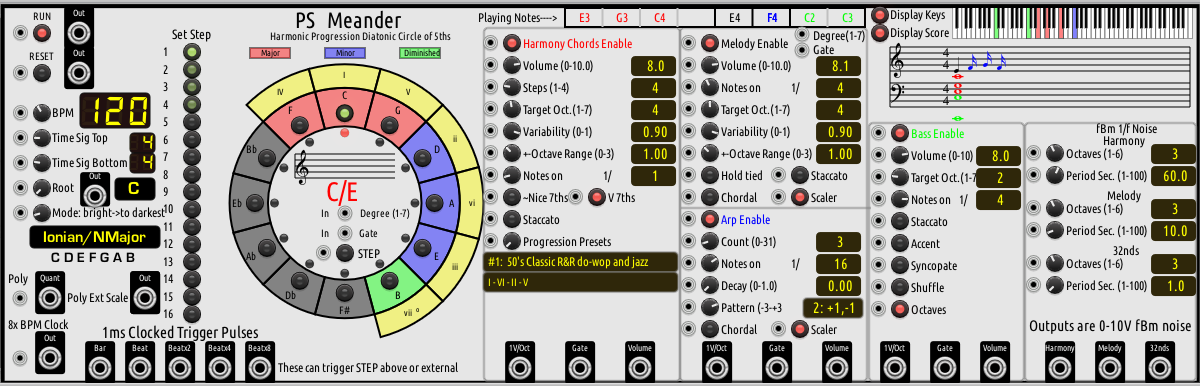
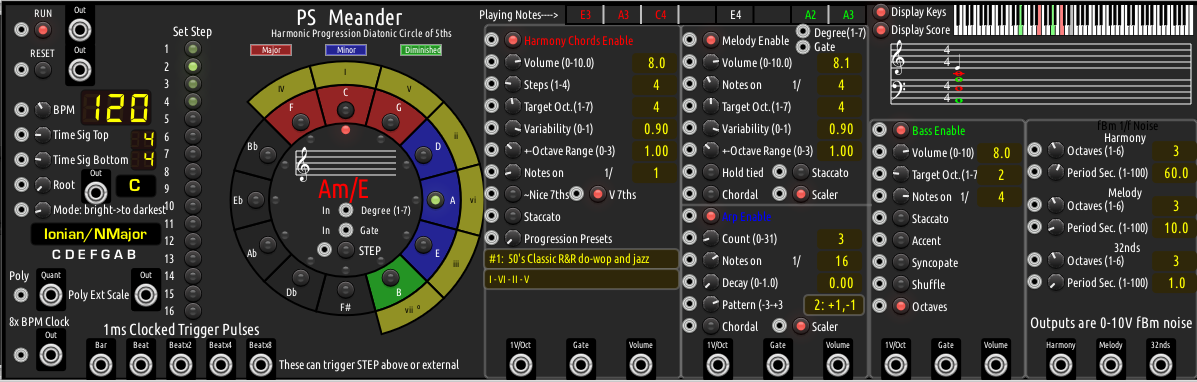
The following panel theme images are both at 100% contrast. Both can be adjusted down to 50% contrast as desired.
The light and dark themes are based on a light and a dark background color SVG file and then all actually rendering is via nanovg at runtime. Theme is selected via the options menu, from which the panel contrast can be adjusted from 50% to 100%, allowing a wide degree of individual preferences. If even darker panels are desired, this works well with turning the room lighting down in Rack.
It turned out to be very tedious getting all of the colored graphics working correctly for both light and dark themes and contrast settings. Hopefully the dark theme will help those who have problems using bright white panels.
Note, the SVG files now have nothing other than panel size and background color in them. All panel graphics are done at runtime via nanovg.
Thank you. Looks great 
Sorry for the changelog formatting. I should not have copied the markdown file and tried to use it as 'preformatted text". Lesson learned.
Hopefully this post of the changelog is more readable!
Meander Change Log Significant Version Changes (Changelog)
V2.0.13 (February 2022)
Superb!
A standard for sharing scales between module vendors would be useful.
I agree, but after messing around with this for a couple of years, it is still not clear to me what the best “standard” would be. Even sharing “modes” is difficult. Meander uses a “modal brightness” mode ordering (which is one of two traditional modal orderings, but which is less common than the other), such that the first mode in the list (Lydian) has one sharpened scale note. Ionian natural major then comes next and has no sharpened or flatted scale notes. As the list progresses to Locrian, one flattened scale note is added per step, up to Locrian having 5 flattened scale notes. Also, the first 3 modes in Meander are major scales whereas the second 3 are minor scales and the lonely Locrian is diminished minor.
Since the flattened scale notes are perceived as “darker” than the naturals, Each step up in mode in Meander is perceived as darker than the earlier modes. So, even though this is called “modal brightness” ordering, I think of it as “modal darkness”.
For this version of Meander, I added some panel notes for the modes that indicate whether each is considered major, minor or diminished and which are considered darker.
Hopefully some will find these “music theory” aspects to be of interest.
I learn more about it all each time I work on Meander.
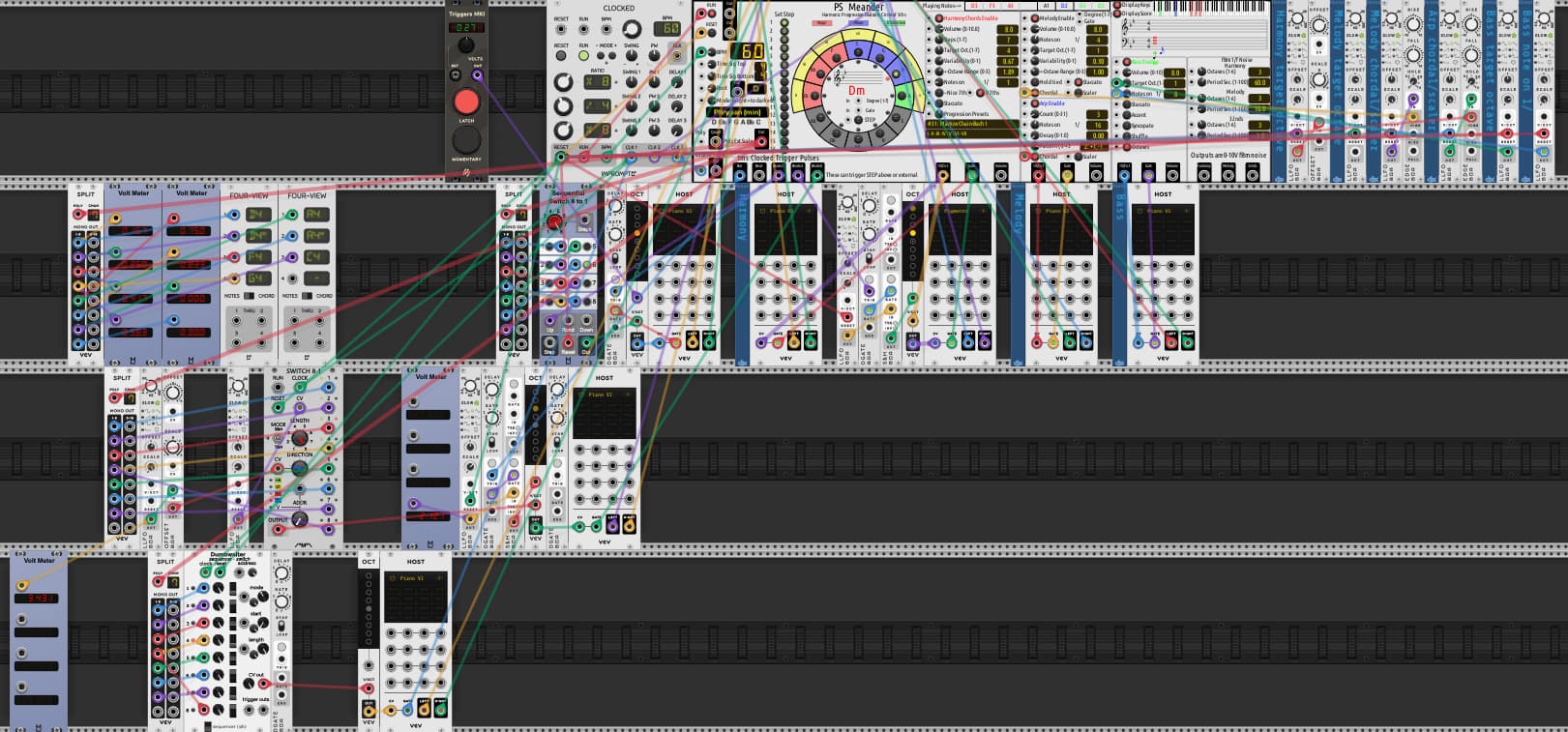
In celebration of Meander V.2.0.13, which should drop in the library in the next day or two, here is a new piece that takes advantage of Meander’s new scale output modes. This is outputting a Phrygian D scale to 3 different brand sequential switches with a lot of sequential switch automation during play. The harmonic progression is Meander #31 Markov Chain Bach 1.
Congratulate Ken! Dark mode looks awesome. I’m waiting for this update Cheers