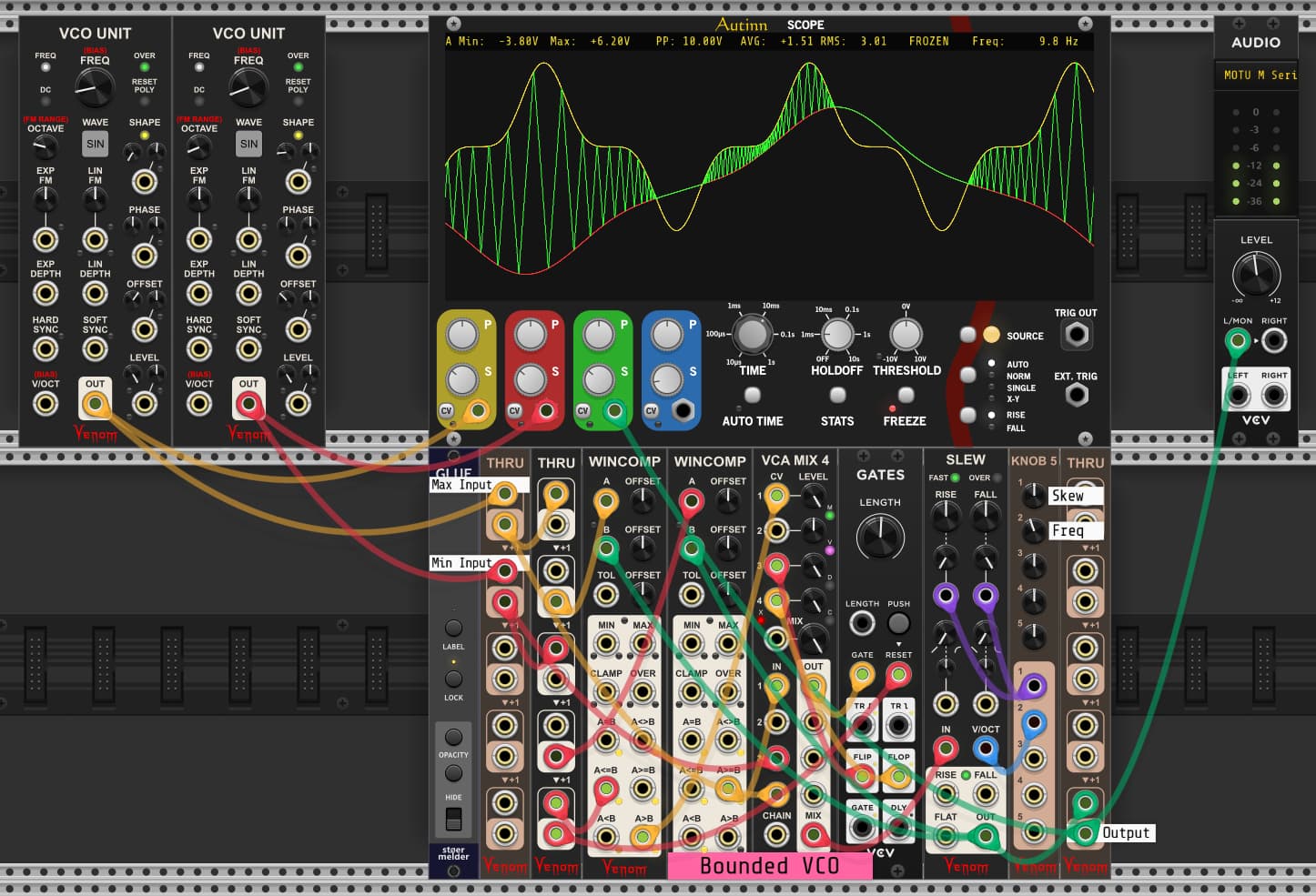
I believe I successfully implemented the following in VCV rack. The oscillator rise and fall rates are constant, but the oscillator frequency changes by modulating the lower and upper bounds of the oscillation.
I ran across this concept at
Did you ever get it to work @koen.kaptijn ?
I found I needed to use a windowed comparator (comparator with a tolerance factor). My implementation produces an ascending ramp wave. The Thru module introduces some sample delays. I empirically found the sample delay count that required the smallest tolerance factor possible.
I used an extra comparator to allow for the bounding oscillators to switch places as to which is the min boundary and which is the max. The purple cables from the 2nd WinComp are just a wacky way of supplying a constant 10V signal to offset the fall time to the minimum supported value so that when switching the slew source to the min input for one sample the output instantly reaches that min value. I didn’t feel like adding an additional module for the constant CV.
Bounded Oscillation.vcv (3.4 KB)

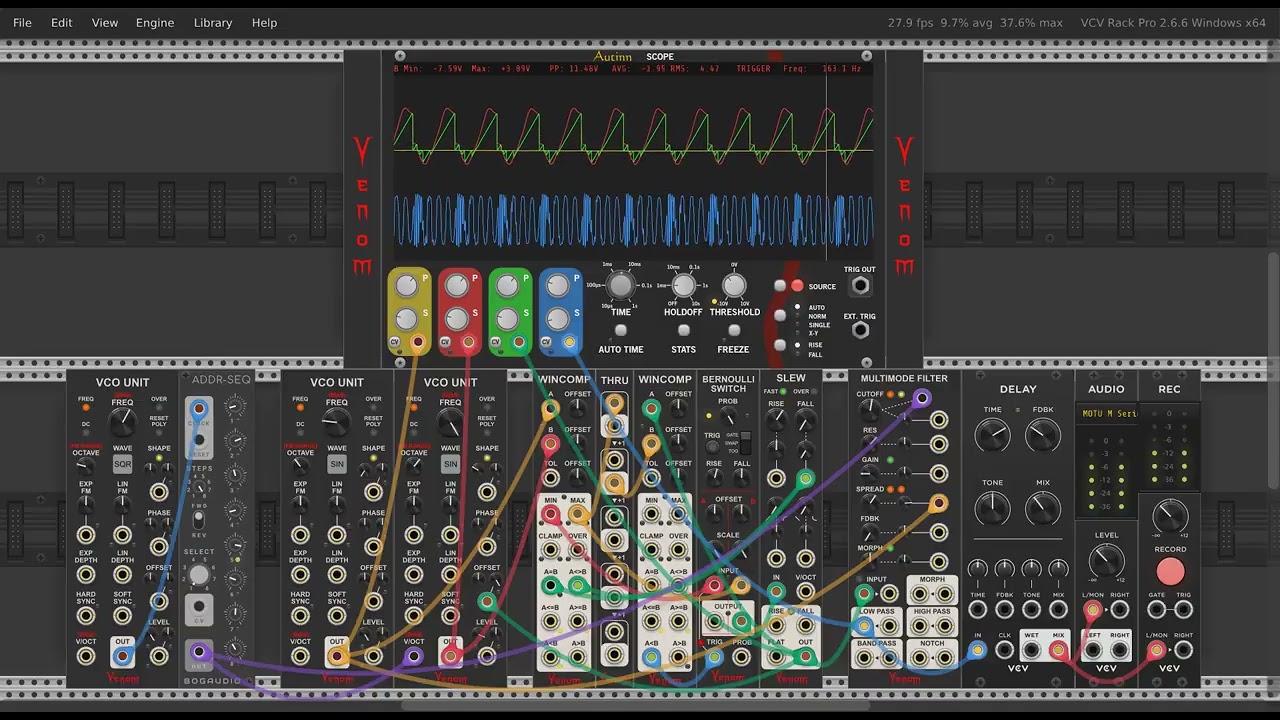
Once I had the bounded oscillation working I decided to have some fun with it, and created the following.
Sequenced Bounded Oscillation.vcv (5.2 KB)
I believe Peter’s Bound/Bounce oscillators can produce bounded triangle waveforms. I tried to emulate this in VCV, but it was not stable. I am thinking of creating one or more Venom modules that will do this. Perhaps some variation of Peter’s Fourses and/or Swoop modules.