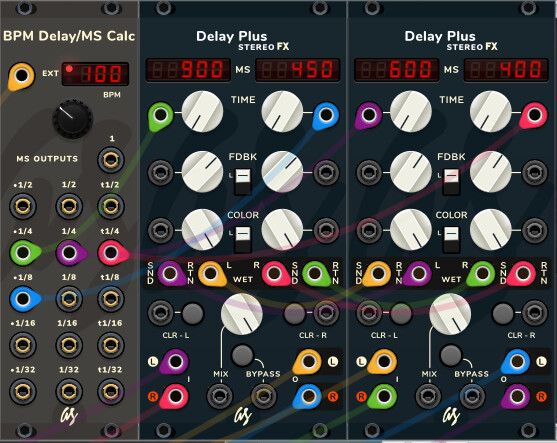
This isn’t Rocket Science but it makes for a really dense spacy delay.
This expands on how you make a ping pong delay with AS - you send the left channel to the right and vice versa. So the feedback path lets the delays interact.
This goes one further and sends the feedback loop for one Delay Plus into a second Delay Plus, whose send goes back to the return input of the first.
This means the feedback is complex but still tempo synced.
It pays to watch the feedback level because this seems to start howling sooner than a single delay on its own.
It’s always cool to patch stuff like this yourself, but just pointing out that Surge delay has cross-feedback built in. That’s not the point though!
I used to do this with the Nysthi stereo phaser, and patch one side into the other to make a 12 stage phaser into 24 stages. That also tended to blow up and chuck out a nanV.
Thats’s cool but the send/return on DelayP allows nonsense like this. Nothing wrong with the SurgeXT but having a feedback path you can insert other processing changes the game.
One thing I love doing lately is throwing a couple of pitch shifters in the cross-feedback path. One pitched up and the other pitched down by the same amount. They are supposed to cancel each other out by bringing the pitch back to the original pitch, but its never perfect. So you’re left with interesting artifacts.
Haha. Frequency shifters work really well too, or if you have the Host-FX module you can use plugins too. I like to patch one called Digitalis into the send return loop of Chronoblob (using two copies for stereo). Hours of fun.
I haven’t got that, but sounds an interesting idea. Clouds in the loop is another one I was messing about with the other day, makes huge slowly degrading drones.
What I like to do is plug an envelope follower into the send to get the overall volume of the feedback loop, then send that into a comparator to have a gate that goes high whenever the feedback starts to go over a certain volume level, and then use that to either turn down the feedback or trigger a S&H that changes params of the feedback loop to keep the feedback in check. In a weird way it almost ends up like a meta-krell patch.