Don’t worry, I am not planning to flood the world with vibe coded modules, my modules will continue to be handcrafted to the best of my own abilities. I already have a few in the pipeline for my next release.
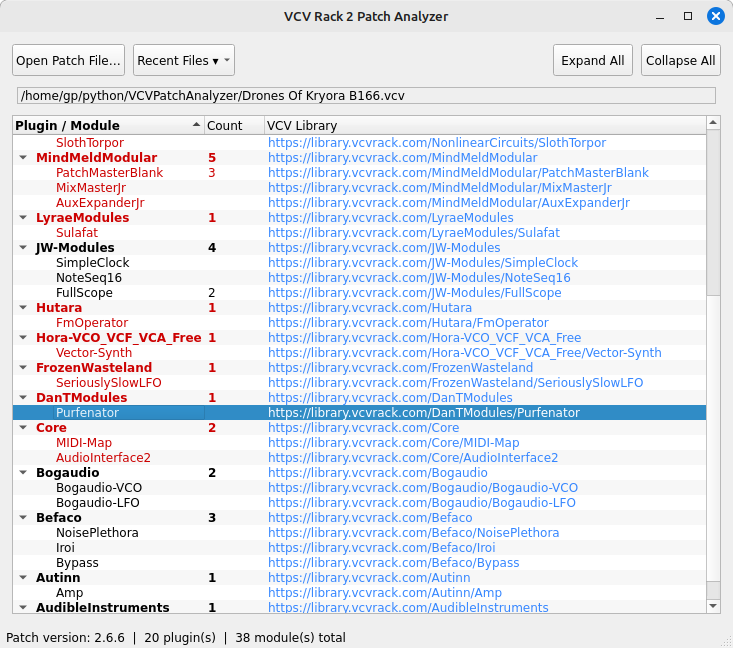
But a friend at work, who is not even a programmer, creates lots of internal tools and test software using AI in Cursor with amazing results. So I wanted to give it a try myself. My goal was a patch analyzer for Rack with these features:
Show a list of modules and plugins used in the patch
Show clickable links to the library for each plugin and module
Show modules missing in my local Rack installation in red
The usual: recent file list, restore last position and size, etc.
It was done in 2.5 hours! Including a rocky start getting the agent to work at all. This screenshot shows the first patch I saw on patchstorage, now I can simply click on a missing plugin or module and jump right to the library and install it.
It is written in Python, I used Jetbrains PyCharm (the free Community edition) with their “Junie” coding agent and the Claude Opus 4.6 model. I used about a third of the monthly AI credit allowance in Jetbrains’ “Pro” plan (8.33 Euro + VAT/10$ per month).
I am sure this will require some additional testing and finetuning, also testing on Windows (this is Linux, don’t have a Mac) to check if it finds the local installation to find out which modules are installed. So it is by no means in a state for release yet.
Nevertheless and I do hate to say it, I am really impressed with what can be done with AI these days.
I’m using Zed to do plugins. Just the tab completion, not full AI. I find it sometimes very useful, sometimes the tab just gets in the way of tabbing (esc works), and it does sometimes go crazy with mislaying out front panels, and it annoys me. (no, I don’t want everything moving 1 HP!)
I get some simple python scripts from GPT sometimes, but I’m never letting it loose on C++ pointer code. I do find it useful for templating nano SVG functions though. It knows them all, but confuses (width, height) for (x, y) maximums sometimes.
Wow, interesting tool. im an interested. if any interest, i could insert my attempt to analyze patchfiles here also,if you want. the purpose is, to remove faulty or missing modules, or list inventory or give an overview. But unfortunately it is forbidden to upload py or zip files. any ideas?
And yes, I also use code completion in C++ and sometimes it surprises me (“how did it guess what I had in mind?”) and sometimes it annoys me. But all in all the good outweighs the bad.
I am using Jetbrain’s Ai Assistent in CLion (Linux and Windows) for the Rack modules, at work I use Github Copilot in Visual Studio.
Completely agentic coding without touching a single byte of the code was new to me.
@Karl: I will polish this a little, test some more (already saw one bug when the module name has a slash in it) and then I will host the Python on Gitlab or Github. Also have to check what license I could use if I haven’t written any of the code, but it will be free.
I am sure there are multiple solutions to this problem since it plagues everyone sharing patches with others. I vaguely remember reading about a website doing the same.
For me it was just a test vehicle for vibe coding and I am still stunned how quick and easy it went. Makes you wonder what sets you apart from a machine as a professional programmer. I choose to believe that the machine will fail once things become more complicated.
No, it doesn’t and it won’t create anything. In fact, about the only thing I will check when I will have a look at the code is that it doesn’t open any files for writing. Then it should be safe to use despite the fact that noone has checked every line of the code.
On my Linux I had to install the pyqt5 and zstandard packages into the virtual enviiironment for this one, I am not sure, if more packages are required for Windows or MacOs. Since this is my first Python program ever and I didn’t even write it myself, I won’t be much help in case of problems with the Python enviroment….
(for some reason the forum software has cached outdated link content with all my original typos )
 (no, I don’t want everything moving 1 HP!)
 )
)