I have been fooling around with altering my percussion with sound effects since a long time, mostly for my own amusement, rarely in live performances.
But since I discovered VCV Rack the possibilities of manipulating sound have expanded enormously. And I would like to share some of the things I came across here in this thread.
No clue how often I will manage to post here, but starting this thread also gives me a bit of pressure to finalise the ideas I have. And that will also help me to find a good workflow with recording and editing the videos. Because creating the patches is one thing. But I always felt that they need more of a visual component as well.
And since nowadays you need social media to promote the things you are doing and also make people aware of it in the first place: having videos is not the worst idea
When the v/oct function was added I felt curious what would happen if I would live sample my instrument into a memory module and play it back over a keyboard.
And I was surprised how well that actually worked!
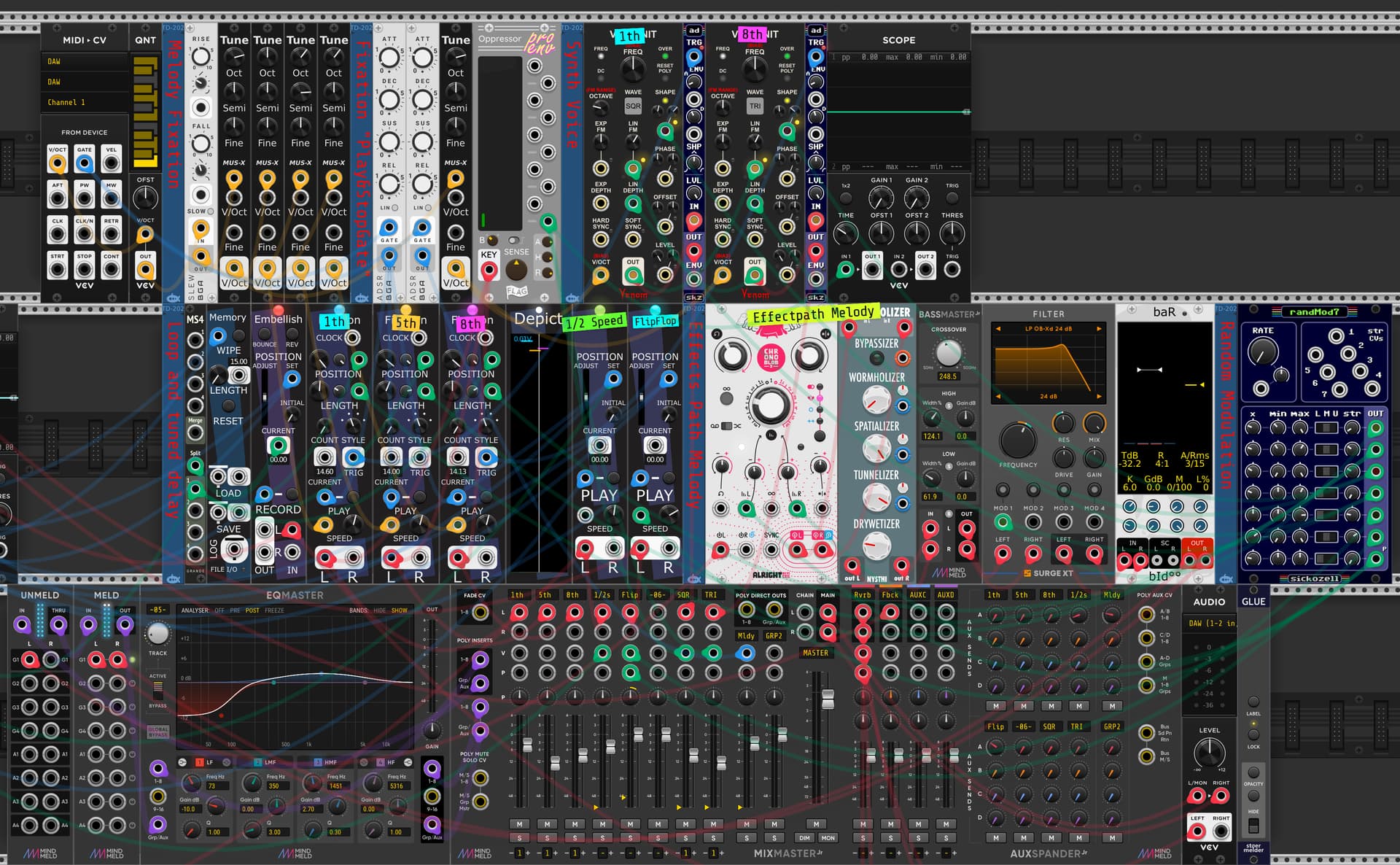
The core of the patch are three instances of the FIXATION module with v/oct plus two RUMINATION modules. One as some kind of texture effect, just bouncing back and forth within the buffer with SPEED set to 4 and the second one as a half time and octave down effect of the recorded audio signal.
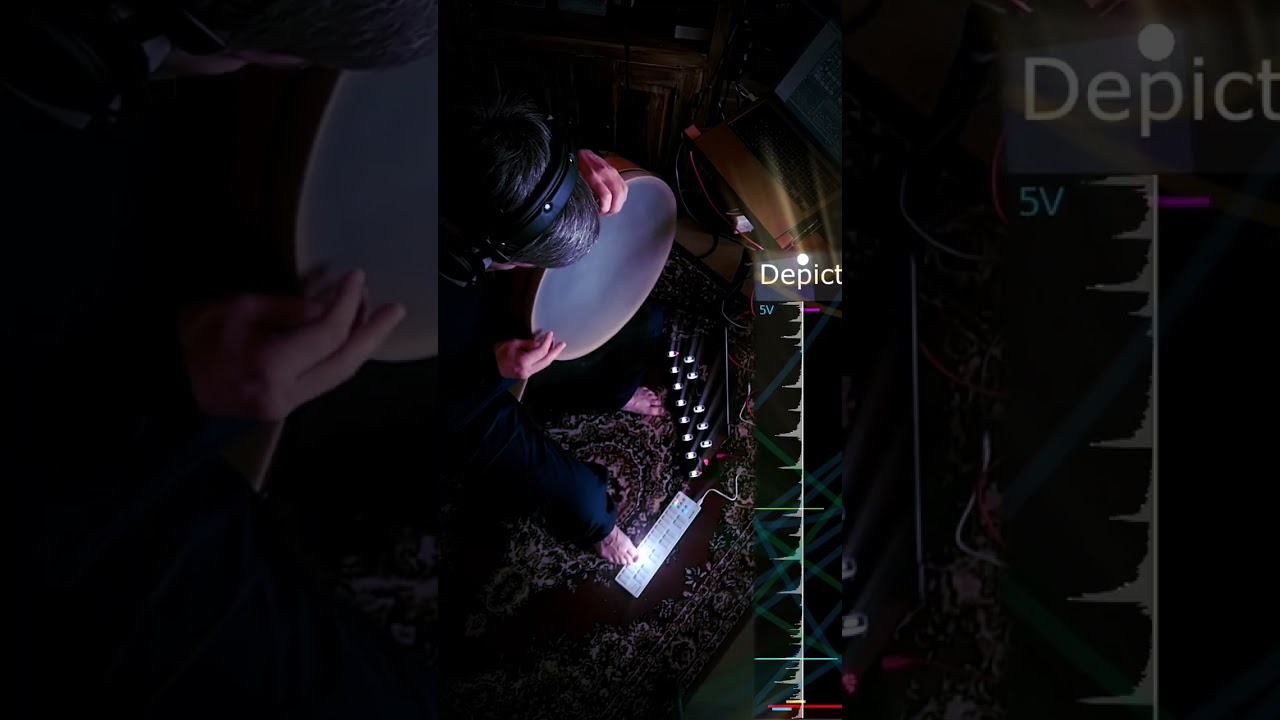
The instrument I’m playing is called Bendir (or more generic: Frame Drum). It’s an instrument played in different forms and shapes in the Middle East and around the Mediterranean Sea.
This one has a very clear pitch and I tuned it to C. If it’s not accurately tuned the whole patch falls apart though.
Let me know what you think I’m happy about comments, suggestions, inspirations etc…
Oh yes! I love frame drums and non-western meters. How do you count that one? I was counting 3/8 3/8 3/8 3/8 4/8
I am out of town now, but I am looking forward to getting home and playing some Native American flute to this recording.
Even with your written description, I struggle to hear that you are live sampling and manipulating the playback. It just comes across as additional voices, which is a good thing.
I actually feel this as two bars in 4/4
Something like that ||: D - - T - - T - | - - - - - - - - :||
One bar of Groove and one empty bar.
The groove isn’t really any traditional one. Maybe close to Ciftetelli (Arab or Turkish Rhythm). But then slower.
I’m also working on some odd-meter stuff but I didn’t really finish the patches yet. But there will be more different time signatures in the future for sure.
I would LOVE to hear that!!!
The live sampling is literally just EMBELLISH from the Memory Modules recording constantly in a (I think 15 seconds) loop. And then Fixation and Ruminate just play back from that audio buffer.
In the video the thing on the right is the DEPICT module from the Memory Modules where you can basically see what’s happening.
The red line is the recording head from Embellish, the turquoise (?) is the bouncing reading head from Ruminate at 4x speed, the green line is Ruminate at 1/2 speed (so, one octave down plus an extra layer of the half time rhythm of what I play) and the blue, yellow and pink are the reading heads from the three Fixations.
The white keyboard on the floor is sending midi and a gate to Fixation, the dark keyboard is for starting the patch, triggering a feedback loop into Embellish and starting the 1/2 Ruminate.
I was amazed the first time I patched that up how good that sounded and how easy it worked!!!
Mahlen did an amazing job with his modules there!!
I thickened up the melody with two VCOs through a percussive envelope which get’s triggered by the trigger out of two fixations. But even without it sounds already like … a melody with a clear pitch. I really didn’t think that it would be that easy to play melodies with my frame drum
This is excellent! It’s great to see other people using VCV to process acoustic instruments, I’ve never understood why this isn’t more popular.
The Stochastic memory modules are brilliant too. I made some ridiculous patches recently using 16 Fixation modules, merging the outputs into a single cable then adding polyphonic effects.
You could probably use this system to have a few more layers, building up multiple loops and overdubbing more sounds. That would be cool too.
I agree!!! It’s so much fun and endless possibilities
If you want to check another drummer doing modular synthesis, check out Dan Mayo.
He is using Euro Rack modules though. I think he started with guitar effect pedals some time ago and moved to modular at one point. He was and is a big inspiration.
But basically the person I need to blame for me giving this a more serious try is Soheil Shayesteh.
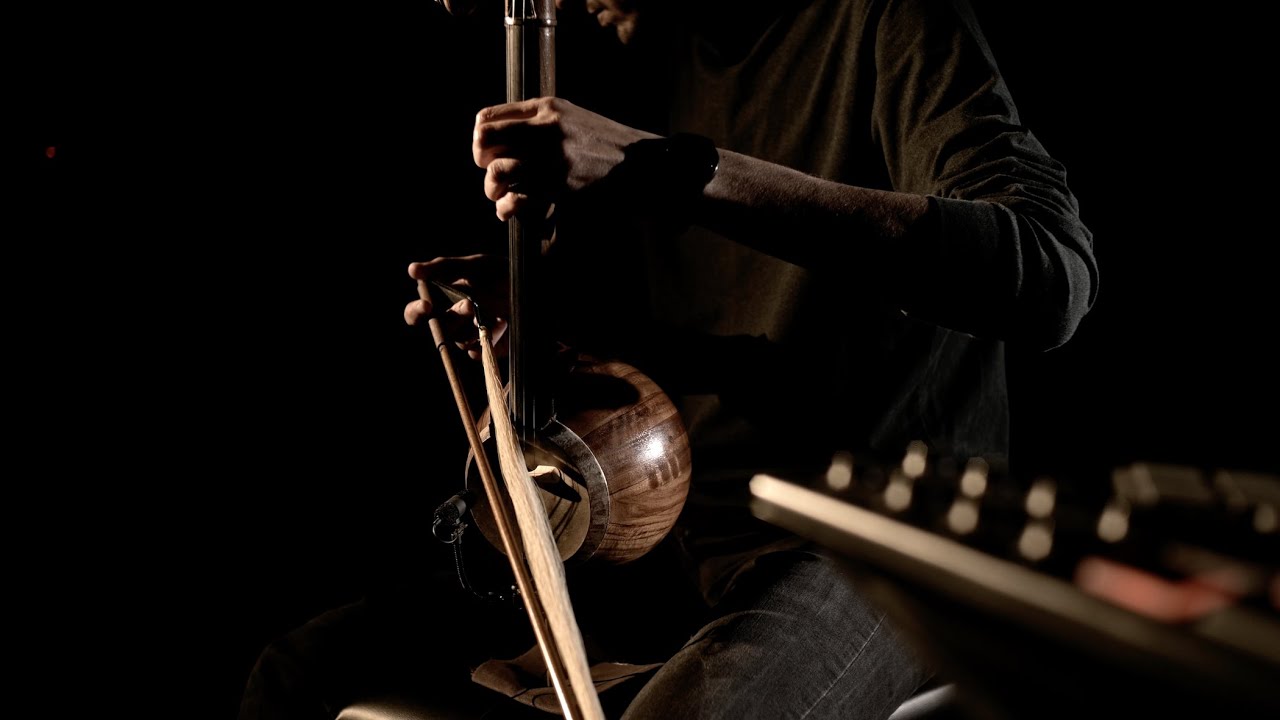
He is an Iranian Kamancheh and Violin player, based in Amsterdam who is working with Max for Live (Ableton) to create customised sound effects for his instrument. He does beautiful sounds and compositions!
I had the luck to work in one project together with him once where he processed some of my percussion instruments through his setup. And that made me thinking: mmhhh… I should look more into this. And then I stumbled over Omri Cohen and got interested in VCV … and here I am now
Yeah, the options there are basically endless!!
My approach right now is to create “small modular effect patches” that do one specific thing and then combining them in different ways. Let’s see where this journey brings me
Hey Mahlen,
I’m very happy you like it
And also thank you so much for linking it to the memory modules page!!!
My plan is to make more of those kind of videos in the future for my patches. But I’m not sure if everyone will be as elaborate as that one. It takes quite some time … but I also want to get better at the workflow for video editing. So I will for sure invest some more time into it.
The plan for those videos is also to publish them on my social media in the end. I would love to create a small life set with solo percussion and those modular effects. But you need something visual to grab peoples attention, that is the main goal for those videos. I also would like to look into small light effects for live performances but that’s still just a thought.
And I think Depict is a wonderful module for visualising what’s happening with the memory modules. It also made editing quite easy in a way: just needed to put a “light source” out of the frame next to it plus some moving masks on one of the moving lines. okay… slightly more complicated then that but it already provides a lot of beautiful visual cues that do quite a lot of work.
This is really interesting, thanks for the link. I’ll check out some more of his work.
I think you have a good approach, I’m currently trying to make the most ridiculous sound mangling effects possible using polyphony so you get different copies of an effect on multiple channels. I’m not sure how much further I can go with this, but if I get bored with it I can always go back to simpler ambient guitar patches with more traditional looping.
Yeah, Soheil is great! He also used a lot of live video projection manipulation for his performances.
Quite a one man show.
You also have been busy with sound effects with VCV for quite some time now! I still want to work my way through your video collection for inspiration
I think my approach right now is more towards: how can I alter the percussive signals into something non-percussive. Like creating a drone from one hit on the drum, more ways of creating melodic content, different textures, maybe even automated arrangements?!
Let’s see were this takes me in two years time. (if my feeble mind can stay focused on this for that long… )
The again very original title is: Rhythmic Memory (because the main modules are again from the memory modules from @StochasticTelegraph)
this one is build around the idea of creating a rhythmical loop / delay effect that is processing the incoming sound in a non-linear way.
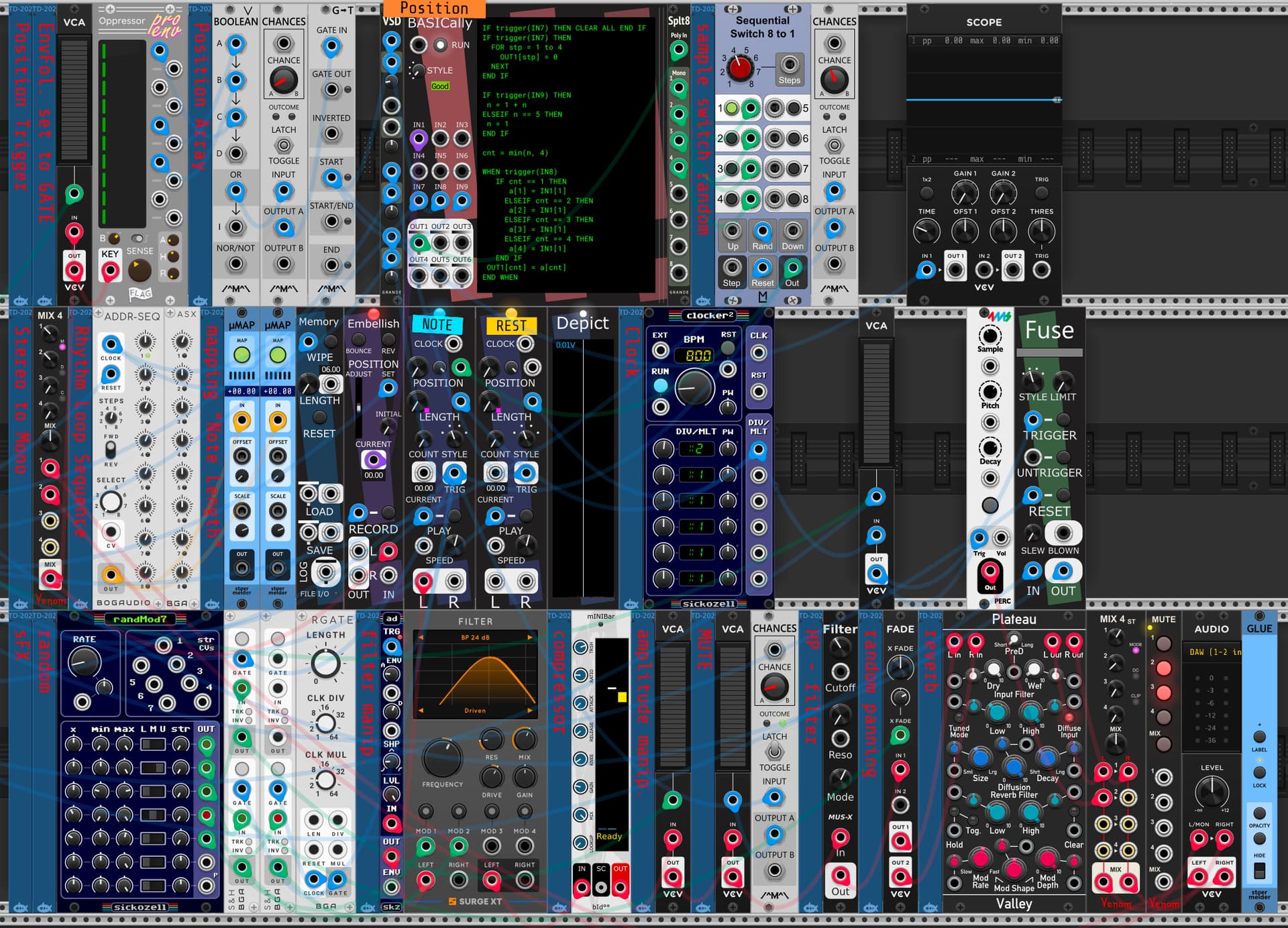
The core is again build around Memory, Embellish and Fixation.
Fixation got this new “Interpret LENGTH as note length” function (accessible through the menu) which together with a clock gives you the possibility to play back the buffer in a specific length (1/4, 1/8 etc).
I used µMAP to connect the LENGTH of Fixation to a sequencer with a programmed rhythm. And the sequencer gets driven by the TRIG out from Fixation. TRIG sends a trigger each start of the play cycle of Fixation.
Embellish is recording the live audio from my drums and the incoming audio is also sending a trigger above a certain threshold to a “sample and hold array” (programmed in BASICally) which then stores the position of Embellish. The array sends the values to a sequential switch, which randomly updates the position of Fixation.
The result is that you get a kind of repeating rhythm out of samples from the drums, where each sample get’s updated every so often from new sounds from the incoming audio.
Then there is some post sound processing with filters, amplitude & stereo manipulation and a random off switch to mute certain notes.
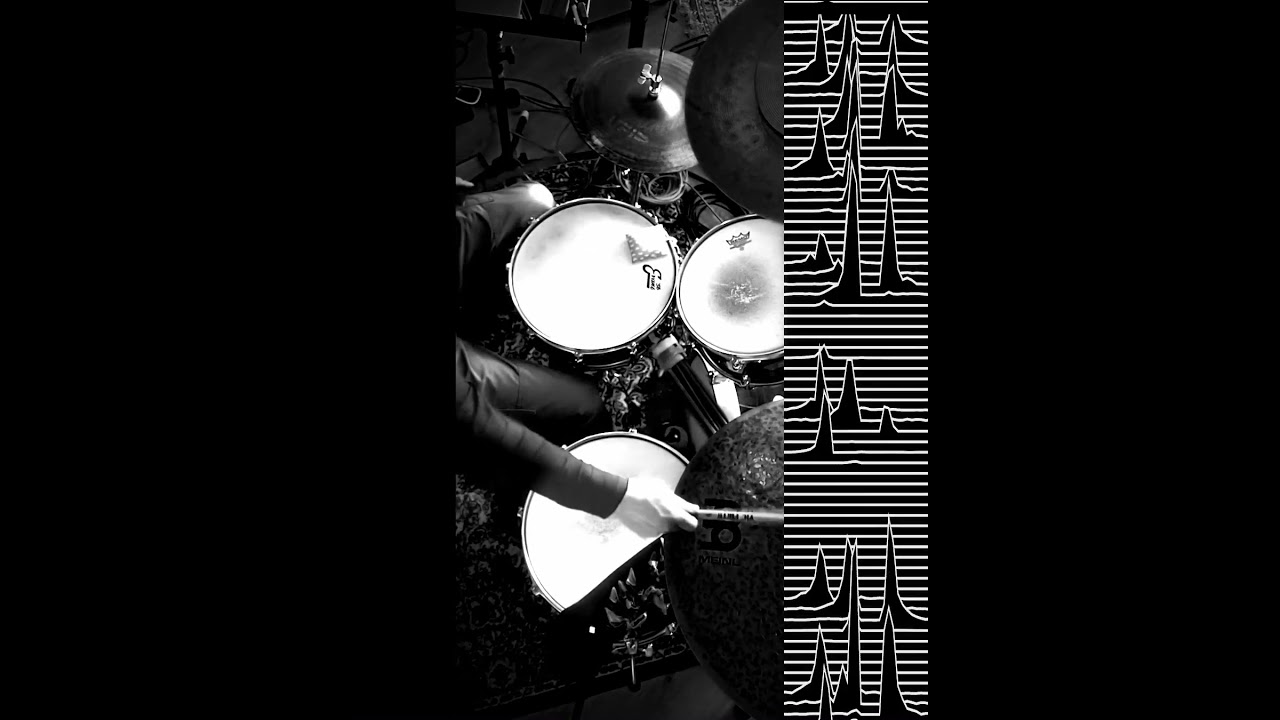
and to round things of I used Nysthi’s UNNYSTHIPLEASURESGRAPHER to visualise the rhythmical loop. It was again hell of a lot of work in Davinci Resolve to bring everything together but I’m quite happy about the result.
Nice drumming, this sounds great! Did you share the patch anywhere? I think it’s an interesting idea, but it’s quite hard to tell which sounds are sampled repeats and which are new bits played live. Would be cool to try it with other instruments too, and see what it does with bits of melody.
No, I didn’t share it yet. But I’ll do that here now
Rhythmic Memory_v09.vcv (12.1 KB)
I’m not sure how easily it is to convert it to a different instrument though.
ALSO:
It’s slightly different than the patch in the video. I don’t have that one anymore since things progressed since I recorded that video. I changed the post processing and I added a kind of Rhythm Bypass. When engaged the Sequence keeps on running but goes to a second Fixation that does not have an audio out connected.
I still need to figure out how to switch in-between those things while playing though
But the basic thing is still the same. You need to adjust the “Position Trigger” for the incoming signal or maybe find a better way how to trigger BASICally for storing the position of Embellish.
And there are two CHANCE modules that change how often the sound get’s swapped to a new one.
The logic is that BASICally saves the position of the sound when it gets a trigger from the incoming audio. Then those positions are “stored” in a random switch that sends it’s OUT to FIXATION. And Fixation only accepts a new position after it finishes one PLAY-cycle. So that way every new POSITION from the switch only affects the next sample.
It is for sure!! Even while playing sometimes it can be confusing
I needed to practice this a bit to get it to work.
I tried to “hint” on the repeating samples in the video edit though. So there are some moments where the video also repeats the sample from the audio. Not for all hits but just the once that I thought are more audible. (quite some edit work though…)
But I agree, it’s not really obvious what this effect actually does, just by listening to it. But I also think it does not need to be obvious. I still would like to have more control about the density of the whole patch though but right now I’m still at a loss how to implement that. And also how to control that while playing.
Thank you! I’m quite happy about the end-result. It took some time to get this tight though. The repeating sequence does not care if I’m slightly to fast or to slow …
I will also share the other idea for the evolving rhythm the next week or the week after.
Don’t have much time to work on it yet.
But there it’s a bunch of FIXATIONS with a fixed note length setting where the play get’s triggered randomly from randLoops. But then just using one sample from the incoming audio. So just a S&H on the position from Embellish that get’s send to Fixation. Triggered again by the incoming audio.
I still would like to have one starting rhythm and then gradually morph it to a more open rhythm over time. Probably with Path or Trace. Or maybe TRANSIT …






 )
)

 I needed to practice this a bit to get it to work.
