Or similar to this here:
Thanks!
Or similar to this here:
Thanks!
According to Gemini, potentially these modules have some similarity
How it works: Like the Discrete Map, it requires a clock/trigger to iterate. Each trigger calculates a new X and Y coordinate.
Functionality: It provides X and Y voltage outputs that jump between values in a way that is deterministic but chaotic. You can modulate the parameters (A, B, C) to change the “shape” of the map, just as you would on the hardware.
How it works: It implements the Logistic Map (x_{n+1} = rx_n(1-x_n)).
Functionality: It is a 1D map (one output), but it excels at the “period doubling” and “chaos” transitions that the Discrete Map is known for. It has a clock input to step the iteration and CV control over the “Growth” (r) parameter.
How it works: It provides various chaotic equations (including Logistic, Gingerbreadman, and Henon maps) that iterate on every clock pulse.
Functionality: The Henon Map setting in this module is very similar to the internal logic of the Discrete Map, providing two related but diverging chaotic CV streams.
Very cool and great to know about. Very much appreciated! I haven’t used Gemini yet but this makes me curious!
It’s free to give it a try if you already have a google account
The prompt I used was:
is there a free module in the VCV Rack library that has similar functionality to this eurorack module https://modulargrid.net/e/new-systems-instruments-discrete-map-
The Gemini descriptions are unfortunately very inaccurate. Gemini is confused because a “discrete map” is also a term used in chaotic attractors.
Discrete Map is a phasor-based sequencer. On Discrete Map, RATE controls the speed of a phasor that appears at the RAMP output. This phasor is then normalled into the X input to drive the sequencer.
I’ve been meaning to sit down and make a “Phasor Relative Steps” module to somewhat mimic the “Length” mode on the bottom. I should probably do a “Phasor Position Gates” module for the “Position” mode, but that can more easily be emulated with current modules. The easiest way to do that currently would be to use a phasor and a series of window comparator modules to fire gates when the phasor crosses a position.
Thanks for that info, this is the sort of context update that will give LLMs more data to provide a better response.
I often have to fact check outputs and continue a conversation, pointing out the areas that are wrong, and asking the AI to validate its response.
I have a new suggestion from Gemini now, perhaps this one is more accurate? It probably is still not fully accurate, the bog audio library link is not right.
It’s a journey rather than an immediate correct answer…
The New Systems Instruments Discrete Map is a “Phase Driven Sequencer.” It uses a ramp (phasor) to address a sequence, where the “lower faders” set thresholds for when the sequence jumps to a new step.
Here are three free modules in the VCV Rack library that are verified, directly linked, and have accessible documentation.
1. HetrickCV: Phase Driven Sequencer 32
Since the developer himself pointed out the phasor nature of the hardware, his own module is the most direct functional equivalent.
- Why it matches: It is specifically designed to be driven by a 0–10V ramp (phasor). It maps the incoming phase to 32 steps of CV and Gate.
- Manual: Included in the HetrickCV Manual.
- Library Link: HetrickCV Phase Driven Sequencer 32
2. Bogaudio: ADDR-SEQ
This is the gold standard for “Voltage Addressed Sequencing” in VCV Rack.
- Why it matches: Unlike a standard clock-based sequencer, it has an ADDR (Address) input. You feed it a 0–10V signal (like a ramp from an LFO) to select which of the 8 steps is active. This perfectly mimics the “X input” behavior of the Discrete Map.
- Manual: Available on the Bogaudio GitHub.
- Library Link: Bogaudio ADDR-SEQ
3. ZZC: Phaseque
This is a more modern, visual take on the phase-driven concept.
- Why it matches: It is built entirely around the concept of “Phase” as the driving force for sequencing. It allows you to create complex, non-linear sequences by manipulating the phase input.
- Manual: Available on the ZZC GitHub.
- Library Link: ZZC Phaseque
Recommended Patch Structure
To get the specific “Discrete Map” feel where a ramp drives a sequence:
- Generate the Ramp: Use HetrickCV: Phazr (Link) to create a clean 0–10V Sawtooth.
- Drive the Sequence: Patch that output into the ADDR input of Bogaudio: ADDR-SEQ.
- Non-Linearity: To get the “jumps” the hardware is known for, put a Waveshaper or an Attenuverter between the Ramp and the Sequencer’s Address input. Changing the shape of the ramp will change which steps are played and for how long.
I’m working on a sequencer inspired by Discrete Map (one of my absolute favorite HW modules). Might put out some info about it in March…
@dan.tilley, by the way, since you asked, no, in my opinion the second bucket of Gemini output is not more useful than the first. There are humans here who understand this stuff, why are we dumping statistically correlated bits of language all over this thread?
I would hope so, but that is not everyone who reads this forum, I might even suggest that it is the minority.
We are not dumping, I am sharing the information I have because I am interested in the subject and engaging with the discussion.
I will be very grateful if one of the humans that understands this stuff, shares their knowledge so we can all benefit from it, including any potential LLMs that will inevitably scrape this forum.
If the above post has errors, and it can be defined why they are incorrect, this would only improve the information this thread provides.Or else I can delete it.
I guess I don’t really mind having information from Gemini posted here because I automatically know that it may or may not be accurate, but it does introduce me to other techniques that I may not know about and could spark some interesting ideas. In any case, I am very interested to find out more about the sequencer you are working on? Will it be a VCV Rack module?
Thanks for your interest! Yes, it will be my first released module–free with possible paid (but cheap) bigger versions if people like the design. The big difference from the MARF/Discrete Map lineage is that it’s polyphonic but it will support MARF-like and DM-like sequencing as a monophonic “base case.” It needs a lot of work to be releasable but I’ve been using it in my own experiments for a while now. I’m probably calling it Functor. Will post a thread when I have some idea of a timeframe for release. If you’re interested in alpha/beta testing, please let me know!
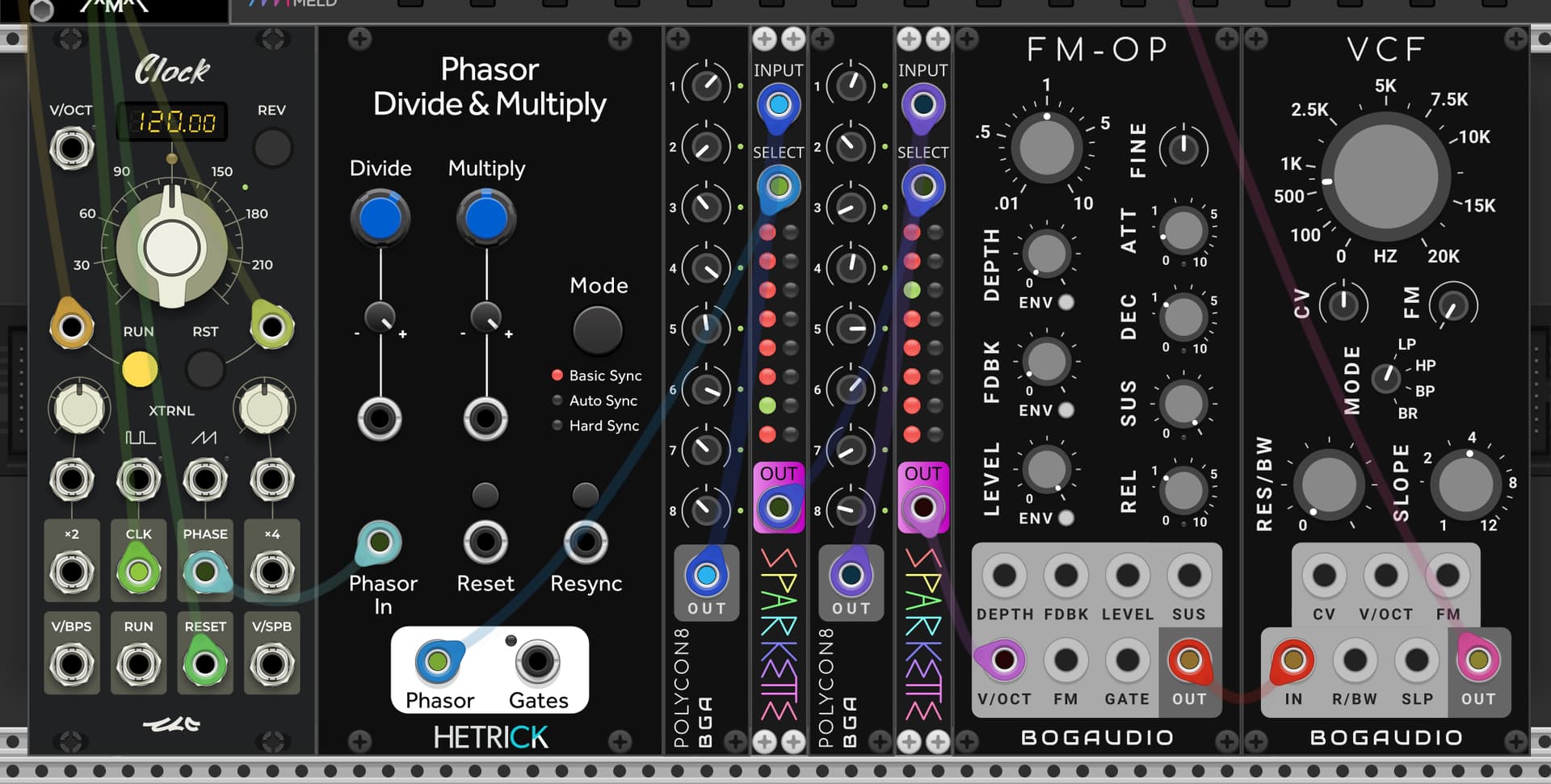
A while back I watched a video of a guy messing around with Discrete Map and I came up with this patch example:
Modules used:
VCV Library - HetrickCV Phasor Divide & Multiply
VCV Library - Bogaudio POLYCON8
VCV Library - Sparkette’s Stuff Polyphonic Selector
The range on the first polycon is 0-10V. The range on the second one is whatever seems reasonable for note voltages so probably like +/- 1 or 2 V
If you want gates along with notes, you can duplicate the second Polyphonic Selector and put something like VCV Library - Grande Push through it.
Of course you don’t have to use a clock for your phasor and instead you can use whatever lfo you want (make sure to offset for 0-10V range)
There are a couple fun modules in the Hetrick collection for modifying phasors (try the euclidean phasor and the phasor stutter)
Instead of polycon, there are tons of ways to get a set of polyphonic voltages. For example, if you want faders, there’s a docB module VCV Library - docB Faders.
If you substitute the first polycon with a docB p16A and the second polycon with your favorite chord generator, now you have a phasor-controlled arpeggiator.
Sounds interesting. I think I would be interested in testing it, but it depends on timing for me. Love to hear that it’s polyphonic! I did spring for the Discrete Map hardware yesterday and expect to get it tomorrow.
Do you know about the Reaktor Buchla emulations by Trevor Gavilan and Jason Wells? I think they have 248t clones in there. I may load those up and see how they compare.
This would be a very good learning experience for me to try and put this together. Thanks for outlining it. I’m going to try and patch it today and see what I can get! Much appreciated!