The Infinite-Noise plugin (version 2.0.2) for VCV Rack 2.5 or later has now been released in the VCV Library
Development started back in 2024, but real life got in the way a few times.In hindsight, this turned out to be a good thing. Over the past two years, modules have been removed, replaced, redesigned, and new ones have been added.I also had several unfinished modules that kept delaying the release, so I finally decided to move their source and resource files to a local folder and continue working on them at a later time. This allowed me to finally release the plugin rather than keep postponing it.At this point, I’m very happy with the plugin, and I don’t want to make any major changes to the existing modules going forward.
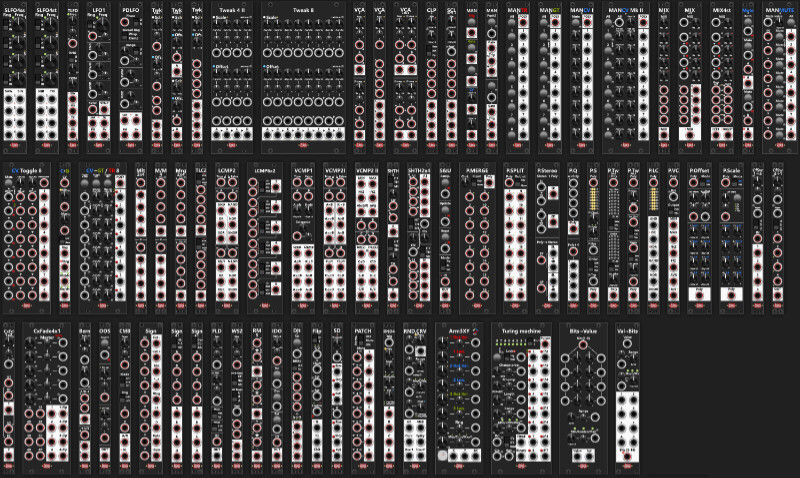
The plugin currently contains 76 modules, primarily focused on CV generation and manipulation, covering a wide range of categories including LFOs, VCAs, manual controllers (buttons/knobs), mixers, mutes, merge/mult utilities, logic and value comparators, S&H/T&H/H&T modules, polyphonic utilities, random value and curve generators (with distribution control), wave shaping/folding, flip-flops, Turing Machines, Bits↔Value conversion, and much more.Most modules can both accept and generate polyphonic signals, although a few are monophonic only. The plugin also includes 11 dedicated polyphonic utility modules, designed specifically for manipulating polyphonic signals and converting between polyphonic and monophonic formats.
Simply looking at the list of categories/modules, I’m sure many will think, “We’ve seen it all before,” and that’s probably true. However, I’ve put my own spin on these modules.For example, many inputs and outputs can be configured to work with either triggers or gates. When an input operates in trigger mode, odd-numbered triggers act like a gate going high, while even-numbered triggers act like a gate going low. In addition, the frequency or rate of many modules can be affected by a Rate Chaos setting (available from the context menu), adding subtle—or not-so-subtle—timing variations for less static and more organic signal or value generation.But don’t take my word for it—I’m probably “a bit” biased 
All module panels are available in both light and dark themes and, by default, follow the appearance setting selected in VCV Rack. All outputs are clipped to a ±12V range by default, though this can be changed via the context menu.For modules that accept or generate gates and triggers, both the detection thresholds and output voltage levels can be customized via the context menu if you need to change the default behavior. For example, a gate output can be inverted by configuring high gates to output 0V and low gates to output 10V.All polyphonic ports are identified by a thin red ring. In addition, port tooltips are prefixed by default with “(m)” for monophonic ports and “(p)” for polyphonic ports, making it easy to distinguish which ports support polyphonic signals. These prefixes can be disabled via the context menu if you prefer cleaner tooltips.
The plugin is now available in the VCV Library, and for anyone interested, the complete source code is available on GitHub, along with comprehensive documentation covering all modules..
Known issue:Speaking of the manual, there is one small issue I noticed after releasing this first version to the VCV Library. The manual states that the Manual Push 2 module accepts both gate and trigger inputs. This was the intended functionality, but apparently I overlooked implementing the trigger mode before the release, so the module currently treats inputs as gates only. I’ve decided to leave the manual as it is for now, since the issue is already fixed in my development version and will therefore be corrected in the next release.


