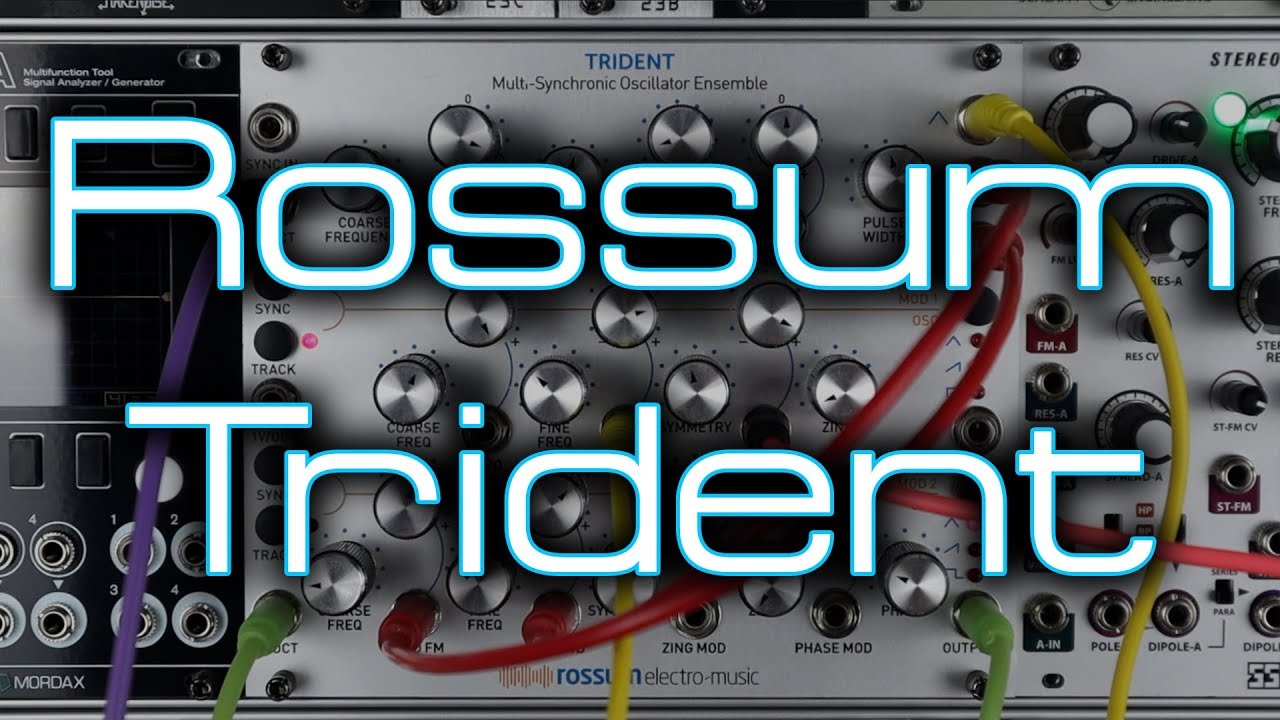
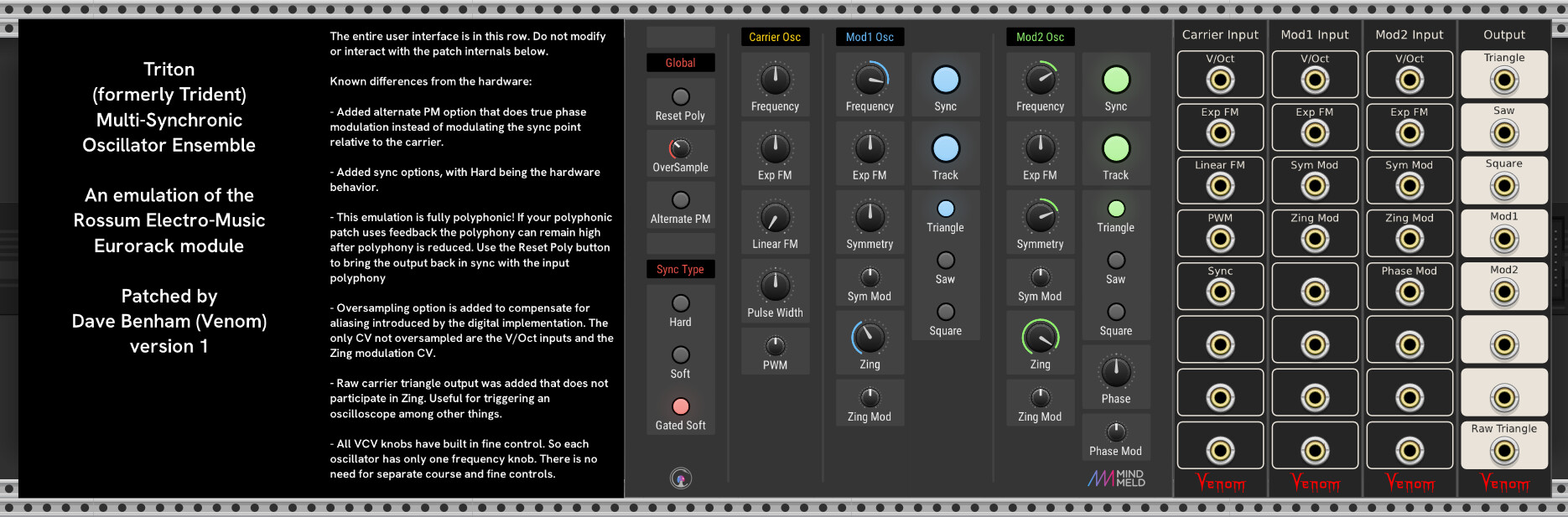
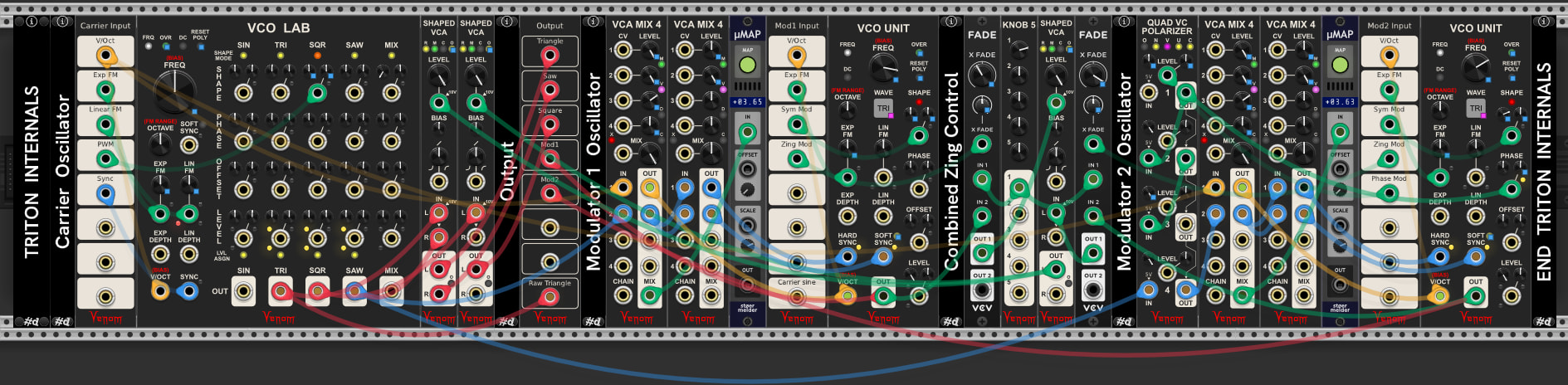
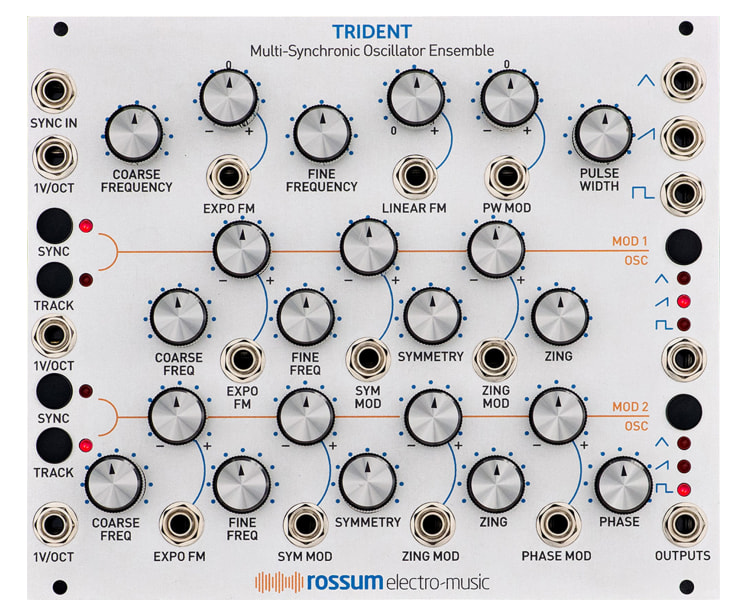
I stumbled on this cool module and realized my Venom oscillators are well suited to emulate it. The Trident uses synced oscillators to ring modulate the carrier, which Dave Rossum calls Zing modulation. The sync enables the ring modulation to always sound harmonious, not unlike what it can do for FM.
Here is a DivKid video about the Trident (now Triton)
I think the emulation is able to behave and sound very much like the hardware.
This emulation relies on Venom v2.16, which has not been released. I enhanced the oscillators to support a new type of soft sync that I call Gated Soft Sync, in which the oscillator plays in reverse when the soft sync gate is high, and forward when low. I also added a new Sync Threshold option with a miniscule 0.1 mV hysteresis centered about zero. As long as the syncing signal is symmetric with equal times high and low then the gated soft sync sounds very similar to a traditional hard sync, or 1 octave higher than a normal soft sync. But add a tiny bit of asymmetry to the sync signal and you get a sync sound with a lot of motion - the timbre constantly shifts in a pleasing way.
I used this new feature to add sync options not found in the Trident hardware.
You can get a dev version of Venom with the needed enhancements below - all you need is a free GitHub account to access the download capability.
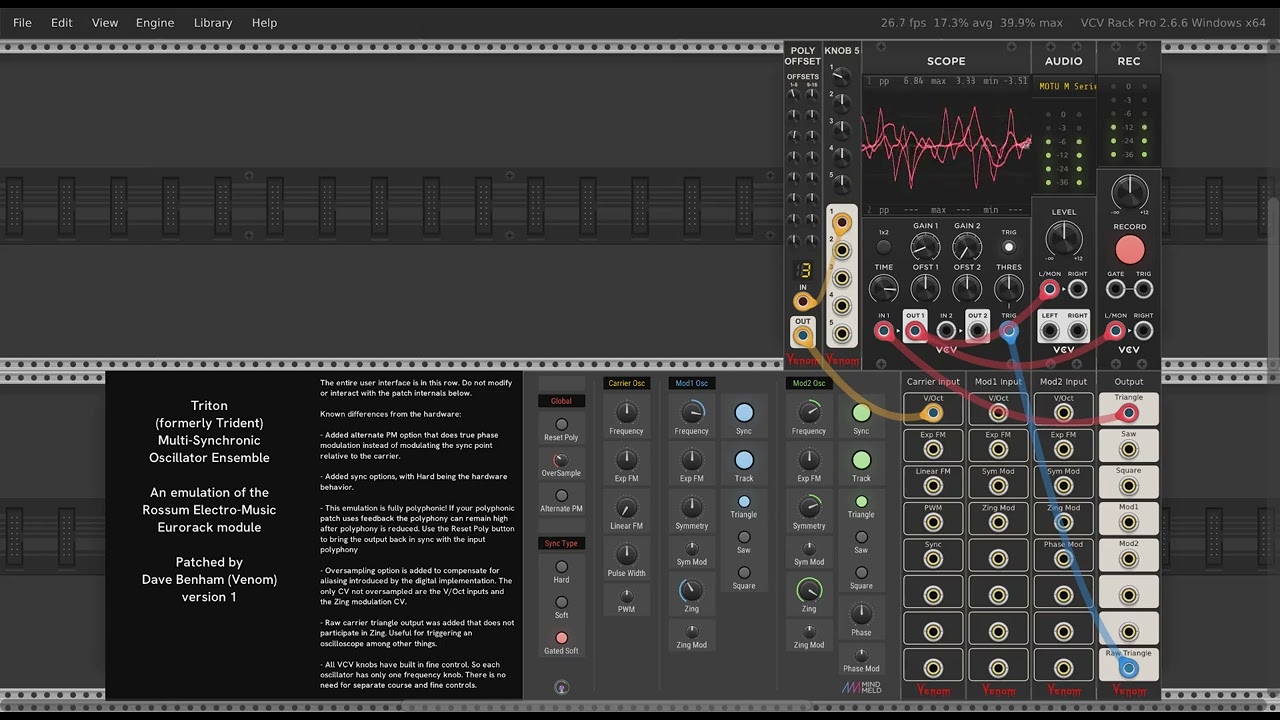
I created a demo patch that uses the gated soft sync feature to create a polyphonic drone that I really like. Here is the patch and a short video:
As stated in the message:
“I am considering creating a commercial module with the features of this emulation.”
No need asking for free modules.
And –with all respect– if you want free:
learn how to patch/emulate/code yourself. It will take time and effort, but no money.
In this case the patching is already done for free.
Have fun with it!
Fascinating ! Thank you for sharing and documenting.Had a quick read and I will try if I can get this to work with hardware (Schlappi Engeneering 3 body +….) Looking forward to a dedicated VCV module.
Is it something unique that the Trident can do a mix of exponential and linear FM?
I’m wondering if the final signal (carrier or main oscillator) is a mix of both modulations (linear and exponential), or if the output of for ex. the linearly modulated signal (from main or carrier) is exponentially modulated (in series).
Does it makes sense/is it musicall to mix the modulation/place it in series ?
I can’t quite figure it out from the manual from Rossum Electro Music TRIDENT. I’ve contacted Rossum Electro music and will update.
@DaveVenom how did you implement this in the vcv patch / what do you think ?
Pretty much every VCO that can perform linear FM also simultaneously performs exponential FM - the V/Oct input is exponential FM after all, it just doesn’t have any FM depth control.
The Trident simply has a 2nd exponential FM input with depth control that gets summed with the V/Oct input. There are other hardware VCOs with simultaneous V/Oct, exponential FM, and linear FM inputs. One example is the Future Sounds Systems OSC2 Recombination Engine.
You can add additional exponential FM modulation to pretty much any analog VCO hardware. Simply use a mixer to combine your V/Oct modulation at 100%, and your exponential FM with user controlled amount and send the mix to the V/Oct input. If the mixer has VCAs per channel you can also provide for voltage controlled FM amount. This typically does not work so well for digital VCOs because audio rate modulation introduces digital aliasing. Exponential FM inputs often have extra processing (over sampling) to compensate. But V/Oct inputs are usually not modulated at audio rates, so they usually are not over sampled.
Bear in mind - most VCOs that claim to do linear FM are actually performing phase modulation instead.
My emulation patch is there for you to study! Have at it. Don’t forget you need to download the dev version of my Venom plugin because the emulation relies on some VCO Lab/VCO Unit features that have not yet been released.
What makes the emulation possible is the design of my Venom VCO Lab and VCO Unit modules. I designed them to make as many modulation types simultaneously available as possible. One of the reasons I created them in the first place is because I was interested in emulating various hardware complex oscillators, and often times I struggled to find a VCO that had all the features required. So I built my own.
When trying to create the Trident emulation I realized I could improve the end result by adding some new features to VCO Lab and VCO Unit. As I run across / dream up new modulation types, I add them!
I got a quick and detailled reply from Rossum Electro music.
Thank you for your message and for your interest in Triton (formerly known as Trident).
The FM sources are mixed together, not arranged in series. The Carrier (main) oscillator has one frequency, and both FM inputs act on that single oscillator at the same time. The Expo FM input (after its attenuverter) is summed with the Coarse/Fine Frequency controls and the 1V/Oct input in the exponential (1V/octave) domain, and the Linear FM input is a separate, AC-coupled path that adds a linear frequency offset to that same oscillator. So the instantaneous carrier frequency is the exponential and linear contributions combined in parallel on the one core. There’s no arrangement where a linearly modulated signal is then fed into exponential modulation, or vice versa.
Other oscillators have both linear and exponential FM, but Zing modulation is unique to Triton. In short, it’s mathematically akin to ring modulation, but because the modulation oscillators are hard-synced to the carrier, the usual aharmonic sum-and-difference tones of ring mod collapse into complex but purely harmonic overtone spectra that shift dynamically with the mod oscillators’ frequency, symmetry, waveshape, and phase. Dave Rossum explains the whole idea (with the underlying math and scope shots) in the “From Dave’s Lab” section here: