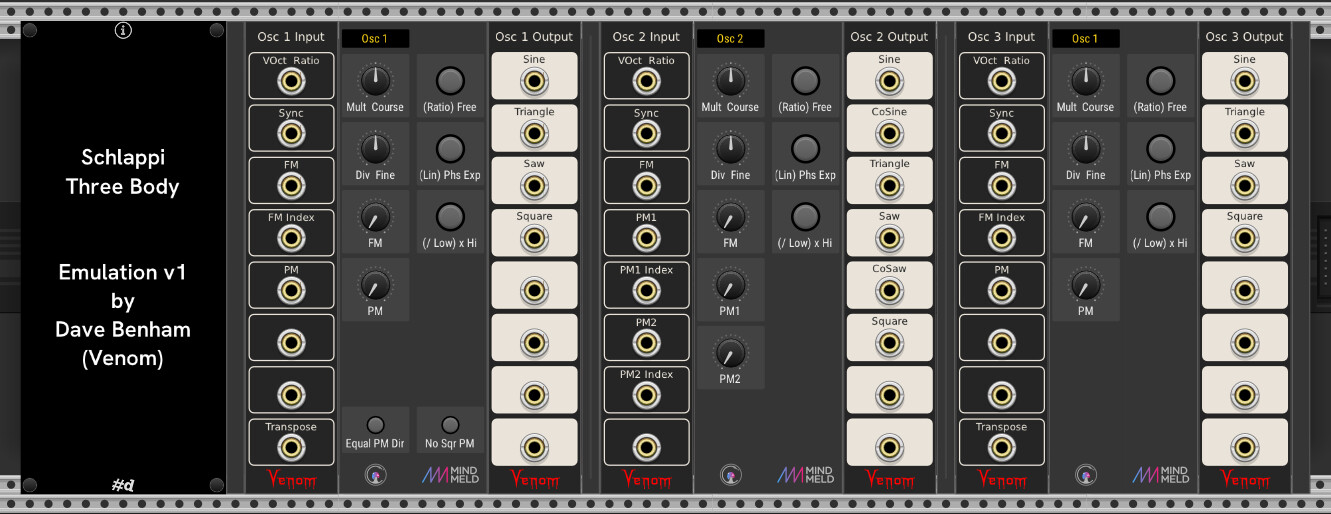
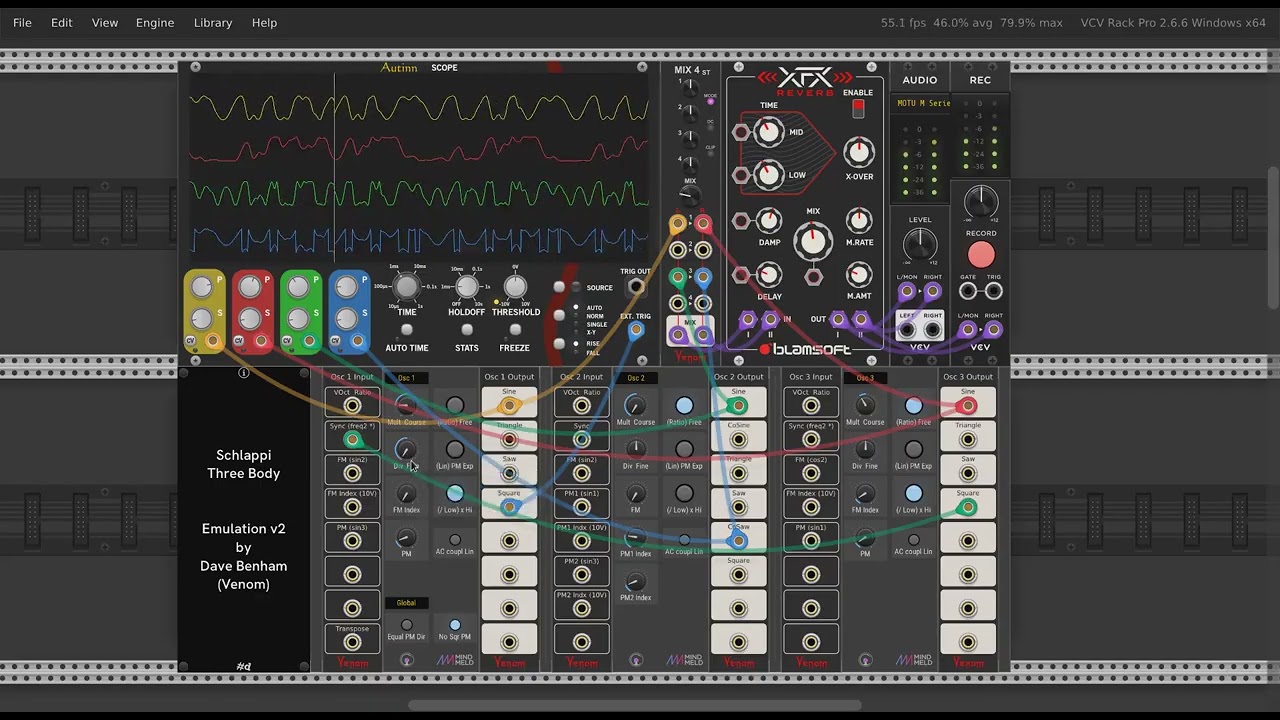
I have been fascinated with FM and PM for a while, and I decided to take a crack at emulating the incredibly deep Schlappi Engineering Three Body complex FM VCO.
The module is an absolute beast, with a dizzying array of options using a limited number of single function controls - no menu diving! Watch the videos on the Schlappi link above to get an idea of what it can do. It is so deep that Bries created a two hour video just to introduce all the features! There is also a link to the well written and informative manual on the site.
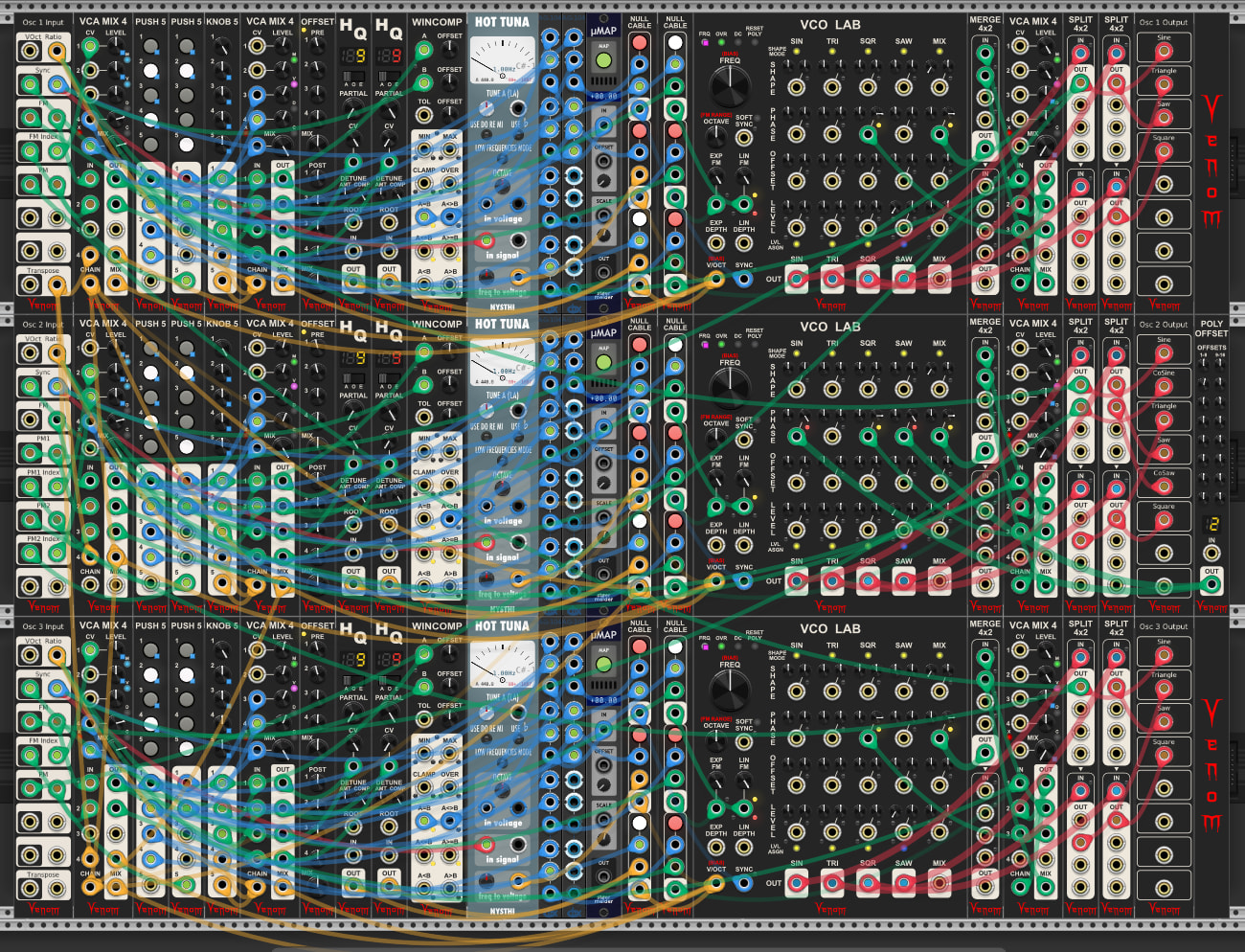
There is no way I can summarize how to operate this thing. Watch the videos and/or read the manual found on the Schlappi site. I really worked hard to faithfully emulate every damn feature in the hardware! Pretty much all of the controls, all of the inputs and outputs, including all of the normalizations, . . . even the header options available on the back of the board. The hardware is digital, and my Venom VCO Lab is built to handle FM and phase modulation well, so I believe the sound from my emulation should be close to the real thing.
Note that the patch is quite large, and consumes a lot of CPU. It may not be useable for some
Also note that this emulation does not support polyphony because the internals already use polyphony to establish some of the phase relationships within each oscillator.
Here are some notes on known differences from the hardware:
VCO Lab does an admirable job controlling digital aliasing through oversampling. But the hardware operates at an insane internal sample rate well into the megahertz range, so I can’t compete with that! Still, the emulation does quite well.
Unlike the hardware, the external pitch tracking via the sync input while in Ratio mode does not work at low frequencies.
The hardware mode switches have been replaced by buttons. The parenthesized label represents the off state, and the normal label is the on state.
I don’t think the frequency ranges match, but there should be plenty of overlap to get a sense of what the hardware can do
The scaling and depth of FM and PM (phase modulation) probably does not match. But again there should be plenty of overlap.
The hardware Square Phase Mod configuration header has been exposed as a “No Sqr PM” option button in the UI. If enabled then square waves do not participate in phase modulation.
The hardware Phase Direction configuration header has been exposed as a “Equal PM Dir” option button in the UI. If enabled then the cosine, cosaw, and triangle waveforms no longer respond to phase modulation in opposite directions from the rest of the waveforms.
The hardware PLL Mode and External Filter Select configuration header options have not been implemented.
That is it - to the best of my knowledge, everything else has been faithfully reproduced. Of course, with so many options, there could very easily be some bugs in my patch. Please let me know if you discover something that is not right.
I find the thought process behind this type of patching to be very similar to coding. Even the process of debugging is very similar since I rarely use a debugger when I code (never for VCV plugin development)
I had forgotten to make the Osc2 linear FM DC coupled
The Osc3 PatchMaster was mislabeled
I also made two enhancements that are not available in the hardware:
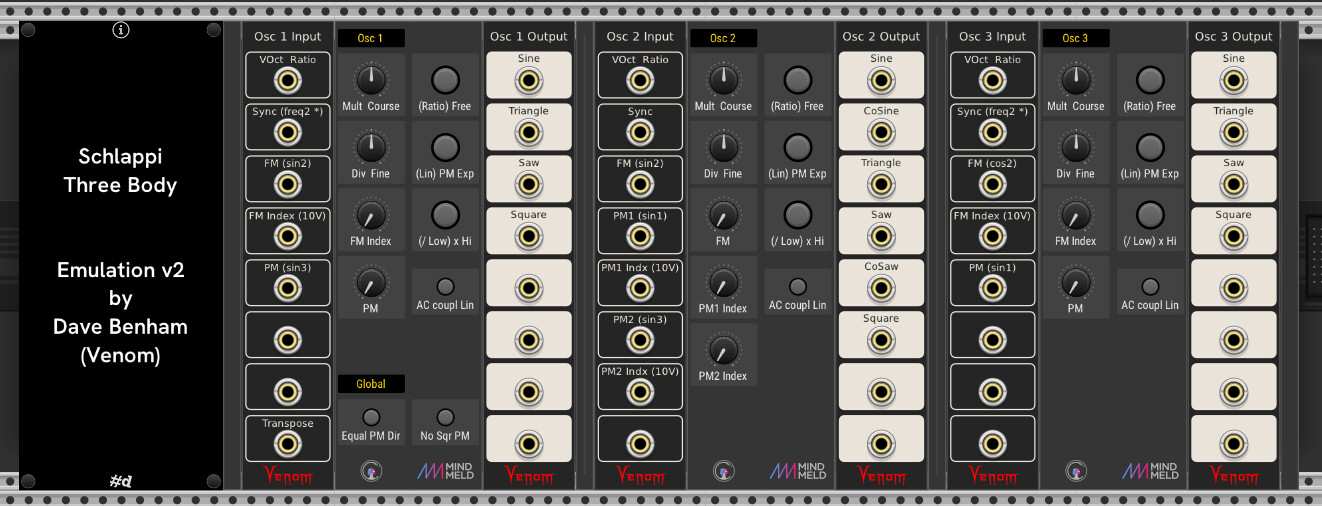
Osc2 FM input is now normalled to Sin2 so it can conveniently do self FM
Each of the VCOs now has an “AC coupl Lin” option button to make the linear FM input AC coupled. By default they are DC coupled like the hardware.
I also improved the UI labeling to make things clearer.
The CV inputs now have parenthesized text to show any normalled (default) signal path.
The freq2 normalled path for Osc1 and Osc3 sync has an asterisk for two reasons:
It only applies if the VCO is in Ratio mode
It does not patch in the Osc2 output and try to detect the pitch. Rather it pipes the necessary V/Oct CV value directly to the oscillator V/Oct input.
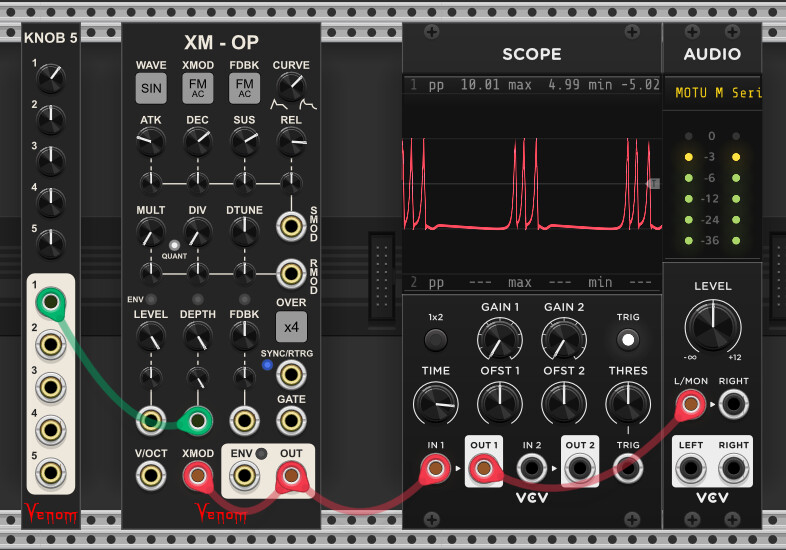
I learned something interesting when playing with AC coupled linear self FM - high index values can lead to generation of subharmonics! It is tough to achieve clean results with this emulation due to sample delays from intervening patch cables. But you can use my XM-OP to explore the concept more easily.
Patch the XM-OP output to the XMod input (FM AC mode), turn up the depth to maximum, and patch in additional FM index CV. Vary the CV amount to sweep through the sub harmonic series.
I have started designing the 3 body emulation module. I have a working faceplate with controls and ports, including dynamic popup labels and scaling based on various modes. But no actual oscillations have been coded. I have ideas for a total of 3 new complex oscillators for a collection, including the 3 body emulation but excluding the 259, but I haven’t committed to if or how I will release them.
For the Buchla 259 I think I am near the limit of my prototype. I have ideas for at least 3 Buchla inspired modules for a collection. But again I haven’t committed to anything yet.
It would be at least a couple months, likely longer, before anything is released. I am a bit of a Luddite, still graphically designing, coding, and documenting everything without the use of AI.
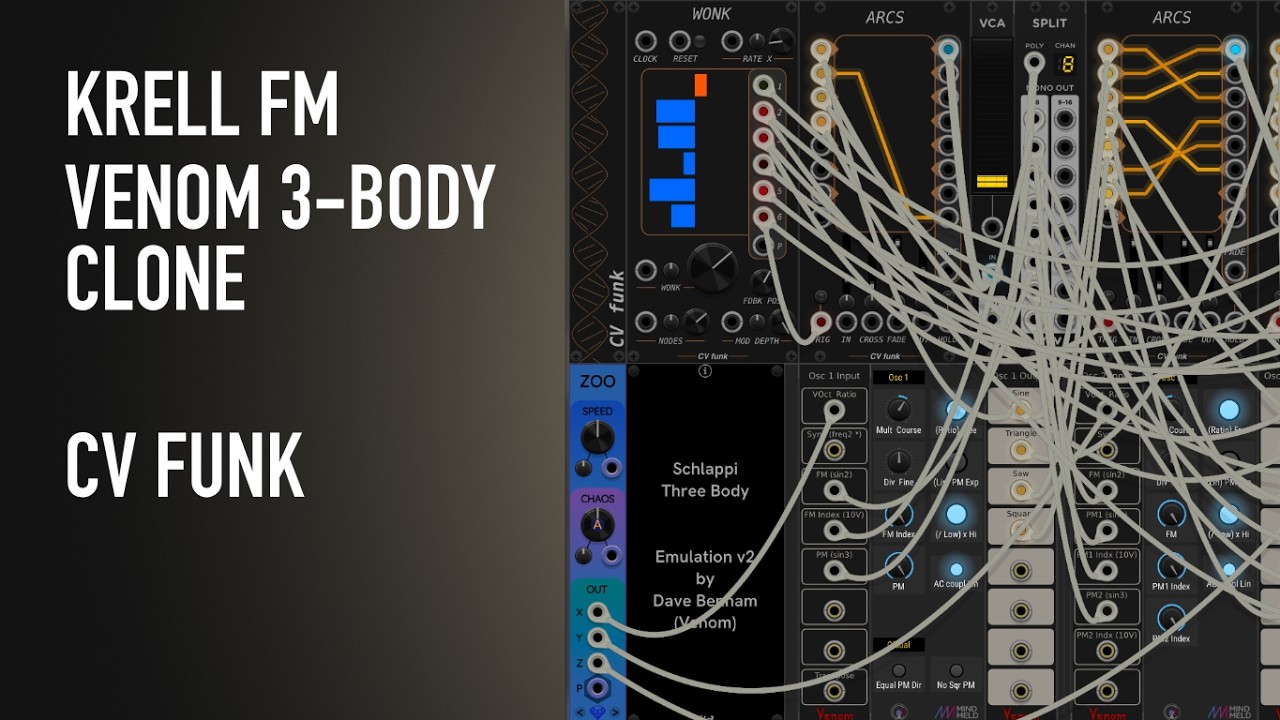
Okay. Finally got around to playing with your emulation patch. holy moly! This thing is a really gnarly beast of screaming noise and crazy buzzing sounds. I made a little patch cross routing all of the outputs to all of the modulation inputs using a bunch of my Arcs modules. Each time Arcs is triggered it crossfades a random subset of outputs to modulation inputs. I patched all of the outputs at once to HotPot. The result is a quite glorious swirling bath of noises and things sounding like an alien space hanger.
I’m sure packed into a single module you’ll get substantial CPU gains with simd streamlining and an internal higher sampler-rate.
Yes - it is very easy to get in that territory. Your patch takes it to an extreme because all your VCOs are in Free mode, meaning it is not using any nice integral ratio frequency relationships.
But even if you use Ratio mode, it can still become a monster if you use lots of cross-modulation. Your patch uses only Free mode and extensive cross-modulation, so yeah - totally nuts.
It is also really easy to get sweet harmonious FM sounds if you switch say the outer two oscillators to ratio mode, and use cross-modulation sparingly.
All of the FM and PM inputs have a normalled source shown in parentheses. So even without patch cables you can quickly explore interesting FM sounds.
It is awesome! Love it Dave. And I forgot to turn on Zoo in the recording so it’s not even going properly wild. I should make a v2, I added a Just quantizer after Zoo and am messing around with it now.
I find it fascinating how the frequency ratio of a single VCO somehow manages to establish a pleasing chaotic melodic pattern for all three droning VCOs via cross-modulation.
Configuration:
VCO 2 is running very slow Free LFO mode
VCO 3 is running mid range Free audio rate with linear FM from VCO 2 cosine
VCO 1 is running in Ratio mode, tracking VCO 3 square by the built in pitch follower, with the ratio initially set to 4:3.
VCO 1 and VCO 3 cross phase modulate each other using sine outputs
VCO 1 and VCO 3 also phase modulate VCO 2 using sine outputs
The audio output is a mix of:
VCO 1 sine left (yellow trace)
VCO 3 sine right (red trace)
VCO 2 sine left (green trace)
VCO 2 “cosaw” right (blue trace)
Changing the ratio of VCO 1 completely changes the musical patterns:
0:00 - Ratio = 4:3
1:04 - Ratio = 2:1
2:04 - Ratio = 4:1
2:43 - Ratio = 4:3
2:52 - Ratio = 1:1
3:23 - Ratio = 4:3
3:45 - Linear FM from VCO 2 sine is a bridge too far, adding more chaos
4:22 - Linear FM removed and fade out
I didn’t show this, but the VCV sample rate controls the tempo of the musical pattern. I am running at 48 kHz sample rate. Higher sample rates speed up, lower slow down.
I don’t understand how any of this works, but I hypothesize that the many sample delays introduced by the cabling of the cross modulation in the emulation internals play an important role in establishing the melodic pattern. I predict that the Schlappi hardware will not behave the same unless some micro delays are introduced to the cross modulation, but that is just a guess.
Interesting idea! But the Nysthi Hot Tuna (pitch follower) and docB DC Block are not available in Cardinal. Perhaps substitute modules could be found, but then the patch would need to be retested in VCV as well.
Wow! I haven’t tried Cardinal yet. But I did a survey using different pitch detectors, and man they all make a tremendous difference!
Nysthi Hot Tuna
Sapphire Env
CV Funk Tuner
Entrian Follower
Then throw in the configuration options available to each of the followers, and the variations are tremendous!
So I still think sample delays can alter the over all results, but the pitch detector is what is determining the musicality of the sequence. That only stands to reason, now that I think about it.
Nysthi gives the most discreet jumps. I don’t know what I prefer.