It is easy if you are smart, haha. But I am not smart, so I mess up every time and then I am trying to fix it. Well, that’s how people learn, I think… But I still mess up even things that I already know, like the virtual ground thing. i already had this problem. And quite recently… I think it was with a comparator in a sequencer… There was something wrong with the reference… I don’t remember. Anyway, thanks for kind words! Perseverance is indeed what keeps me going.
Hi! Alright, straight to new stuff, which is not a lot, but all very interesting! So I like reverbs and I have a guitar pedal reverb and Alesis Midiverb thingie and I used to have a dedicated guitar multiFX unit that I used for reverbs only, cause all the overdrive/distortion and even delay-based effects were bad, while reverb was passable. Anyway, a year ago or maybe even more I decided to make my own spring reverb. Like from scratch. Then I realized that to make a spring tank I would have to make a box and maybe suspension and also wind the transducer/receiver and mount it all in the said box and this and that… Meh. It’s better to just hunt for an old radio that has this reverb included. There are some radios of this sort, in post-USSR lands. One of them is Gaina (Гайна Р-301Л) and I didn;t really hunt for it, I was just waiting patiently, and then it appeared and I bought! And it turns out that’s actually Гайна Р-302Л, so basically the same thing but without a reverb. Well, I gutted it, leaving only the amp inside. And now I have a tube amp. And I already had it last time I wrote a post here. Maybe even before that, I bought it less than a year ago. I was tinkering with it, cause it’s not too loud, I would even say, it’s pretty quiet. And I was trying to mod it, so it would be louder. With no results at all. But it works… My fear is that it’s physically impossible to make it louder (I think the power transformer’s highest winding is ~260V or less and most of the tube guitar amp schematics I saw for reference are using 300-320V windings for the output tube plate…). And the biggest problem is that even though I kinda grasped the basics of solid-state electronics, tubes are just… I don’t get it. Alright, back to square one.
On october/november I made a box. It was a great box! “Wow,” - i though, - “I made a box”. About a month or two before that in my local DIY electronics store I saw an owner just destroying dismantling small transformers with laminated cores. I asked if I can have the cores, and he said that they were about to throw them away anyway. “Wow,” - i though, - “I bought the laminated core plates”. So I made another box, this time I was keeping in mind the idea of making a spring tank. And I made it, it was even better than the last box. Objectively it’s like 4/10 woodwork, but I was proud! Then I wound…winded? I made a receiver coil using a 0.1mm wire, which was an actual bottleneck of a project, meaning if I can’t make it, there’s no point. I can make a transducer, I know that, it’s not hard to make a magnet go “boing~”. Receiver though is… at least in my mind it was much more delicate, I guess. Maybe I am wrong. But I made it and I checked it with my oscilloscope to see if it actually works. And it does, I was plucking a string with a magnet attached to it and I saw a very strong signal on the scope. Not just 1mV or whatever, but something like 30-50mV. So I quickly made a transducer coil and waxed it all, just for funs. And mounted it into my box. I used old heater NiCr springs for testing (y…y-yeah, not that I hoped they would work and I wouldn’t have to buy springs…). And here, look
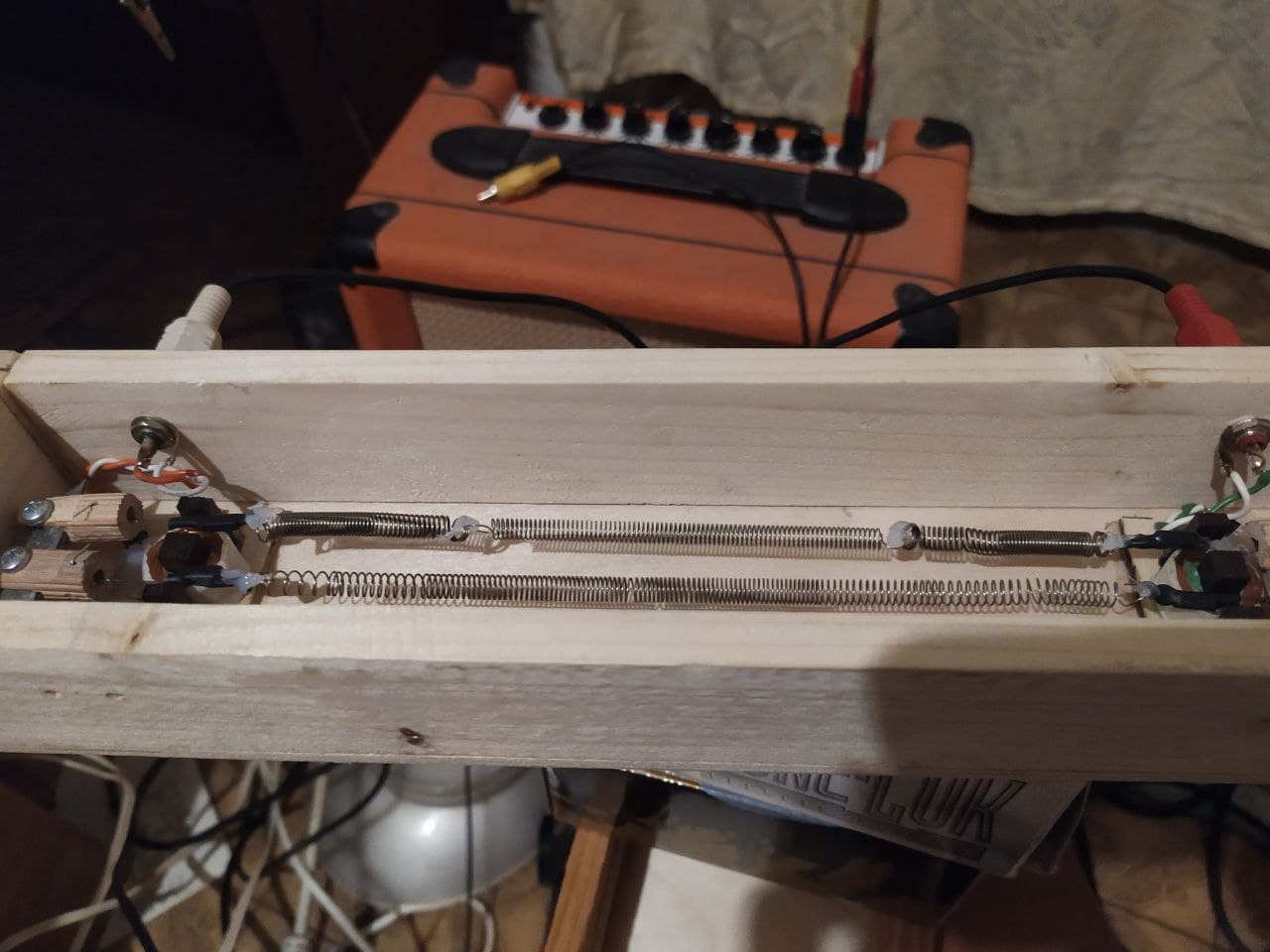
It worked, btw. I know how it looks, but it actually produced reverb! It was noisy and distorted and… my way of mounting springs was bad, and for some reason one spring was reacting more than another spring, and I used neodymium magnets that I put in a heat shrink, so they always found a way to stick to the transformer coils, but yeah, it worked!
Well, it is great that it worked, but there were lots of troubles. And while troubleshooting I used my tube amp. And I destroyed it. Haha. I blew up my output transformer somehow. It’s not hard to buy a new one. But I decided to fix it maybe. It’s like 2700 turns of 0.1mm wire for the primary, but oh well. So I unwinded… unwounded? The secondary and here it is, the burn mark.
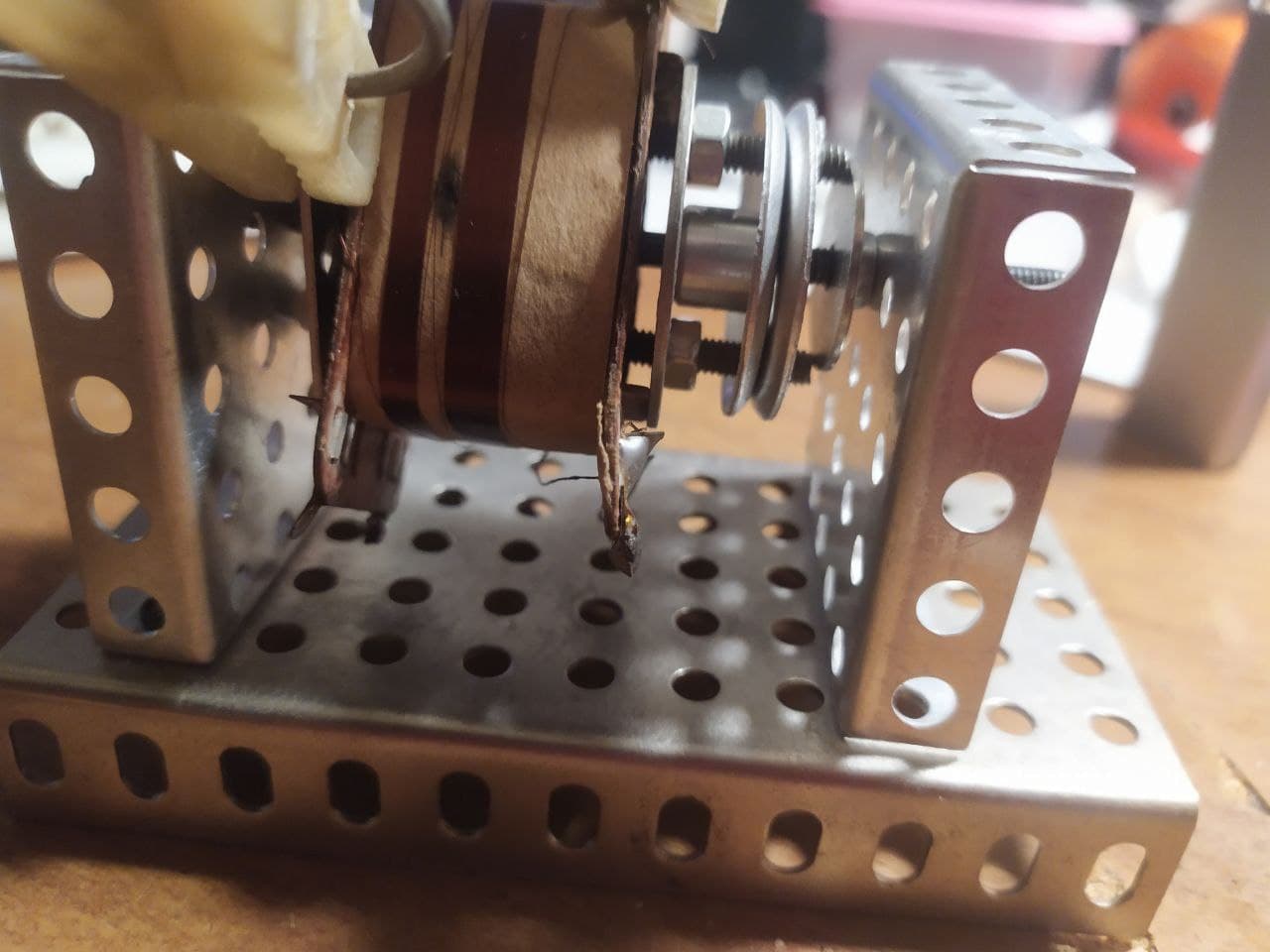
Luckily, it affected just maybe 20-30 turns. So I removed them (you can see it on the photo, it’s after I removed them) and soldered the remaining unaffected halves together. I put a small paper thing under the repaired spot, cause I think maybe copper was pulverized and maybe there is some copper molecules where the black spot is, and I haven’s looked under this spot… There’s a whole layer of 0.1mm wire underneath. If it is somehow bad too, it would probably be better to buy a new transformer. But it works. I tested it. By the way, I fixed it last week. So for a couple of months I was using another amp, this one is solid state guitar amp, a cheap combo drive or whatever you call it. You can see it on the background on the photo above.
Alright, I was fixing my spring reverb and suddenly I just decided to make something out of… some kind of MDF support/whatever-it-is that I found on the street and an old alphabet board for magnetic letters, I remember using it when I was a kid…
Look
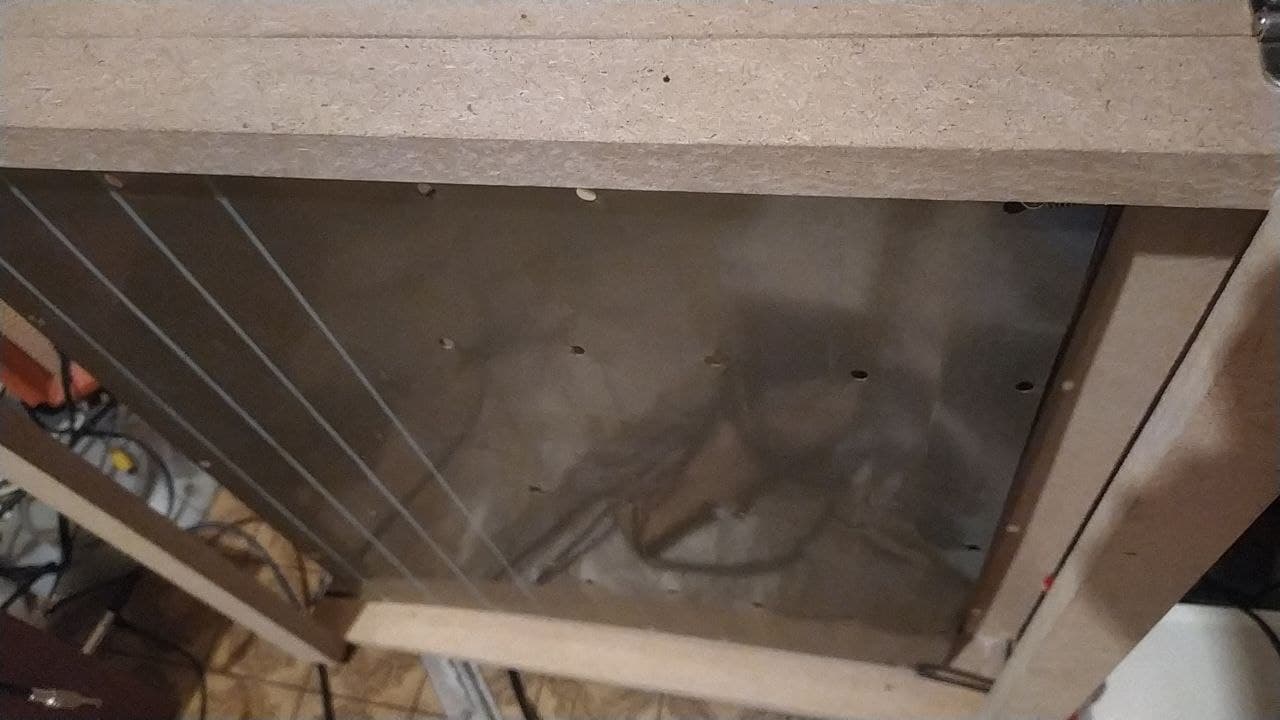
Yep, a plate reverb! This one don’t need any esoteric explanations. I just glued a speaker on the back of this thing and put a couple of piezo microphones. To drive the forementioned speaker I bought a TDA2030 kit. Which, by the way, is the first kit I ever bought… It works! Somehow it’s muddier than my spring reverb, even though this bar is very low, it managed to limbo dance under it. I think the metal is bad, it’s a cheap thin plate. I might do something with it later… Or might now, haha. We’ll see!
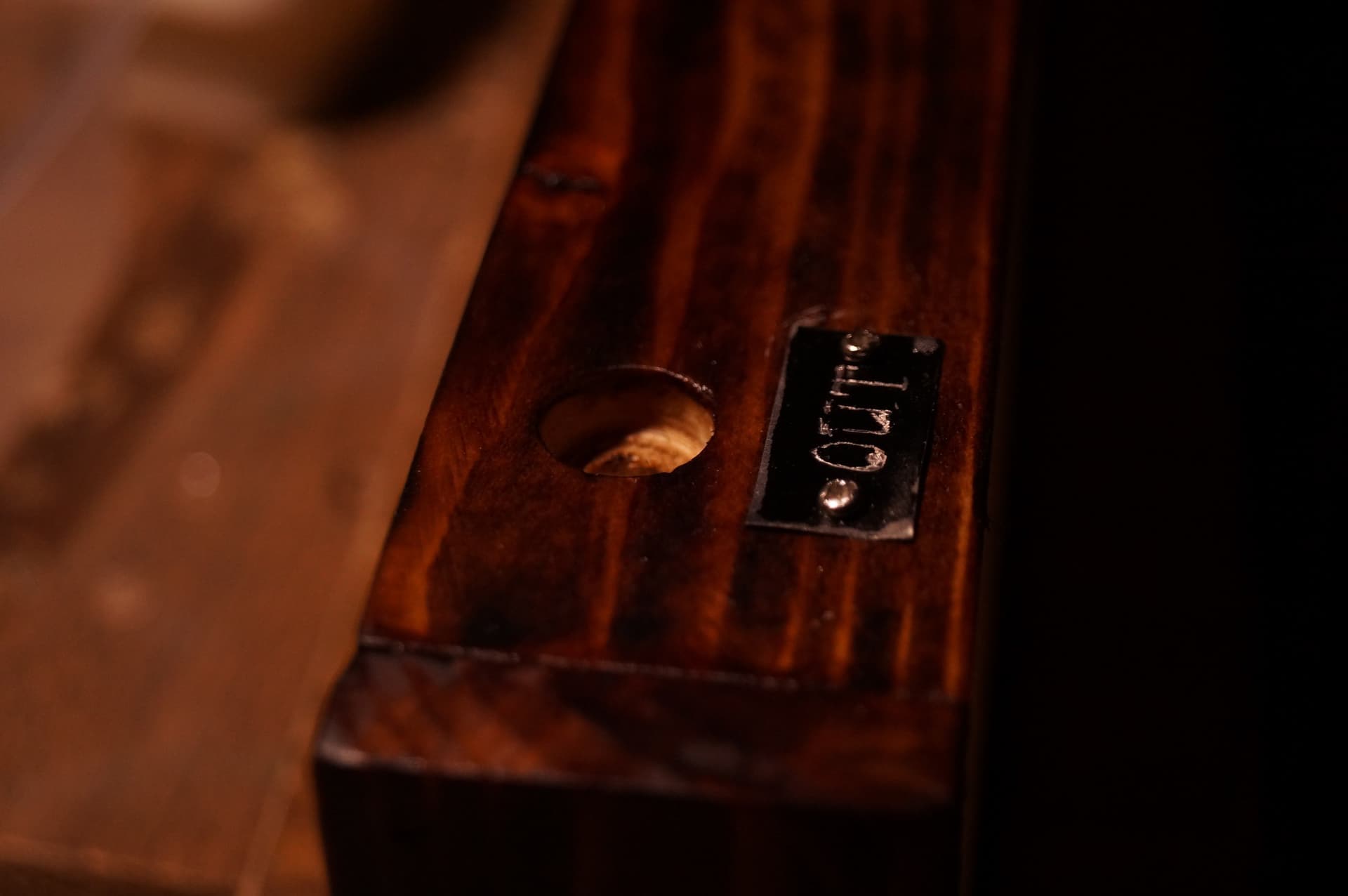
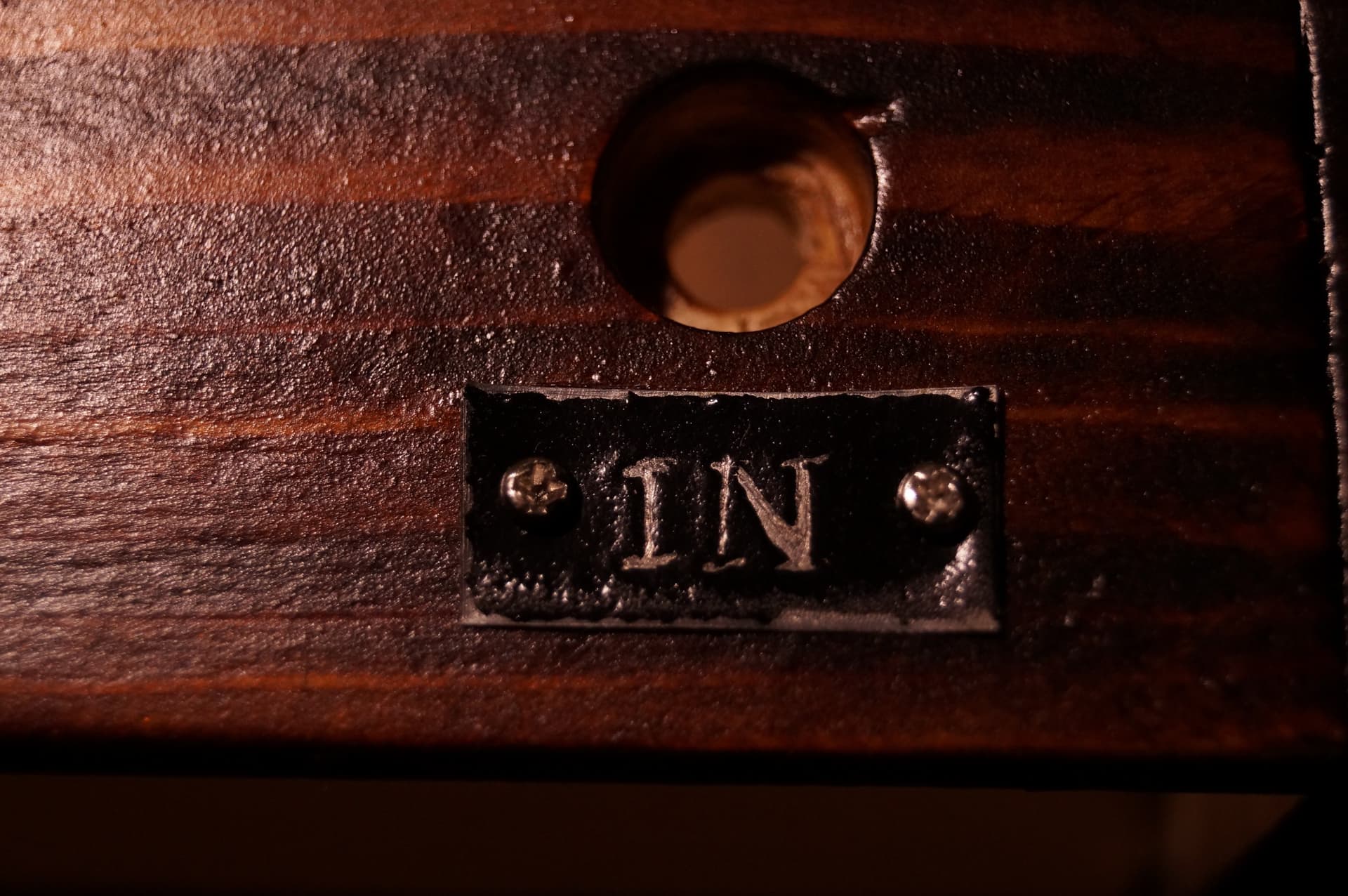
Now, the spring tank was hard to fix. I mean, fix all the problems, like with escaping magnets and moving springs… Like I couldn’t fixed the springs so they would hold the magnets in the gaps of E-cores. So I just demagnetized the magnets by blasting them with hot air out of my heat gun (I also changed the way of attaching them to springs, I used a gel pen tube or a stem or whatever you call it, haha) and redid the way of mounting the springs. I also bought other springs, And stained the wooden box… and made engraved plates for IN and OUT.
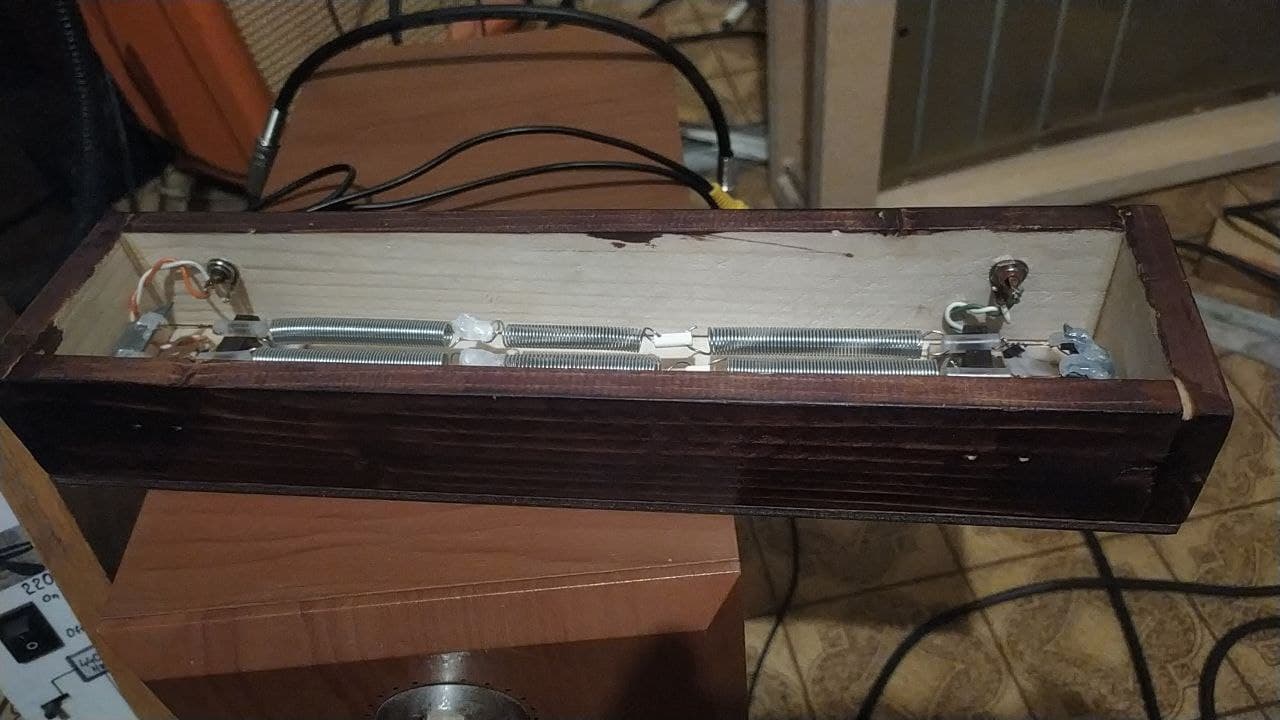
Sorry for sudden jump in quality, i shot this with my DSLR
Now the other part of this build, which I am currently on. It’s not ready. But I wanted to complain. I used parts of this and that schematic, like MFOS + Elliot Sound Products + Skull and Circuits. And unexpectedly I want to complain about Skull and Circuits. So first of all, I am a monkey. I do what monkey do, they see - they repeat. And then they think. So I just collaged the three schematics together, mostly 1st and 3rd one. Elliot’s schematic i used to expand the functionality of a limiter in Skull and Circuits design, which in turn was borrowed from Elliot’s design, so it is logical to go and see what was borrowed and how it actually works. Anyway, one part of Skull and Circuits design, which I liked, was a tone stack on the output. I just redrew it. Now, look, that’s from his schematic
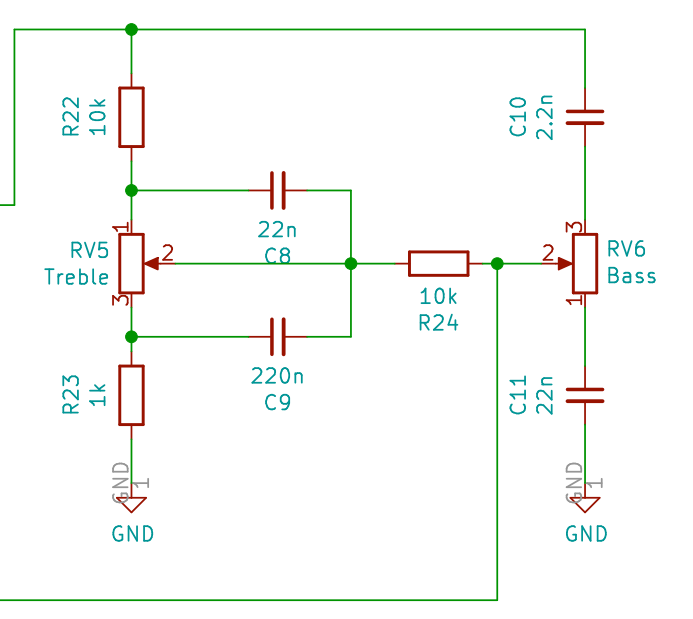
See the problem? That’s not a big issue if you make it like I usually do: on a perfboard and then drag the wires to the pots, but this time I ran out of perfboard space and decided to build the tone section separately, soldered directly to the pots. And while redrawing it in EasyEDA I encountered a problem of… like which lug goes where, which pin is which, and while trying to understand this schematic I felt like I am having a stroke, like: alright, we turn the treble knob and… what happens? Why? And the bass pot, so you turn it and.. What the hell? So I consulted the AI, I roughly summarized the schematic and it kept telling me about treble section capacitors that go here and there, and I was like - wait, it says treble caps are just across the pot. And in typical AI fashion it goes “You are completely right“. I like being right, so I forgave the AI for being dumb (and in reality I was being dumb). But it still didn’t make much sense, so I googled a source on tone stacks and found a great site! Here it is, and you can play with it! And while playing I realized why it felt so wrong when I was thinking about this tone section before, yep. The treble and bass pots on the Skull and Circuits schematic are backwards or… mistyped or whatever. Thing is, dude gaslighted me even without knowing me, that I can respect. I thought I am losing my mind. I even argued with AI about that, while being in cognitive dissonance, but believing in what is written. The moral of this story is - … I guess, there’s no moral in this story, I will continue being a monkey.
Alright, so the faceplate is ready, but I will show it when i finish the soldering and stuff. See you then!
3 Likes
Blahblahblah section:
Well, the reverb module project is still on a pause. And the reason is… Annoying, haha. I just can’t make a PCB for some reason. The heat transfer method fails, because I do like big ground planes, and no matter how wide I make my tracks, they still just don’t want to stick to the copper. I know what the problem is, it’s my toner actually. I bought a cheap cartridge for my printer. And it works for some projects, like with Thomas Henry XR-VCO it did fine. But the more tracks you have, the more possibilities for it to go wrong and you can’t just paint over some tracks, as they are placed in a middle of a track labyrinth. Well, and… eh? What was it… Photosensitive film? Photoresistive film, yeah. This one is just bad. I use russian poor man’s film, it’s quite bad. Copper is fine… I think. it’s toner and film that are bad, sadly
Korone
Anyway, I recently downloaded LTSpice to check something. And it was so much fun, I ended up actually creating a circuit that I named Korone. For legal reasons, it is not a reference. But as it is my debut with actually making a circuit, it is quite a weird thing and not extremely… polished so to speak. Rough, yeah. In that sense it is… similar… Well, anyway
here it is:
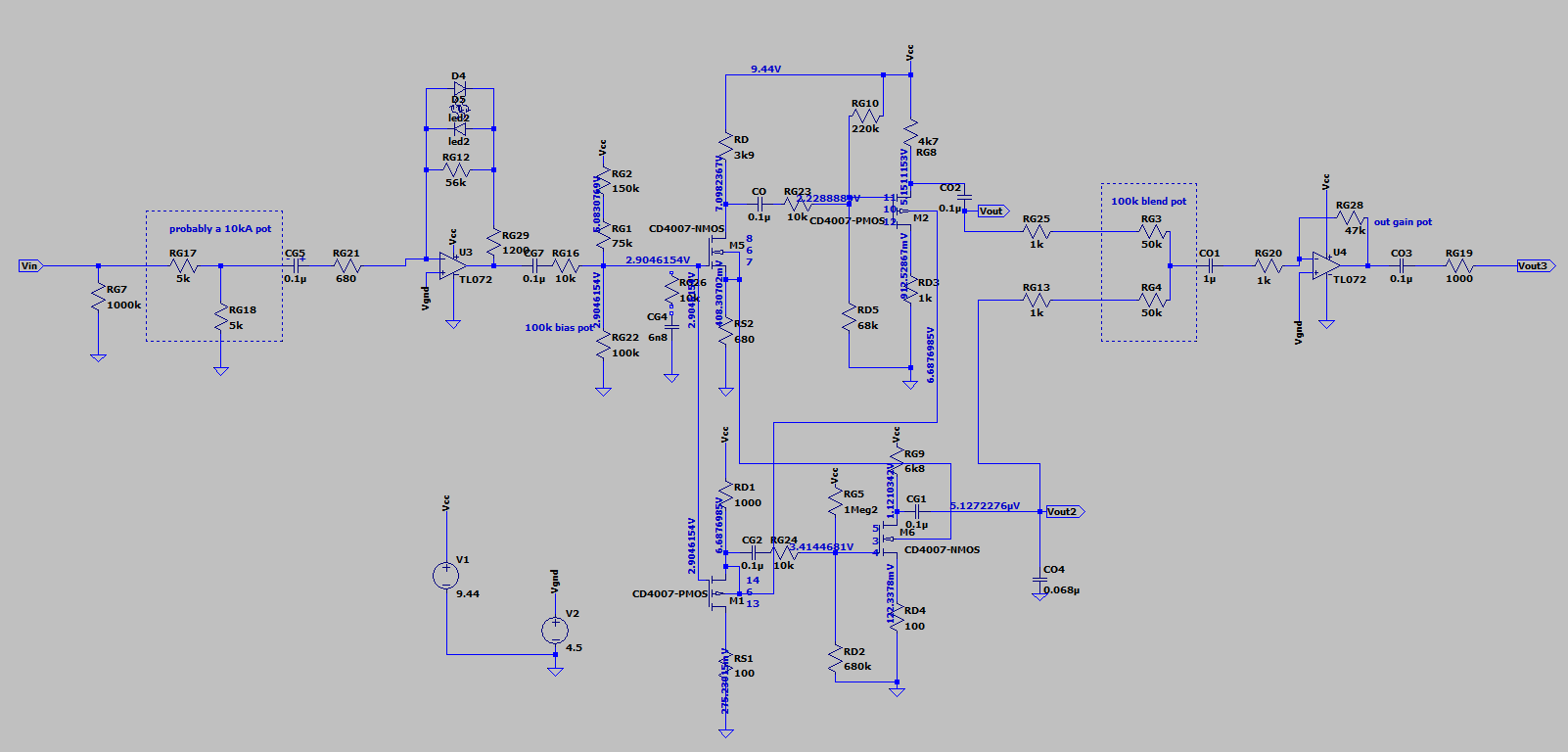
*I took out one of the LEDs from the input stage limiter/clipper, to make the MOSFETs work harder on the unaffected pole.
**CO4 from the Vout2 to the ground was me just putting capacitors everywhere on my actual breadboard.
***It produces quite a lot of analogue hiss, unless you push the volume up high or start playing, so the “idle” noise floor is quite high. The reason to include CO4 was to lower it a bit. It still is hissy, but less now.
****The reason why I avoid active lowpassing/highpassing is… well, it’s too aggressive for a guitar already, and with bass and synth it just sounds bad, in my opinion.
I hope it’s not too compressed. Anyway, V+ here is 9.44v, because I was comparing the numbers with my actual breadboarded circuit. I will redo the gain staging, probably. It is a guitar pedal as of now, but I will make a modular version later, because while playing with it, I discovered that it is an interesting waveshaper. With hot 5v signals and 9.44V headroom on some settings it produces a throat singing effect. I am not kidding. Like full on Sygyt (you can hear the ACTUAL Sygyt here, for example, the whistling high notes). I am not quite sure how easy it is to reproduce though. Cause maybe that was just one of the MOSFETs catching oscillation. That would be embarrassing. Anyway, so formants and waveshaping aside, let me tell you what it actually does as an effect (spoiler: it wasn’t supposed to be an effect)
So roughly the signal flow looks like this:
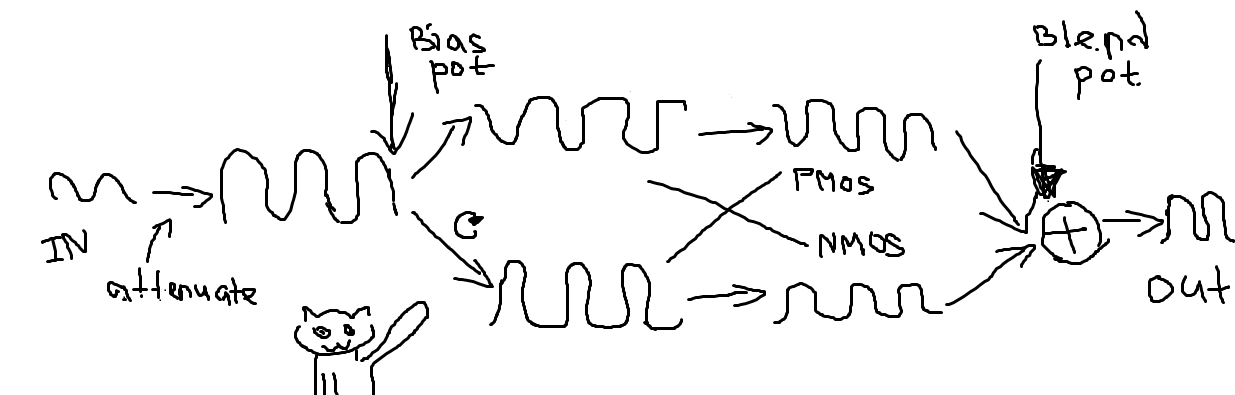
I think it’s self-explanatory, but I will explain some things that are not obvious. the upper row after the split is NMOS1 → PMOS path and the one under it is PMOS1 → NMOS. Both PMOS1 and NMOS1 squish a sine against the nonlinear region and the following NMOS and PMOS are either to make the squishing more pronounced or, when the signal is mostly clean, to just add some class a amp distortion. Blending after that is passive, it averages the signals, on my scope, a real one, the summing looks a lot like crossover distortion. But the opamp output is fine and doesn’t have a crossover knee. I don’t know what’s up with this. Probably some science is happening. With biasing we can move the signal along the curve, so… I think as you push the biasing towards the ground, the output sound becomes more distorted and compressed. While if you lower the resistance to the V+, it makes it louder, less compressed, but also more bassy/mid-lows, as more second harmonic enrichment is happening to the lower guitar strings. Now, with guitar it’s not very throat-singie-ish. There are some harmonics that pop up, but it sounds just like a booster pedal or something. The signal is too low as it is, and if you push it with the input opamp, it just distorts heavily, and the distortion is not nice, it’s very bassy again, muddy. BUT if you just push it and put an overdrive after that - that’s great. It becomes a very rich distortion effect. I wouldn’t compare it to a tube amp, but it’s interesting and it’s not just clipping, you know, it feels more than that. I will rethink the input section though, I think I already mentioned that. One of the things that might be responsible for “whistling” harmonics is a safety mechanism in CD4007. It make the second PMOS “fold” the positive pole when it goes higher than the 14th pin. It quite interesting, actually. I was afraid that it would just burn the chip, but instead it does this. Funny! I’ll show you how it looks in LTSpice. The real scope shows something similar. Not 1-to-1, but similar…
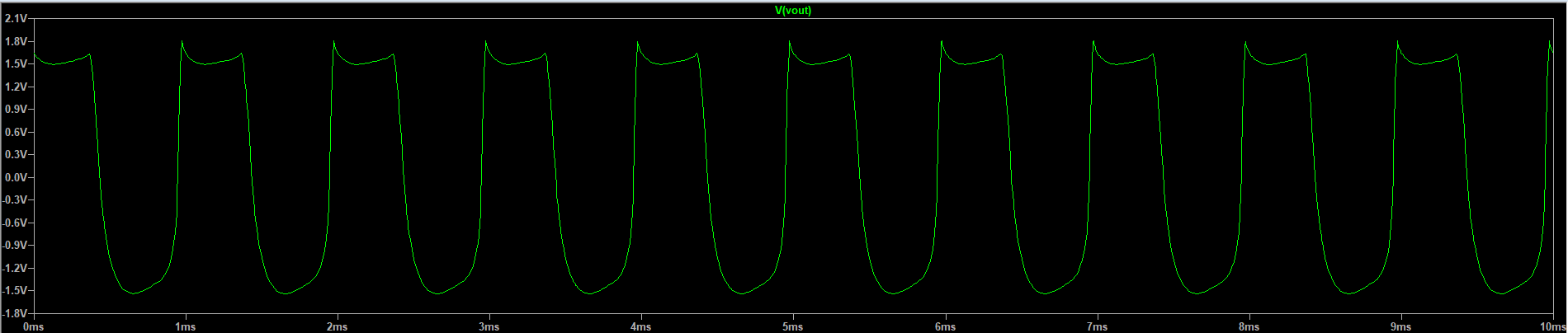
Anyway, the real pain is to rebias it for all the different chips. If you want to build one… I would suggest building it on you breadboard first. Well, actually, I would suggest checking the Vth of your PMOS and NMOS and Kpp or whatever it is, I forgot, and then… yeah… It needs attention. Not a thing that is translatable immediately.
Well, actually it is a mixer strip on steroids. Just a preamp section that I came up with (it was initially with JFETs, then with 2n7000 and then I remembered that I have a bunch of cd4007 chips, so I made a poor decision to use them instead, as they are thermally coupled and well, 6 of them in one chip - that’s great! Not quite…) I think the module version is almost done already, even with this. I would probably have to redo something when raisng the voltage from 9.44v (It works with 9v too, dont; worry! It actually starts working at 7.5v, I think… Maybe i am wrong) to 12v, bigger headroom, less distortion, which is great for a mixer, but not for a waveshaper… In fact… It’s not almost done at all…
CD4007 wasn’t a great choice, because from the ones I have, a bunch of HGSEMI chips, well, almost all of them work great in this circuit. But if you have TI chips and put it there, you would have to redo the whole biasing. Not even just gates, but also drains and sources too (I prefer to call them plates and cathodes, that’s easier to remember for me, which is which). Just for the completion of this report, here’re my CD4007 models in LTSpice.
.MODEL CD4007-NMOS NMOS (LEVEL=1
+ VTO=1.29
+ KP=7.5e-4
+ LAMBDA=0.015
+ CGSO=20p
+ CGDO=20p
+ GAMMA=0.6
+ PHI=0.65
+ TOX=1e-7
+ CJ=2e-4
+ MJ=0.5
+ PB=0.9
+ CJSW=5e-10
+ MJSW=0.33
+ JS=5e-9)

.MODEL CD4007-PMOS PMOS (LEVEL=1
+ VTO=-0.72
+ KP=5.2e-4
+ LAMBDA=0.02
+ CGSO=20p
+ CGDO=20p
+ GAMMA=0.6
+ PHI=0.65
+ TOX=1e-7
+ CJ=2e-4
+ MJ=0.5
+ PB=0.9
+ CJSW=5e-10
+ MJSW=0.33
+ JS=5e-9)
Most of the number I just stole from another model and VTO, KP, LAMBDA and csgo or whatever the hell, Chatgpt computed for me based on my measurements. It does well with analyzing the data. I had to tweak PMOS KP a bit, not that I know what I am doing. I just notices that with the same gate voltage there is a big difference between real breadboarded circuit and a simulated one, and VTO I am positive that it is around -0.7v, I measured it many times. So the only other thing that I understand is Kp that in russian, I think is “крутизна характеристики”, I think. So I kinda understand what it is and what it does, i felt that I can tweak it. And after tweaking it actually started to show the numbers that are extremely close to the real PMOS. With NMOS… I wasn’t as ready to mess around, but it is somewhat similar too.
Anyway, maybe I will write a report after making a module version of this thing. Or maybe not! Who knows?
1 Like
Hi! So this is a sad story about a failed project. It doesn’t work, but I decided to write about it anyway. After this one, maybe in a week or two, I will write about another project, which will be a Steiner-Parker VCF. But for now, the 4069 VCO story and a lot of things that I did wrong.
((BTW, my reverb project is paused, it’s still not ready for a reason that is connected to other stuff that I also put on hold, I don’t want to bore you with my problems, so let’s just say - it will be done by the end of this summer, hopefully. For now I am rearranging the circuit, trying to make it pretty.
Also as for Korone, it is still on my breadboard, because I am very slow with designing and stuff… And as it is my first and only original, I think I can take time trying to make it as nice as possible. I redesigned some parts of a circuit, the input section for example, because as it is great for synths and buffered signals, if you plug a guitar into it, it sucks tone like crazy. So, I am waiting for J201 that I was promised by my friend, and my friend will be here in this city at some point during this summer, so we are waiting for now. I can’t buy it. There are complications with my financial situation, to put it mildly. Nothing good, but not some gravely serious stuff. Anyway, that’s the update on that))
Okay, so VCO with CD4069 chip was originally the second (if I remember correctly) VCO that i was planning to make. But somehow I made 3 VCOs already and only now I decided to finally make this one. As you remember (and if you don’t, I will remind you anyway), I was complaining about transferring the PCB layouts: the photoresistive film didn’t stick to the copper and thermotransfer method didn’t work either for some reason, it just stopped working, it worked before – with various results, but usually I was just correcting the tracks with a marker. Anyway, I made a layout for this 4069 VCO and for some reason it worked immediately. I used the thermotransfer method. I was overjoyed. I was ecstatic, to the point of just dumping it in the etchant immediately. You see where this is going, right? There was some kind of mistake, it just can’t be this easy. And there was a mistake, a huge one. It forgot to mirror the image. I realized it immediately after etching the PCB: I was paranoid, so I took CD4069 to check if it will fit the footprint, cause for some reason the actual size for my printer is 99% of the original image. So I put CD4069 against the footprint, it was okay, the size was fine, but just for fun I wanted to know the orientation of this chip. That’s when I realized… Well, whatever, so you have a PCB and a chip, you can’t do anything with the PCB, but you can do something with a chip, which is - just bend the pins and put it upside-down. The other solution is to, again, bend the pins, and put it in the smd-fashion onto the copper tracks. The second solution isn’t great for my poor-quality russian boards, that are extremely happy to let the copper traces loose. Even a weight of an IC will be enough to do that, and also there’s a chip replacement argument. If this one fails, you would have to dance around the board to change it. Right, so a better solution would be to just bend the pins to flip the IC, and that’s what I did.
I was also aware that I need to change the polarity of my diodes and transistors. Which was much easier, because I use BC5xx transistors almost always, and it’s as easy as just turning them around. Well, I don’t think (!!) I made any mistakes after that, but when it came to test the VCO, it was dead. No sound at all. Again, I don’t think I made any mistakes, but that’s not completely impossible. And also there’s a PCB layout that wasn’t tested and it might contain some errors already at that stage… As I told yous before, I hate breadboarding, so I just go straight from the schematic to PCB and then straight to the board if possible.
So, it doesn’t work, why? Well, there are three possible scenarios and that’s besides the flipped PCB, which is more like a complication than a scenario. These scenarios are:
- bad layout
- bad PCB/soldering
- bad components
So, here’s my project list from EasyEDA. Just believe me when i say that I checked every node and every component, making sure that it is exactly right. Could it be that I still made a mistake? Yeah. But the important thing is the expo converter and how it is connected to the chip. And this one part I checked 100 times.
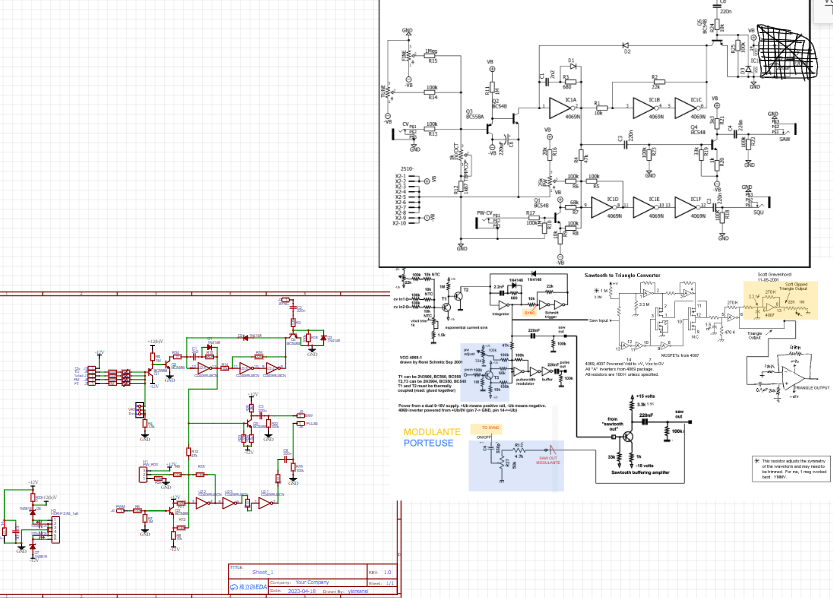
I said the important part is on the exponential converter side and how it connected to CD4069, why’s that? Well, After failing to make it work I, of course, started checking the nodes on the actual circuit. And it appears that the expo converter doesn’t convert the expos! Sorry for this bad joke. Well, the point still stands. So here’s my layout,

Sorry for the mess. So first of all, the expo converter is npn+pnp with NTCs as designed by Rene Schmitz. If you look at it closely and remember what I told you about the mirroring issue, - yeah, I had to flip the transistors and to make the thermal contact area bigger, I just filed the backside of the transistors. Not too crazy, I checked them after doing that, to make sure I haven’t filed the substrate or wires by mistake, and it was fine. The actual thing looks like this:
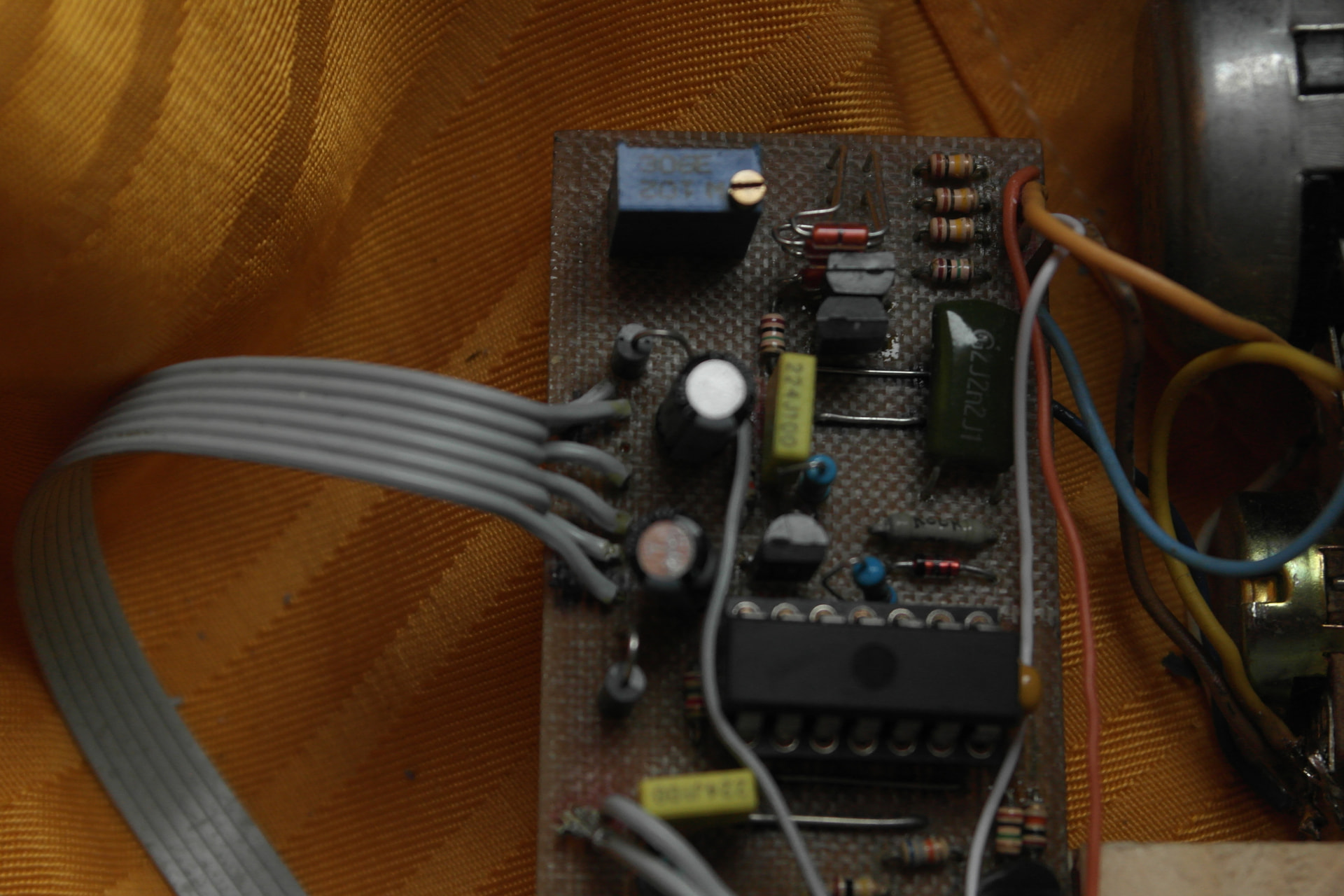
Sorry if’s a bit dark. But you can see, hopefully, the transistors on the top. And also the CD4069 being “upside down” or “inside out”, if you’d prefer to describe it like that.
You can also see that I used a lot of 1/8W resistors. That’s because I have loads of them from desoldering the things I hoard, haha. Anyway, that’s not the problem, at least I don’t think it is.
So I would say the possibility of a mistake on this level is low. Not impossible, but low.
And that’s two scenarios, actually. Because It’s not like I believe in my soldering too much, but I don’t think my soldering was a problem here. That leaves us with the third scenario: bad components.
So, could it be that I bought cheap CD4069 chips and they are fake? Yeah… Could it be that my transistors are borked? Yeah… Could it be that there’s something other than that? Yeah… And that all multiplied to the complications with mirrored PCB. That’s a bit disheartening, to be honest. I don’t want to bend the pins of another IC, so that’s one side of this problem, but I can change the transistors - that’s a bit easier, but the way I soldered them doesn’t make it absolutely easy. I tend to cover the tracks with leads to enforce them. So that’s what I did, and after that if another lead crosses/overlaps the enforced track, I just put it on top. So to desolder this mess I would have to desolder most of the upper part of a circuit, that’s what I mean. And that’s not super inconvenient, the thing doesn’t work, so either way I would have to desolder it at some point. But… idk. As I said, it is disheartening, so I just put it into my “bad modules” box. And forgot about it until now. All of this, by the way, was done around the time I realized I need a buffer for Korone, so maybe mid-march, and now it’s june, so 3 months ago. It was waiting for me to write about it for 3 months. That’s how annoyed I was with the result. And, yeah, you could say: dude, just make another PCB and use better components. Well, I tried. It doesn’t stick to the copper now, after i mirror the layout. As if it wants to stick to the copper only when there are mistakes. Well, that’s it for now. It’s not dead. If I manage to make a better PCB, I’ll try to just depopulate the bad PCB, while checking all the components, and then I will change the transistors. Which by the way, what I suspect the most is actually BC547. I know it’s BC548 on the layout. But I use BC547, it shouldn’t make MUCH difference. Anyway, I distinctly remember checking this npn and seeing the hfe being around 350-380, I think. Well, that’s weird, because all the other transistors in that box consistently show me 410+ with the average being 430 or so. I noticed that after encountering a problem with this whole thing. I don’t remember why I, well, remembered the hfe for this transistor, but I did. And I wasn’t really picking any particular transistors. I just took it, put it in the transistor tester, saw the numbers, remembered it and put it in the project box. Well, anyway, that’s it for today! I’ll try to make it work , but no promises. I will promise though, the next post will be about my VCF that I tried to make different, visually, from my other stuff, and failed miserably. Well, it does look different, but not in a good way…
2 Likes
Okay, now it’s time for a sad story about how I butchered a somewhat nice idea that I had for a front panel. It wasn’t anything special, just “What if I made it all brown and black with white text on black panels, like old equipment”. You know what I mean? Like Moog or something, but with text on little plates. Here’s what I imagined it might look like:

Something like this. Now, let’s start destroying this idea. But first, the Module itself is a Steiner-Parker VCF from yusynth site. I made PCB using a photoresistive film this time. Well, not a film. I just had a bunch of presentivised boards. Is that how you spell it? Anyway, boards that are ready to be exposed. I had to experiment a lot with exposure time and how to develop it after that… That’s a long story though… Well, I am writing this post anyway, so I’ll tell you. I use an array of smd UV LEDs. I don’t even remember how many of them there. I also have a nail-curing thingie with mercury UV lamps. Yay, toxic metals! Well, they are safe unless you manage to break a tube. I think I have much more lead in my organism than mercury. I also have this hoarding hobby, so I pick up trash and make use of it. One time I picked up an old broken laptop screen, so I took it apart and now I am using it as a frame for all the LED stripes. Wait a second, i’ll take a photo of it. Sorry that it’s dark and grainy.


As you can see, it has hinges on the back and the front is fixed with a magnet thing. I was experimenting with a distance of how far/close you can put your board and that’s why it has all these boxes and stuff on the first photo. You can also see a transparent film with yusynth’s layout for this VCF, haha (you can also probably guess that the boards are positive, not negative type, that’s why the layout is a positive). I forgot it was there! Anyway, so that’s the rig. After that I develop the board. And developing is painful every time. Because the boards were sold without a developing thingie that should’ve been included, but oh well. So I tried washing soda - didn’t work, I tried silicon glue or whatever you call it - didn’t work. And by didn’t work I mean exactly that, it changed absolutely nothing, like it was just pure water or something. Well, so it appear that only the big guns are allowed here, so I bought a drain cleaner with ~70% NaOH in a powder form, dissolved a small spoonful in 100ml of water and it just washed the whole photosensitive layer immediately. But for one microsecond I saw the testing text that I didn’t even expected to see, to be honest, I thought that this “photosensitive material” is just an acrylic paint layer or something and it was a scam. But it worked! Anyway, to keep it short - the pain is to make it work each time, because there’s no way to know the exact concentration of NaOH for each spoon taken. It’s not a fine powder. Anyway, I managed to do it three times now. And I mean three consecutive times. So I got a hang of it.
Okay, so back to visual designs. You know how I do it usually, and if not - well, just scroll up, and you’ll see. This new approach was something I planned to use for bigger things. Like maybe a device of some sorts. We’ll see. But now I might rethink this whole way of doing things. So first of all, white text on black plates - cool, how to do it? Well, one way would be how I made the in/out plates for a reverb tank, right? Again, scroll up if you forgot how it looks, but what I did was - I just sprayed a tin can plate with black acrylic and then I carved the text with a dremel. Well, that was fine for like 5 big letters, but if I want to make smaller text, that wouldn’t work. My hands are shaky and also I would hate it. So… rubber stamps with an ability to make custom texts. I don’t know the exact name in english. But that’s what i did. And by the way, all of that was during winter. Like 5-6 months ago. So I had a lot of time to experiment with it and came to a conclusion that it would be almost impossible to do with the materials that I have and/or can buy for cheap. Acrylic paint was hard to apply and hard to wash from the little miniature letters. Not impossible though! But the effect i was after wasn’t achievable for me, for some reason. Maybe if I do this for a week or so every day for many hours, I would find a way to do it great every time, but my attempts for now with acrylic were like 0/100. The problem was with making text legible. And each time it wasn’t. So I washed all the little letters and binned this idea of using acrylic.
Okay, so no white text on black background. Well, blue text on silvery/metal background works too! And that what I did. I just stamped beer can metal with a stock stamp paint and dried it with a heat gun, because if you don’t do it, it is very easy to smudge. And then I realized that when I spray it with a lacquer, it will just dissolve the text. So I put a layer of transparent tape on top.
Alright. Text done. As for a plate I just took a slightly bigger plywood piece. I usually use 4cm wide panels, This time it was 6cm, because the selector/rotary switch was very big. It was a soviet brutalist selector (advertised as mini in 70s, I bet), you’ll see later. And instead of gluing paper on top as usual, I stained the plywood, making it brown. It looked okay.
So the plates on my spring tank are actually screwed-on, because they are bigger and heavier, but these ones are flimsy and light and there are more of them, and i only have this much little screws, so I decided to glue them on. Well, that was a disaster. It turns out the epoxy I was using (I remind you that I developed an allergic reaction to superglue, which is funny if you think about) was unpredictable. Sometimes it cured in an hour, sometimes in 24 hours and sometimes one part cures in 2 hours and the other part - in 2 days. I don’t know why. No idea. Well, I didn’t know that. I tested it two times with, I don’t even remember what it was, but it cured in 24 hours completely. So I though that would be more than enough. And in a day after putting all the plates on the face panel, I took it and the arched-shaped thingy unglued itself from the wooden surface. And i think one or two other things also weren’t ready. Well, the arched thing was sticky, So i just put it back and pressed on it and it was more or less fine, but the other ones I had to add some extra epoxy and… Well, you’ll see.
After that I was a bit sad that It looks more and more like shit. And the color doesn’t make it better. So I thought “whatever, just put a 3-4 layers of lacquer on top and call it a day”. So I did. Or so I though I did. But instead a lacquer I sprayed it with a beige colored acrylic paint… I panicked and tried to salvage it. Again, you’ll see… Then I sprayed it with lacquer this time. And… yeah. Plywood absorbed the lacquer for some reason more greedily than usual. 3-4 layers are usually enough to make it look a bit glossy (it is a matte lacquer, so not like superglossy, just a bit shiny). Aaaanyway… Here it is. The big reveal


On the last photo you can see some flux that I forgot to wash away, sorry if it disturbs you.
I forgot about the knobs. I made these wooden thingies myself! All for this look, the brown woody kind of style. So how i made them? In winter I bought an extra cheap drill press. It was like 100$, maybe less. I fought with it to make it more precise, because when It was working there was no way to make any precise holes. It was like +/- 5mm. So I put a piece of pvc tube inside to make it more stiff, I guess. And it worked! Now the precision is maybe 1-2mm, so about 5 times better. And it allows me to drill holes wood and then cut the cylinders with centered holes on them using the small diamond hole saw. I use this one, because the usual hole saw bits are bigger and also not this deep. Anyway, that’s how I made them. They look fine, I think. Not extremely sexy, but fine in a kind of DIY soul way. Well, that’s it for now! I will probably fix the typos later. Or maybe not. Just be aware that sometimes I make very stupid typos, like “would” instead of “wouldn’t” and stuff like this.
Wait… maybe a little roadmap would be great, like what to expect from me in the nearest future (meaning 6-7 months, of course).
So minus the Korone problem and reverb struggles, I have two project that i am working on now.
A scope! Purely mine. I made it with AIs. It’s based on a bluepill, and there are like millions of them already, so nothing special. But still, a nice project that I am designing a frontend for, lazily, as always, it works already, the basic scope function, I mean, it would also have a tuner and stuff to help with tuning VCOs like CV to frequency converter… I am not sure if it works though. But it does show the waves already! SO this function works, at least.
Hagiwo Burst module. This will be funny when i finally make it work. You’ll have a good laugh at me. For now it just doesn’t work, because I was stupid. It’s based on MH-Tiny instead of whatever Hagiwo used.
Well, there are other projects that are not ready and… it will take me a year at least to even start mentioning them, but it will be a DCO, a sampler of some sort and other things. I hope we’ll all survive to see that! And on this optimistic note – see ya!
P.S. Ah! Silly me, forgot to say. VCF works. Well, it was designed by an actual smart person, so as expected. I noticed that it likes bad chinese TL074s for some reason better than a genuine ST TL084 that I had… I don’t know why. But maybe you’’ disagree with me on that. Because i can see an argument that 084 is more smoother sounding, while chinese chips are rougher, but they have better resonance sound, in my opinion. Weird!
Really amazing thread. Keep posting pls 
oh, haven’t seen your reply! I will post something new, maybe in a month or so… Hopefully, haha. Meanwhile, I am literally collecting trash, so dumpster diving to get some components from stuff people throw away… man, jfets are not really popular in any of the circuits I’ve desoldered by now. I don’t think I’ve seen even one jfet there. Anyway, this story is for later.
1 Like
I get that, i too am a electronics trash panda