Will be very useful indeed.
Updated version with a Poly sort based on @DaveVenom 's suggestion. This also fixes a bug in the Link processing of the MergeSort and Split Sort. Let me know what you think!
PolySort

Sort polyphonic signals, optionally reusing the same sort order as other inputs. Sorted output remain in sync with one another at the sample level.
Buttons:
- Link - When pressed, the input is sorted using the same sort order and the previous input above it. When unpressed, the input is sorted on its own.
Inputs:
- In - 10 separate polyphonic inputs.
Outputs:
- Out - 10 polyphonic sorted output corresponding to each input.
For example, an alternate way to sort MIDI similar to the example above for SplitSort would be:

I just found and fixed a bug in the Tintinnabulator quantizer which caused it to mis-track the reference chord values if they were changed or modulated during performance.
You can get the fix at
Unless someone finds something else, I’ll submit this for inclusion in the next Library refresh ASAP.
Hello there and friendly greetings! So, forgive my lack of knowledge but I need to know something: I am searching for a way to record a MIDI melody with my keyboard inside the VCV environment; that melody should be saved as MIDI file and it will be later used by any other MIDI reader to properly drive a VST plugin called Chipspeech.
If I got it right, your module can do that: can record from an external keyboard and save on a MIDI files, am I right?
Yes, the MIDIRecorder and MIDIRecorderCC can be used to capture the same set of CV data that the VCV CV-MIDI and CV-MIDI CC modules sends out to MIDI devices, but instead write it to a standard MIDI file. Give it a try - let me know if you have any questions/problems.
Hello there! Yeah, I gave it a try and it totally works, with my great joy and happiness! The only issue is that now I need a MIDI player and as far as I’ve seen I haven’t found any around.
Yeah, it is totally possible that I missed a plugin in the 230 that I’ve downloaded (I am not fooling nobody, I just love to have billions of plugins!  ) but so far no success.
What it matters, for now, is that I can record a MIDI sequence just as I want. Great modules! Thank you so much!
Maybe this one?
Glad you are putting it to good use!
Yeah, I found out that one after I posted my answer… :-/
I’ve created a new module which likely has a fairly limited audience. It’s an attempt to recreate a unique instrument called the Golden Harp - used by New Age pioneer Iasos.
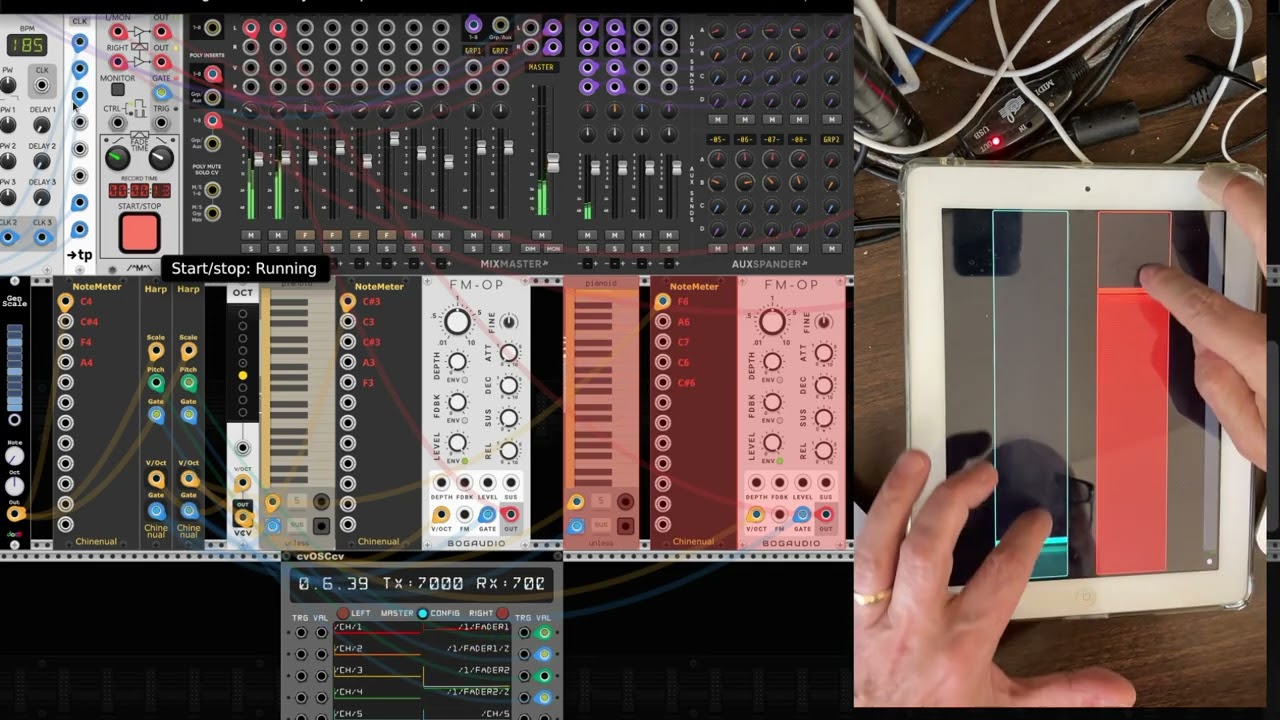
Would appreciate any and all feed back before I submit this to the library.
I’m really late, but I love this module!
Great idea! How does the playing surface of the original golden harp looks like and work?
Glad you like it! Hope you make some interesting music with it.
The original instrument was a Colortone Pro keyboard. I have a video of one of Iasos’s performance on the harp, and a description of the original instrument in the Harp user manual at:
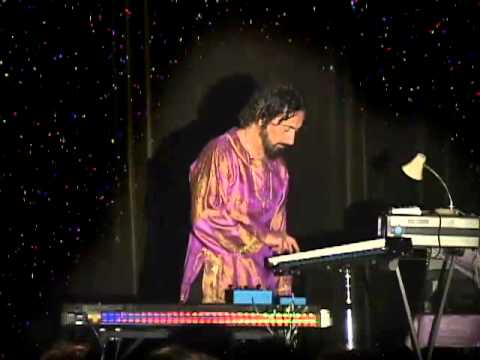
Though I call them “chicklets” in that description, the strips on the top of the Colortone have small “detents” rather than raised chicklet style bumps. Those detents give some feedback to where your fingers are strumming, making it easier to play accurately than I can on my ipad (or presumably on a ribbon). I’m not sure what the underlying hardware is. They are polyphonic - you can play “chords” by touching more than one detent at the same time. Iasos and I had planned a project to disassemble one of his spare harps and try to reuse the strips, but sadly he passed before we got started.
Thank you for the detailed expanation. I’m sorry to hear that this genious musician passed away.
So I tried something on my LinnStrument:
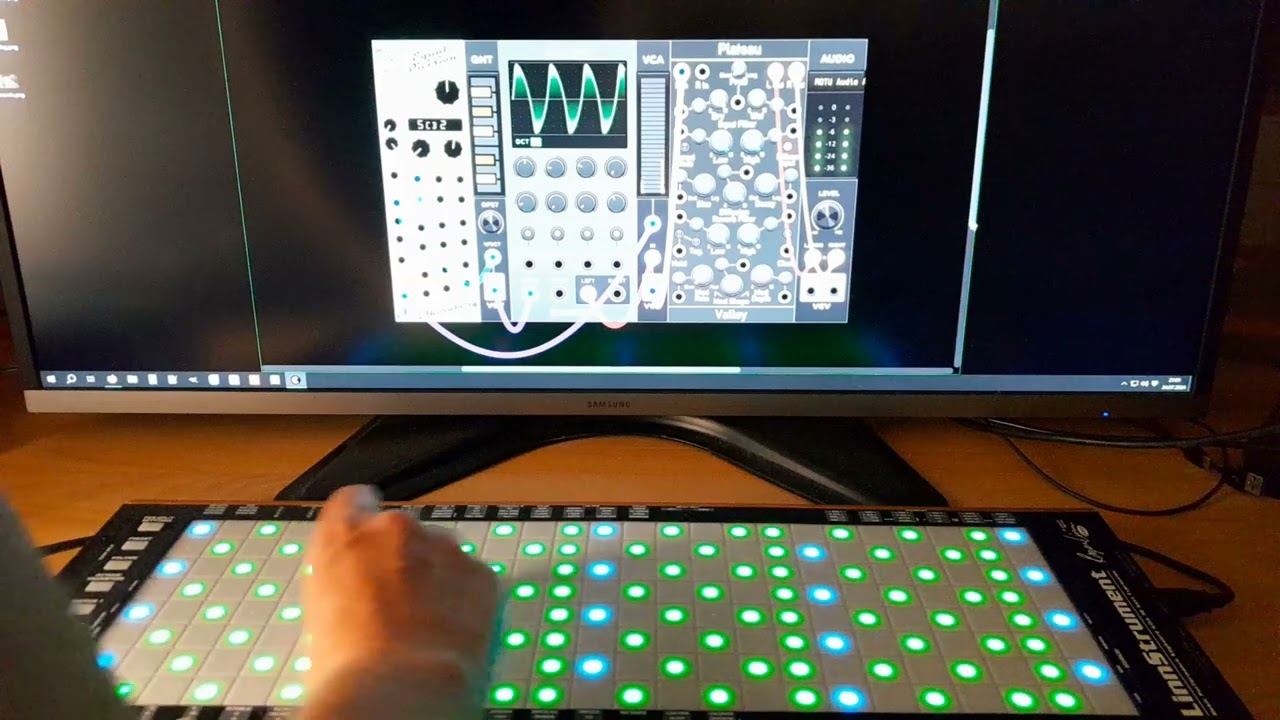
and here’s the patch:
The Golden LinnStrument Harp.vcv (2.4 KB)
Would love to play around with a LinnStrument!
Take the following with a grain of salt: I am making some guesses on how your patch works.
I don’t think your patch captures a key aspect of the Harp. You are running the output of the Linnstrument through a quantizer. Assuming the incoming signal is chromatic, that would mean that as you run your finger across multiple buttons, they will sometimes retrigger the same notes. On the Harp, each key plays a single note in the configured scale - so moving from one button to the next always advances to the next (or previous) note in the scale - never retriggers the same note.
(I don’t hear this happening in your demo video, so it could be I just don’t understand your patch!)
In my patch, the pitch CV signal runs to an attenuverter that stretches the signal a bit (to a kind of microtonal chromatic scale/tuning), so that the quantizer does not produce the same note for adjacent pads on the LinnStrument.
In this particular quick’n’dirty patch I think the pitch CV is stretched a bit too far by the attenuverter so that sometimes a pitch of the quantizer is missing out.
I’m not aware of a module that can map chromatic pitch CV to a given scale, maybe BASICally or FormulaOne can do the trick, but last night I wasn’t in the mood for math and coding 
off-topic: At the beginning I was disappointed by the LinnStrument because no MPE capable VST can reproduce all the fine details that happen in the attack-phase of a note when playing on the LinnStrument, in contrast to the Continuum synth/controller (listen to the sound compairson in the link below). HakenAudio is also aware of this problem and published a detailled explanation including a possible solution called MPE+ (but up to now I don’t know any VST that implements MPE+ and also the LinnStrument only sends out “vanilla” MPE).
So I coded my own MPE-to-CV module to address this problem just a bit by making it possible to play notes with soft attack when gently pushing a pad on the LinnStrument but also to play notes with a sharp attack and an adjustable release when hitting/tapping a pad quickly (like a mallet or a drum stick would do on a percussion instrument).
In my MPE module I also corrected some bumpyness in volume that appears when I do a very slow pitch-slide on the LinnStrument (maybe my particular controller is a bit broken, I dont’t know).
At the end (at the moment) the LinnStrument ties me to the VCV Rack because of the the fine-grained articulations I can express while playing that no VST can actually give me, regardless of all that beautiful crafted sounds these VSTs come with (I am not a good sound designer). Also some DAWs do something to the MPE signal (mostly data reduction) that kills the details in the articulation especially in the attack of a note, so using VCV standalone is my way to go (and this leads me to dive more and more into coding a DAW-like or more tracker-like sequencer module that fits my personal needs).
But in compairson to other MPE controllers like Eigenharp or Seaboard (on both I had played around a bit) the LinnStrument clearly stands out. Maybe I should go to the next music store and try out the Osmose synth/controller 

I hope to use it live with a ribbon controller, prepared a basic patch to test it in the meanwhile
C-Harp.vcvs (8.2 KB)
of course the way of playing it will be similar to Iasos’
aaah … GenScale is the module that does the magic trick 
aaron static ScaleCV works in the same way, but you can create your own scales as well, and it’s pretty silmple: just put values in a polyphonic cable 
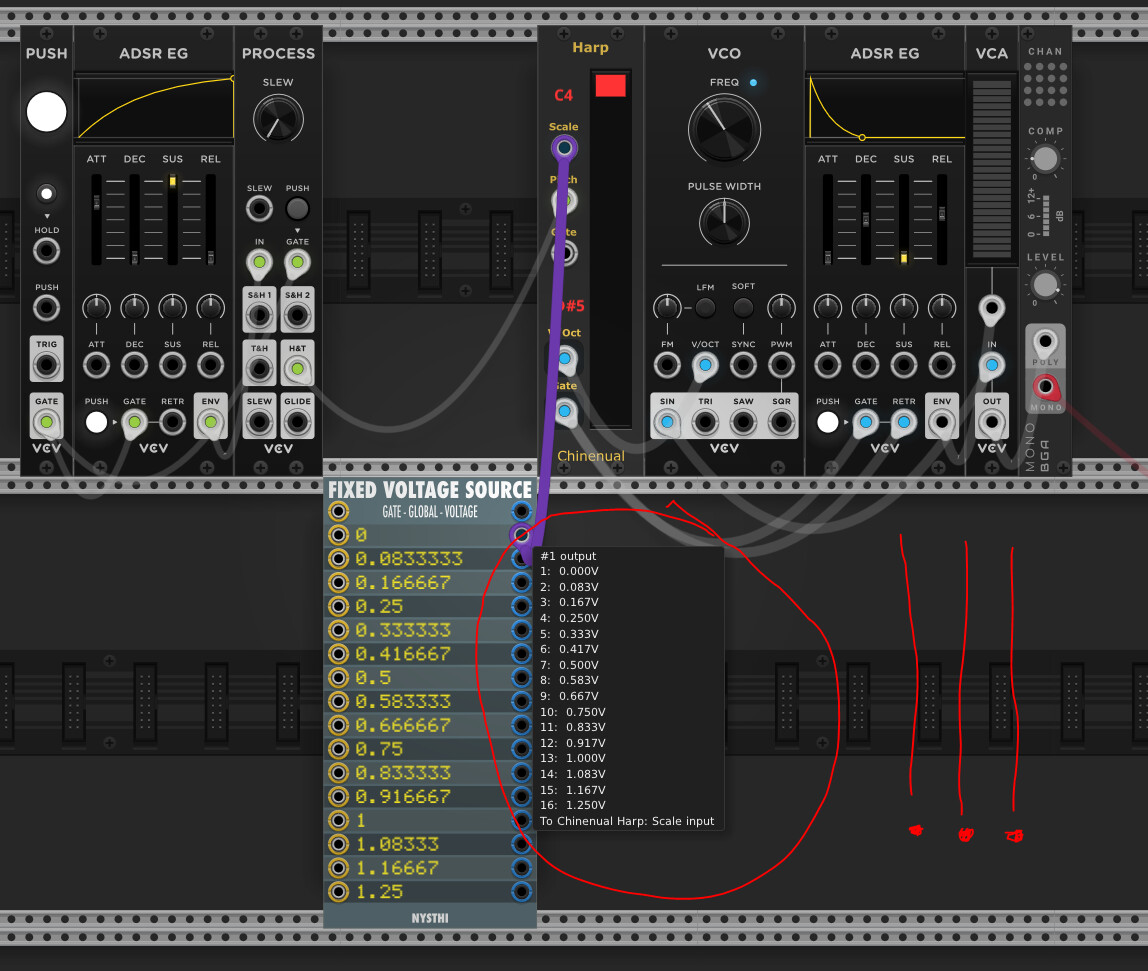
A module I didn’t know until yesterday is Bogaudio Assign, maybe it works well with your linnstrument
assign-kind’haarp.vcvs (7.2 KB)