Starting a new thread because the old one was getting long.
Some things that used to take several modules to implement - like adding the CVs of two different sequencers - are much simpler. You get to leave out the OR gates and math modules.
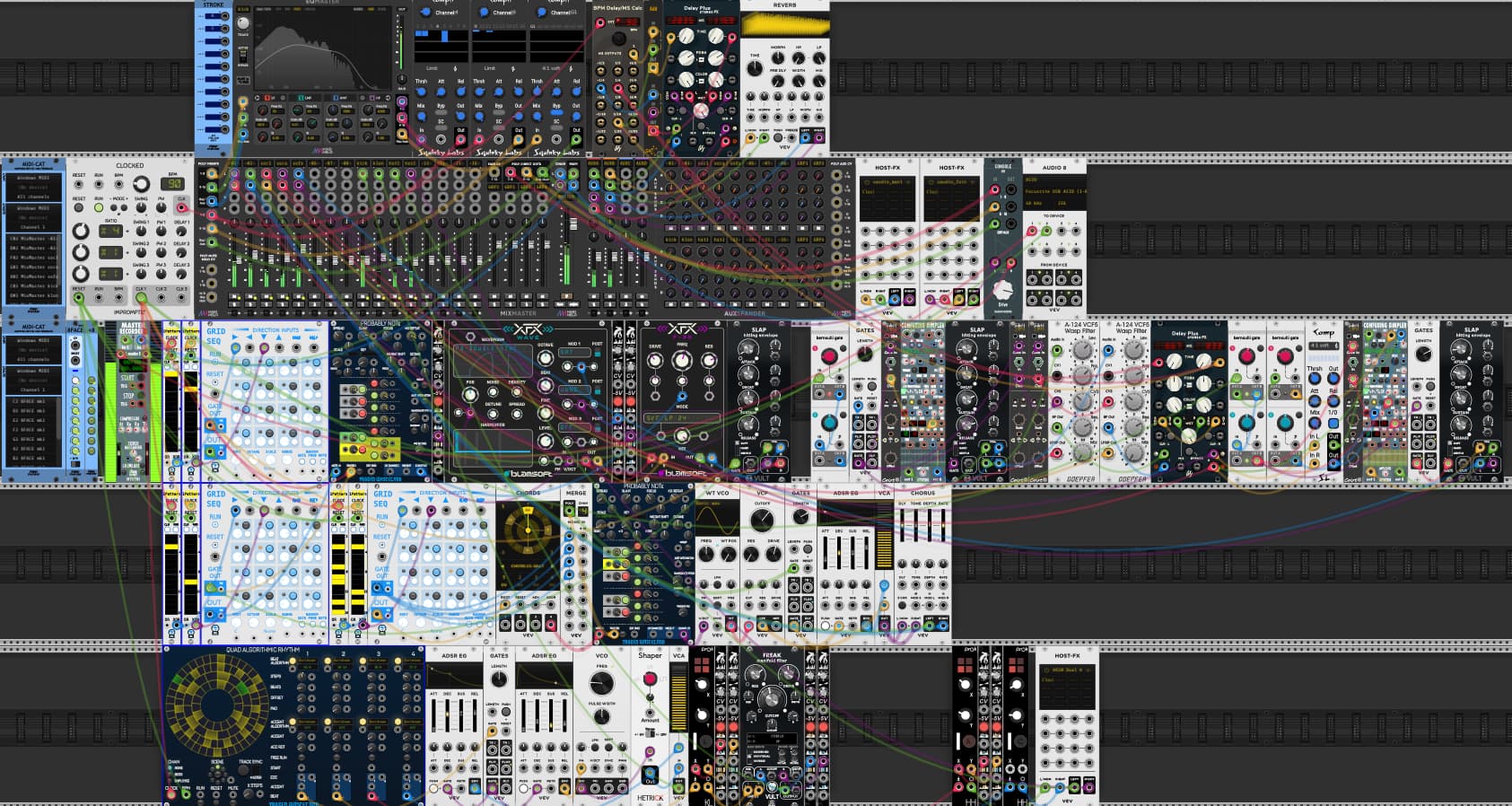
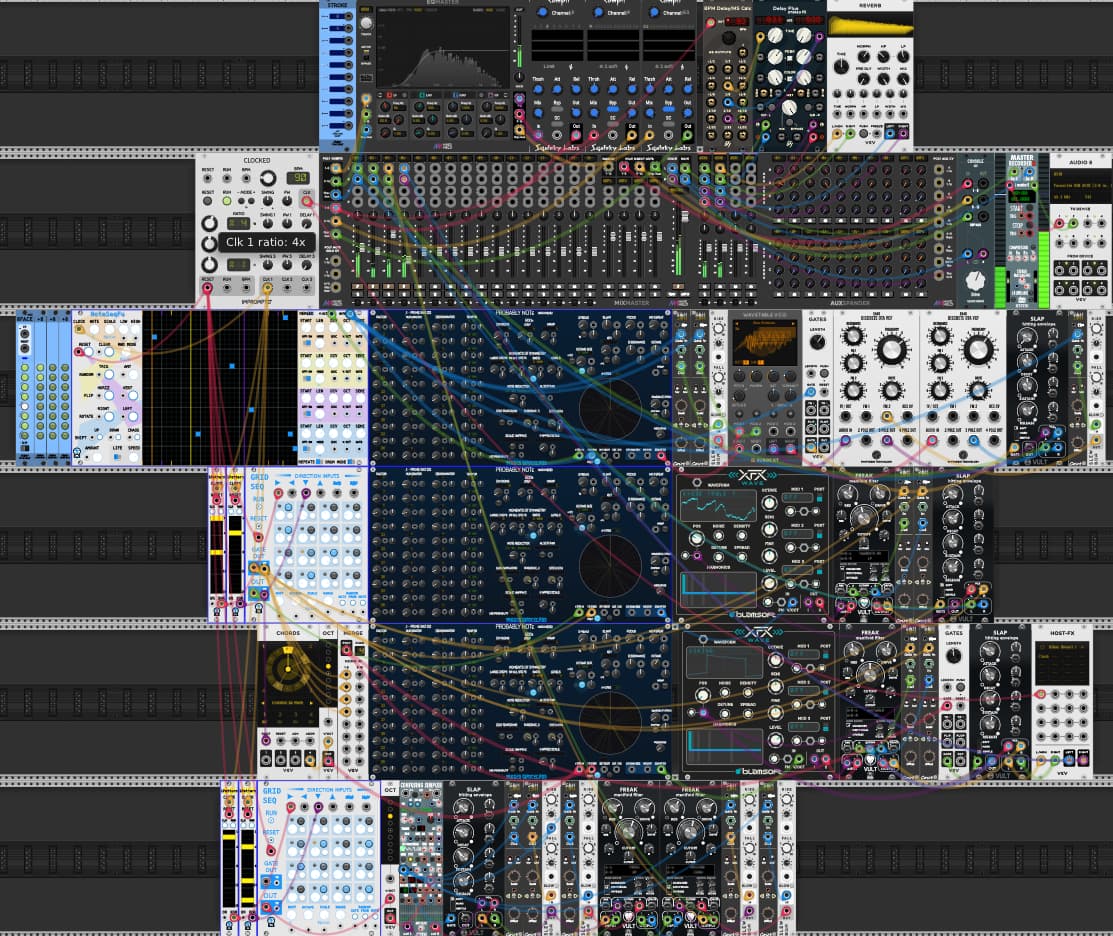
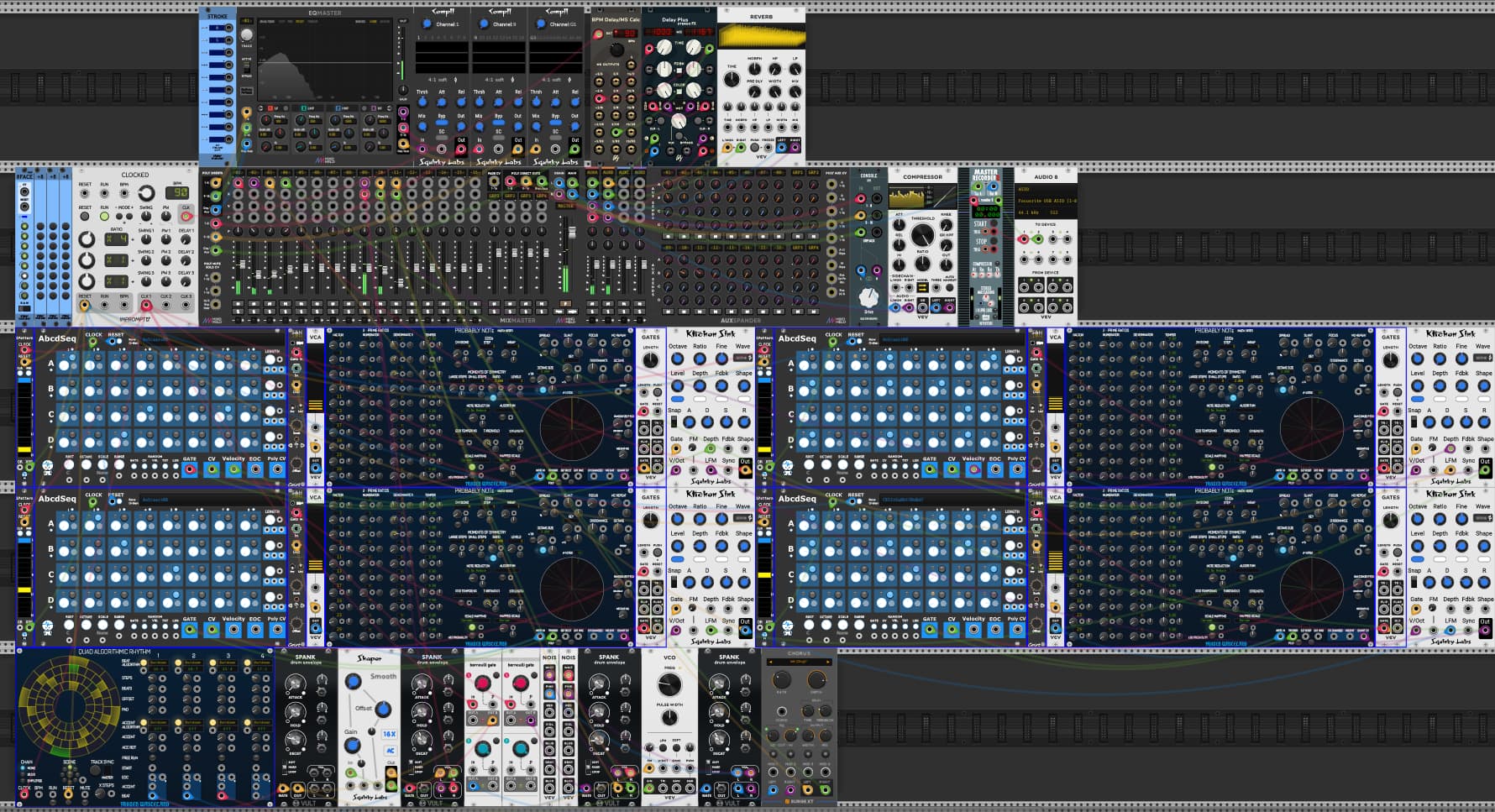
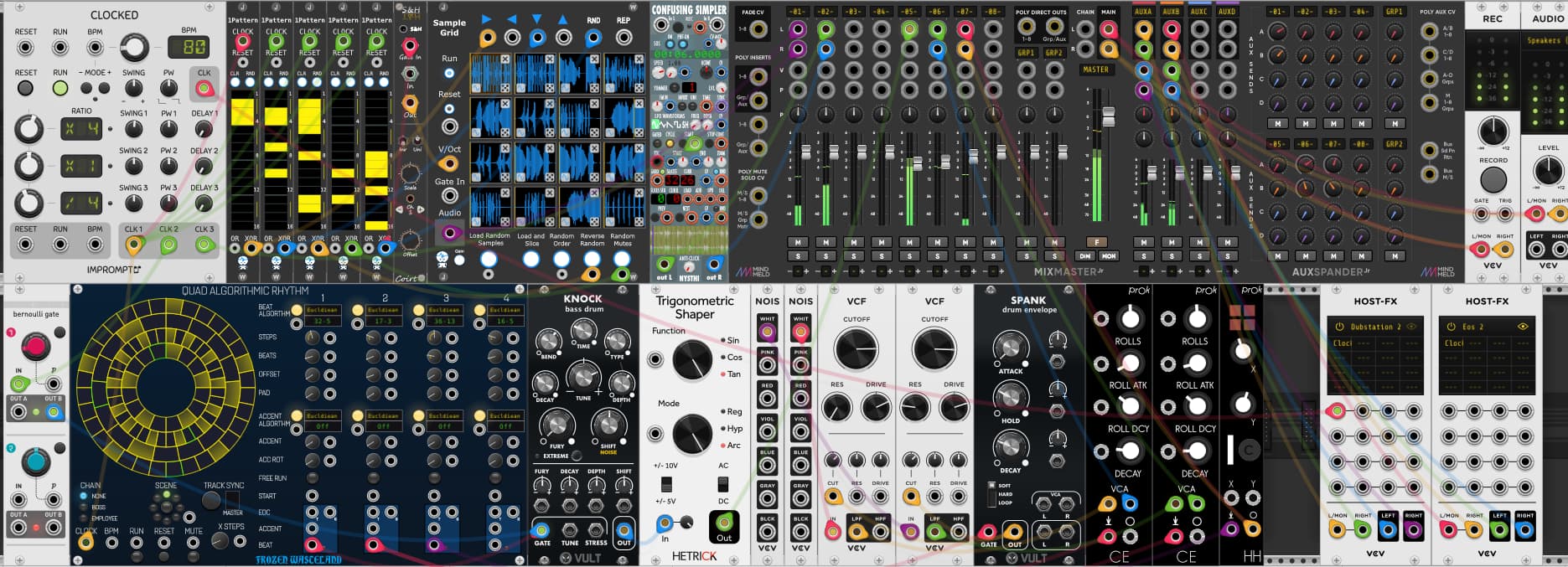
The main sequencer is two JW Gridseq sequencers. the CV from each is plugged into the input of the Frozen Wasteland Probably Note Quantizer. The gate from both GridSeqs are similarly plugged into the gate inputs as needed. Adding two gate signals is the same as doing logic ‘OR’ of the two signals, so you get triggered by both sequencers.
The sample is of a choral piece by Montiverdi from archive.org. I’ve hopefully mangled it enough to make sample clearance unnecessary.
I’ve started using the Frozen Wasteland QAR a lot for drums, and it’s warping my rhythmic sense. I like it when the rhythms aren’t square, and you can’t hear the bar lines. There’s a point around 3 minutes when it goes into what seems like a steady 4/4 beat, but it’s a Euclidean rhythm, so every 8 beats it skips an 8th note.
So the tuning is a combination of numerators and denominators, that defines a 13 note scale.
I didn’t post this when I made it last week because I thought it was the sourest, weirdest music I’d ever made. Then I was listening tonight, and had one of those weird perceptual shifts, where it started sounding like some out there jazz, and even sweet in it’s own way.
Math Nerd does a whole bunch of things I haven’t tried, but one of the most fun things is to dial in a 30 note scale (or 31, or 17…) and then use the option for scale mapping. You get that cool rational temperament sound but closer to a regular scale.
This was fun. I put a contact microphone on a Fisher Price xylophone and then used several instances of Confusing Sampler to record loops. This is a sub-optimal contact mic on a crappy plastic xylophone, so the thwack of the mallet (or in this case, a screwdriver) gives you a huge thumping attack, and the notes are much quieter.
Even better, the contact microphone taped the hollow plastic case turns the xylophone into a microphone that picks up room sound.
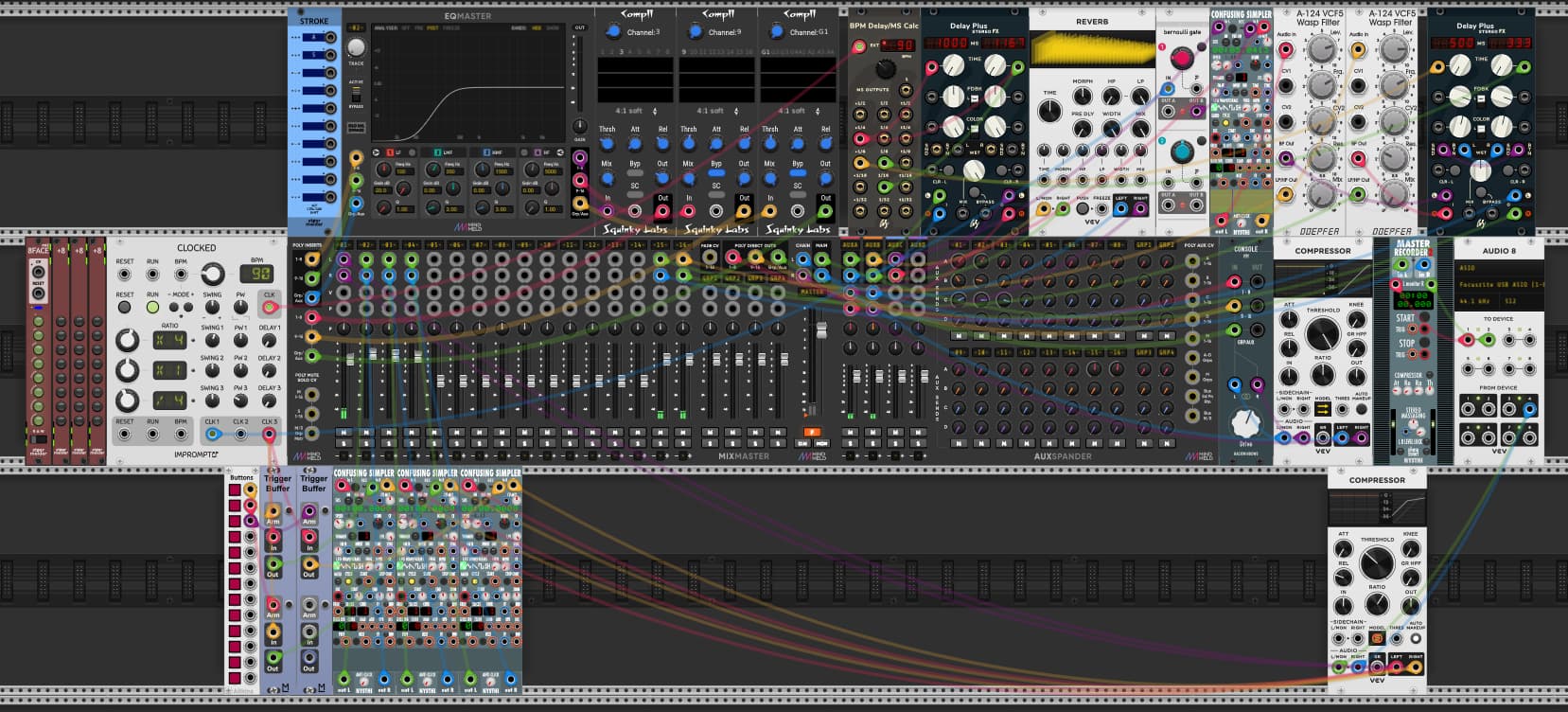
This is almost all done with @synthiNysthi Confusing Simpler, including an effect send, where I’m using a Bernoulli gate for record and loop start triggers to record and playback sample input.
The documentation for Confusing Simpler is mostly non-existent, but it’s not too hard
to figure out, and you can make it do insane things. Record audio input then trigger playback. It is double buffered, meaning it’s playing the last recording while you make the next recording, and when recording stops, it starts playing the just-recorded buffer.
You can turn on the sample grid, and it chops the sample into short loops, and you can skip around the sample, playing fragments.
My performance was experimental in that I’ve never improvised a whole set. I had 4 loopers and some effects set up, but played slide guitar with a slide and an infinite sustain gizmo like an ebow. I brought a keyboard and had a synth that I could also record in the looper.
The only preprogrammed things were the drums and the synth playing chords, and I changed the patterns live. I also had a couple of Kalimbas - one melodic and the other that just makes weird scronking noises. A plastic harmonica, and a Fisher Price xylophone
After a day to rest my ears I listened to it and it hangs together in an odd way. I leaned into my inability to play rhythmically, doing what Melissa calls “brailling it,” just listening and trying to fit with it.
The link above is the recovered 24-bit WAV version.
I’d set up a digital recorder in the first row of the audience. It’s not me coughing, and the various noises were just ambience. Where the recorder was, it would pick up any audience noise (you can hear talking at one point), and I was surprised the audience was that quiet. A good sign? I hope.
I use I step around in the Random Sampler with clocks from 1Pattern which is a clock divider where you can complexify the triggers by XOR-ing different divisions of the clock. The samples get shuffled around and reversed.
This is where I got the loops that are playing in the Sample Grid. There’s a free download of a sampler from the set. They’re supposedly trap samples but when I start to messing with it, it ends up sounding like is evil dub with chaotic drumming.
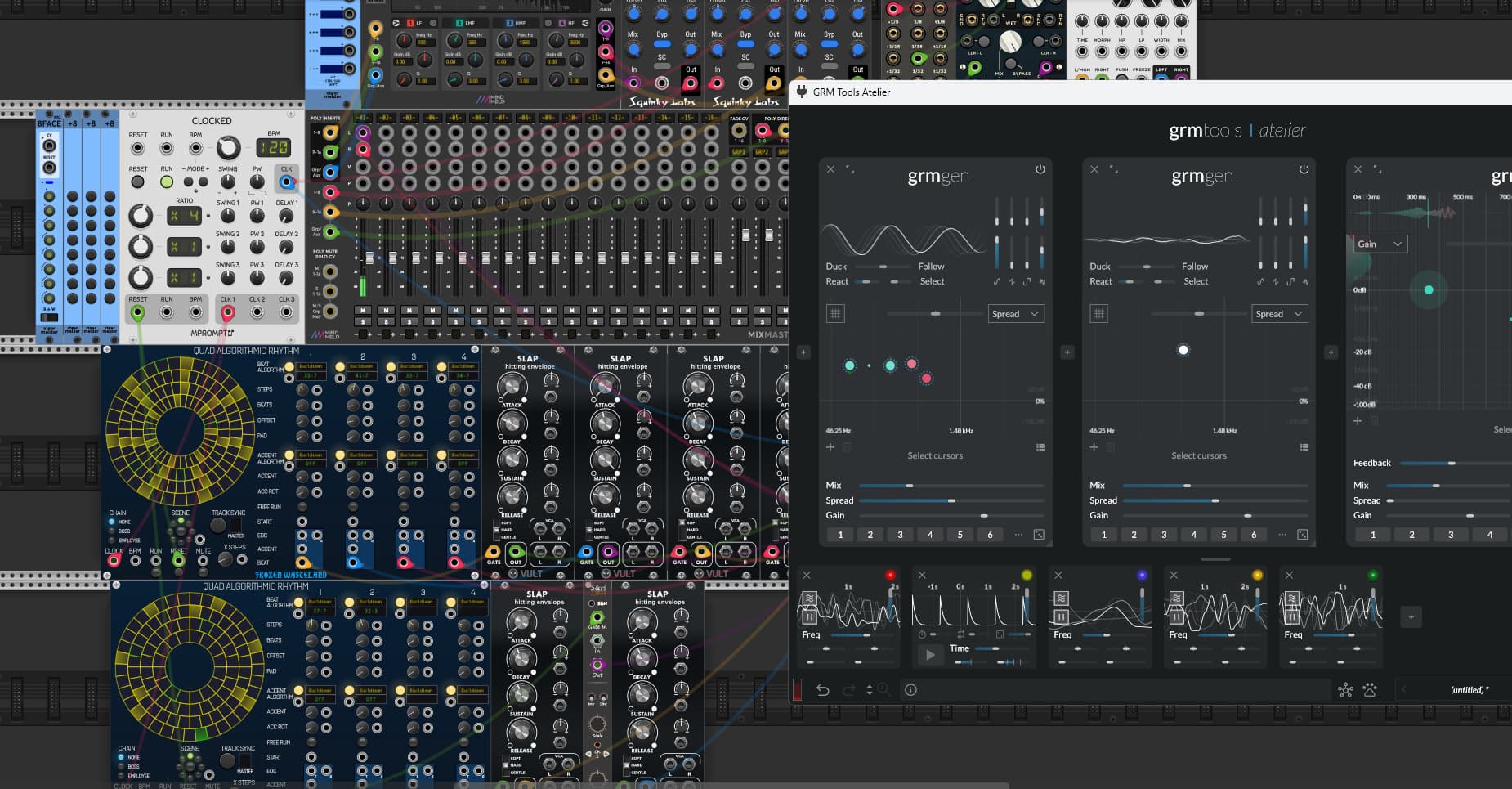
When you want to try and turn GRM Atelier into a drum machine!
The way Atelier works it has the GRM:Gen module which can output any number of waves from sine to noise. Everything is automatable, so from VCVRack I sent envelopes in as MIDI controllers, to modulate the level of individual oscillators.
After the gens, I added a delay and a comb filter for the spooky atmosphere.
It’s rather heinous to do but the results are spooky and cool.
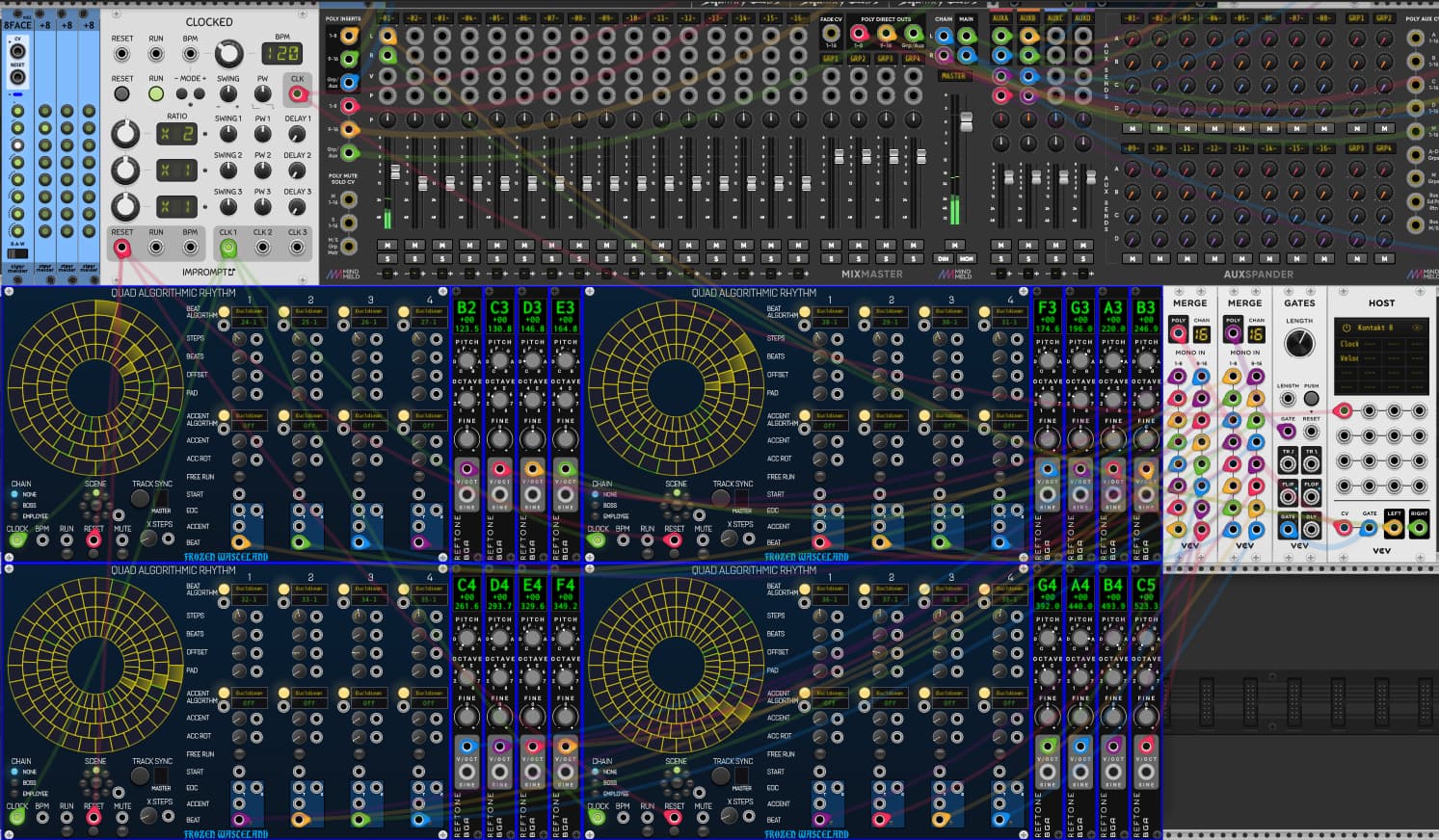
This is a process piece. The 4 QARs are set up with a single note per channel, and the length of each channel’s offset and length increases by one.
So at the beginning you hear an ascending scale. But once the cycles repeat, each at their own length, you get a weird version of Steve Reich-style phase music. But Reich’s stuff you can hear the drift. After the first 4 or 5 repetitions, it starts having a different character. As the cycling progresses notes ‘catch’ up with their predecessors and the pitch descends as well as ascends.
Using BogAudio Reftone modules to set pitches - one per QAR channel - is a weird way to sequence, but also quite fun. There are other presets in the 8Face Mk 2 that are busier, and fun in a different way.
I’ve listened to it a few times. I’d love to write it out as sheet music for a pianist.