I had the stupid idea to try to solve a problem. I like playing around with reverse delays with my instrument BUT it’s never really syncing up to my playing. Especially with percussion instruments that’s very clear to hear.
So I thought: “Is there a way around it?” And, yes! There is! (or might be)
I’m fooling around with the memory modules from @StochasticTelegraph since quite some time now. Especially with the modules Fixation and Embellish
And I had the idea for the following:
- set Memory Module to 10 seconds. This way position output of Embellish effectively becomes a position in milliseconds within a 10 second cycle
- set a Fixation to “CLOCK as Gate” Style and Speed = -1
- send the position of Embellish to a shift register which takes a sample each time I hit my instrument (Envelope follower plus some refinement)
then I get two cycling values: X1 (first hit) and X2 (second hit) and that gives me the possibility to calculate the length between each hits.
X2 - X1 = the exact length between two strokes in milliseconds
- send the position of Embellish through another S&H to the Position input of Fixation
- Set a Gate to the length and send it as a “CLOCK” to Fixation each time I hit my drum
the theoretical result should be looking something like that:
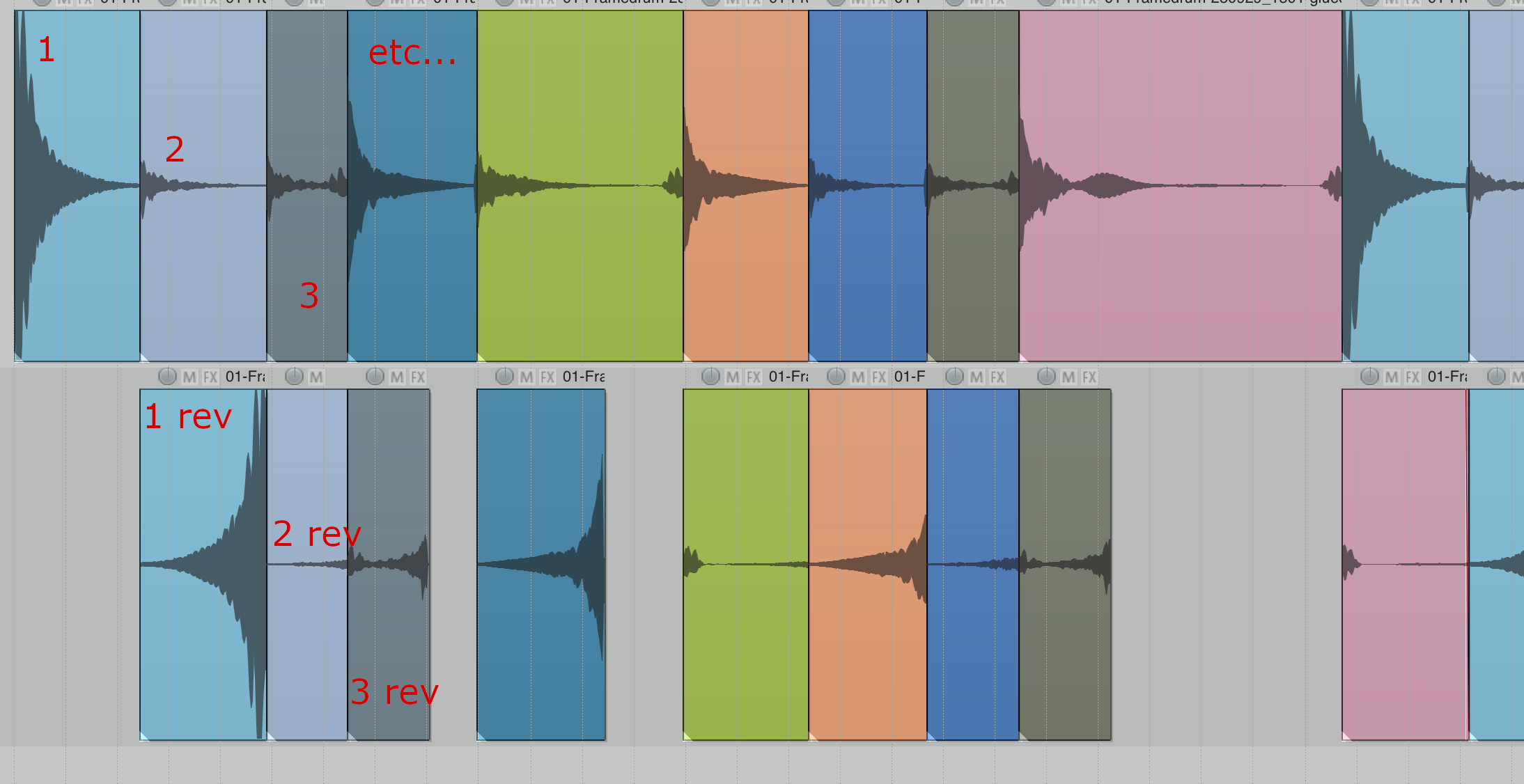
problem:
since each sample has a different length, they overlap and thus don’t play fully.
Solution might be to have several fixations that run kind of parallel to each other.
I also already patched something up to see how it can work…
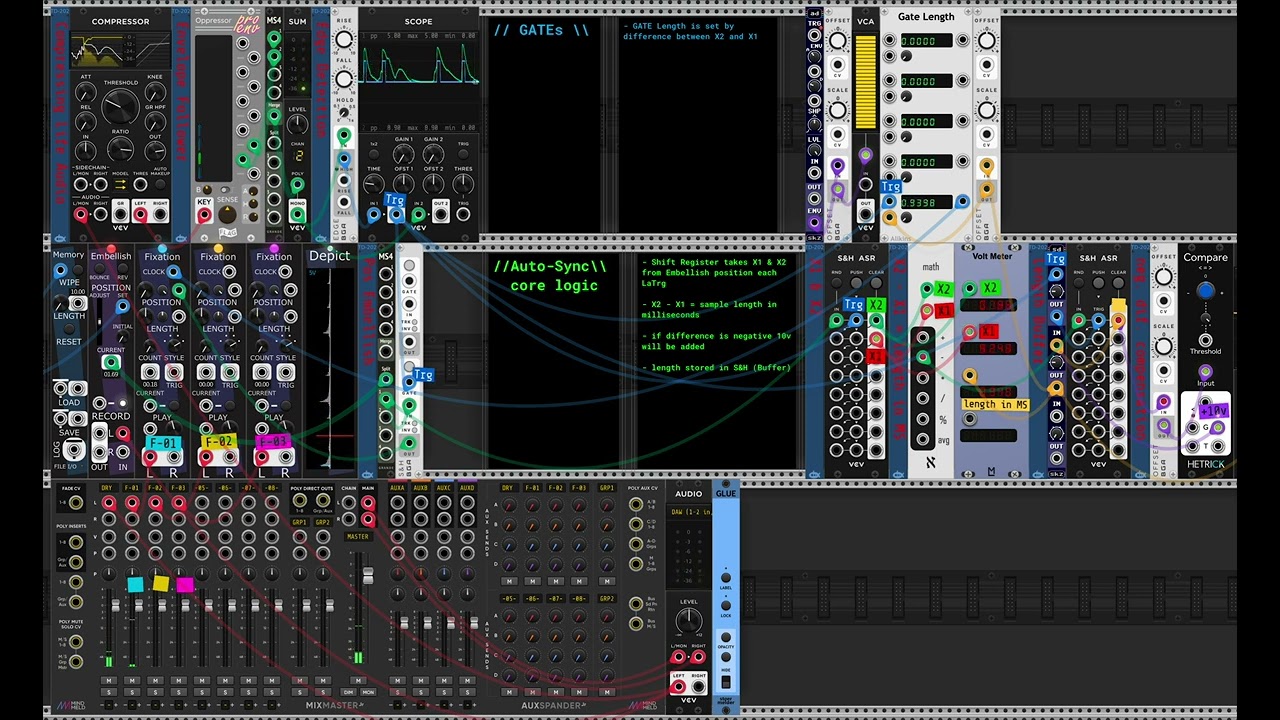
And of course it got way more complex than I thought.  That’s why I’m trying to document it for myself as best as possible to understand what happens and how the signal flow works.
Also I think I’m running into problems of trigger/gate synchronisation issues within VCV due to the added samples between modules?!
And one thing I noticed is that the position of Fixation does not always change while playing. So I might need to put a VCA in-between the gate and Fixation, that closes between each trigger. mmhhh… And I think I get some pops and clicks from the sample starting within the transient of the next hit from the percussion. That also needs solving somehow…
But generally I’m very pleased about the results so far. The reverse sound is WAY more in-sync with what I’m playing then with a common reverse delay. 

And: it also should not be depending on a certain bpm: since the gate length and position is calculated by the incoming signal it should ALWAYS be in sync with what I’m playing.
There is not yet any delay on the patch above, since that’s the easiest problem to solve with just a delay module. But at least the timed reversed sound kind of works (minus the problems from above)
next step:
- fixing the above issues with the position update of Fixation
- adding MORE Fixations and finding a way to cycle them through the positions of Embellish (another shift register?? or a 1-4 switch?)
- solving the clicks and pops at the start of each sample
I’m happy about any ideas and input from the forum people. It’s maybe a bit different than the usual patches here but I really hope you guys find this interesting nevertheless. I’m using VCV mostly to create sound effects for my percussion live setup. Not yet as refined as @VirtualModular but I’m trying my best
And a big thank you again for @StochasticTelegraph for his beautiful memory modules. Without them I would not have the tools to try out those things AT ALL. I really love how versatile they are!