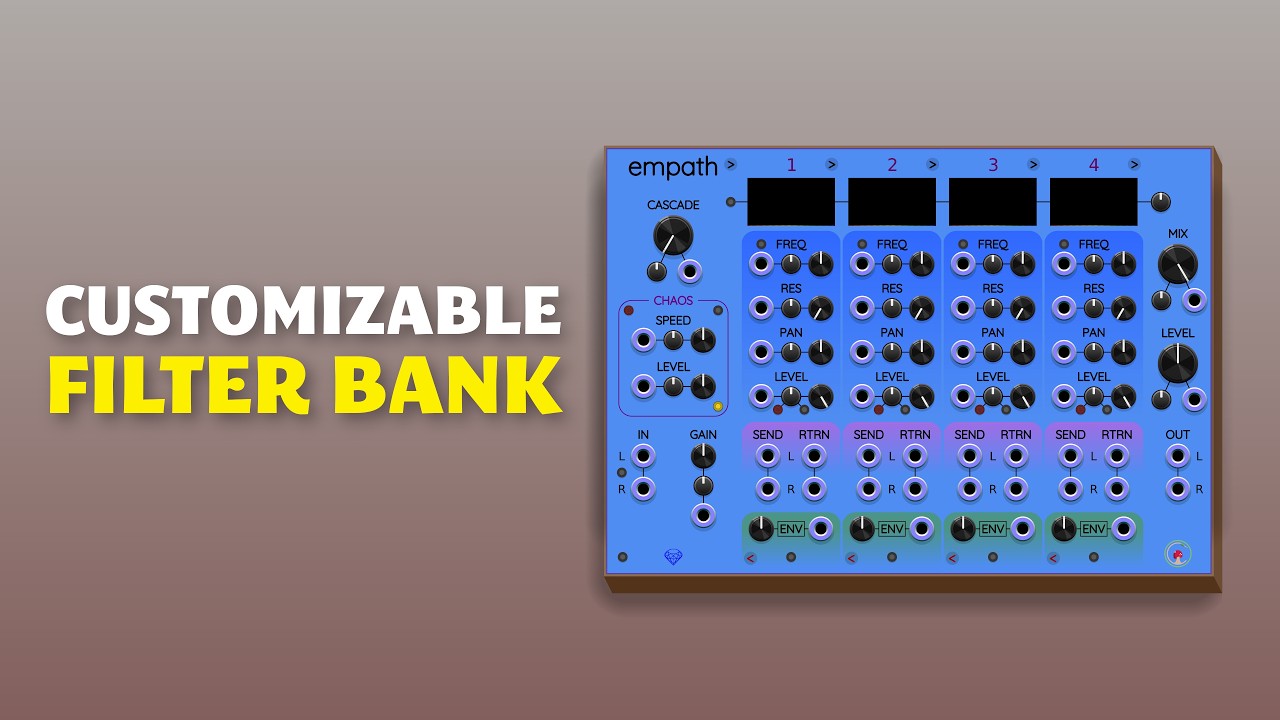
Omri Cohen and I collaborated on another new module. We are pleased to announce Sapphire Empath.
Much like our previous collaboration Echo, Empath consists of an expander chain, only instead of an array of delay loops, Empath is an array of filters.
One of my favorite novel features of Empath is the built-in chaotic modulation engine. This is an idea Omri and I talked about over a year ago to help create generative patches quickly. We decided to make it happen in Empath.
The video summarizes the features of Empath and gives great examples of how to use it in practice.
Instead of creating a new thread, I decided to recycle this one to announce this Sapphire plugin update, because it consists mostly of improvements to existing modules, not new modules.
Echo: Added a new fader button to help reduce startup pitch distortion, as explained below.
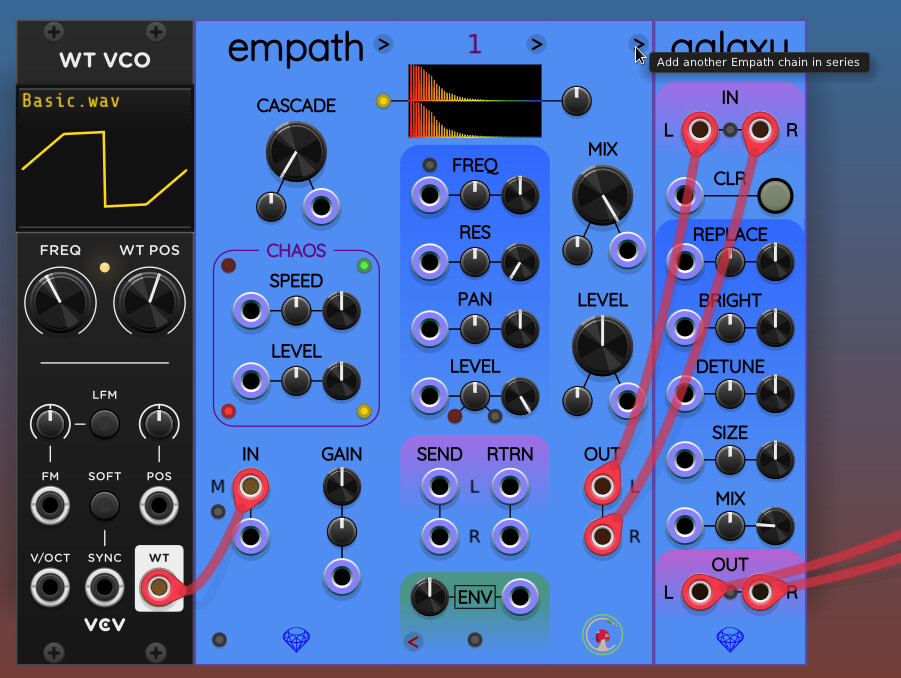
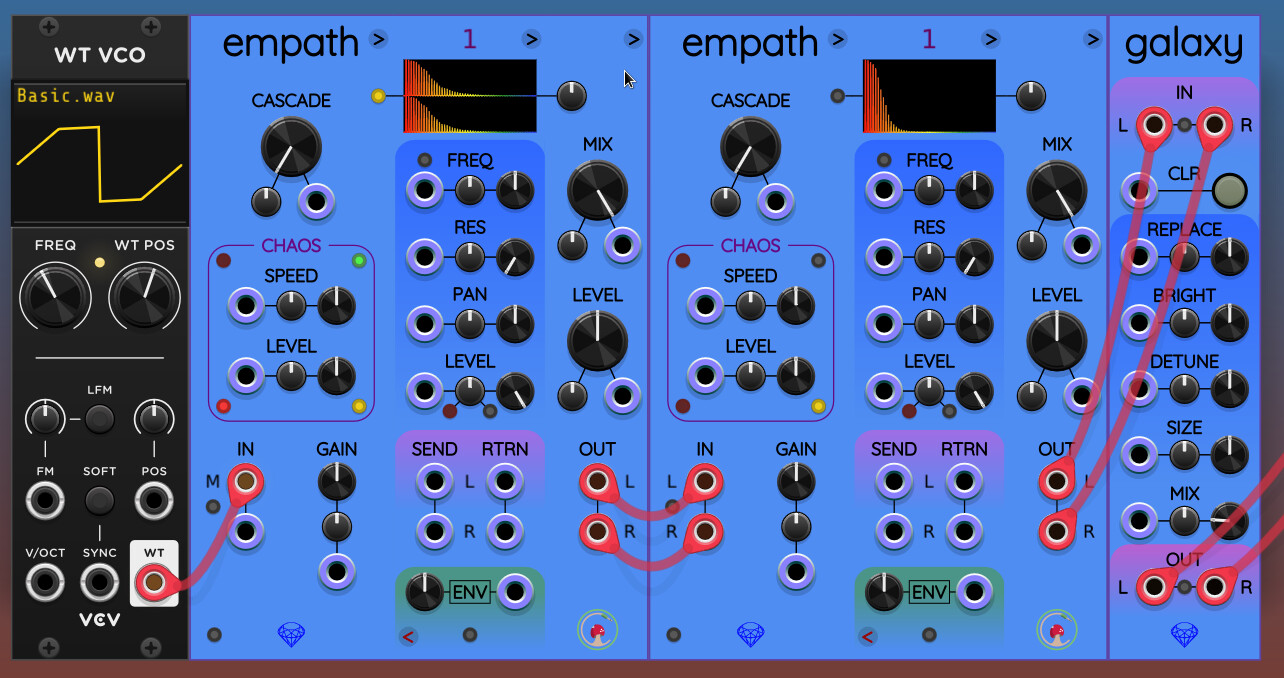
Empath: there is now a button to create another Empath chain in series.
Empath: added CHAOS box button to display chaos voltages as colored rings around affected attenuverter knobs.
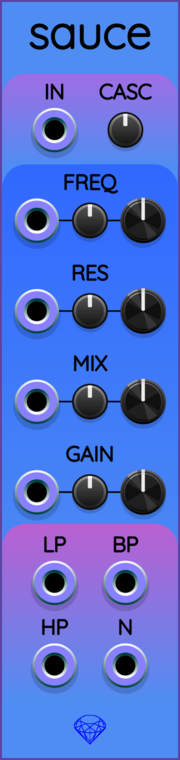
Sauce: added a notch filter output.
Sauce: added cascade control just like Empath has.
Chaops: added tiny button to toggle input format: gate/trigger.
Chaops: added CRUISE control to regulate the variability of the chaotic particle speed.
Tube Unit: allows you to toggle VENT/SEAL by clicking on the label itself. Before, you had to use the context menu.
Empath display chaotic voltages option
Click the lower left button in the CHAOS box to display voltage-colored rings around attenuverters that are affected by chaos. This helps you visually track how chaos is affecting different controls in real time.
Echo fader option
Sometimes Echo makes strange sounds after reset due to changing the speed of the tape loop while it is recording.
I added a new FADER button to reduce this effect:
Fader defaults to disabled, for backward compatibility. When enabled, the fader option causes different behavior after a reset or CLR trigger:
Immediately after being reset/cleared, the fader records silence to the tape loops for a configurable amount of “silent time”, defaulting to 1 second.
After the silent time finishes, the recording level ramps linearly from 0 to 1 over another configurable amount of “ramp time”. Once the ramp time completes, the recording level stays at 1, which leaves us back at normal behavior.
The silent time and ramp time can be adjusted using two sliders in Echo’s right-click menu. You have to right-click on the input module, not a filter module or the output module, to see the sliders:
Empath: adding another Empath in series
Because Empath processes all the filters in the expander chain in parallel, sometimes I find myself connecting more than one Empath in series, so that I can cascade two different kinds of filter.
I followed this pattern so frequently that I decided to simplify it for everyone. Now the Empath output module (the one on the far right) has a little > button in the upper right corner. This button converts this:
I like this, as I was surprised that the Empath does not have an option to run filters in series internally.
Could you not have an option for each filter within Empath to run in parallel or in series? Each in series filter would take as input the output of the filter to its left. The left most filter wouldn’t care if it was in series or parallel.
The end result would be pretty much the same, except you only get one chaos control and one mix control instead of two of each.
Great question! This gives me a chance to share some of our behind-the-scenes design philosophy.
What you said was pretty much our initial design idea for Empath. The more Omri played with it, the more he found he almost always preferred parallel connections. When you put two bandpass filters in series, you get a lot of quiet output unless their center frequencies line up. Eliminating the series/parallel toggle per filter made a lot of other things cleaner and simpler. I can’t remember all the issues, but it was a relief to me as a developer when we both agreed to have parallel only.
Putting multiple bandpass filters in series, tuned to the same center frequency, is something I still wanted to do, which is why I added the cascade control. Now each stage can be put in series with itself, 1..3 times. That made me happy.
Plus I realized anyone can do anything they want by chaining multiple Empaths using cables. Adding the series button brings us full circle to make patching faster for common use cases.
Overall, Omri and I wanted Empath to be somewhat opinionated. It’s not a general purpose tool like a knife; it’s more of a special-purpose tool like a lawnmower. You can do all kinds of things with a knife that a lawnmower can’t do. You could even cut your grass with a knife! But it’s so much faster to use the lawnmower.
Omri and I hope that people will use Empath for a certain class of use cases, and that it will be much faster to wire up with Empath than using general purpose modules, since most of the “cables” are internal. We therefore believe that the main value Empath provides is saved time. When a tool saves time getting to a certain place, it makes that place more accessible for exploration, because our time is limited. The tool then steers what you tend to do with it based on what it makes easy.
We hope that our design decisions are helping people go places in their patches that they would not have tried on their own, and we hope it makes it easy, quick, and fun!
Ah yes - I was forgetting that it only supports band pass and comb filters. The use case for serial band pass filters does seem limited. The situation would change if it also supported low pass and high pass filters.
Yes! And going back to the knife / lawnmower dichotomy, Sauce is more of a filter-knife than a filter-lawnmower. So I took the new cascade idea from Empath and put it in Sauce also, and added the notch filter from Empath:
Notice at the top the CASC knob. It is the same thing as CASCADE in Empath. Also, at the bottom, there is now an N port that outputs a notch filter.
With enough time, cables, and chaotic oscillator modules, you could do anything with Sauce that you could do with Empath, plus an infinite number of things Empath can’t do.
Yes, yes, yes. You can get very complex interesting output from Empath very quickly. The embedded chaos is addictive, you almost feel like you are cheating when you sprinkle it around the module in 10-15 seconds.