I am super thrilled and proud to announce the release of Venom v2.16.2 with 7 new modules plus 2 expanders !
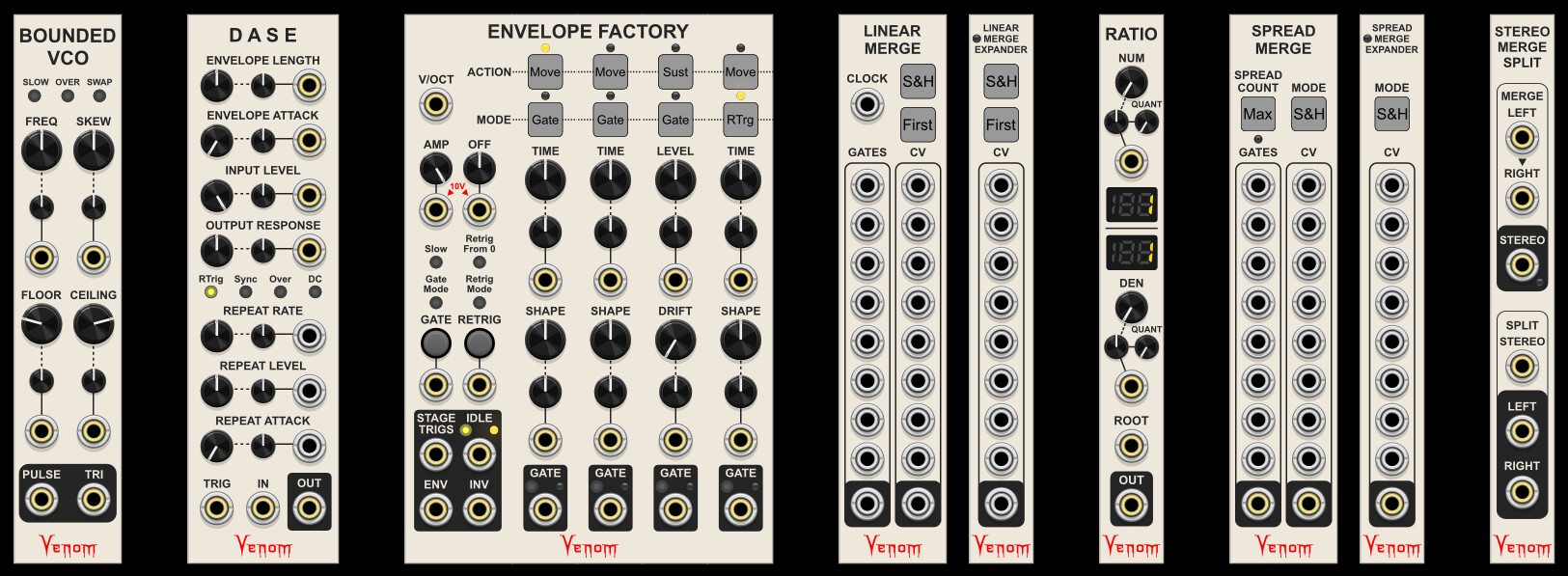
2.16.2 (2026-08-28)
New Modules
-
Bounded VCO documentation - An implementation of Peter Blasser’s Bound/Bounce oscillation that constrains an oscillator with constant slopes between an upper and lower bound. There is nothing else like it in VCV.
-
DASE (Dynamic Amplifying Shaping Envelope) documentation - A novel Attack Decay envelope that also serves as a VCA and wave shaper via audio rate modulation of the envelope shape. An internal LFO can also add repeats that sound like a Delay. It can be temperamental, but also gives really nice results when carefully configured. As far as I know, no one has ever implemented a combined envelope generator / VCA / wave shaper like this in hardware or software before.
-
Envelope Factory documentation - A highly configurable envelope generator supporting anywhere from 1 to 20 stages. I think this is the real star of this release. More about it below.
-
Linear Merge documentation - Merge multiple sets of monophonic gate/CV pairs into a single monophonic stream of gates with associated CV. This is useful for extracting one melodic line from many CV sources
-
Linear Merge Expander documentation - Adds another channel of CV to Linear Merge.
-
Ratio documentation - Computes V/Oct CV for musical ratios using integral numerators and denominators. A great resource for audio rate frequency and phase modulation.
-
Spread Merge documentation - Spread each monophonic gate/CV input pair across multiple polyphonic channels and merge all into a single poly output. Useful for letting the release of overlapping notes in a sequence to ring out to completion.
-
Spread Merge Expander documentation - Add another CV channel to Spread Merge.
-
Stereo Merge Split documentation - A compact and versatile polyphonic merge and split utility for stereo signals. It makes it convenient to use polyphonic modules without stereo support to work with stereo inputs and create stereo outptus.
Enhancements
- Poly Mute
- Add “Exclusive pass” (radio button) Gate Mode option
- VCO Lab and VCO Unit
- Exponential FM no longer disabled when in 0 Hz carrier mode. Only has effect if bias is non-zero.
- New Soft Sync gate mode. If enabled then high gate is reverse, low gate is forward, and hard sync no longer resets direction to forward.
- New sync threshold option with miniscule 0.1 mV hysteresis centered about 0 V.
- XM-OP
- Added “High XM depth for FM & PM” context menu option: multiplies depth by 5
- All modules
- Added “Restore all factory names” context menu option - restores both parameter and port names
Bug Fixes
- Documentation was reorganized so that deep links from an external site now work properly. The documentation has become too large to put everything in one file.
- VCO LAB & VCO UNIT: Fixed Bias frequency display. Used to be off by factor of 100.
- SLEW: Fixed shape CV input names in hover text.
- NORS_IQ: Fixed unit display for interval and scale root knobs.
- Widget Menu Extender: No longer mistakenly adds context menu options to commercial Venom modules.
- Bay modules: Removed allocation actions related to label propagation from the audio thread.
- Removed allocation actions related to name and unit string manipulation from dsp thread for all modules. Affected modules:
- AD_ASR Envelope Generator
- Multimode Filter
- Mix modules Mix 4, Mix 4 Stereo, VCA Mix 4, and VCA Mix 4 Stereo
- Non-Octave-Repeating Intervallic Quantizer
- VCO Lab
- VCO Unit
- XM-OP
- Widget Menu Extender
More about Envelope Factory
I have been dreaming about creating a flexible envelope generator for years, but I struggled coming up with a design I was happy with. I have always been impressed with the power of Mutable Instruments Stages, but I never got comfortable with the interface. I wanted something even more flexible, yet much easier to use. I am glad I waited for inspiration (and some helpful ideas from friends in my dev thread)! - the end result is way better than what I ever hoped for.
Please read the full documentation. There are way too many features to list here, but here are a few possible use cases:
- create just about any envelope imaginable
- as an LFO with complex wave shapes.
- as a V/Oct VCO as long as you stay within the first 2 or 3 audible octaves. Modulation of rise and fall shapes gives interesting shifting timbres.
- as a timed step sequencer where each stage is timed rather than being advanced by a clock.
- as a traditional clocked step sequencer.
Besides being highly flexible, it has a number of features that are rare or novel for VCV:
- Rather than use expanders, the module automatically expands or shrinks to accommodate the chosen stage count. This allows for the creation of convenient presets, as opposed to awkward selection sets.
- Stages can be extremely short, 1 sample for instant steps, or as low as 1 msec via the knob for slopes, or even shorter via CV control.
- Stages can be extremely long, as long as 2.78 hrs via the knob, or even longer via CV control.
- Special support for a true decay envelope with an instant attack.
- Sustain stages have an optional Drift rate where the stage drifts toward the target of the next stage rather than holds steady. So an ADSR becomes ADBDR (Attack Decay Break Decay2 Release), with the Sustain stage defining the Break and the Decay 2. It can be used to emulate a piano sustain pedal that slowly decays until the pedal is released, and then there is a fast release stage from that point.
- Optional built in VCA with velocity control. The envelope triggers can optionally be synced to the VCA input, delaying the triggers until the input crosses zero. This is great for avoiding unwanted clicks that can arise from very fast attacks.
- Retrigger input can be used with triggers, or you can feed it V/Oct CV and it will retrigger every time a V/Oct change is detected.
- A single envelope can have multiple sustain stages that can each be held, only advancing to the next stage when a retrigger signal is received.