CFor2N2ForC (artificialcolors)
Viz (VCV)
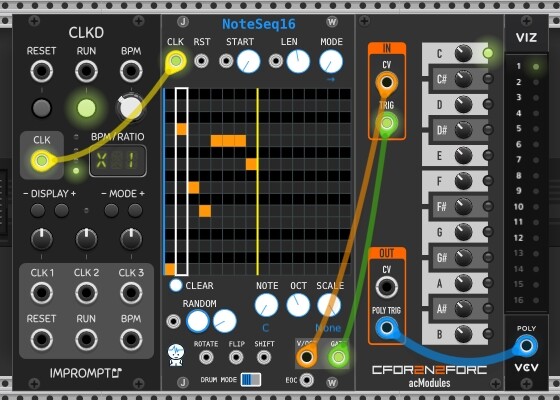
A monophonic trigger signal at the IN TRIG port of CFor2N2ForC (artificialcolors) is routed to one of 12 polyphony channels emitted at the OUT POLY TRIG port.
Channel routing is guided by the CV (musical note, independent of octave) fed into the IN CV port.
In effect, a drum sequence can be generated based on note pitch.
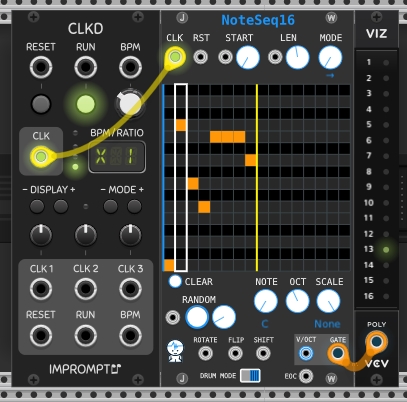
In the first example, triggers and CV are supplied from a NoteSeq16 (JW Modules) sequencer, creating a trigger on every step.
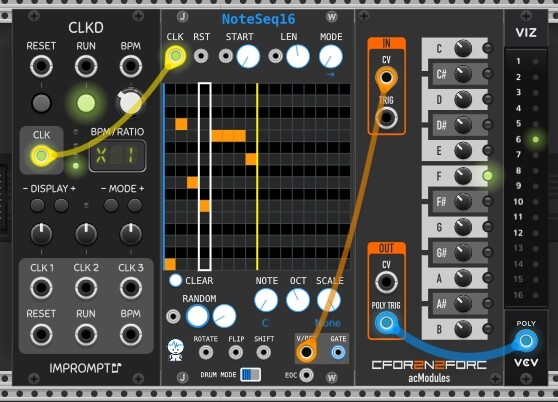
When ‘Output trigger on note change’ is checked in the context menu, a trigger is emitted every time the note value on the IN CV port changes, even if the IN TRIG port is not connected.
In the second example, this setup is used for a patch variation, in which no new trigger is created when the note value remains the same.
Viz (VCV) is used as a channel indicator.
UPC_CFor2N2ForC (artificialcolors)_20241111.vcvs (16.3 KB)
Addendum: Setting NoteSeq16 (JW Modules) to ‘Drum Mode’ and ‘Polyphony channels’ in its context menu to 16 also spreads note values across the channels, with the difference that here the octave also matters. In the example, the second step carries a C note one octave above the C note in step 1 and is guided to Ch. 13, in contrast to Ch. 1 with CFor2N2ForC. If ‘Polyphony channels’ is set to 12, the higher C does not evoke any trigger.
UPC_ADDENDUM_CFor2N2ForC (artificialcolors)_20241112.vcvs (6.7 KB)