This post is a set of thoughts that have been percolating in my head that I thought might be interesting, and then a suggestion for certain kinds of modules.
Randomness
As almost anyone reading this likely knows, in audio synthesis there are a pair of contrasted approaches to creating sound, subtractive and additive synthesis. In brief, subtractive takes a complex sound and carves away the unwanted parts (often starting with a filter), and additive builds up a sound by summing simple signals together. Both have their place, and all is well.
It’s occurred to me that the way randomness has been treated in synthesis has a similar metaphor. We usually take complex randomness in the form of uniform or Gaussian distributions, and then carve away the values we don’t want. A quantizer is often used to push a range of random values to a few selected ones, for example. They are filters, if you will.
After making my most recent modules Distribute and Chances, I feel like I’ve stumbled onto the start of methods for additive randomness. For example, I find myself using this for note creation:
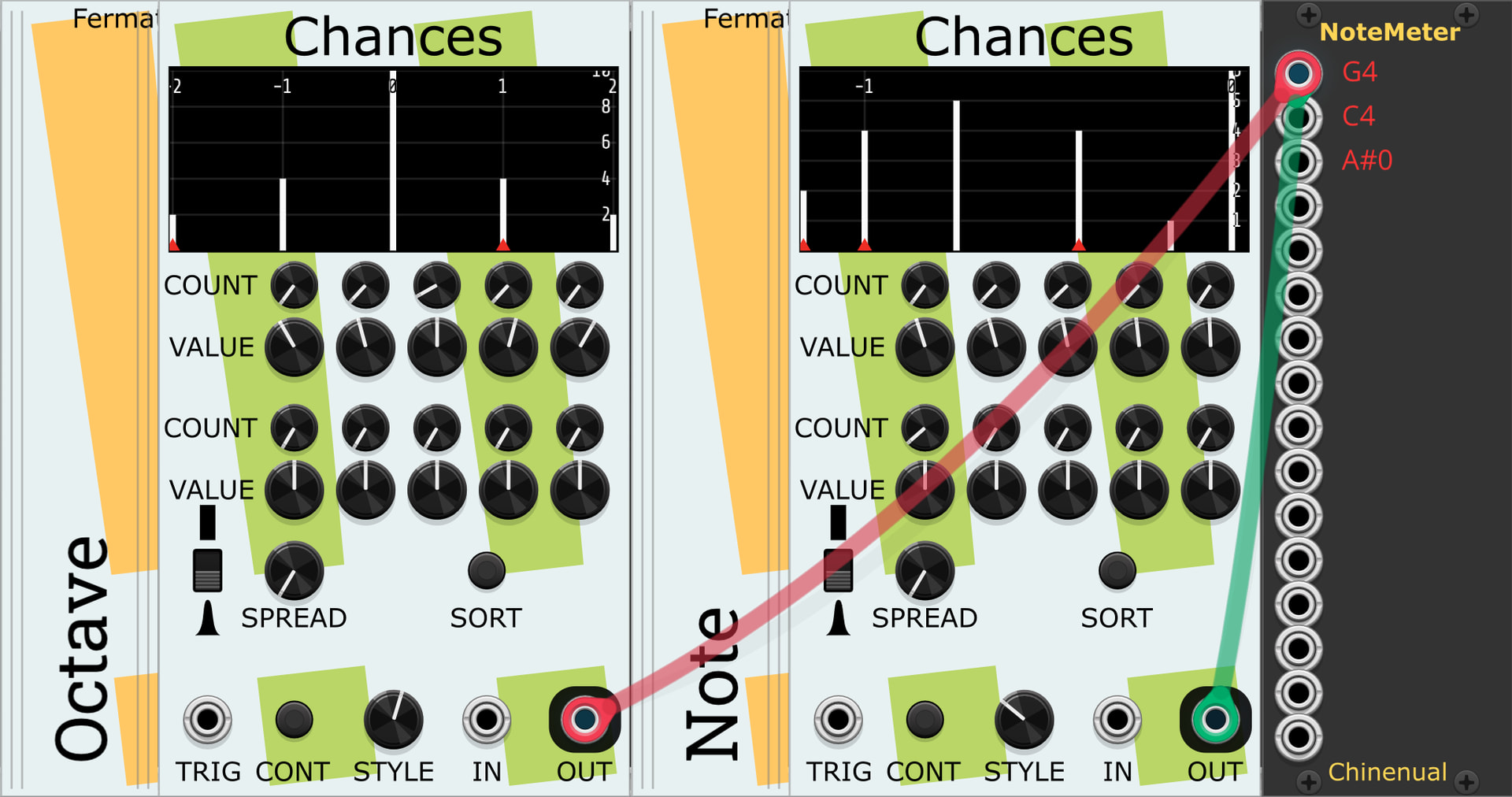
Note Pick.vcv (1.2 KB)
Here I’m summing two Chances to create three-note chords to play. One Chances is picking the octave to be in, with different probabilities of being chosen (favoring the middle octave, but allowing notes that are two octaves higher or lower to be picked). The second is picking the note (favoring C, D#, and G, and less often A#).
There may be ways to do this kind of shaping of the notes chosen with subtractive techniques, of course, but they’re not coming to my mind easily.
What other modules could take part in additive randomness?
A sequencer. An arpeggiator. Maybe even quantizers on a random signal, but with some logic modules thrown in. Modules that are running user-written code. I’m sure you can think of others.
Observation
So far as I can see, nearly all modules that use random numbers to control their own behavior do so by generating values internally and then, with some number of user parameters and settings, subtractively craft those values into the behavior of the module. For example, the module slips does a delightful job of creating melodies. But what could it additionally do if it could take in user crafted values from other modules and used them instead of the internal source? Use scales/keys that aren’t listed on the parameter knobs?
The answer to that depends on in part on how those values are used, and if there’s a user-comprehensible mapping of “random value” → behavior. That’s not always going to be possible. I’ve been trying to figure out how to use this idea in my own Drifter module, and, so far, I’ve not found a result I love yet, but I haven’t given up yet.
Suggestion
My current thinking is that incorporating additive randomness values would require:
- one input port - to pull in values
- one output port - to send triggers to modules, thus “asking” for the next value.
- a menu option to select a number of samples to wait between the trigger and reading the response.
More thoroughly, when the module is asked to execute an event that uses random values:
A - if the input port is not connected:
- then just use the internal generator.
B: if the input port is connected, but the output port is not:
- assume that the input port is getting a continuous stream of random values.
- store as many incoming values as the execution requires.
- then apply them.
C: if the input port and output ports are connected:
- for each value required:
-
- Send a trigger to the output port
-
- wait for the number of samples set in the menu option (e.g., 5)
-
- read the value from the input port.
- Now apply all those values.
Both B and C do add some usually small latency from the event to the actual completion of the event. In some cases or implementations, that may be avoidable or not an issue.
Thoughts?
So, how does this ring to you? Is there something here of interest, or is this me getting lost in the stochastic weeds?
mahlen