SignalFunctionSet Release Announcements

I wanted to share a few ideas to improve the usability of the Gravity module.

In Pendulum mode, it’s hard to catch the top and middle points with the mouse when the pendulum moves fast. Expanding the interaction zones would make on‑the‑fly adjustments much more comfortable. The same usability issue applies to the Billiard Table mode.

A configurable Slew parameter for mouse control would help smooth out abrupt changes and reduce sharp jumps in position. I’d also love to see dedicated CV inputs to freeze or stop the upper and lower pendulum segments independently—this would enable more precise modulation and pattern‑based control.

Separately, I’d like to suggest turning the Billiard Table concept into a standalone module. It could feature a One‑Shot mode with realistic physics: conservation of momentum, inertia, friction, spin, gyroscopic effect, and angular momentum. For better integration, gate outputs for the cue strike and for when a ball falls into a pocket would be great, plus optional CV outputs for velocity or collision intensity. I think it’s a really fun and interesting idea! )))

1 Like

I’d also like to add one more feature to the Billiard Table idea: the ability to toggle each physical law independently at any time. This would greatly diversify the modulation behavior. Plus, it could allow a loop mode — for example, by simply disabling friction. But it’ll eventually end when all the balls fall into the pockets, so a pocket‑locking feature would come in handy if you don’t want to break the loop. ))

These were just thoughts out loud—ideas that don’t necessarily need to be implemented. :slight_smile:

1 Like

Apologies for the slow reply @egor.yashukov ! I like all of these suggestions, I will work on a few things!

3 Likes

@stuart78 You continue to amaze with the SFS Super collection! Thank you so much for all your wonderful modules! :100:

3 Likes

SignalFunctionSet 2.23 is now live in the library featuring two new modules: CISTERN and STRATA. I’ve also made some updates to CANON and COUNT which should make them a bit more useful.

CISTERN is a physically modeled reverb that bases the sound on scans of real locations, most notably the Dan Harpoon Cistern featured on Deep Listening. I recently saw the excellent documentary on Pauline Oliveros and it inspired me to bring that amazing long resonance to the plugin. From there, I added several other cisterns and found several 3d scans of real churches and other environments to bring in. There are a number of controls on the module, but I think it sounds pretty good when left alone.

STRATA is a polyphonic wavetable voice with three dimensions. It is build to support the 3D wavetable format I made for another app I manage (WaveStack), but can take 1d or 2d tables as well. In addition to scanning, you can apply macro controls for fold, tilt and warp. And there is a corrupt section used to play the tables ‘incorrectly’, which can be fun.

CANON now supports four octave range and stochastic note selection for each set. This really expands the possibilities of the module and prevents repetition. It also has a few more play modes.

COUNT now has start/stop and reset.

11 Likes

New wavetable oscillator is just waiting to be fed the wavetable pack I got a couple months ago , it’s like it’s meant to be in 3D with multidimensional reverb too! Definitely worth the look into, gonna have to mix this with some other modulations

2 Likes

Did Canon CV control of ROOT change? If so, are the changes documented somewhere for CANON and any other modules with change CV values for any parameters?

1 Like

Hi @k-chaffin it did not change in this release. Are you seeing some unexpected behavior?

Yes. For example the CV required to set the Scale to Mixolydian changed, along with others. Mixolydian previously did require a CV of 9.71 V to set it, but now requires 6.24 V. I’m not absolutely sure this change is new to V2.23 . I have several pages of CV maps for your modules that I will now have to redo, so each of my SFS patches are broken.

I should mention that I use Stoermelder’s uMap to set parameter knob states rather than the CV in-port.

Thanks, uMap may explain it. The scale order itself has only ever been added to. 6.24 V is correct for Mixolydian on the modules with 19 scales (most of them), and that hasn’t changed in 2.23: no SCALE knob’s range has changed since at least 2.17.3.

Some earlier releases did move these voltages: Note went from 17 to 19 scales in 2.12.0, and Fugue went from its own 12 scales to the shared 19 in 2.16.0. I can’t find any version where Mixolydian sat at 9.71 V, though, so which module was that map for?

For a uMap on most modules, the voltage is scale number × 0.556 V, counting from 0:

0 Chromatic, 1 Major, 2 Minor, 3 Pentatonic Major, 4 Pentatonic Minor, 5 Blues, 6 Whole tone, 7 Harmonic series, 8 Dorian, 9 Phrygian, 10 Lydian, 11 Mixolydian, 12 Harmonic Minor, 13 Hijaz, 14 Hirajoshi, 15 Pelog, 16 Slendro, 17 Melodic Minor, 18 Locrian

Key and Loom/Slide have 20 positions, so they differ: Key is scale number × 0.526 V, and Loom/Slide is (scale number + 1) × 0.526 V (your comment has prompted me to clean these up in the next release).

Could you share a patch that was working and is no longer?

Let’s take uMap out of the question and focus on using CV to set CANON ROOT and SCALE:

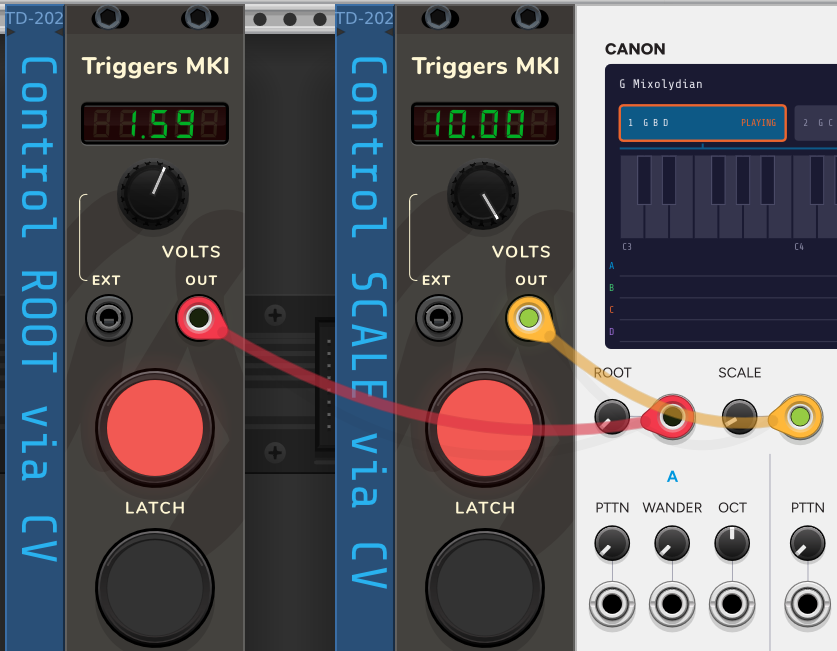
The following image shows what I have to send in order to set CANON to G Mixolydian (1.59v and 10.0v). The two CV ports seem to interact and also the knob positions interact. It was these interactions that resulted in me using uMap to control PTTN, WANDER and OCT rather than the CV in-ports. Is CANON designed to allow arbitrary ROOT and SCALE via the CV in-ports for the knobs?

Yes, both work over CV, and they don’t affect each other. What does interact is each jack with its own knob, because the CV is added to the knob.

ROOT is 1V/oct, rounded to the nearest semitone, and wraps to one octave. G is 7/12 = 0.583 V, and your 1.59 V is the same G an octave up.

SCALE is 1 V per scale, counted from 0 (Chromatic). Mixolydian is number 11. Your 10 V lands there because the knob defaults to Major, which is number 1, so 1 + 10 = 11. It’s only one step off the bottom of the knob, so it looks fully down when it isn’t.

The scale list stops at both ends, so the voltage has to reach the scale you want. With the knob at Chromatic, 0-10 V only gets you to Lydian (number 10). To reach all 19 with one source, set the knob to the middle (number 9) and send -9 V to +9 V, so the scale number is 9 + the voltage. If your source only does 0-10 V, setting the knob to number 8 gives you numbers 8 to 18.

The chord on screen changes with both ROOT and SCALE because a set’s notes are stored as scale degrees, so that part is expected too.

PTTN is added to its knob the same way, at 1 V per pattern with 16 patterns. WANDER is 0.2 per volt, so 0-5 V covers it from the bottom of the knob. OCT is 1 V per octave.

I’m going to add an alternative root selection mode where all values are spread across 10v to make it a bit easier.

Thanks for explaining. I would never have figured it out without a manual. Personally, I don’t think this makes usability sense, but that is just a personal opinion.

Thanks for the feedback. They were designed with more thought to working with other SFS modules, but good to open it up. In the next release you’ll be able to choose two alternate modes for how they respond to external CV.

1 Like

I always struggle to understand why a module would treat a discrete parameter knob with CV input as an attenuverter or modulator rather than a quantized discrete state CV setpoint voltage. I take this approach literally in my modules where a CV input changes the discrete state of the parameter of the knob and actually rotates the knob to track the current state and then write the state on the panel to make clear what is happening. But, at least initially, a lot of users freaked out when CV started turning knobs on my modules.:wink: I also try to document all of the discrete state CV values are in my manuals. My approach is an “automation” approach.

4 Likes