B# major is nice, that G## minor can get a nice Fx for leading tone.or is it F#X I forget
1 Like
Yes, and I think it’s easy to argue that the question itself doesn’t make sense because written music notation is a rather insane thing.
To me, it’s like this: For a very long time, humans had no written language and certainly no music writing system. So a lot of poetry and music was lost over the generations. Then writing came along, and we got epics, poems, laws, to-do lists, etc. And then musical writing was invented, so we got songs and symphonies and musical ‘laws’.
But we humans didn’t stop there. We then invented audio and video recording. So if we need to recall what a song sounds like, we can just listen to it again, no need to flip paper.
No need for a name of a note or interval – you can just hear that note or interval any time you want.
Sure, a nomenclature is still a useful shortcut at times, but for me the freedom of VCV is being able to set a few choice intervals and scales as presets (I use Debug for this, but could be done any old way) and I never have to think about note names again. Because I find it all very kludge-y and distracting from the creative process. Maybe that’s just me!
3 Likes
Both work fine for me, I see a mixture of both, for example C# and Db or A# and Bb, the only ones that seems unusual is Cb which is just B natural or E# which is just F natural… but I accept them equally too even if I very rarely see them like that
1 Like
Musical nomenclature serves a lot of purposes beyond just documentation though. Ear training/audiation/the ability to learn tunes by ear, etc etc… are greatly helped (for most folks) by giving the brain something to latch on to. Not that it’s necessary. Musicians have obviously existed who didn’t know this language and still had a great ear. But I’ve watched a lot of folks learn the interval names (root, major 2nd, minor 3rd, etc) and how to recognize intervals by ear. And their ability to make the music they want to make, and enjoyment of the process, has pretty much invariably improved. These aren’t “laws” so much as “descriptions of what is happening”.
Note names are generally less useful for those purposes though (except perhaps if you have perfect pitch). And I do agree that they are very rarely useful in the VCV context. But if they do show up in an interface, it’s more intuitive if it follows the logic I said above.
2 Likes
That’d be F triple sharp yes.
The reason I thought of the question: I was building a new feature into the Debug module to display voltages as notes, and reflected on how I preferred to see them as flats vs. sharps. The options in Debug will be flats, sharps, or MIDI note numbers.
Screenshot shows the “input” voltage values on the left, displayed as notes + cents, then quantized to a Db Major scale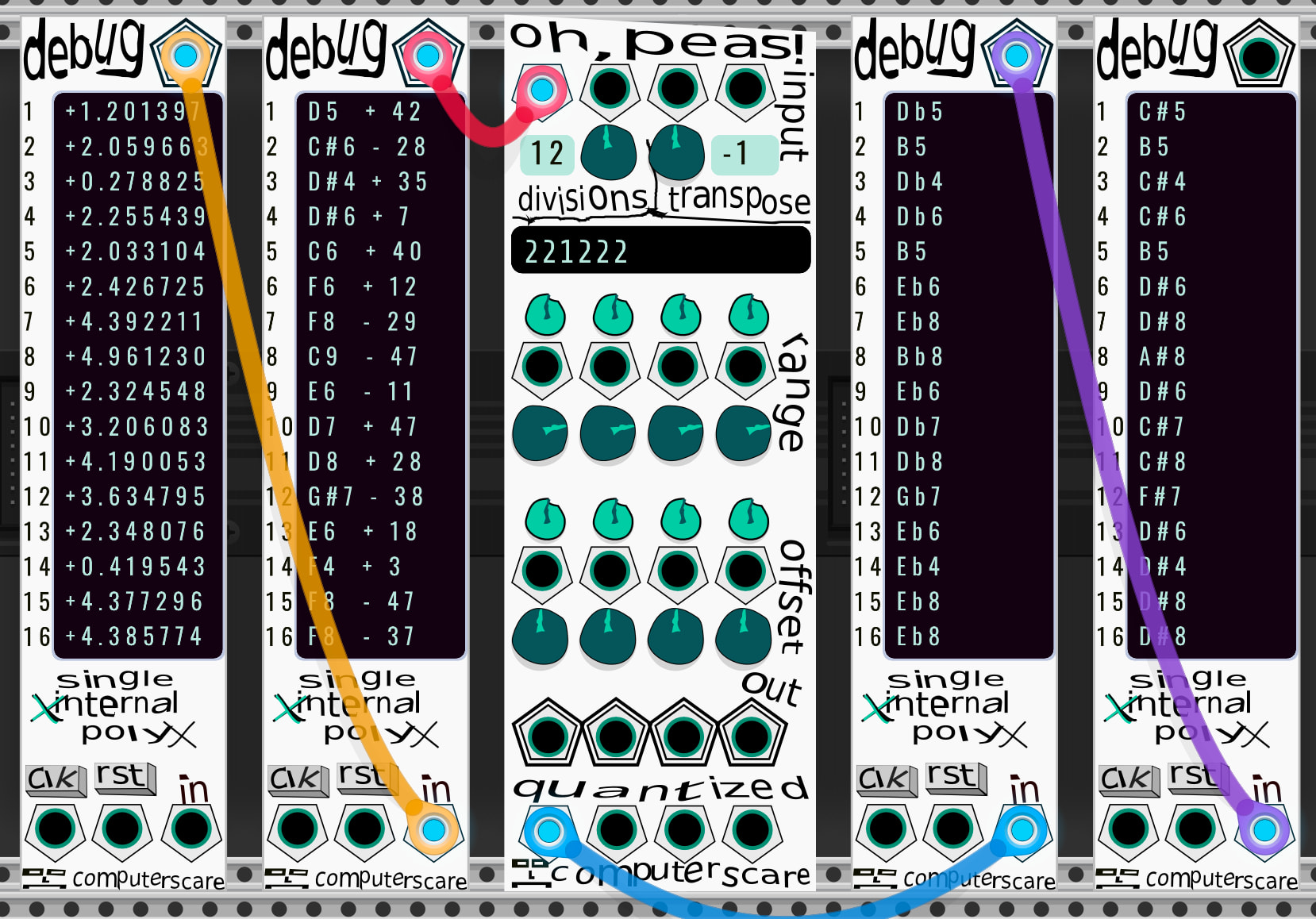
2 Likes
Cool! If you wanted to go full ham, you could give all 6 options:
- All flats,
- Db - F#
- Ab - C#
- Eb - G#
- Bb - D#
- All sharps
The reasoning is, all flats or all sharps will probably feel more unusual to most people, since the most common choice is to stay close to the unmodified note names. There’s a reason A# and Gb keep getting named as the awkward ones, look where they are on the chain. Ab - C# or Eb - G# are therefore probably good defaults, I’m thinking.
for western harmony, TO ME, the most easy way to think to a scale is by forgetting the accidentals first, then put the accidentals later (nobody ever told me this when I was a kid, I learned it when I was 40+ in film scoring school):
first, name the note
second, put the accidentals
let’s try with 2 easy examples:
let’s say F, so → F G A B C D E F then put the accidentals (in F Maj there is just 1 flat) → F G A B♭ C D E F
let’s say F#, so → F G A B C D E F (again) then put the accidentals (in F# Maj there are 6 flats) → F# G# A# B C# D# E# F#
and so on…that’s why double (or even triple in some contemporary “weird” music) accidentals exist 
that said, to get back to the topic  ,the first accidental I learned when I was 5 was B♭
  so my vote goes there
Oh, I really agree.
The frustration I have experienced later in musical life is that, although standard western notation and reference is a great training tool and resource, too often “description of what is happening” does become sort sort of “law”. Illegal intervals.
Like if you have ever had a jam session with another musician who is just too rigid. Or if you pay $$ for a VST to find out the oscillator is hardwired quantized to 12TET. : (