Ouroboros Industries development thread (Looking for testers; New modules: Automata, Warp, ResetHelper, Conductor)

I figured it out, it was because it is not polyphonic. I was sending gates from the MIDI keyboard to two different VCO/VCF/ADSR/VCA chains and expected it to play notes on one of the chains randomly. But most of the time it didn’t play any note, because it only handles channel 0 of the polyphonic gate.

Once I set MIDI->CV to Monophonic it worked as expected.

I’ve added a new module in the dev branch, Automata. It’s a trigger (and optionally CV) sequencer based on Conway’s Game of Life. Nightlies available here, manual page here.

It’s a fairly complex module, so it’ll definitely need some more testing before it can be added to the VCV library.

I’ve added another new module in the dev branch!

This one’s called Warp, it’s a phase distortion effect for audio. It’s very closely related to frequency/phase modulation in oscillators, but works with arbitrary audio! It’s a lot like a wavefolder in some ways, but leaves the amplitude of the signal (practically) unchanged.

Here’s a mini example of it in action: (VOLUME WARNING! Loud, potentially grating and/or tinnitus inducing sounds!)

As usual, it’s already available in the nightly builds for the dev branch, manual page here.
Make sure you’re subscribed to the whole plugin in the VCV library, or the new modules won’t be visible in the module browser!

I’ve added yet another new module, “Reset Helper”! (I hope these update posts aren’t breaking any rules)

It’s a 3HP utility to make it easier to reset sequencers from multiple sources. (e.g., clock reset + reset every 4 bars)

It converts multiple incoming gates to triggers, with an optional “merge window” after each trigger where it ignores new incoming triggers. It’s also polyphonic!

I hope this one will be more useful to more people! :grinning_face_with_smiling_eyes:

As always, it’s already available in the nightly builds for the dev branch, manual page here.

I’m designing a new module for the collection, a performance controller for pattern sequencers.
It lets you queue pattern changes to happen on an “advance” signal, with two control methods: using external controllers (e.g., MIDI) with a couple of different modes, or using a virtual pad controller.

I’ve sketched up an idea of how they might look, which I’ve attached below:

I’d be interested in hearing others’ ideas and feedback on this, as I think it would be a rather useful module, and I feel others might have useful feedback.

I like them and can think of ways to use them already. :slight_smile:

Sidebar: I find it interesting and fun to see how another creator sketches modules, most of my module planning doesn’t include hand written stuff.

Conductor, Conductor - External, and Conductor - Grid are out now in the development branch!

Conductor is a sequencer pattern performance controller, acting as the “core” of the module, while Conductor - External and Conductor - Grid are expanders with the actual input methods.
Conductor - External allows use of Conductor with external controllers (e.g., MIDI), while Conductor - Grid is a virtual pad grid controller that allows use of Conductor with the mouse.

This is my first time doing expander modules, so there may be some bugs I haven’t found. Please report any bugs you find so I can fix them!

As always, it’s available in the nightly builds for the dev branch.
Manual pages: Conductor, Conductor - External, and Conductor - Grid.

I’ve published a release candidate for 2.2.0, 2.2.0-rc1. See the announcement post for more information.

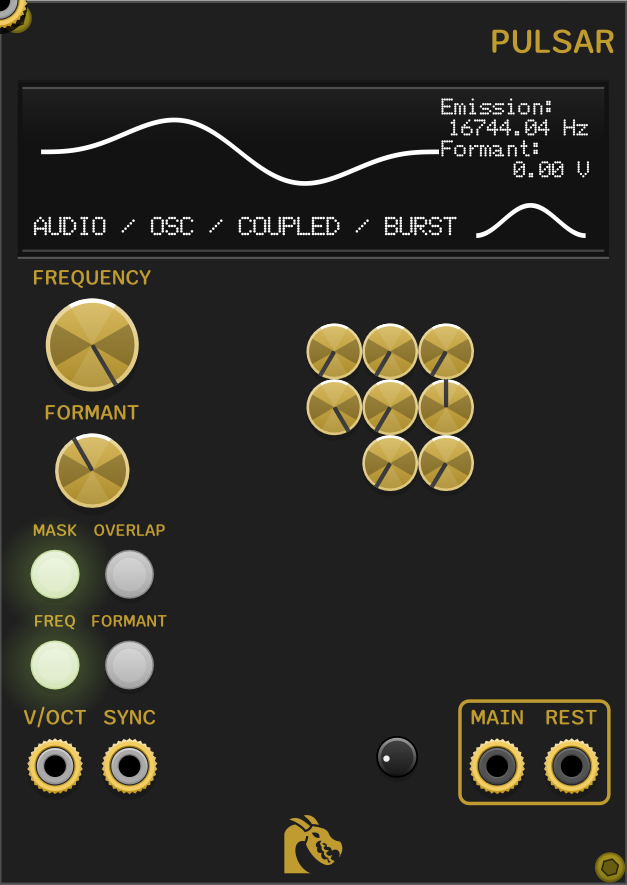
Those of you who frequent the Discord server are likely aware of this already (I can be quite talkative there! :smile:), but for those of you who haven’t seen it yet, here’s a sneak peek at the next module coming to this collection, quite possibly the biggest I’ve made yet!

This is Pulsar, a pulsar synthesizer/oscillator based on the concept described by Curtis Roads in his book Microsounds and his article Sound Composition with Pulsars.
It generates packets of sound called “pulsars”, made up of a basic waveform combined with a window. It’s closely related to granular synthesis, but has a few differences.

It’s very close to being finished, the only thing left now should be laying out the panel (… Which might take a bit :sweat_smile:), unless I discover any issues.


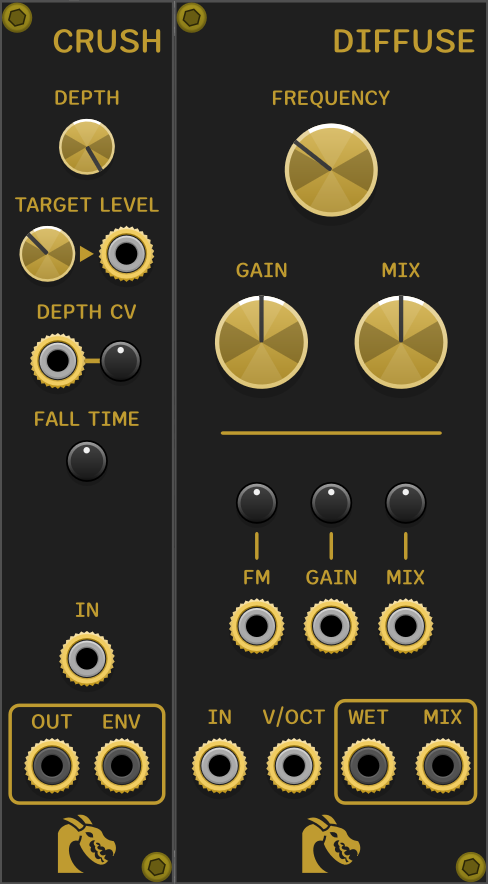
The next version will also include the modules Crush and Diffuse, along with two new features for Meta: Glowing cables and cable LEDs!
(And some optimizations, improvements, and fixes, of course!)

Crush strips away envelopes and dynamics from audio, both increasing and decreasing the amplitude of sounds to keep them at a flat volume level. This can be used, for example, to remove volume dependency from effects such as saturation or distortion, “normalizing” audio for use as modulation, such as with Warp’s “Modulator” input, or to replace the envelopes of samples or other such types of signals with “baked-in” envelopes. There’s a demo video in the linked manual page

Diffuse is a Schroeder allpass filter, a common building block for reverbs and physical modelling algorithms. It differs from more “common” allpass filters in that it works via a long delay, which allows it to “diffuse” a signal. It can be used to soften transients, shift phases, or even for pinging or as something similar to a slapback echo at extreme settings.

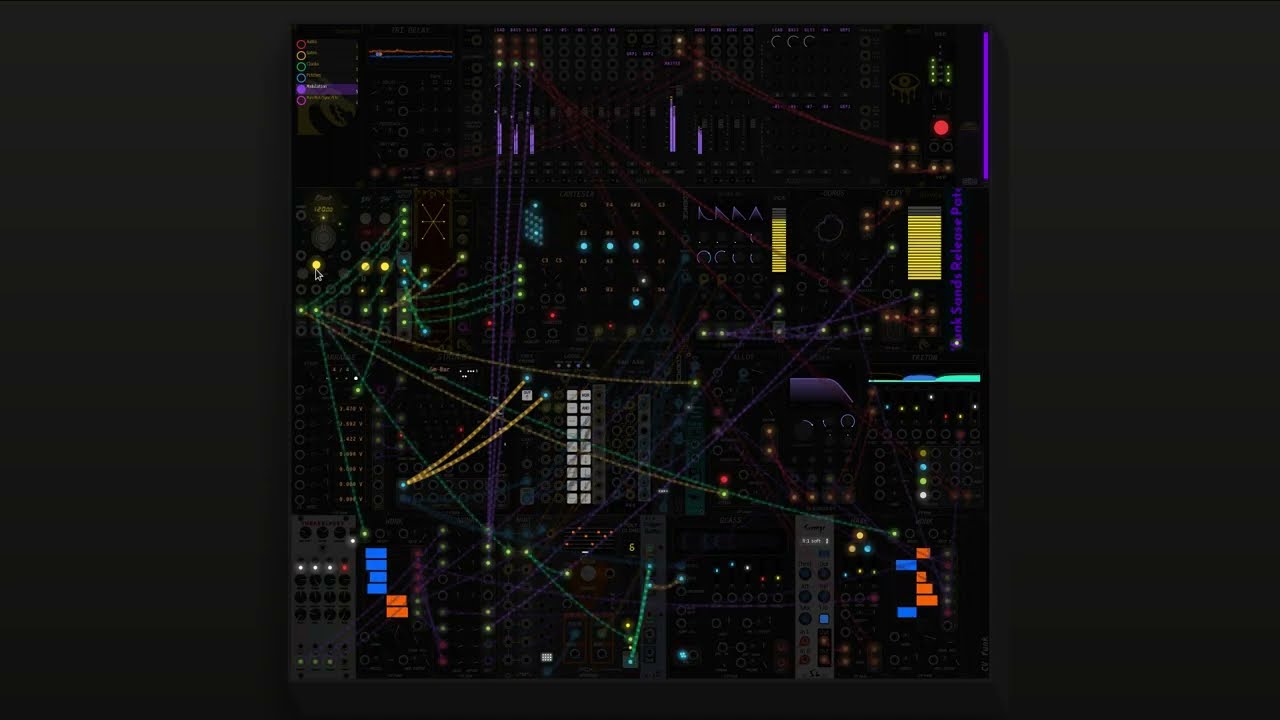
The new cable glow and LEDs features of Meta can be seen in my submission to the CVfunk Sands Release Patch Challenge:

Crush, Diffuse, and Meta’s new features are already available in the Nightly builds for the development branch. (Have been for a little while, actually :sweat_smile:)


Speaking of new Meta features: About two years ago, I coded support for Meta to have sounds for placing and removing modules, but that feature’s been waiting for the sounds to go with it for, well, two years now. I lack the sound design skills to make them, so I think it’s time to ask for help instead of just letting that code rot. I would be very happy if anyone were to provide sounds for it!
The only thing to note is that the sounds must be licensed under something like CC-BY, CC-BY-SA, or similar (e.g. CC0/public domain, but not anything like CC-BY-ND or CC-BY-NC)

The whole feature (including the plugging in/out sounds) was inspired by the game The Signal State, so if anyone would like to help, I’m sure the sounds in that might help as inspiration!