It is a collection of modules that work with ambisonic signals (3D full-sphere sound fields, carried over 4,9 or 16 polyphonic cables depending on the 1st, 2nd or 3rd order of the ambisonic signal).
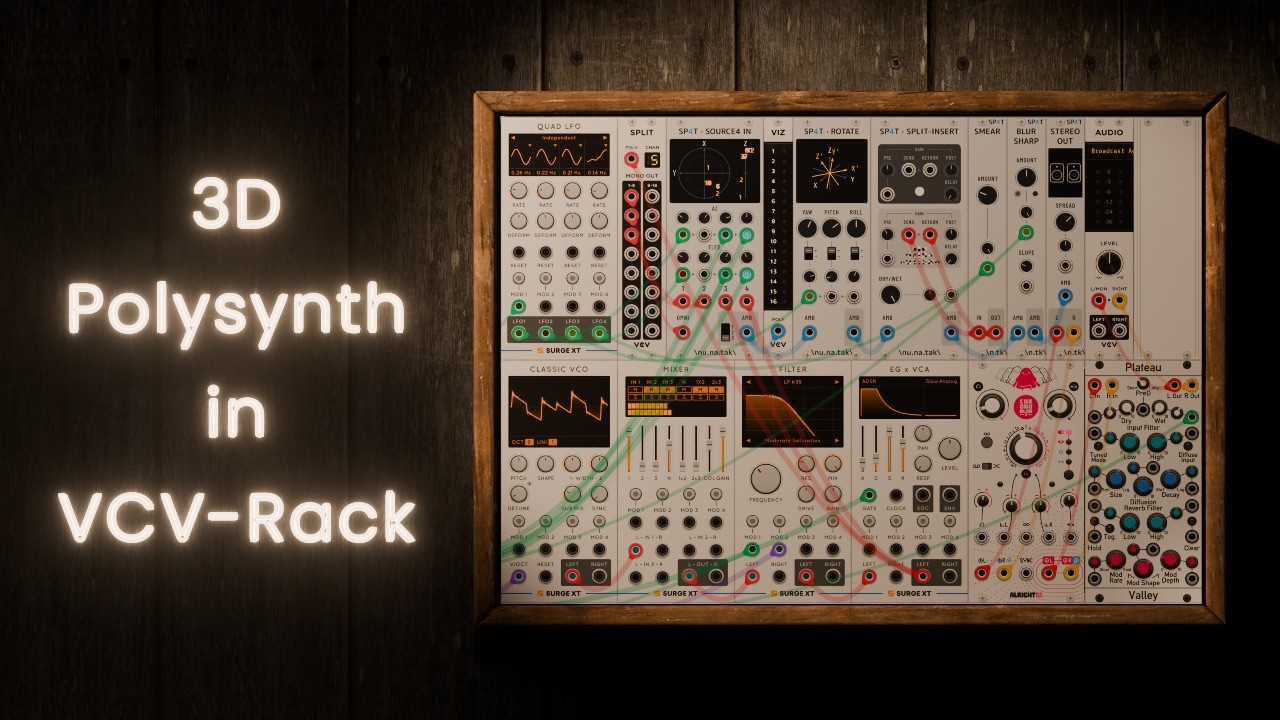
Currently there are 13 modules that allow encoding one or more sources into an ambisonic signal, processing the sound field as a whole (rotate, flip, blur), and decoding it to speakers (stereo L/R) or headphones (binaural). I plan to add more modules in the future (encoders, multi-speaker decoders, etc.)!
The SP4T modules reuse the same DSP engine than the spatial audio framework behind the SPARTA plugins.
Of course one of the goals is to use these modules in an immersive audio context, but my initial motivation was rather to explore the potential of ambisonics in general, including non-immersive sound design. VCV-Rack (modular) is the perfect environment for such exploration! I was actually surprised not finding any ambisonics plugin in the VCV library (maybe I missed it?).
It is still very much work in progress. It’s not available in VCV’s plugin library yet (I just submitted it), but it is possible to download it from the github repository for any adventurous soul who wants to try the modules. I develop the modules on MacOS arm64 and haven’t tried running them on other platforms, hopefully they will run well! If you find issues, do not hesitate to report it.
Here’s a video showing some of the SP4T in action (subtractive polysynth with “3D” voice panning and processing):
Oooh - I am excited about this project! And the demo is great!
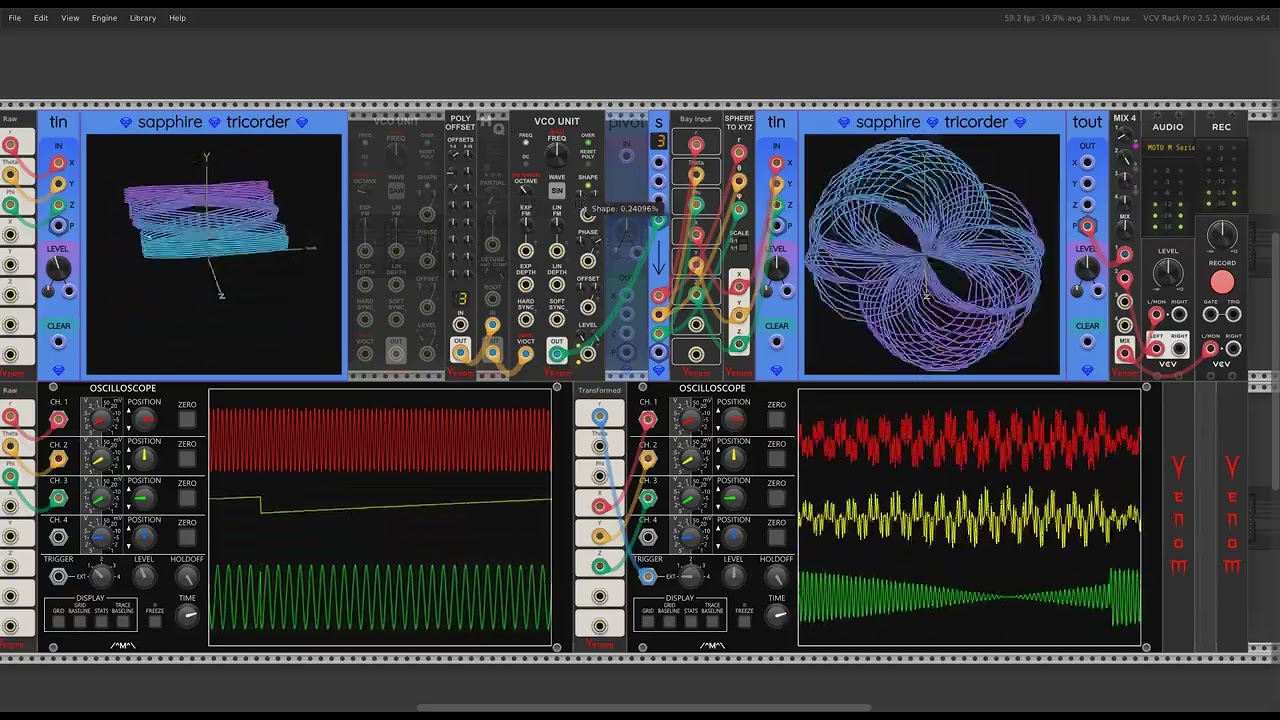
I have a Venom 3D Pan module that can pan a voice in virtual 3D space represented by 8 outputs positioned at the vertices of a cube.
It is fully polyphonic, so up to 16 voices can be panned and then each poly output can be summed into 8 mono outputs. But I haven’t known what do do with it. I am hoping I can somehow translate the Pan 3D output into input for your system so it can be output as ambisonic stereo. Is that possible?
It looks like you may already have a similar module that makes Venom Pan 3D redundant, but I would still like to see it work with Pan 3D.
Oooh - I am excited about this project! And the demo is great!
Thanks!
I am hoping I can somehow translate the Pan 3D output into input for your system so it can be output as ambisonic stereo. Is that possible?
Yes, I think it would be possible.
Pan 3D looks similar to encoding up to 16 input sources into an ambisonic signal (after converting x,y,z cartesian coordinates to azimuth/elevation coordinates) then decoding that signal into 8 virtual speakers (or beams) that have each 45° angles with the X, Y and Z axes.
Actually, next on my list is adding an ambisonic encoder module that supports up to 16 input voices (point sources) specified at arbitrary directions via azimuth/elevation CV inputs, using polyphonic cables. And likewise, adding a decoder module that supports up to 16 output virtual speakers or beams. So both would work together like Pan 3D, in a more flexible way, but not exactly redundant I think (ambisonic sphere != cube).
I would still like to see it work with Pan 3D
I could totally imagine connecting the 8 outputs of Pan 3D into one of the SP4T ambisonic encoders, treating those Pan 3D outputs as input point sources with fixed directions (i.e., the vertices of the cube), then do whatever you want with the ambisonic signal before decoding it to stereo or something else.
Wouldn’t that also require a distance to specify a point in 3D space?
I have written a module to go from spherical to cartesian, but not the reverse.
I am still a little puzzled how I would use your existing modules to transfer info.
BTW, the Sphere to XYZ is a lot of fun to use as a signal modulator, combining 3 independent audio signals, totally divorced from 3D space. It has elements of ring modulation, but a lot more. It can produce some wild sounds and pretty pictures.
Wouldn’t that also require a distance to specify a point in 3D space?
It depends on the encoder. Ambisonics itself does not natively integrate the concept of distance to a sound source (this makes the maths simpler: represent a full-sphere sound field based on spherical harmonics expansion). A basic ambisonic encoder like SPARTA’s AmbiENC only takes directions (all it requires is to specify points on the sphere surface), although it is common to have encoders that combine ambisonics with other kinds of pre-processing algorithms simulating things like proximity effect, wall reflections, doppler effect, etc. (e.g., SPARTA’s AmbiRoomSim, Ambitool’s encoder).
It would be nice if some of those effects could be integrated in the SP4T encoder modules as well, but I’d like to focus on “core” ambisonics first.
I am still a little puzzled how I would use your existing modules to transfer info.
Does the explanation above help? With “core” ambisonics you’ll probably loose some information during encoding (also including the fact that the harmonics expansion is truncated to max 3rd order, so limited spatial resolution), but what you have is a scene-based representation that can be processed then decoded in lots of ways.
BTW I’ve tried to write a short introduction to ambisonics here: Ambisonics - Nun4tak SP4T. I hope it will be helpful (disclaimer: I don’t consider myself as an expert in ambisonics, if anyone finds something wrong in the documentation please tell me and I’ll be happy to fix it).
Sphere to XYZ is a lot of fun to use as a signal modulator,
It seems so indeed! That’s the kind of experiment that I’d like to do with ambisonics as well, i.e., use it in unconventional ways and see what comes out of it.
Thanks. The top explanation definitely helped. I had skimmed your ambisonic introduction, but couldn’t make much sense of it. It might make a bit more sense now.
I see how to use four outputs from Pan 3D, but cannot figure out how to use all eight. I set the four azimuths to 0, 90, 180, and 270 degrees. I was able to see the effect of panning in X and Y directions. But I am missing Z. I tried using a polyphonic pair consisting of a top and bottom corner for each input. I used polyphonic CV to specify positive elevation for the first channel, and negative elevation for the second channel of each input. But that didn’t appear to do anything. So I guess the azimuth and elevation CV inputs are monophonic?
Any ideas on how to move forward?
Or must I wait for the 16 input version to use all 8 outputs from Pan 3D?
Or must I wait for the 16 input version to use all 8 outputs from Pan 3D?
Yes exactly. I guess you’re using the Source4 module, and you are right all the inputs of that module are monophonic. I was thinking about another “SourceP” module supporting polyphonic inputs, but now I’m wondering if we couldn’t just reuse Source4 to support encoding up to 4x16 point sources!
In the meantime, what you could try is using two Source4 modules, and mix the two AMB outputs (i.e., split each AMB out > sum channel-wise > merge). BTW the SP4T plugin may also include at some point a convenient module to sum together two or more ambisonic encoded fields.
I was able to see the effect of panning in X and Y directions
So I guess you were able to install and run the plugin? I’m glad you’re trying it. May I ask you which platform you are using? Is performance good? (Just curious).
I was just thinking this week, if there are any modules that can work with Ambiosonics.
I have some ambio field recording which will be interesting to see if they work with vcv.
I was looking for a decoder module that translates Ambisonics back into the eight corners of the world, but couldn’t find one.
I have a 5.1.4 speaker setup (Surround + 4 ceiling speakers (front and rear L/R) and it would be nice be able to use the Ambisonics transformations and then convert it back to the individual speaker channels.
@GPaudio Indeed currently there’s only two decoder modules: stereo speakers and headphones (binaural). That’s pretty limited, but a flexible decoder module for multi-speaker setups is planned for the next release! Something similar to SPARTA’s AmbiDEC plugin (maybe a simpler version without the frequency-dependent decoding options)…
I didn’t worked on it yet as I don’t have such surround setup (my initial motivation was to explore ambisonics with stereo decoding as part of a sound design chain), but I agree that a multi-speaker decoder module should be the basis of a plugin focused on ambisonics .
 .