The task for November 2026 centers on the modules from the Lunar collection, recently released by Ambient Modules.
Lunar is a free VCV collection emulating parts of the Solar 42 hardware synth by Elta Music. Even though the VCV version doesn’t have all the cool elements of the hardware (such as the microphone, the touch keyboard and plate, and the light sensors), it provides the oscillators and a few options for modulation.
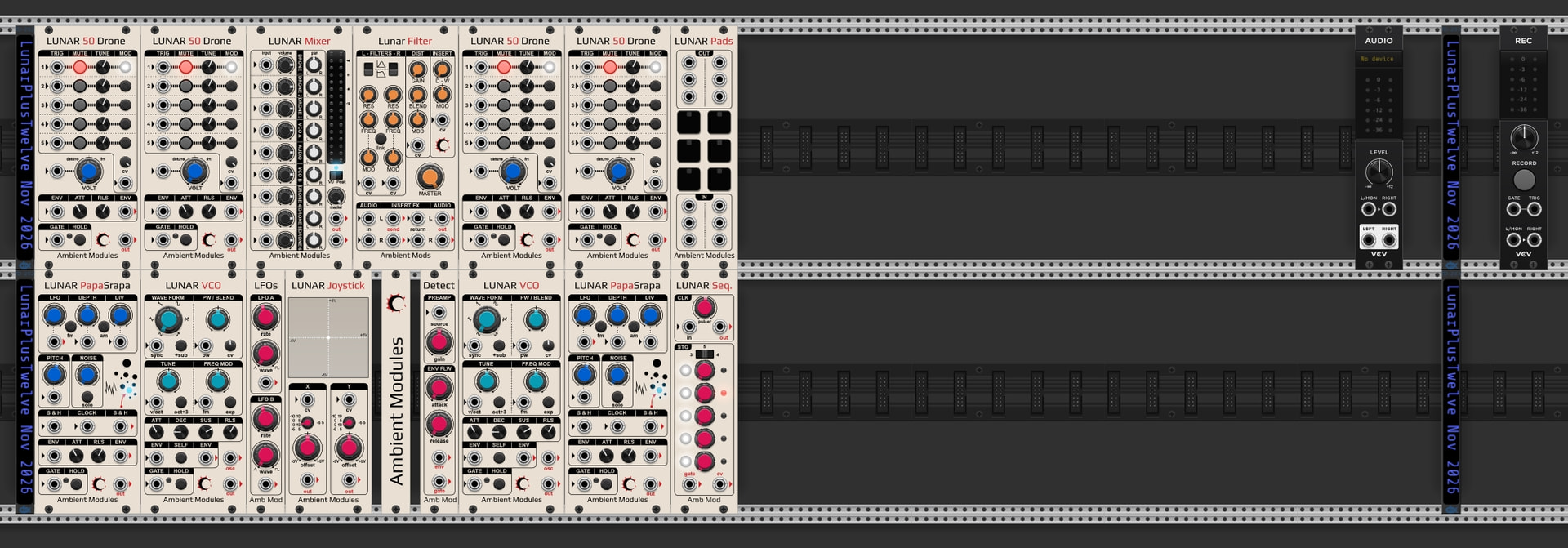
The challenge starts from a given template. To make patching a little easier, a limited number of up to 12 modules can be added to the patch.
So, here are the ‘rules’ and instructions for this challenge:
Download the starting template (below) and create a patch in any genre. Lunar is great for drones and ambient, but (almost) anything is possible! Tip: The Lunar Mixer has an audio input, too, so you can feed it audio from another instrument.
This is a semi-fixed rack challenge: On the left half of the patch (73HP), you must keep and use the Lunar modules as they are arranged in the template. On the right half, you can add up to 12 modules of your choice. The additional modules can be anything, such as clock, sequencer, VCO, FX, modulation, merge/split, mixer, utilities etc.
None of the add-ons should be from the Ambient Modules collection — choose something different!
Adding more than one instance of a module adds to the module count. So does the use of expanders etc. No more than 12 modules can be added in total. The Audio and Record modules already in the template do not add to the count.
All modules together need to fit into the boundaries of the template (2 rows of 146HP each).
All added modules shall be available for free in the VCV Rack library. No use of external sample files, please.
Post your patches (.vcv) on Patchstorage, if possible, and/or in the thread here. Tag the entries with LunarPlusTwelve Nov2026. You can submit up to 12 patches.
Post video/audio examples on YouTube, SoundCloud etc. To keep all entries together, I’ll compile all YT video entries into a playlist in the end.
The challenge will run from now until November 30, 2026.
As in prior challenges, you can win absolutely nothing, but a lot of experience, practice and enjoyment can be gained.
I am generally very impressed with the quality of this plugin. I only wish some effort had been taken to mitigate digital aliasing. The aliasing is typically lost in the sea of sound from a typical patch. But when listening to a sweep of a single oscillator the aliasing becomes painfully obvious. The hardware is analog, so no aliasing there.
Despite the aliasing shortcoming, the collection can produce some beautiful sounds. I look forward to what everyone comes up with.
There are so many really cool hardware controllers out there! In principle, you can do anything you like, since no one is going to ‘enforce’ the rules — but please continue reading…
On the other hand, keep in mind that inclusion of an external device, be it a simple MIDI keyboard or an exotic wearable controller, will rapidly limit the number of people who can play your patch.
So, ideally, everything you need should be accessible for free inside the box.
There are a number of free controller emulations in the VCV Library, such as the Impromptu TwelveKey, the Impromptu Tact, the Venom Mouse Pad, or even the Lunar Joystick already included in the template. I know that’s not the same, but using any of those may be a good compromise to grant creativity a slightly longer leash.
Everything’s fine — I just figured it’d be easier to play the melody on a MIDI keyboard than to draw it in the module with a mouse. Anyway, I’ll treat it as a challenge I need to overcome.
So, performance controllers do not add to the count and do not have to sit inside the template boundaries.
However, if you decide to add any performance options to your patch, their use should be clearly visible/demonstrated/explained in your video and the patch description, so viewers and fellow patchers can understand what is happening.
Yeah, I see! There always is the option to record notes in from a MIDI keyboard, save them inside a module and then delete the MIDI interface. Obviously, you need to make sure that the MIDI is saved with the patch then, so others can load it, too.
In general, you are free to experiment with, add, delete and rearrange anything on the way, as long as the final patch meets the criteria of the challenge.
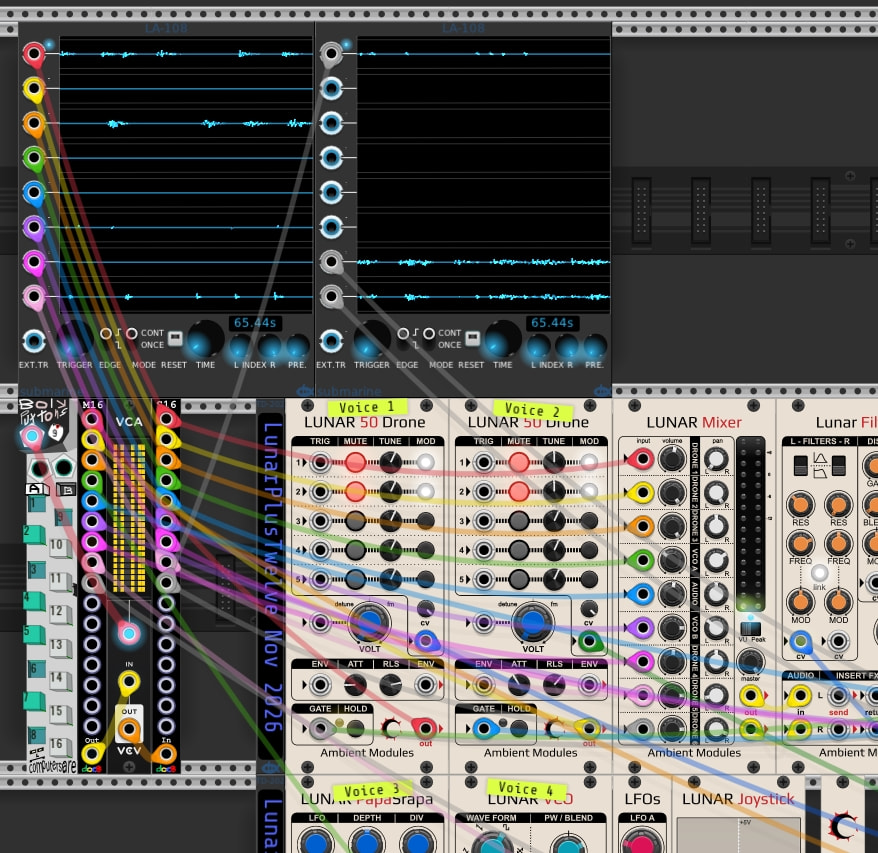
For example, I have been adding buttons to my patches to mute/solo individual voices, as well as scopes to monitor voice activity and a stoermelder Glue for orientation. All these will be deleted before finalizing and submitting a patch.
The Solar 42 is such a rich instrument with so much possibility! Even without the touch sensitive keyboard with its powerful sequencer and arpeggiator, the Solar 42 hardly needs any external modules to achieve very satisfying auto-generative patches. All three of the patches above would have met this challenge, using 12 or fewer external modules to augment the Solar 42 emulation.
Onward to this month’s actual challenge!
Here is my (first?) entry:
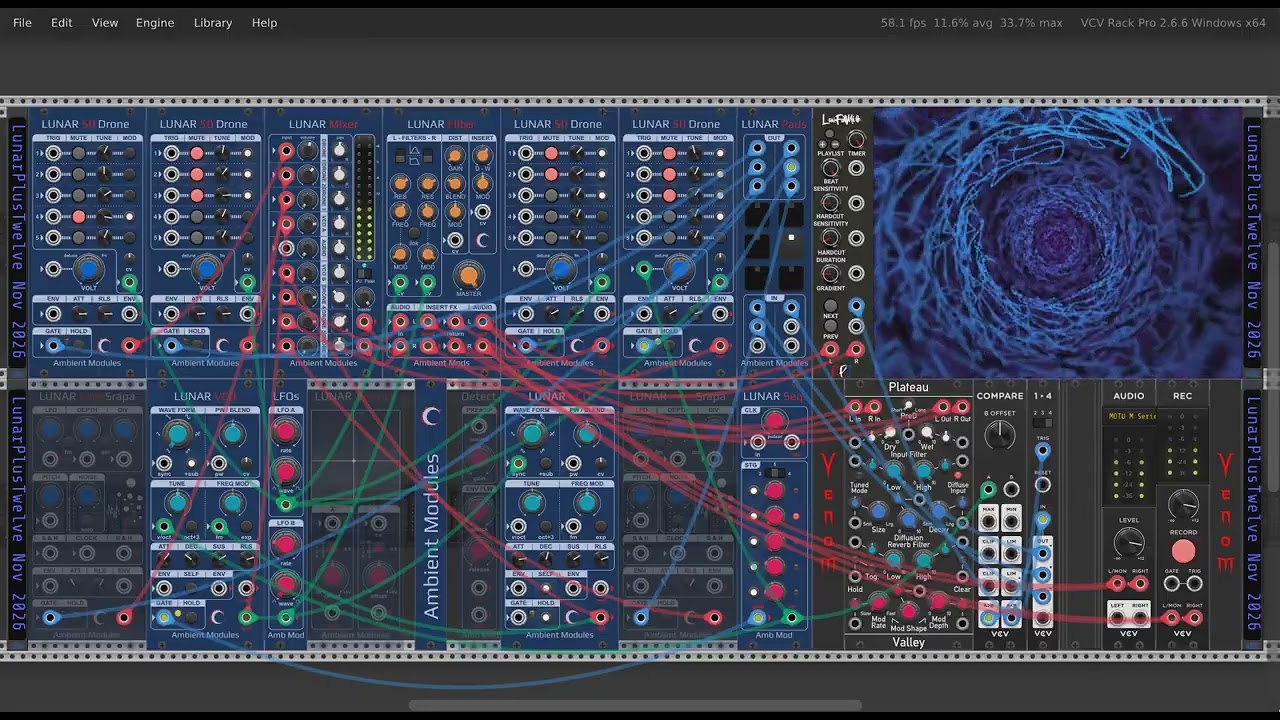
Even though this challenge is for the month of November, I made sure to get this patch out in time for Halloween – I think it fits the season. Disregarding visuals, I only added three modules – A Valley Plateau reverb for atmosphere, plus a VCV comparator and 4:1 switch to extend the sequencer from 5 to 20 steps. The switch selects which static drone voice (if any) to add to the dynamic drone voice and lead voice that are controlled by the main 5 step sequencer. In the spirit of the Solar 42 that the Ambient Modules are emulating, all VCOs and the sequence were crudely tuned by ear with no particular scale in mind. Unused template modules are bypassed.
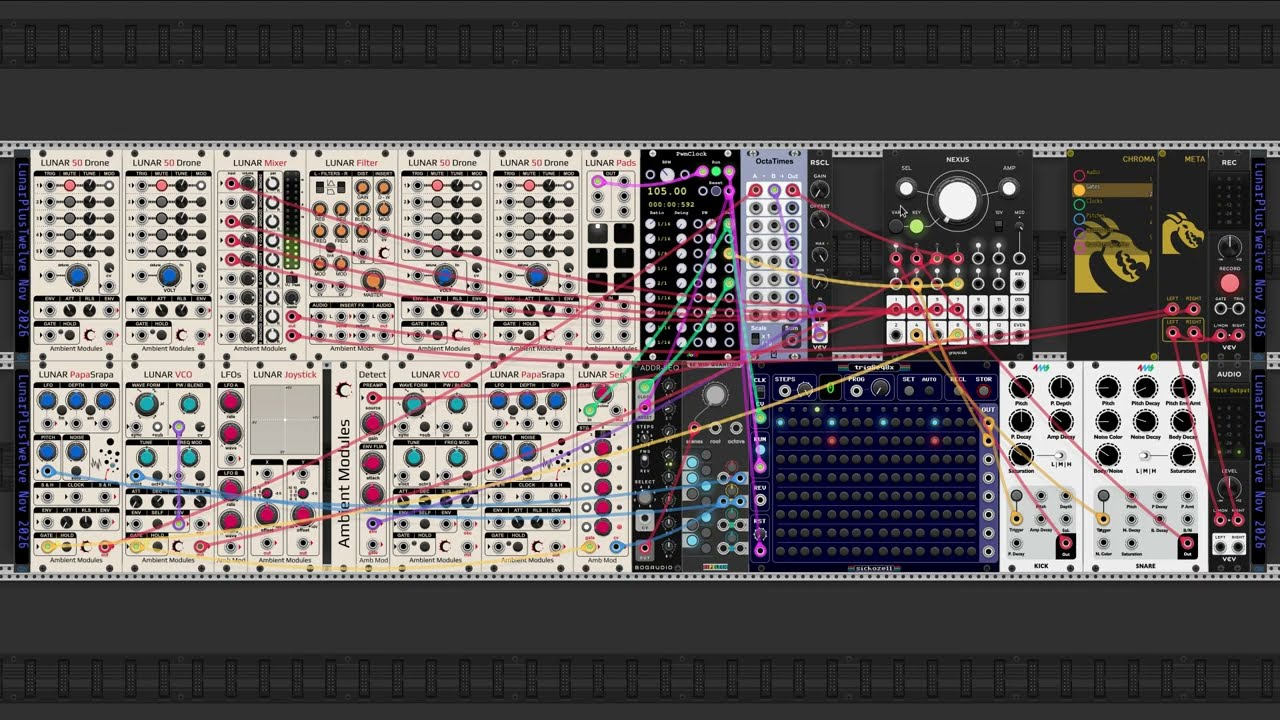
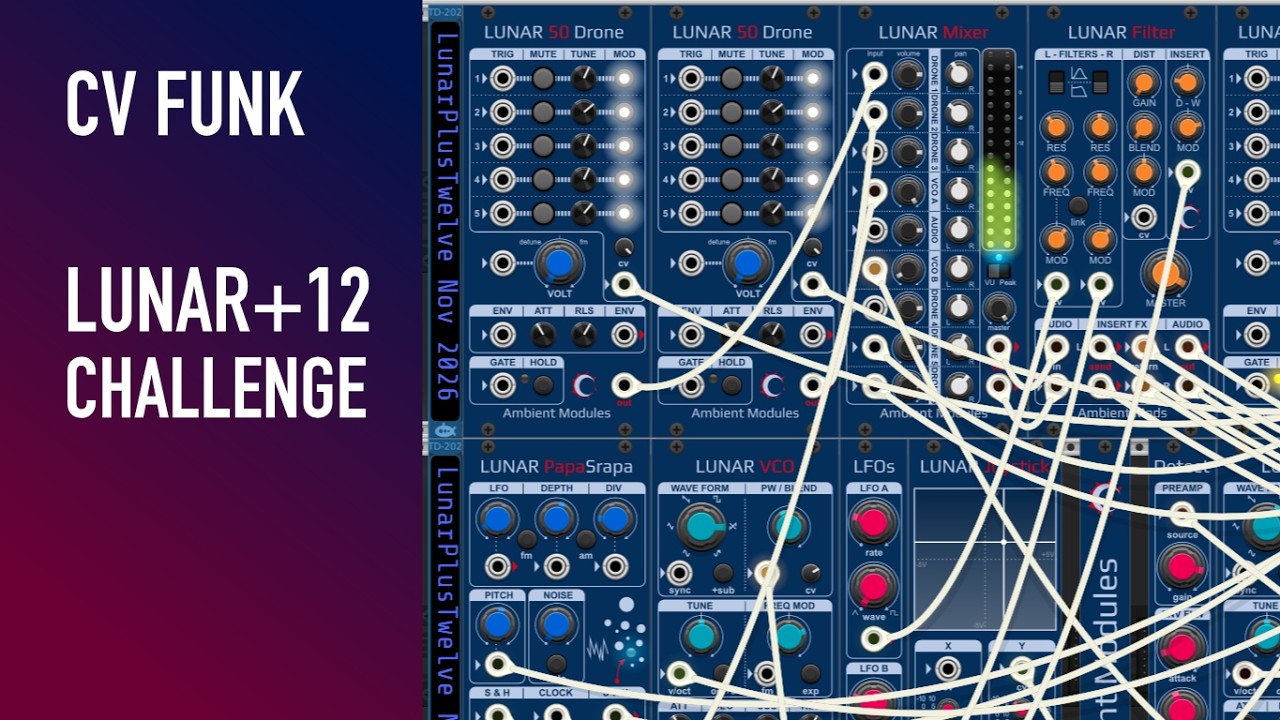
Here’s my entry for the challenge. I decided to make something non-ambient with the ambient-oriented modules. Because why not!
Maybe I could’ve done more with the Lunar modules, but alas, I couldn’t think of anything.
In the video I had a bit of an oopsie I didn’t notice. I accidentally pushed one of the fixed modules by 1 HP because of the gaps around the blank plus the smart rearrangement option. It’s fixed in the patch, but I really didn’t wanna have to do yet another take for the video. The uploaded patch is the exact same, except I moved the kick module up to fix that.
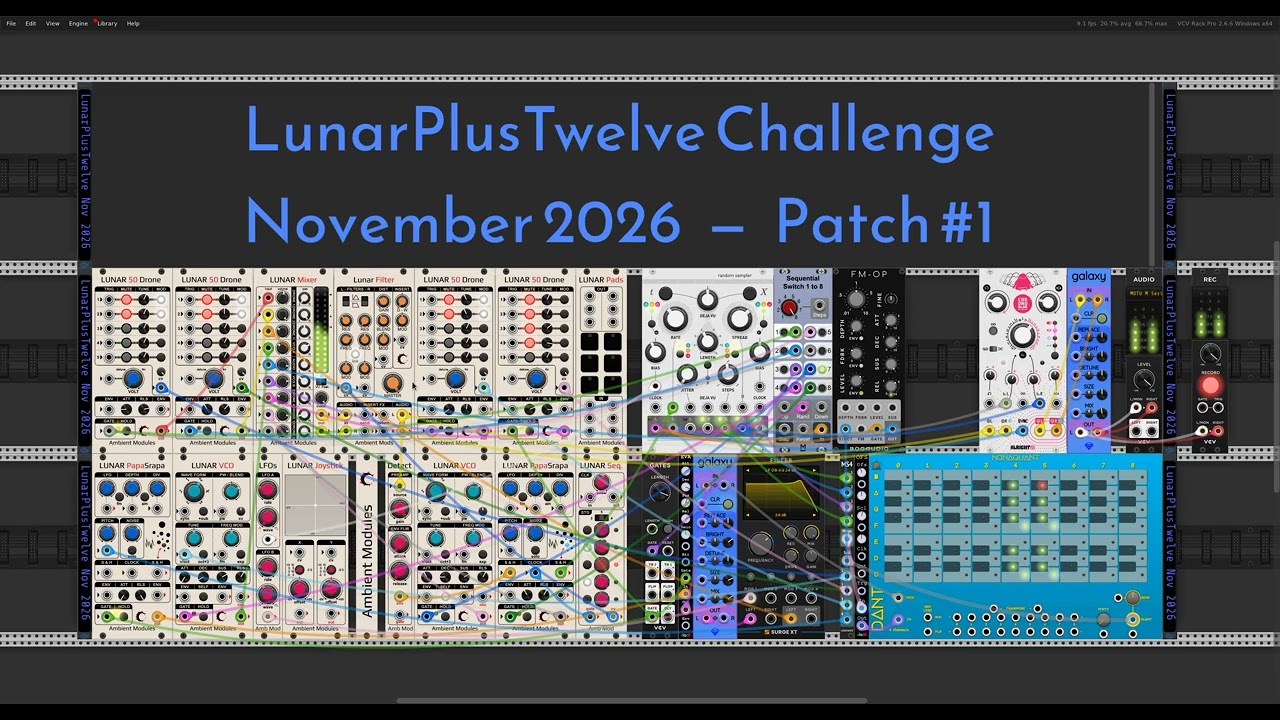
I chose 10 CVfunk modules plus SIM Coerce, and an additional Lunar sequencer for my 12 (I swapped out the gate module for the sequencer on the layout).
The chord sequence is created by two overlapping sequencers, with the root being sequenced in five steps {D,A,E,G,B} and the chords in a shorter four step sequence of {Maj7, add9, sus2, min7}. This creates a much longer evolving ambient chord progression that stays structured.
Each of the Lunar50Drones is tuned so that we have the root, an octave, 2 detuned drones, and a perfect fifth. Each set of drones is set to one of the chord outputs from Weave.
Weave is then patched to Coerce to set the quantizer scale, and several different sources are being quantized to the moving base scale.
The root note from Weave is patched to Vega bass, which is layered dry on top of the mix at the end.
I’m using a StepWave to generate one moving sequence for the quantizer, and an additional gate rhythm that’s being used to overdrive the Vega bass.
The Collatz is being used to generate semi-randomized trigger pulse chains for the melodic notes, this keeps it rather jazzy as each Collatz cycle gets a CV controlled starting seed.
Hmm.. I probably did a few other things too, but it gets a bit overlapped and complex, so if you are interested you can just download the patch and play!
I want to take a closer look at as many of the submitted patches as time permits, and will try to write up some of my (admittedly mostly marginal) notes on personal findings and patching ideas. So, I am starting with this one.
Impressive: Patch only contains a reverb and a switch for voice arrangement, everything else is Lunar!
Top right Lunar50Drone nicely dominates the sound with its drone, two pitch inputs coming from Lunar Seq and Lunar LFO A, respectively.
LFO affects the pitch only very little (curbed by the CV attenuverter on the Lunar50Drone), yields a beautifully smooth and subtle, haunting pitch slide. Pitch of other oscillators also controlled by these two modulators.
Lunar Seq is used to its full potential, very slow speed, multiple functions, including pitch, Lunar VCO gating, and voice arrangement switch control.
Lunar VCO on the lower right is muted in the mixer, but is connected to the FM of the other Lunar VCO.
Plateau reverb connected as a Send effect through the Lunar LP Filter.
Wondering what it would sound like if the sentimental howl of a coyote was added through the Audio input, adding to the drama (just kidding!).
I give up… What’s the deal with the LunarPads module? Is it just 6 manual-or-CV gates? Or does it relate to the other modules in some more intricate way than that?
Right yeah! I understand the purpose of a few manual gates. The tooltips on the outs/ins just have these module names in them that made me think it’s doing something more than that. I am guessing that relates to what these buttons would do in the actual hardware thing somehow. But here they can of course do anything. Kinda confusing! But ok, got it now.
 What’s the deal with the LunarPads module? Is it just 6 manual-or-CV gates? Or does it relate to the other modules in some more intricate way than that?
 , no?
