Hemiola Audio: free modules, starting with Cycle Clock and R&T for counting rhythm in whole cycles

Hello all,

I am releasing my first modules. Both free and open source.

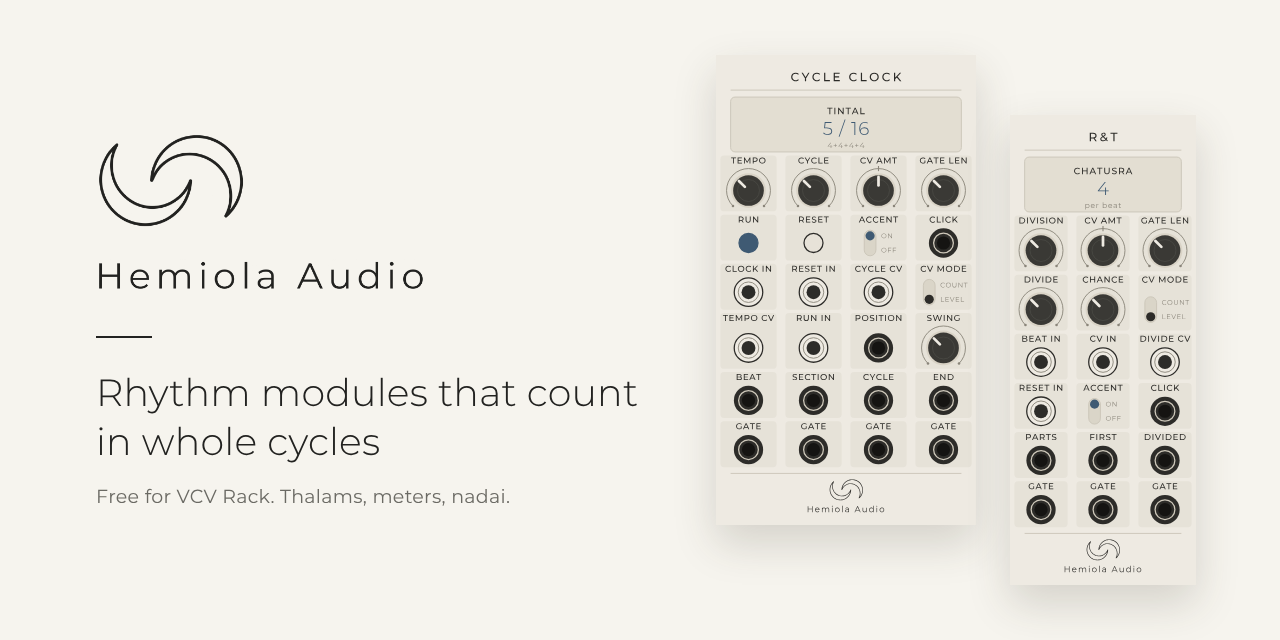
Cycle Clock counts a whole rhythm cycle and tells you where you are in it. It has 55 cycles: ordinary meters, 7 Hindustani thalams (Tintal, Keherwa, Dadra, Rupak, Jhaptal, Ektal, Dhamar) and all 35 Carnatic thalams. You get a trigger and a gate on every beat, on each section start, on the cycle start and on the cycle end, plus a position voltage and an accented click on beat one. It has tempo CV, run input and swing, or it follows your own clock.

R&T splits every incoming beat into 1 to 9 equal parts, the way Carnatic music counts nadai (tisra, chatusra, khanda, misra, sankirna). A divide knob goes from 1 to 64 with its own outputs, so a fast split such as nine to a beat becomes slow enough to follow. There is a chance knob, a reset input, and CV for both the division and the divide.

They work alone or together.

Patch the Cycle Clock beat output into R&T, and the cycle trigger into R&T reset, and the divided pulses stay lined up with the bar.

A few things to know. I am new to this, and I work alone. I write the code with an AI assistant, and I decide what the modules do and how they feel. The timing rules are covered by automatic tests, but I have only had my own ears and patches to judge them by. I would very much like to hear what you find.

If you play or teach Hindustani or Carnatic music and spot a wrong grouping or name, please tell me. I have checked the presets against published sources and listed them in the manual.

Manuals, two example patches and the code are on GitHub: GitHub - hemiolaaudio/HemiolaAudio: Free, open-source VCV Rack modules, made to be played. Out now: Cycle Clock and R&T · GitHub

It is in the Library now: VCV Library - Hemiola Audio .

There is also a Mac (Apple silicon) download on the releases page, and you can build from source on any system.

More modules are planned, and not all of them will be about rhythm.

Thank you for reading. With love, Hemiola Audio
15 Likes

Neat off-grid rhythms in different time signatures await!

1 Like

Hi @hemiolaaudio ,

These are lovely looking modules. My one critique would be that the documentation is difficult for me to read because it seems to be generated by Claude Code:

Most clocks tick. These know where they are. Cycle Clock knows it is on beat 11 of 16, and R&T can cut every beat into five, seven or nine equal parts, the way a Carnatic musician counts nadai.

It’s hard for me to be critical about AI generated anything, since I use AI myself.

What I have found to be useful is to use ChatGPT to refine AI generated output. For example:

This was written by Claude AI and is difficult to read. Can you rewrite it to sound more natural?

Results in…

Free, open-source modules for VCV Rack, designed to be played.

The first two modules focus on rhythm, with support for counting in full cycles (like Indian thalams or conventional bars) and dividing those cycles into smaller rhythmic patterns. More modules are in development, covering a wider range of ideas beyond rhythm.

Cycle Clock keeps track of where you are in a cycle, so you always know which beat you’re on. R&T lets you divide each beat into five, seven, or nine equal parts, much like nadai in Carnatic music.

Version 2.0.0 · Free and open source · GPL-3.0-or-later

Or, as a last resort, write it by hand. :scream: Ha ha ha.

I should acknowledge that this advice might have a short shelf life. This seems to be a wide criticism of certain AI models, and it’s likely to be solved over time.

Again, great looking modules, and I can’t wait to see what you launch next!

7 Likes

Thanks a bunch, Bret. This is exactly the kind of feedback I’m looking for (apart from the workings of the modules themselves)! I’ll ensure I do a pass hereon. Apologies.

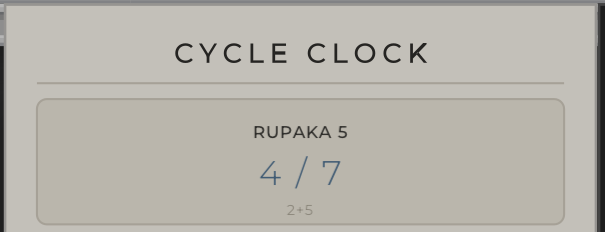
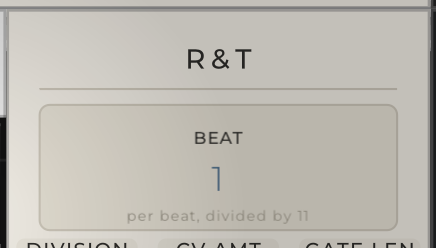
Thanks for your work! My suggestion is to re-configure the displays so that the smaller/lighter-colored text is more readable. It seems to me that there’s wasted space in the display that could be better used to have the smaller text be more readable at smaller zoom values. For example…:

a) if you placed the “4/7” and “1” values to the right of “rupka 5” and “beat” respectively, you could make “2+5” and “per beat, divided by 11” the same size as the larger text.

b) making the sub-text a different (darker?) color would also help readability, IMHO.

Thanks again for the great modules!

2 Likes

Amazing! Thank you for that! Will implement this over the weekend and push for an update. Thank you, again.

This is very interesting, I will try it soon!

Glad to hear you’re working on the documentation, these modules are really interesting!