btw…AULOS —> no more cpu spikes in the last two days 
1 Like
Newest nightly build is up.
Glass - I made it louder. Then, to balance it out, when you play multiple notes simultaneously the pressure is decreased per note. This decreases the loudness a little bit as you hold down more notes at once.
Aulos - I got rid of the clicky transient at the start. Damp now darkens the tone, and the damper intensity control is moved to context. Also I added a ‘legato’ effect that’s a bit of slew and some envelopes, but I think it works. You can also disable it!
1 Like
They both sound really great. I still get a transient in Aulos if I hold the gate down and change notes. Sort of a loud pop like it’s struck over the end of the tube.
1 Like
Drat. I made a little edit, I think I fixed that… but it’s really hard to tell. Let me know if it’s any better.
1 Like
Its different yes, but still present.
new funk.vcv (6.6 KB)
Funny enough its a good sound, very physical in nature.
Just wish I could control when I “pop” and when I don’t. Feels like it may be in sync with the gate releasing, not neccesarily note change.
Great stuff, the glass harmonica is stunningly beautiful.
1 Like
Thanks, that helps a lot in making it sound amazing. no more 10dB needed. Still have to redo the mix for the etherial patch, but it starting to sound good at this stage….
1 Like
I spent some time looking at your patch… it was a little hard to follow. But I think I figured out what is going on, and I’m not sure if it’s a bug or a feature. Probably a feature
What I gather is happening is the pipe is changing lengths at the same time as the gate is going low.
If you want the legato effect, you need to v/oct the finger input, as only the fingering can legato. At least this made sense to me somehow…
Also, controlling the fingering will result in more interesting timbers than just controlling the base pipe length. Or controlling both! but it gets confusing fast as you need to keep the fingering within the range of the pipe.
1 Like
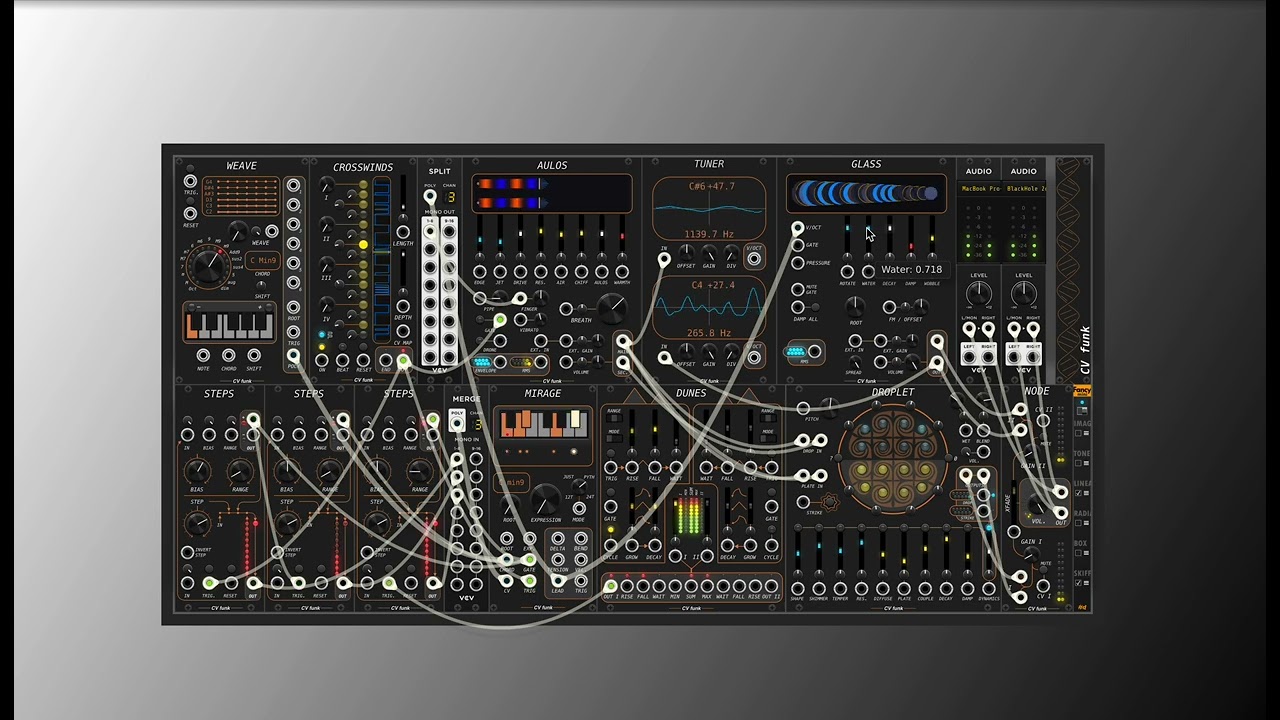
I made a little sound test.
Overall I’m not displeased with the sounds these two modules make. I want to go further, but I just can’t with the underlying architectures.
I had high hopes for making more realistic flute/clarinet sounds, but in this exercise I’ve finally learned enough about waveguide synthesis to find I’ve basically done it all wrong so far. Rather than a proper bi-directional waveguide, I’ve ended up with two uni-directional ones with different timbres… It still makes a physical pipe sound, but because the underlying architecture is wrong for a flute, I can’t refine the Bore/Bell parts to work in a proper physical way. The odd harmonics can’t cancel out unless I make a proper bidirectional waveguide, and so I’d need to start over to get the fully morphable pipe architecture I had aimed for.
Sooo… maybe I’ll have to save the bidirectional wave math for the next physical synthesis module!
What do you all think?
7 Likes
I really like it!
And –if you are like me– it is hard to unknow something… so when you are up for it, going for an Aulos mk2 sounds like a good idea.
1 Like
I think I’ll need a link to your GitHub for the new modules as I’ve got plenty of catching up to do, what’s a few more noisemakers to modulate? I bet the glass armonica monster is gonna get me charged up to put some effects on it
Haha, yeah. No need for any embarrassment. The more you know, the more you realize how much more you don’t know. The cynical view on this phenomenon is the Dunning Kruger Effect…facing the Valley of Dispear…
But hey, no need to discover/reinvent what was already discovered/invented/shared by others. As they say, most major innovators stand on the shoulders of giants that preceded them. And most inventions are extensions or recombinations of earlier inventions.
Doing some (historical) research sure helps you to explore problem- and solution domains and also helps decide to discover/get ideas, determine scopes and goals and how to actually achieve them. Great to live in an age where so much knowledge and tooling is available for so many. Much of it free or affordable.
BTW, I’m old enough to remember the Yamaha VL-1 hitting the market. The realism and expressiveness were revolutionary for the day (still great).
The (Yamaha) Breath Controller played an important role in that expressiveness. But somehow the breath controller never really took of. Maybe because many earlier synth architectures (e.g. earlier subtractive synths) could not really exploit it for expressiveness the way physical modeling can.
Physical modelling also never really widely took off. Mainly because of what happened with FM/PM. The Waveguide modeling technology was patented (by Stanford and Yamaha).
Around that time (1995) just about only Technics brought a Waveguide based synthesizer to the market: the Technics SX-WSA1
BTW The Yamaha DX7 (1983) was already equipped with a dedicated 3.5 mm mini-jack breathcontroller input port, which was a great option when combined with the FM/PM carrier/modulator frequency/amplitude modulation options of the DX7. Several other/later Yamaha synths were also equiped with such a breath controller input. They were (originally) analog modulation sources. These days, there are USB/MIDI options too.
Breath Controller was put into the original MIDI 1.0 specifications (1982). MIDI itself was an amazing cooperation between the (then) major synth producers, initiated by Ikutaro Kakehashi (Roland) who mainly coordinated with the Japanese manufacturers and Dave Smith (Sequential Circuits) who coordinated with the american manufacturers .
In the MIDI definitions, Breath Controller is the second modulation source in the MIDI Continuous Controller (CC) list: CC 02 Breath Controller, right after CC 01 Modulation Wheel. But it is currently mostly used for Aftertouch and generally often even referred to as Aftertouch.
2 Likes
VCV is totally the appropriate place to tinker with these ideas. And far from an imposter, you are a leader in this space, it takes experimentation to get there.
3 Likes