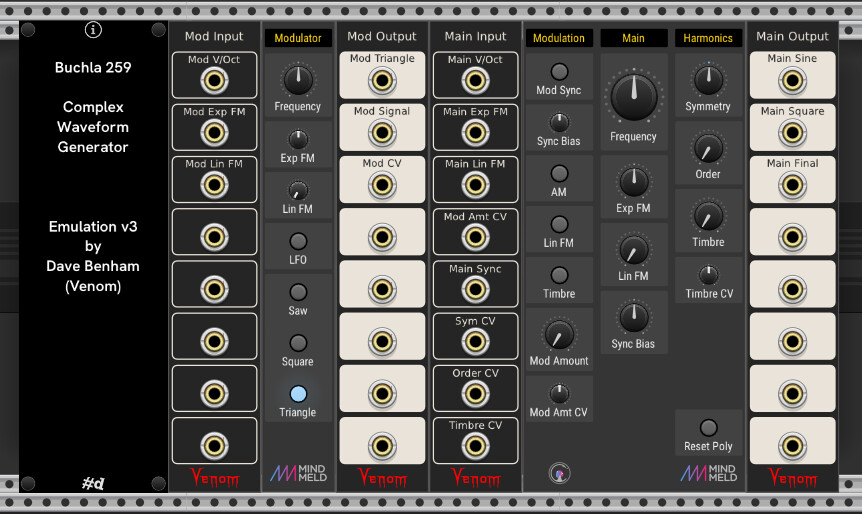
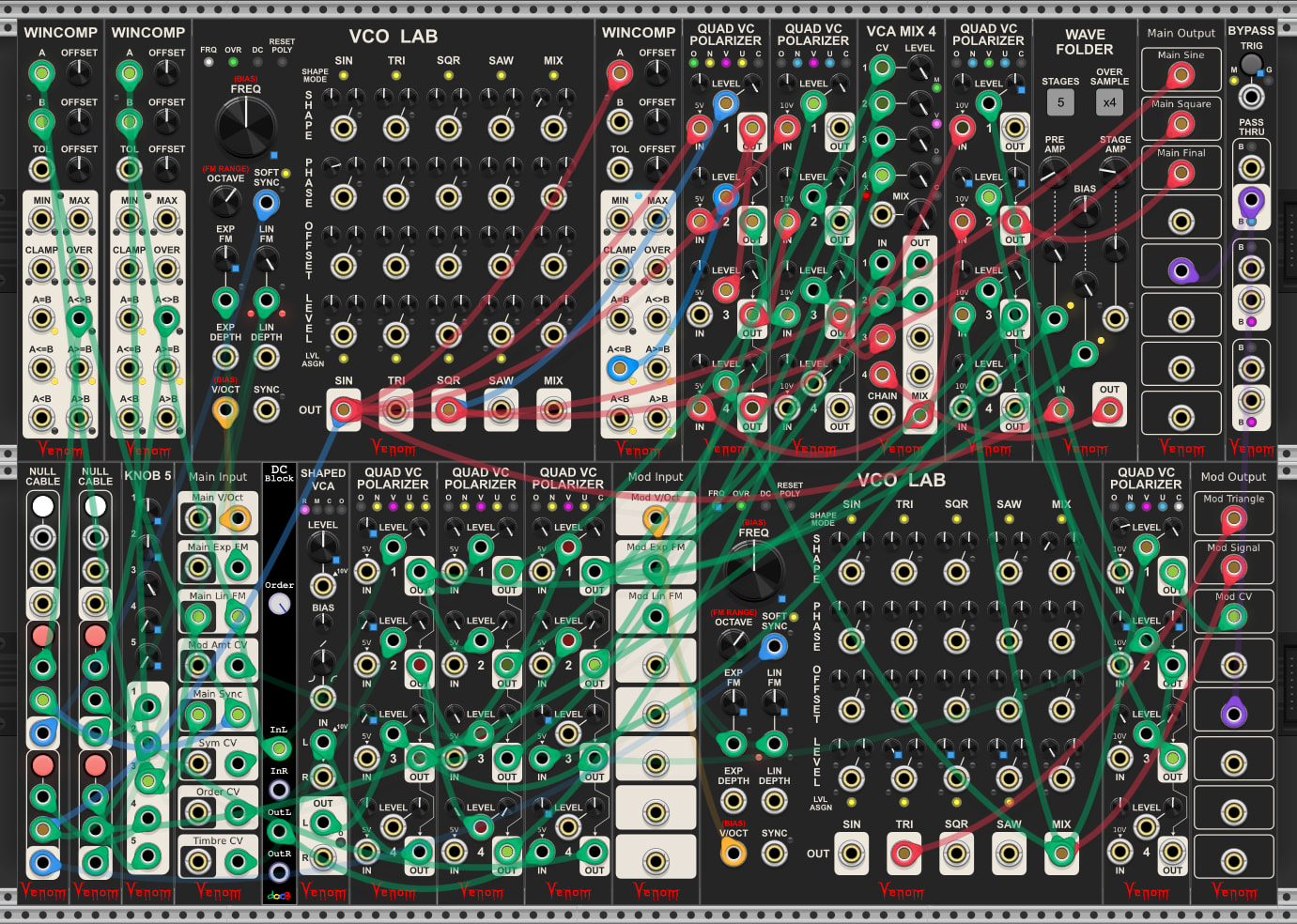
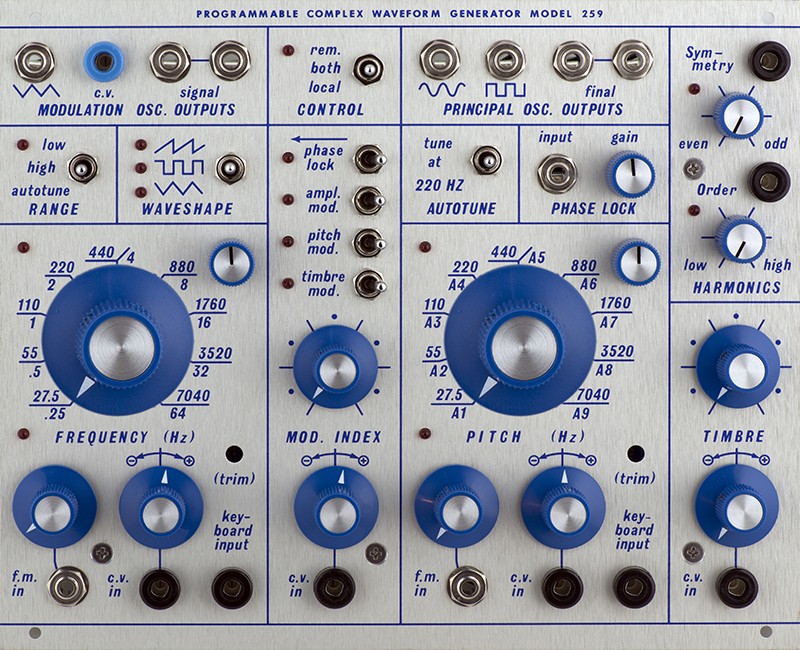
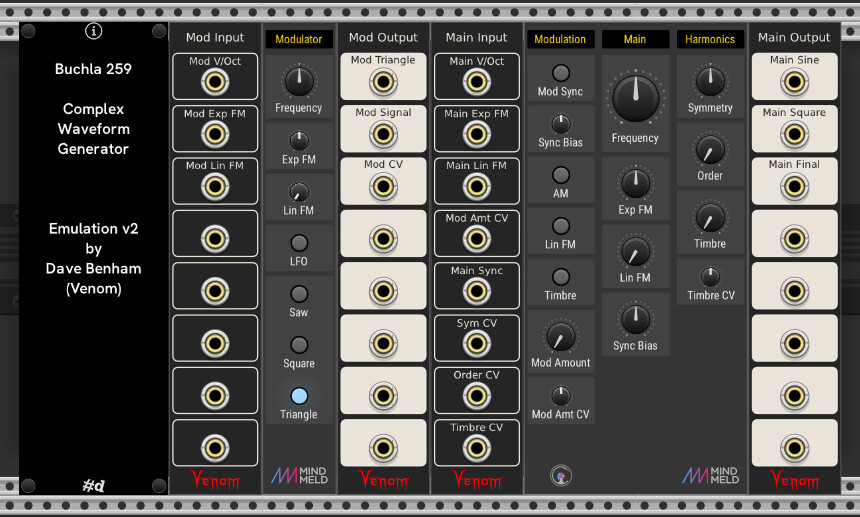
The Buchla Programmable Complex Waveform Generator model 259 is considered to be the original complex oscillator that many modern Eurorack modules are patterned after. But there isn’t any existing VCV module that really emulates its feature set.
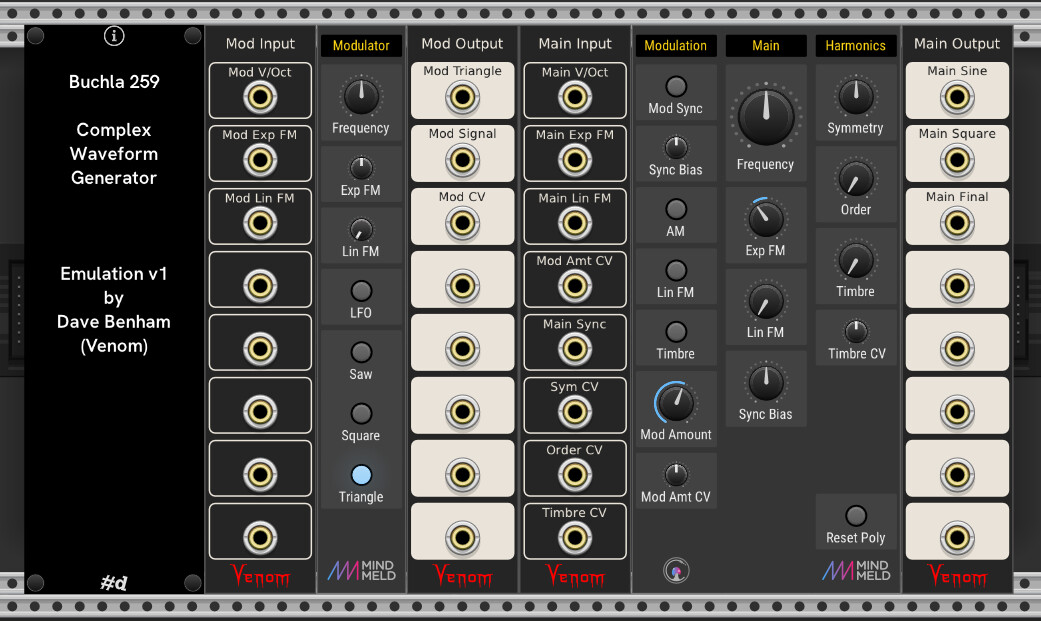
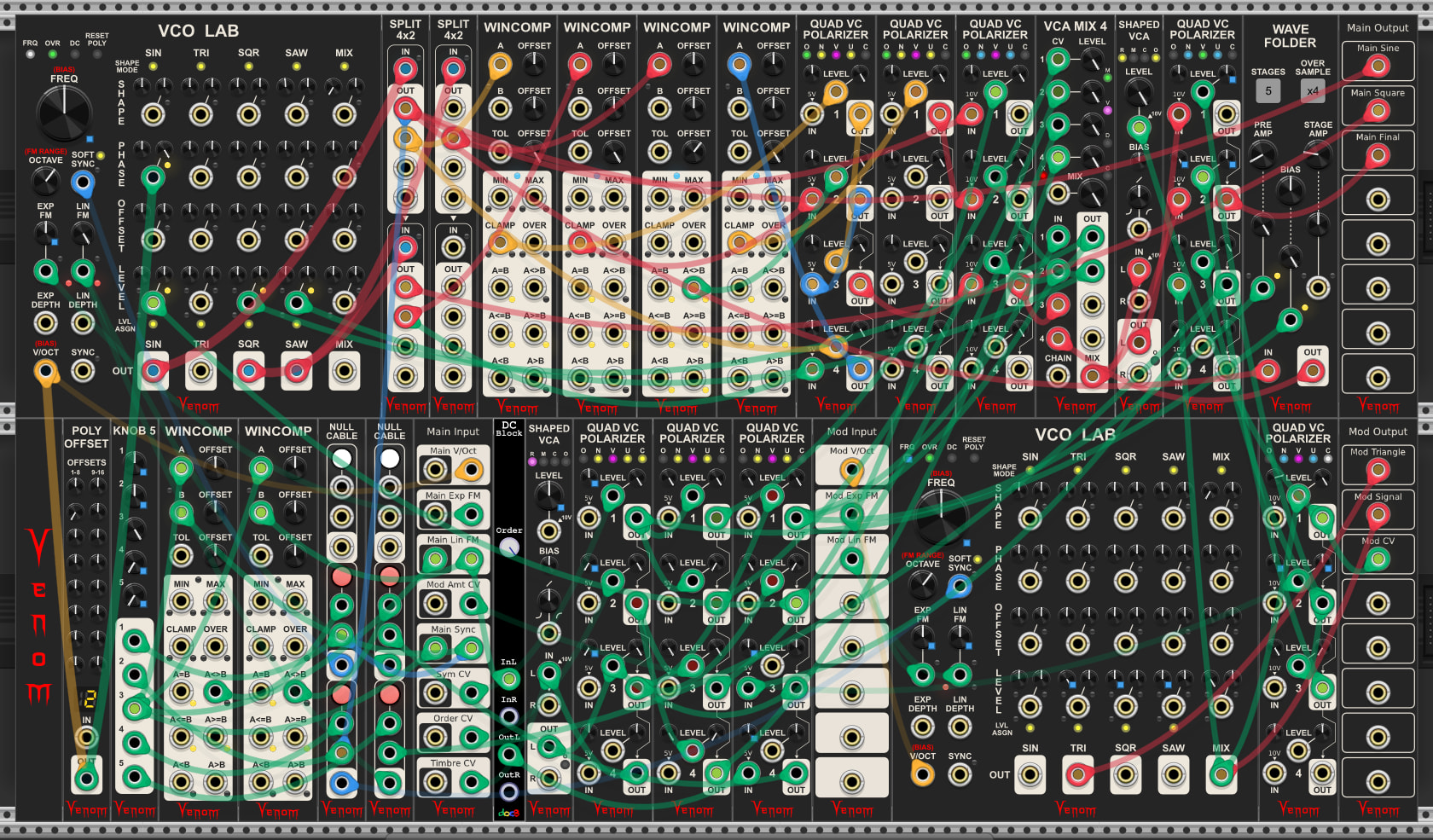
I have attempted to emulate the functional design with existing modules and a MindMeld PatchMaster / Venom Bay Module user interface. I am not confident that it sounds like the original, but I believe most of the basic design is correct, and it is fun to play with.
There is an improved emulation version 3 in a later post that I think behaves more like the hardware. But continue to read this post for some additional info
The TipTop 259t manual is a good place to get an overview of how the 259 works. Of course there are differences.
There are a couple hardware features that are non-starters for an emulation. The remote control section for interfacing to a computer is of course not attempted. Also the autotune feature doesn’t make sense for a digital VCO, plus I don’t think it was ever fully realized in the original hardware. Also the TipTop ART feature is proprietary to TipTop, and not in the original hardware, nor this emulation.
Here are some major known differences from the hardware:
The M wave used by the hardware wave shaping section is approximated by a simple square wave instead. I also used a simple saw wave in the wave shaping section, but I think the hardware may use a wave derived from the sine.
The two phase lock functions are supposed to be some form of phase locked loop. I don’t know how to implement that. I have done something similar with comparators, but my experiments horribly distort the waveform. So I opted to use gated soft sync instead (normal direction during negative portion of the syncing signal, reverse during the positive portion). It is basically the same as a typical reversing soft sync except it preserves the frequency of the incoming signal rather than pitching it down 1 octave. A major drawback of this design is the sync only works well when the syncing signal is lower pitched than the follower. The hardware is able to generate subharmonics when the syncing signal is higher pitched.
The hardware has a gain knob for the principal phase lock signal. I dropped that, and added a sync bias to both the main and modulator sync. When the syncing signal spends equal time positive and negative it locks into a stable pattern. The bias applies an offset to the signal which leads to some pleasing motion to the result. This is actually the opposite effect of the hardware phase lock, but I like the result.
Unlike the hardware, the emulation actually supports polyphony. Feedback can cause polyphonic output to remain after the original polyphonic input is removed. Use the Reset Poly button to temporarily bypass the patch internals, thus allowing the patch to re-establish the correct poly count.
All CV inputs support bipolar CV, unlike the hardware that only uses unipolar CV
I have renamed a number of features for clarity, and/or to get the label to fit within the limits of the UI.
Principal oscillator is renamed Main oscillator
Pitch is renamed Frequency (main oscillator)
Keyboard input is renamed V/Oct (both main and modulator)
f.m. in is renamed Lin FM, and c.v. in is renamed Exp FM (both main and modulator)
Pitch Mod switch is renamed Lin FM (modulation section)
Mod Index is renamed Mod Amount (modulation section)
A couple implementation details I forgot to mention.
The Buchla graphics show the saw as being ramp up. But it is actually inverted to be ramp down.
All of the internal modulation from left modulator to right main (principal) is DC coupled, including the pitch (linear FM) modulation. But the linear FM external inputs for both the modulator and main are AC coupled. I could have made the linear FM through zero, but disabled through zero to make the emulation more like the hardware.
Maybe this concept could be your next module developed? Instead of trying to build one from existing modules you could build one from scratch… heck I’d buy that if it was premium and maybe you could study the various buchla modules and ecosystem and make a bundle if possible? Could be a premium bundle reminiscent of Chaos Boxes or a single oscillator but if you’re already busy with other projects you can take your time…
A Buchla-esque bundle is already a concept in my head. I’m just not sure if I want to release a dedicated module that purports to be an emulation of the 259 without support for the phase lock feature.
I have a design in mind for the 281 quad function generator, with a base mode that closely adheres to the original design, plus an enhanced mode with a bunch of additional features.
I also have an idea for the MARF, preserving all the functionality, but with a significantly redesigned UI that should be easier to use than the hardware.
I would love to do a Buchla style low pass gate, but that is a tough nut to crack. There are a few low pass gates in VCV, but I don’t think any of them sound like the real hardware demos that I have heard on YouTube. There is a common misconception that the low pass gate is simply a VCA and low pass filter in series. But that is not at all correct. The Buchla low pass gate is actually a filter in all cases, with three different configurations to get the different modes. I haven’t a clue how to model the electronics.
hello, good to hear that you thinking about Buchla modules. Some weeks ago I created my first batch of modules of the Buchla world. they are currently in review from vcvrack. it contains my heavenly inspired marf module with expanders. my second batch contains a quad function generator and two dual function generators, inspired by the corresponding Buchla and tiptop modules. if you’re are interested, I can send you the documentation of the working modules.
You don’t have to be 100% accurate, you can put a spin on things to turn classic hardware components into modern VCV style ploddities perfect for new takes on the classics… for example use a wavetable instead of a standard subtractive oscillator waveform or introduce distortion into the low pass gate structure, it just depends on how you approach each piece and if something is worth the effort… just always know I’ll be patiently waiting for your next module and eager to add it to my toolbox and willing to pay for premium modules in November to support your development.
I’m so glad to see this is in the works!! I was hoping to find a Make Noise DPO emulation but this is great because I think the DPO is inspired by the 259. even though Tony Rolando never actually used the 259
I do often wonder how Make Noise was able to get that sort of woodwind quality to their sound. I know the module is analog, but I really love that hollow acoustics in the sound.
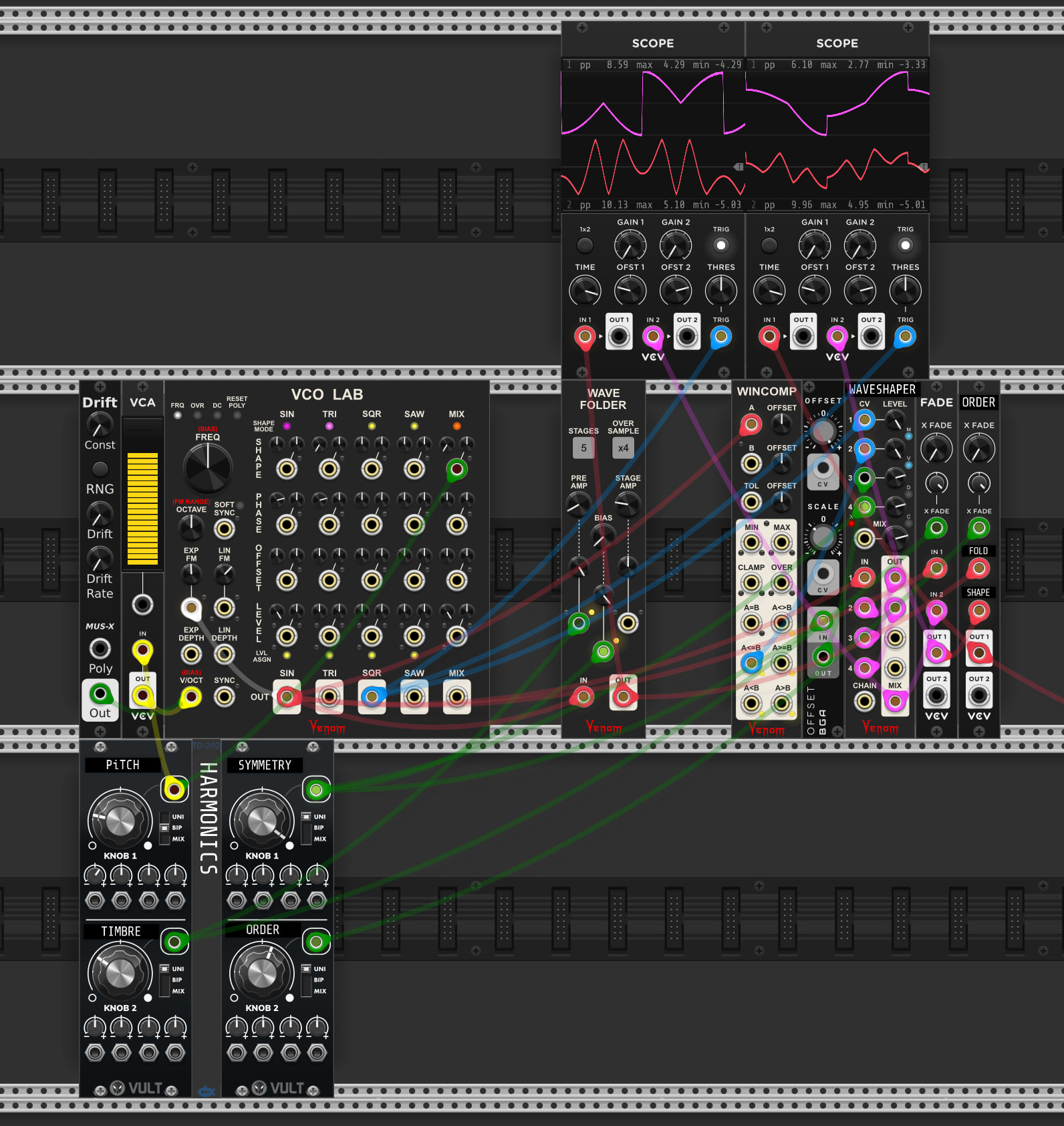
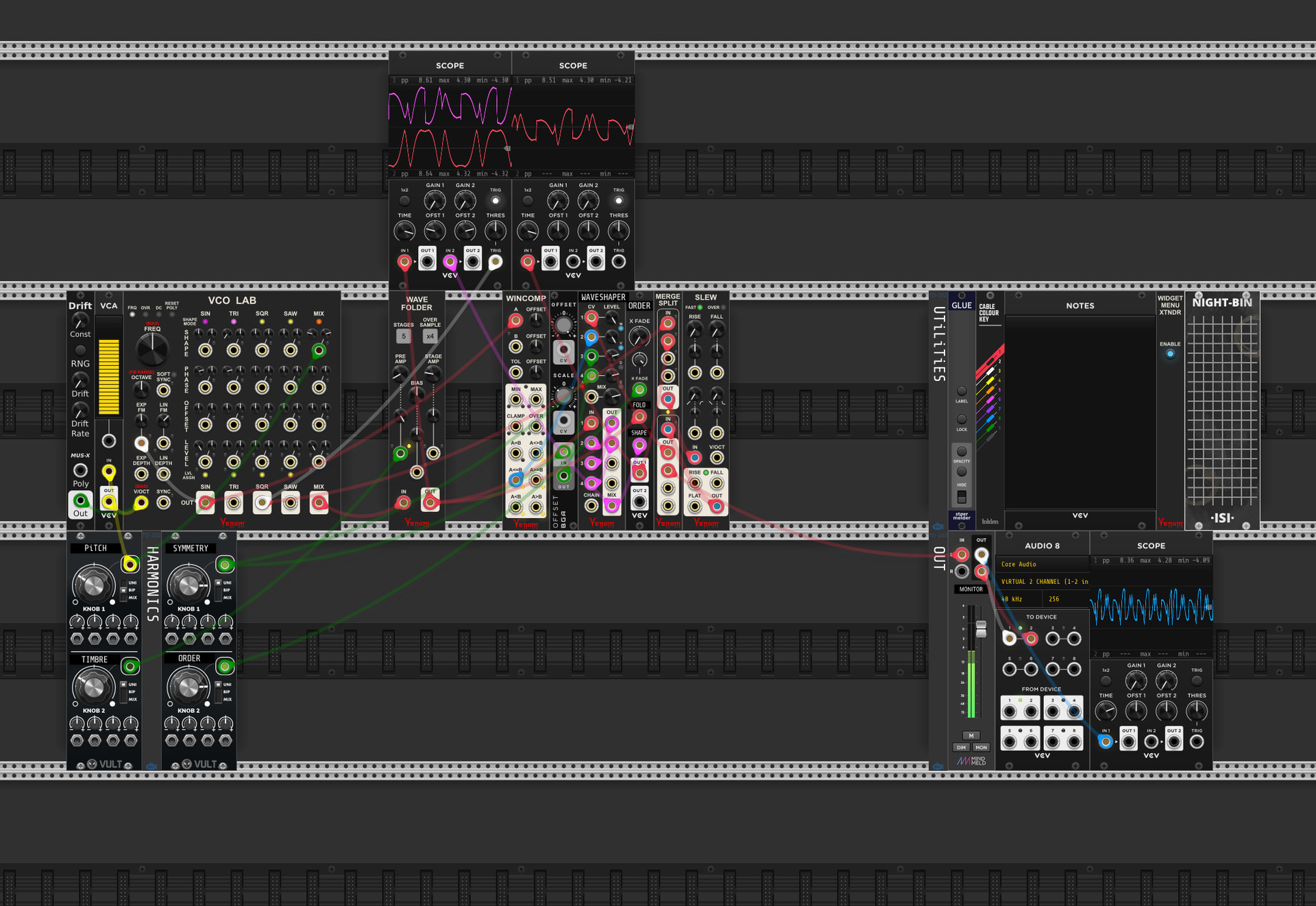
About half a year ago I was exploring it as well. I revisited my old patch, cleaned it up a bit and you can download it here. I made a waveshaper from Venom modules and I think I have patched it correctly. The Harmonics section of the 259 is there at least with the morphing saw and M-wave, both derived from the core sine wave.
It can be I have the order wrong though: in this patch the wavefolder is before the waveshaper: the Order control crossfades between the wavefolder and the waveshaper, blending in the waveshaped sound. The wavefolded signal also goes into the waveshaper as well. But it could also be that the Wavefolder is after the harmonics section. You would have to change the input of the waveshaper from wavefolder to the sinewave. And then patch the crossfaded output to the wavefolder. Not sure.. Both sound nice actually.
I hope it is of use!
Thanks Koen! After seeing your example, I was able to create the pseudo saw and the M wave with the same geometries, but with different, albeit more complicated, patching. I pass a bunch of signals through meaningless modules with oversampling to make sure all the components stay in sync. This allows me to create stable waveforms that stay in sync without any phase drift and minimal aliasing. They also work well at high frequencies.
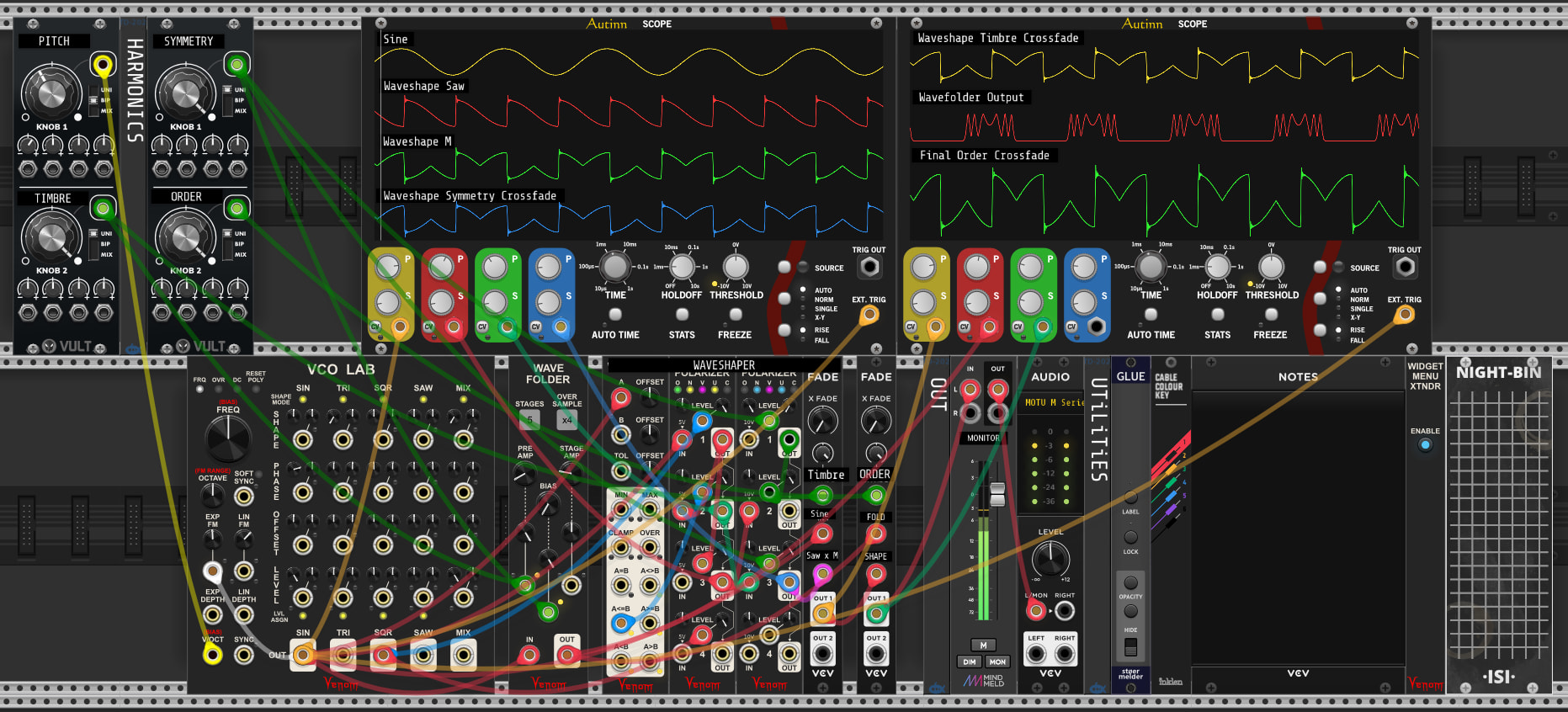
The wave folder and wave shaper are not in series - they are strictly parallel.
The wave folder processes the simple sine only. The Timbre controls the fold amount, and the Symmetry controls folding bias.
The wave shaper simply mixes the sine, pseudo saw, and M-wave, with Symmetry crossfading between saw and M-wave, and Timbre crossfading between the M-wave/saw mix and the sine.
The Order crossfades between the wave folder result and the wave shaper result.
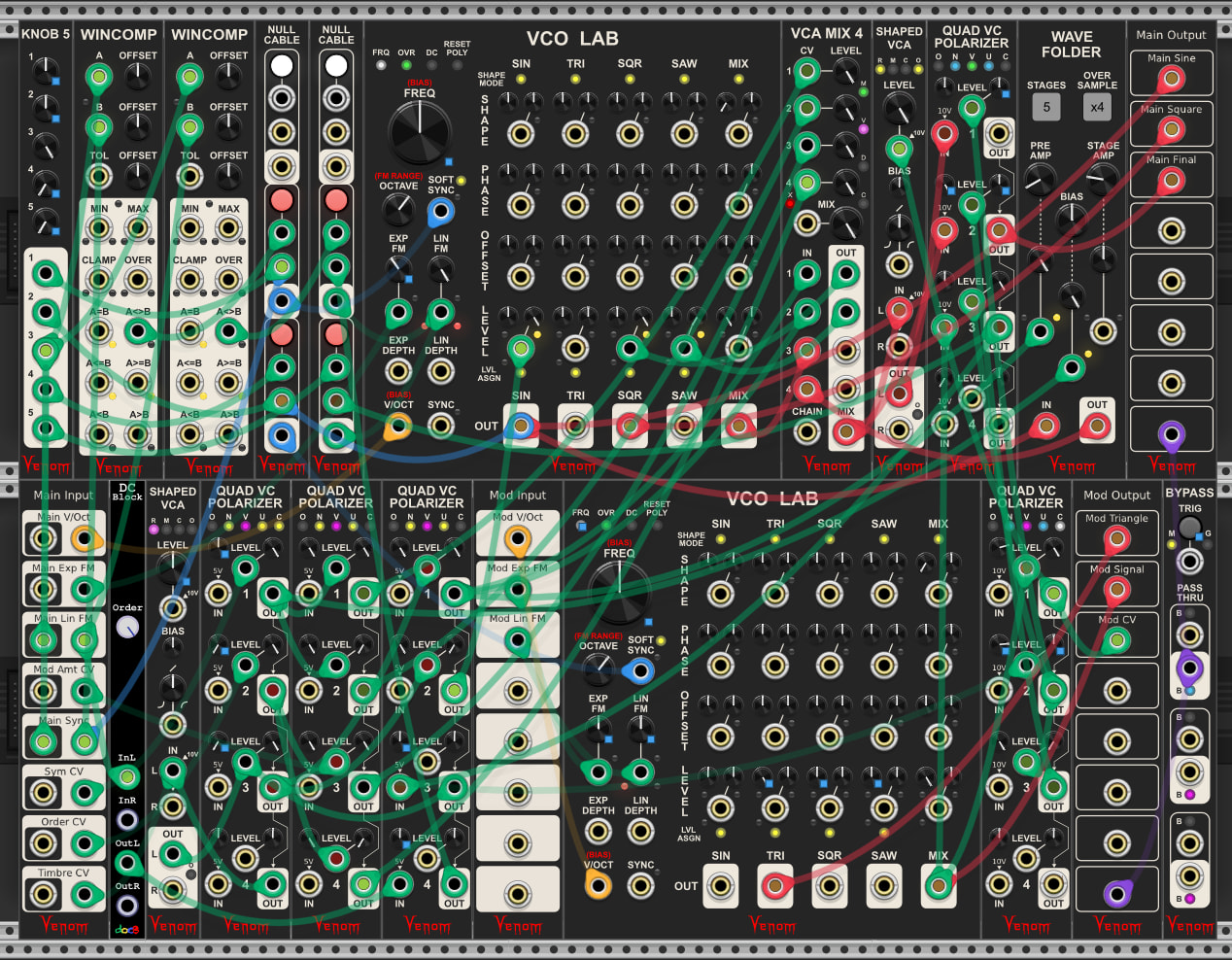
Here is my emulation version 2 with the improved wave shaping. I like the sounds I am getting much better with these improvements.
Note that the main oscillator is using polyphony to generate the wave shaped saw and M wave, so this emulation no longer supports user polyphony. With a bunch more patching I could support up to 8 channels of polyphony, but the patch is big enough as it is.
And thanks for the remark on the parallel architecture. I did some research and you are right of course, but the three crossfading stages make it look a bit hybrid. To summarize:
There is a wavefolder with the core sine as input and 5 parallel stages that are summed and mixed with the original core sinewave. The depth/crossfading is controlled by Timbre.
Parallel to this is the waveshaper, which is a blend between the sawtooth and m-wave. Both shapes are also fed by the same core sinewave. This blend is crossfaded by Symmetry: CCW = saw CW = m-wave
Symmetry also controls the dc offset of the sine into the wavefolder, creating a bias control for the wavefolding.
Order is a crossfade between the wavefolder and waveshaper output. CCW = wavefolder CW = waveshaper.
It is fascinating to see how powerful the three crossfaders are in this design!
I looked at the code of this oscillator and it is different from the actual 259 architecture.
For one it is not using the harmonics/waveshaping as the 259 at all. What it calls the Harmonics is actually a wavefolder, and it uses a rectifier in series. So, if you want an emulation of the 259, this oscillator does not provide. It is “inspired by” which is perfectly fine of course,
As for my previous explanation, I think Timbre does something more on the 259, so my summary was incomplete:
Not only does it control the depth of wavefolding, but it also controls a crossfade/mix between sine and the waveshaped section. I will adjust this in my proof of concept patch and will share it here if people want.
thank you for sharing, also to @DaveVenom . this vco is a beast. I will use your both emulations. as far as I have searched, there is not other vco modules to provide it.
Awesome @DaveVenom I cant’ wait to try it, I’ll measure it with the 259t, along with the 281t I still have to do
There are so many unexpected interesting things with this oscillator! mostly
the FM bus is not linear or exponential,it behave like a blend of two curves depending where you are on the knob, very peculiar!
The timbre section has a whole other world of sound with the order knob fully CW, something in between saw and square, I never seen a wavefolder (hardware or software) replicating this feature
here is my updated patch for anyone to play with.
You can get great sounds out of it.
I also removed the micro-slew, its conceptual effect is negligible.
259_071026.vcv (6.3 KB)
Ahh - the simplification helps with understanding, and it is much more elegant than what I was doing! Everything is derived directly from the one sine and one square wave, both at the same frequency:
square multiplied by (ring modulated by) sine yields the pseudo saw, one octave up.
The pseudo saw multiplied by the square phase shifted 90 degrees yields the M wave, back to the original octave.
The Wincomp is used to phase shift the square wave 90 degrees for the 2nd ring modulation.
I can see how this could all be done in hardware efficiently.
I took your patch, added oversampling, as well as some extra unity processing on some signals (with oversampling) to get the same result, but with everything phase aligned perfectly so no unwanted spikes. The x4 oversampling controls aliasing. I also restored V/Oct pitch control, and removed the VCO drift, just to further simplify.
OK. I took the improved wave shaping design from Koen, along with my modifications, to create I think my final attempt at emulating the 259 with existing modules.
The end result is nearly identical to version 2, except:
The pseudo saw is shifted up one octave. My previous attempt shifted the M wave down one octave
The internals no longer need polyphony to do the waveshaping, so user polyphony has been restored, and the Reset Poly button is back!
The waveshaper is greatly simplified, so it much more CPU efficient
Thanks! I look forward to seeing the results. Be sure to use my 259 emulation v3, as I think it will be closer to the hardware.
Interesting. Are you sure it is not linear FM, but without through zero? That would allow a low FM index to change the timbre without affecting pitch, but high FM index values will raise the pitch. The lower the carrier pitch, the smaller the window is for preserving pitch. As the carrier pitch rises you get more room for higher FM index values without pitch change. High FM index values cause pitch shifts because negative modulation can only go so far before the VCO stalls, whereas positive modulation can go ever higher.
Also, I am pretty sure the internal FM modulation is DC coupled, so if the modulator VCO output has any asymmetry it can also cause FM pitch shifts. I believe the external FM inputs are AC coupled.
Yeah, there are two parallel waveshaping techniques that you can crossfade between using the Order knob.
CCW yields a fairly standard wavefolder with fold amount control via timbre, and bias control via symmetry
CW yields a mix of three simple waveforms:
Simple sine wave
Pseudo saw derived by multiplying sine by square
M wave derived by multiplying pseudo saw by phase shifted square
Symmetry crossfades between pseudo saw and M wave
Timbre crossfades between pseudo saw/M wave mix and sine wave
At least that is my understanding from reading the tiptop documentation, coupled with Koen’s patching insights.
The wavefolding and wave mixing sections share the same Symmetry and Timbre knobs, but process them independently. The Order knob cross fades between the wavefolder and wave mixer results.
It definitely results in a rich palette of sounds!
I don’t think the Buchla Archives article does justice to the waveshaping architecture found in the 259. It only mentions wavefolding, which is only part of the story.
I look forward to seeing the results comparing the emulation with the hardware. It will be interesting to see if my “understanding” above is actually close to the real world!
Thank you for this detailed view of the waveshaper; it does seem to be an accurate description of what I see on the scope! It’s crazy to think that the waveshaper and the wavefolder are two completely different circuits linked to the same knobs!
For the FM: at least in the 259t,
sending the modulator out into the primary’s external linear FM input provides a very different result than doing the same with the FM bus. The primary’s FM can then be modulated in 3 very different ways (bus; AC coupled lin ext and DC coupled exp in).
I found it so intriguing that I compared it to my other VCOs, and none had similar behavior, except one. I tested a Doboz based on the 3340 with lin/exp, a Shakmat Banshee Reach with thru-zero FM (don’t know the chip), and the Blacknoise Eclipse. I happened to have worked on the development of this one; the chip couldn’t do thru-zero, and just for fun, we added a 3rd mode, which blends the linear and exponential curve. It’s great for special effects, and it happens to be very close to the 259t bus… If I had known it back then, we would have marketed it that way.
I confirm the 259t external AC coupled FM behaves like what you’d expect from a linear fm input without TZ on other analog VCOs
This said, the concept of linear FM seems to be associated with the Buchla world somehow, but I did not see any Buchla documentation using the words “linear FM” anywhere to describe the 259 or 259e, so maybe it was just some experimentation or early attempt to linear FM. was linear FM even conceptualized at that time?

 I will use your both emulations. as far as I have searched, there is not other vco modules to provide it.