Sounds fantastic.
1 Like
Here is an autogenerative patch featuring both the earliest and most recent Venom modules I created. The Rhythm Explorer provides polyphonic triggers for eight voices. An 8 voice polyphonic VCO Unit LFO provides data for a polyphonic sample and hold used for pitch information. The Rhythm Explorer gates trigger both the sample and hold and ping the new Multimode Filter. Polyphonic constant offsets vary the filter cutoff octave, gain (saturation), and resonance for the eight voices. The LFOs are reset upon every Rhythm Explorer phrase gate to achieve melodic patterns. A Bogaudio Switch routs every other Rhythm Explorer phrase gate to advance the CV Funk three stage Count. The Count phase is attenuated to offset the Filter cutoffs by 0, 1/3, or 2/3 octaves. At the end of the 3rd count the Rhythm Explorer Dice is triggered to generate a new rhythm and melody.

13 Likes
Nice one!
Here is my final performance from last year at the December 28 open mic at Morsbergers Tavern, just outside of Baltimore, MD. It is run by the illustrious Rob Hinkal and is always a great experience, even if hardly anyone shows up like on that night.
For my set I play my flutes to a new Venom module I created called the Venjolin - a digital emulation of Rob Hordijk’s Benjolin. The Venjolin will be part of a new commercial plugin called Chaos Boxes that I plan to release this first quarter of 2026.

11 Likes
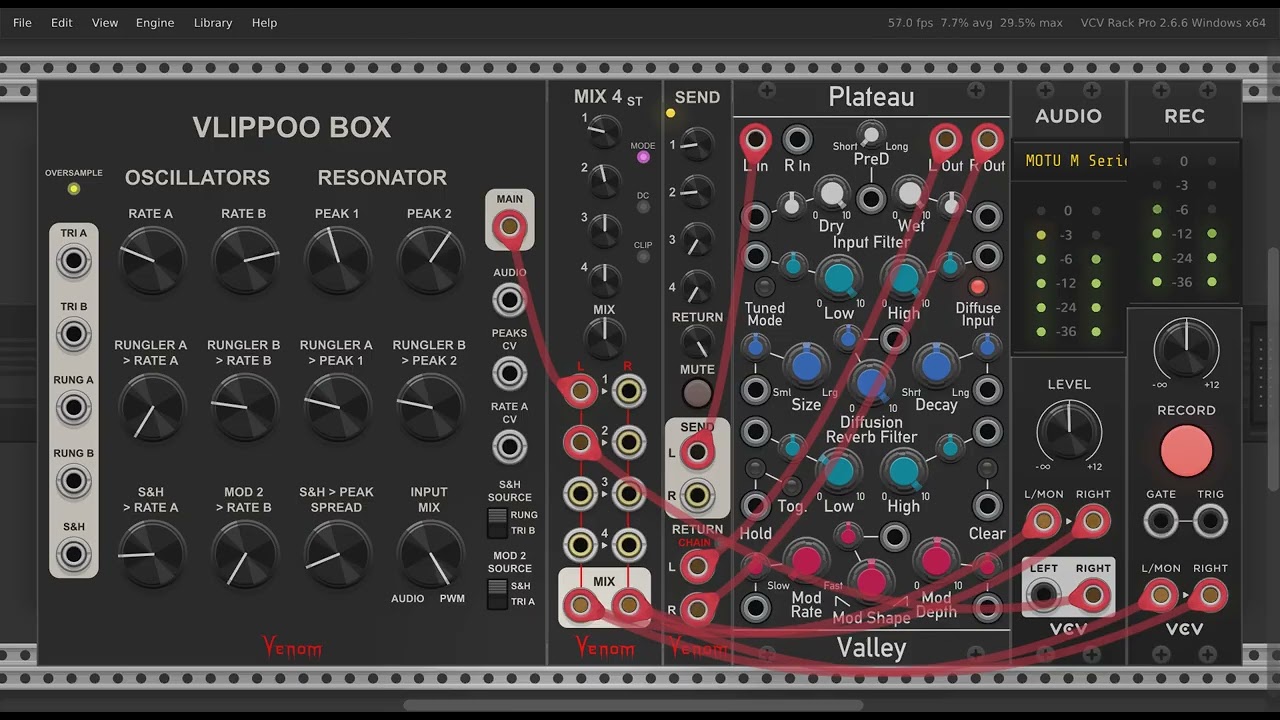
I received my Blippoo Box Legacy hardware synth from BiyiBlip two days ago. Tonight I dialed in a sound that I liked, and then wondered how my Venom Vlippoo Box for VCV Rack would sound along side it. So I dialed in comparable settings on the Vlippoo, mixed them with some reverb, and got this. It is just two instruments, one physical, one virtual, recorded in one take, and no post processing. Maybe there is something wrong with me, but I love this!
The Venom Vlippoo Box is my take on the Blippoo Box. It will be part of my upcoming Chaos Boxes commercial plugin for VCV Rack. I plan to release Chaos Boxes by the end of this March, 2026.
12 Likes
I can’t wait to get this collection! I love my Benjolin and the Blippoo Box was always a (unobtainable) dream. 
1 Like
Dark Worlds Vlippoo Quartet
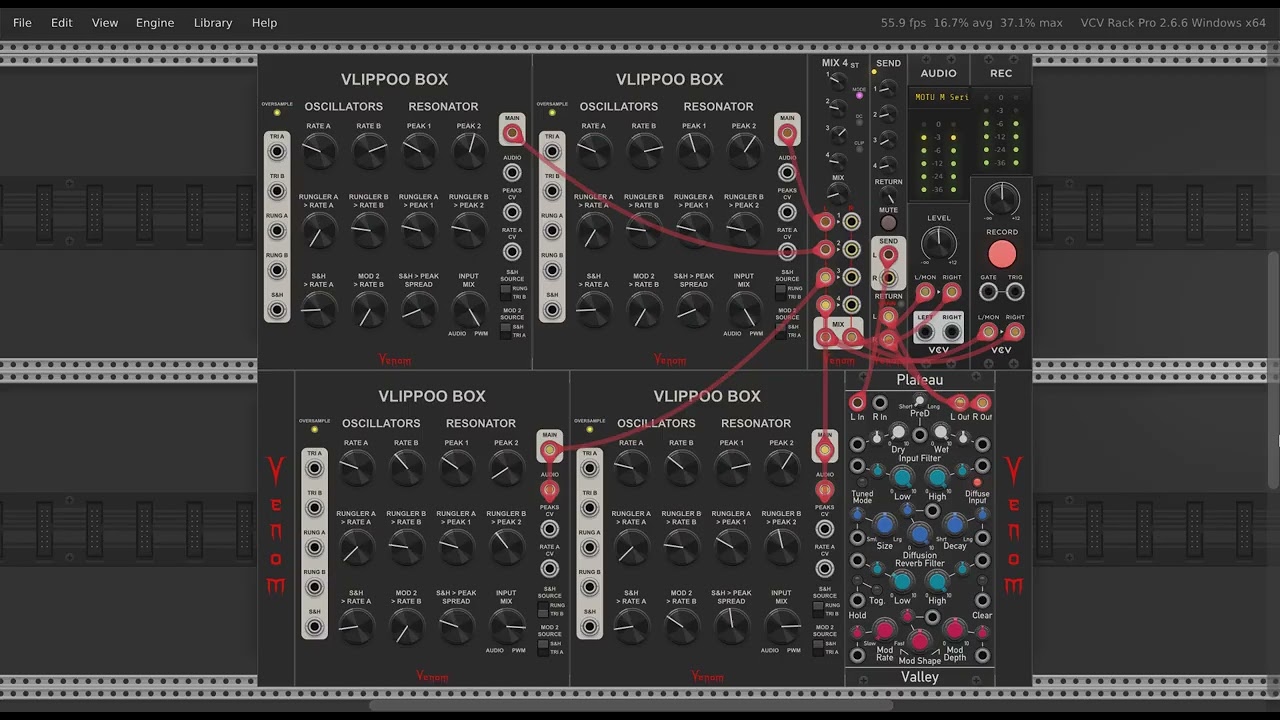
In this version of my previous patch I replace the Blippoo Box hardware with another instance of the Venom Vlipoo Box. I then add two additional Vlippoo Box instances for a bass line and high pitched “lead” voice. These latter instances utilize a technique that I don’t think is available to the Blippoo Box hardware - self oscillation via feeding the main output to the external audio input, and adjusting the input mix.
The self oscillation is very interesting - it is asymmetric. Only one peak (resonant low pass filter) self oscillates, while the other continues to ping instead. This is due to the way the Twin Peaks resonator works. It creates a band pass output with resonant peaks at either edge by subtracting one low pass filter output from the other. This makes the resonant peaks 180 degrees out of phase with each other. If I invert the main audio before feeding it back, then the oscillators switch places as to which self oscillates and which pings.
I haven’t been able to get my Blippoo Box hardware to oscillate like this. In the Vlippoo Box I provide context menu options to increase the filter input gain, as well as the amount of resonance. Perhaps that is why the Vlippoo Box can self oscillate and the Blippoo Box does not.
I am still on track to release the Venom Chaos Boxes with the Vlippoo Box later this month.
7 Likes
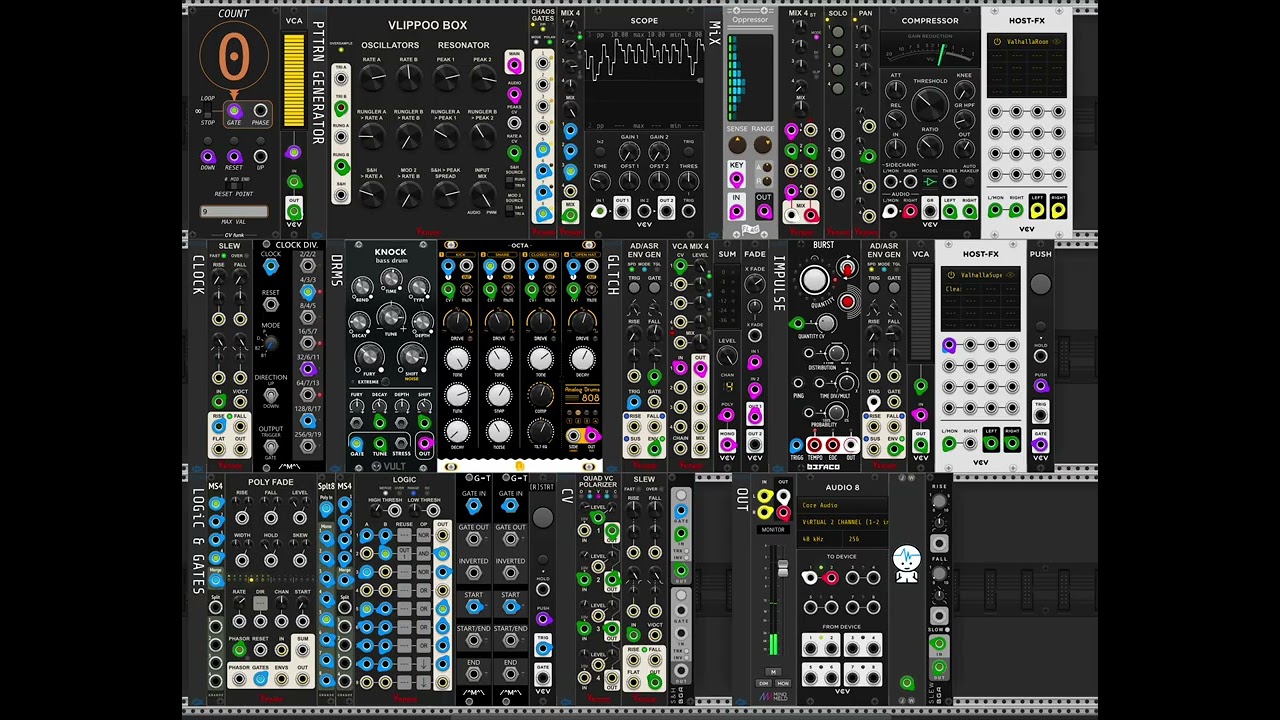
Another sneak peak: While testing the Vlippoo Box, I created this fun little patch, trying to use the Vlippoo as a pattern generator for drums and glitches.
6 Likes
With all of the Venom programming I have been doing the last few years, I have hardly been playing music. At least once a month I would participate in some group non-traditional (often noise) improvisation, but hardly any of that is recorded. As far as patching, most everything has been small, either exploring synth ideas, or demoing modules. I have totally gotten out of the practice of creating moderately large, multi-voice patches.
I decided I wanted to create a larger patch, and man is that intimidating - staring at a blank rack! I knew I wanted to use mostly Venom modules, but that was it.
I ended up with this
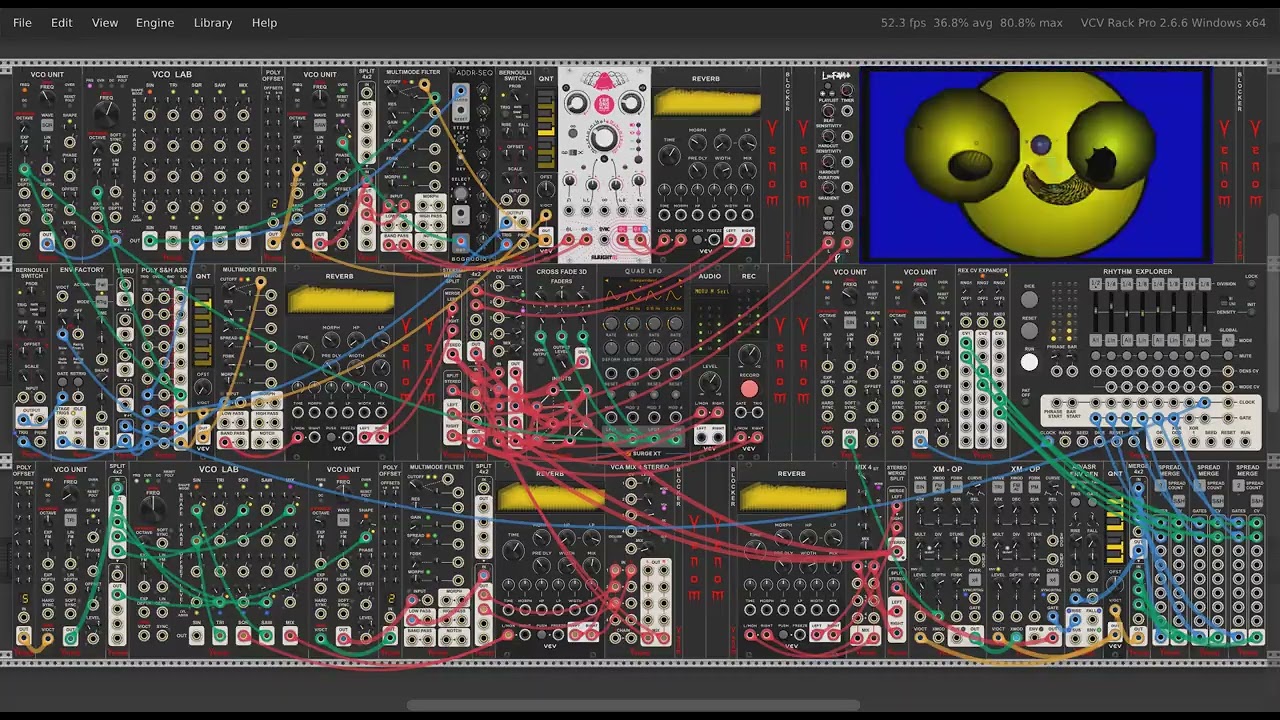
To get a jump start I reverted back to some of the earliest techniques that I first explored with VCV rack
- Picking out individual harmonics from a harmonically rich sound source using filter sweeps of a highly selective resonant band pass filter (top left)
- Pinging a resonant filter (middle left)
- A drone (bottom left)
I then added a fourth voice using Rhythm Explorer + expander to generate a polyphonic melody that is played by 2 XM-OPs. (middle and bottom right)
Finally I mix the four voices with a 3d cross fader (middle center)
There are only a hand full of non-Venom modules
- VCV quantizer and reverb
- Bogaudio sequencer
- Surge Quad LFO for random modulation
- Alright Devices delay
- RPJ Low Fat Milk for visuals
Here is the final version of the patch. It is a bit simplified from what is in the video, but it gives identical results.
Ambient Venom Ensemble.vcv (19.6 KB)
The patch requires a couple modules from Venom v2.16 that have not yet been released to the library. You can get the pre-release dev version below.
6 Likes
Very nice Dave, great timbres and atmosphere.
1 Like
Whoa, nice patch! Not as rusty as you think and I know the feeling staring at a blank Rack. Your many months of intense programming have netted us mere mortals so many great modules. Thanks!!!
2 Likes
Beautiful!
30 Minutes of Slow Ambient Modulation from Venom
Ambient Random Modulation 3.vcv (6.4 KB)
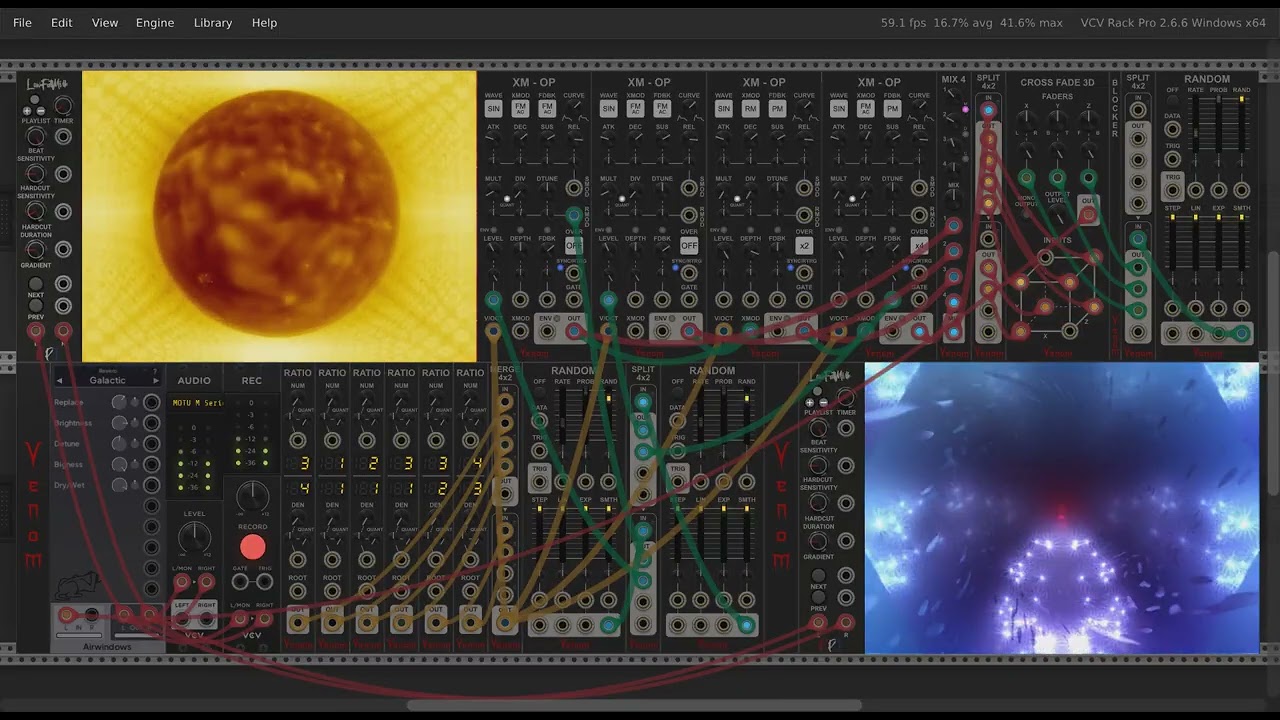
I use Venom modules to explore various combinations of linear through zero frequency modulation, phase modulation, ring modulation, integral ratio frequency relationships, and dynamic mixing, with various parameters dynamically controlled via slow smooth random CV.
There are 6 drone voices with root pitches set to harmonic relationships – 3:4, 1:1, 4:3, 3:2, 2:1, 3:1. All four voices are created by four polyphonic XM-OP VCOs. The root pitches are sent to the V/Oct input of all four XM-OP VCOs.
The four XM-OP sine operators are configured as follows for each voice:
XM-OP 1 – n:3 ratio with varying n centered about 7, constant linear FM feedback, varying output level
XM-OP 2 – 8:3 ratio, constant linear FM feedback, varying output level
XM-OP 3 – 1:1 ratio ring modulated by a mix of operators 1 and 2. The final output is a constant mix of the raw sine and ring modulated result
XM-OP 4 – 1:1 ratio with varying phase modulation feedback, frequency modulated by operator 3 at a constant level
The polyphonic outputs of all four operators are mixed and then split out to 6 of the 8 vertices of a virtual 3D cube in the Cross Fade 3D module. A final mix is created by cross fading the vertices via the x, y, and z axes.
The cross fade output is then passed through Air Windows Galactic reverb for some final ambient goodness.
In total the patch uses 27 slow smooth random CV signals produced by three polyphonic Venom Random modules.
This polyphonic patch was derived from a monophonic version I posted below:
6 Likes
Sounds organic and simply amazing. Flows great  !
2 Likes
Excellent stuff Dave!
1 Like