*toots horn*
Yes indeed. but I think the first model is a bit easier to understand for us mere mortals.
I’ve never had a strong faith, but I remember having nightmares when studying quantum mechanics, feeling like I was challenging the authority of God.
Oh cool, I just read your documentation about Logistiker. I didn’t know the term logistic map so I looked it up. I found out I knew about this by a different name: the Verhulst formula.
For people new to this stuff, the logistic map belongs to a different category of chaotic formula. Instead of velocity calculated from position like the 3D attractor formulas, this formula iterates in discrete steps to produce a chaotic sequence of real numbers. So instead of a smoothly moving point in space, it produces an endless series of numbers one at a time; the values of the numbers jump around.
I see that Logistiker has an internal clock. It makes sense that it would need some kind of signal to choose when to jump to the next value.
One thing I’m curious about: I have read that for chaotic sequences like this, sometimes it’s fun to take the most recent N = 2, 3, … whatever samples, and treat them like a vector. Sometimes patterns and hidden order appear when you do this.
For VCV Rack, this could be done feeding the output of Logistiker into VCV SHASR (Sample & Hold Analog Shift Register).
Hmm… I might use this as a creative prompt for a patch…
Of course that lead most of us to Einstein’s famous quote “God does not play dice with the universe”
I think docB’s “Hopa” module is of this iteration type as well:
Here’s the formula for the iteration:
Hopalong is 2-dimensional (Fraktalwelt Hopalong), so I’m not sure what the module actually outputs, probably only one of the two coordinates.
I intend no criticism by this at all, but it just struck me that all of us are following roughly the same design on these: speed, variable parameters, and multi-dimensional outputs.
I’ve been in the process of soldering a lot of Nonlinear Circuits modules again (last time was a decade ago… then kids happened  ). I’m really fascinated with the way that Andrew approaches chaos. He has a number of modules that follow the same mentioned design, but he has a larger number where the chaos is used to glue together a bunch of functions in unusual ways.
The most recent example is Coupled Comparators: Hyperchaos and Comparators have an all-in-donnybrook — Nonlinearcircuits
It has an analog hyperchaos generator at the heart of it, but it’s used to drive three interconnected comparators in a way that generates rhythms.
Frisson is beautiful: Frisson — Nonlinearcircuits
A Mackey-Glass attractor is fed into an 8-stage phaser, so you have time-delayed and filtered copies of the chaos, kind of like an analog chaos cousin of Make Noise’s recent (and spectacular) Multimod.
Stochaos is my most recent build: chaos vs random gate and CV generator — Nonlinearcircuits
I haven’t had a lot of time to sit with it yet, but chaos is used to drive the probabilities of various gate outputs with different divisions. From my initial tests, it is extremely useful and locks into very pleasant grooves. A similar one that is a personal favorite is Flip-Flop Chaos: Flipflop chaos — Nonlinearcircuits
A simpler idea is substituting chaos where noise is frequently used, like this take on the Buchla SoU but with chaos instead of white noise: Helvetica Scenario — Nonlinearcircuits
A clearer view into this design process is Primal and Signum Hyperchaos. Primal came out first: Primal Hyperchaos — Nonlinearcircuits
Primal Hyperchaos is pretty similar to the VCV designs, although it has a bonus gate out. A “signum” switch (a switch based on signal polarity) is used as part of the analog circuit. It’s cool, but it got a massive design upgrade in Signum Hyperchaos: Signum Hyperchaos — Nonlinearcircuits
In Signum, the switch is now on the panel, so you can replace parts of the chaos with your own signals, rewire the attractor, or whatever you want. It’s a simple upgrade, but it ends up completely changing the interaction with the module and opening up a lot of possibilities with integrating it in your patch beyond acting as a generator/modulator.
Okay, last one, I promise. Spasm is another simple attractor, but it includes this “Inject” input that I’m constantly getting great results from: SPASM — Nonlinearcircuits
I have very poor knowledge of analog circuits aside from (and in spite of) soldering them together, but it doesn’t feel quite the same as modulating the variables. I’ve seen “inject” elsewhere, and it’s in this patch from my favorite DSP book ever, Generating Sound and Organizing Time (Generating Sound and Organizing Time | Cycling '74) Fun side story: I think Graham Wakefield was the person who introduced me to chaotic attractors back when we were both students at MAT/UCSB.
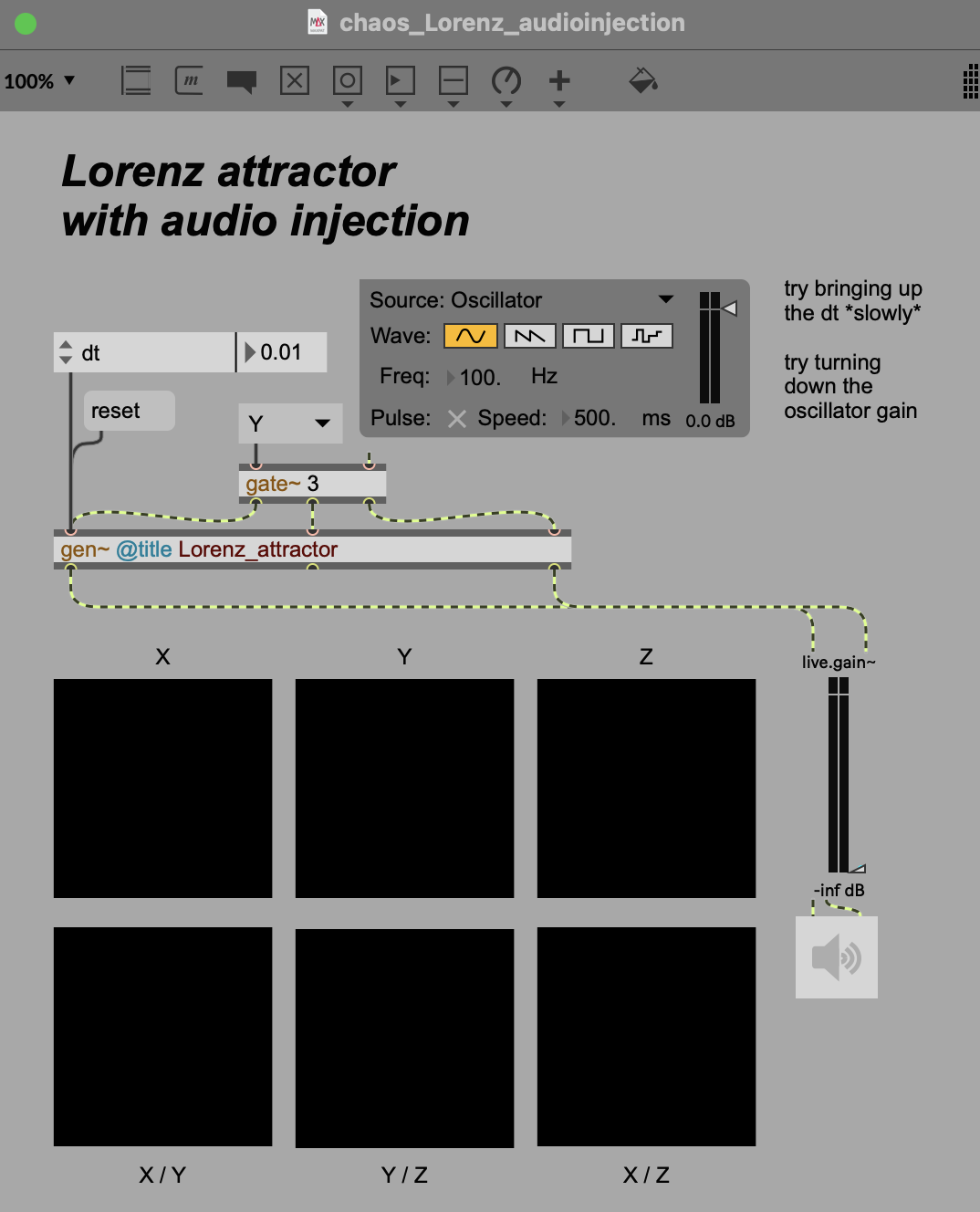
Better view of the gen~ guts:
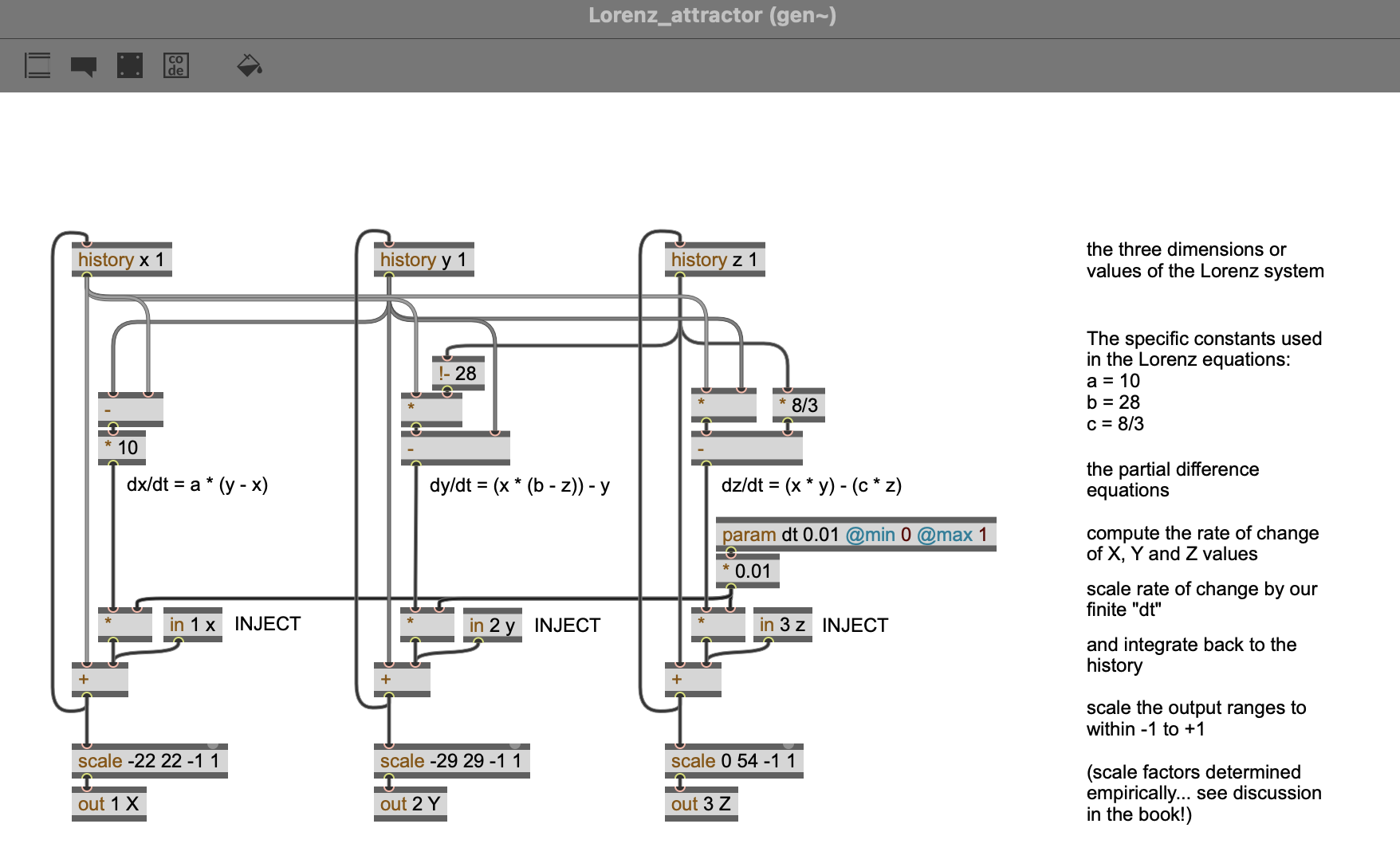
The three audio inputs there are summed with the results of each differential equation after they are calculated but before they are stored in the feedback history. It ends up sounding like an extremely unusual filter, kind of roughly like a low-pass filter being modulated by chaos, but it has a lot of failure states that contribute oscillation hangs, dropouts, etc.
TL;DR: Fun chaos ideas!
Wow, thank you @kwurqx … an entire book about chaos in electronic circuits! I have already started reading it. Fascinating so far!
This paper does indeed what it says in the title: A Concise Guide To Chaotic Electronic Circuits.
Plenty of scattered specific research papers, in any niche domain (much of it never reaching mainstream). But often hard to find a comprehensive informative overview of some domain.
But, more generally, scientific papers (e.g. via researchgate.net) are a treasure trove of ideas, explanations and implementations. Often including block diagrams and other visuals, including circuit schemas, algorithms and math (very convenient voor programmers).
Some (ever more…) scientific research papers are behind a login/paywall, but loads of it is (still) freely available.
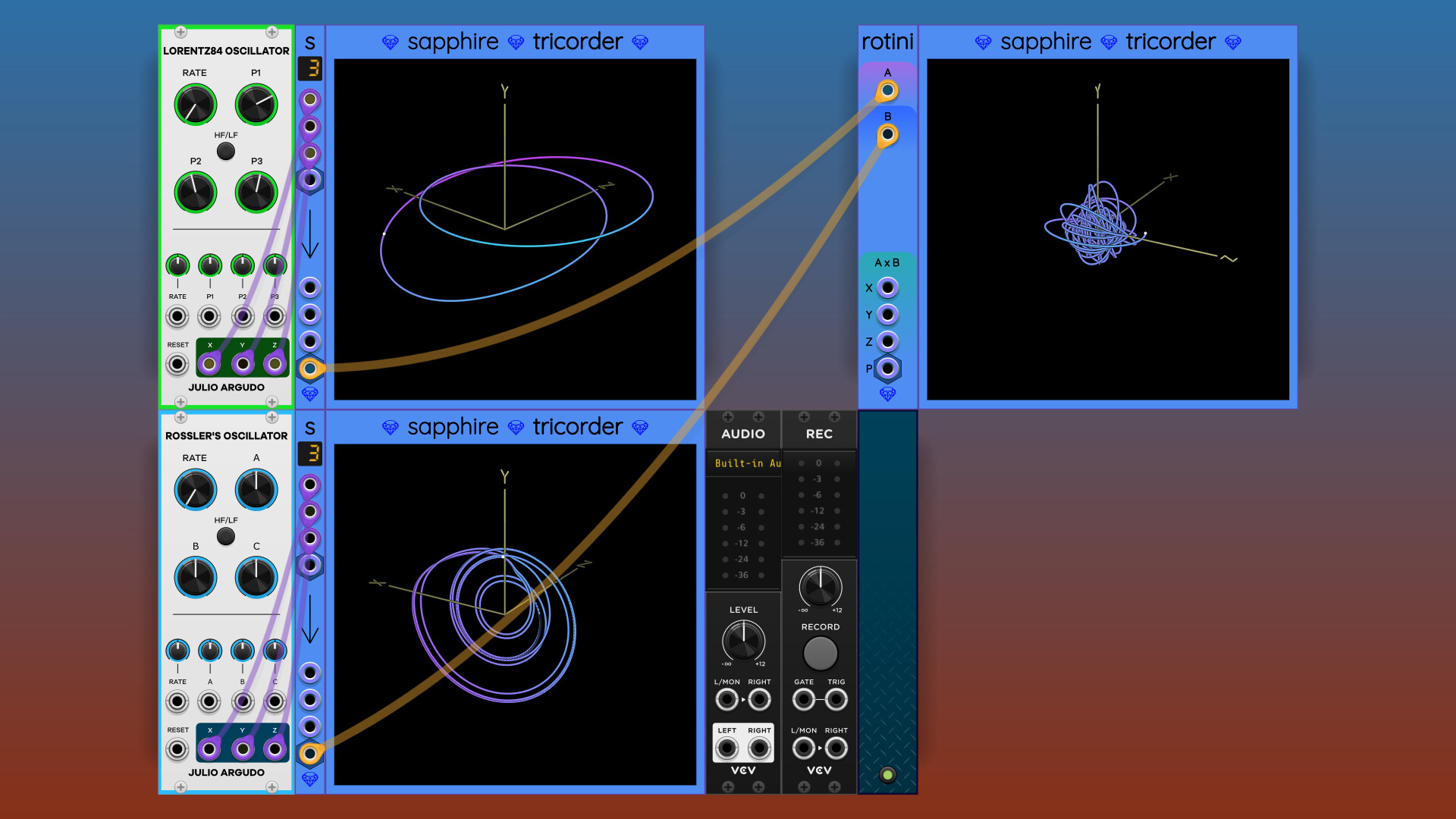
While we are on the topic of chaotic oscillators, sometimes you might want to experiment beyond the usual slow modulation sources you have been using. If you would like to use existing chaotic oscillators (or 3D vector generators in general) and combine them to form novel modulation sources, you might be interested in using Sapphire Rotini.
Rotini accepts two 3D vector inputs, takes the vector cross product of them, and produces a 3D vector on the output. This means you end up with an output vector that is at right angles to both input vectors.
You can combine Sapphire modules like Frolic, Glee, and Lark into Rotini to get completely different shapes. You don’t need to use Sapphire modules for input though. Anything that can produce 3 voltages can be combined into a vector, for example:
This shows a little-known trick of my Split/Add/Merge module: in 3-channel mode it lets you visualize its output on Tricorder. So it can be used as a skinnier version of Tin.
Vector cross products aren’t the only thing you can do. Scaling and adding two vectors works also. Here’s an example using VCV VCA Mix with 3-channel polyphony to perform a scaled vector addition:

And of course you can combine all of these in chains, or trees, of arbitrary complexity. There is an astronomical number of possibilities even with just a few modules combined together.
Also keep in mind you can also make non-chaotic vector sources that are useful for complex modulation in your patches. Here is an example to spark ideas: 3 sine waves at slightly different frequencies form your (x, y, z) coordinates:
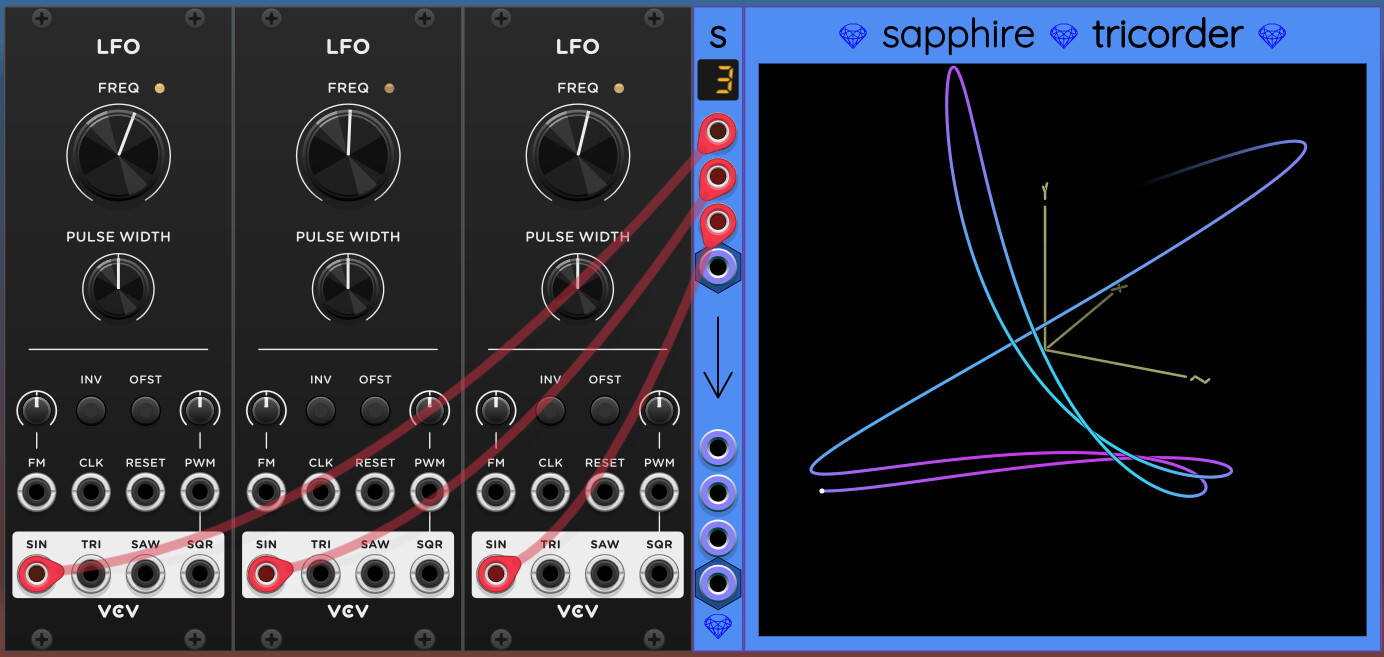
Then combine this with other vector sources through Rotini, or whatever. The possibilities are endless.
I wanted to get this idea out there because it is a lot of fun to play with, even just to look at the shapes you get on the scope.
Also, @DaveVenom did some 3D vector stuff using audio rate modulation and got some wild results:
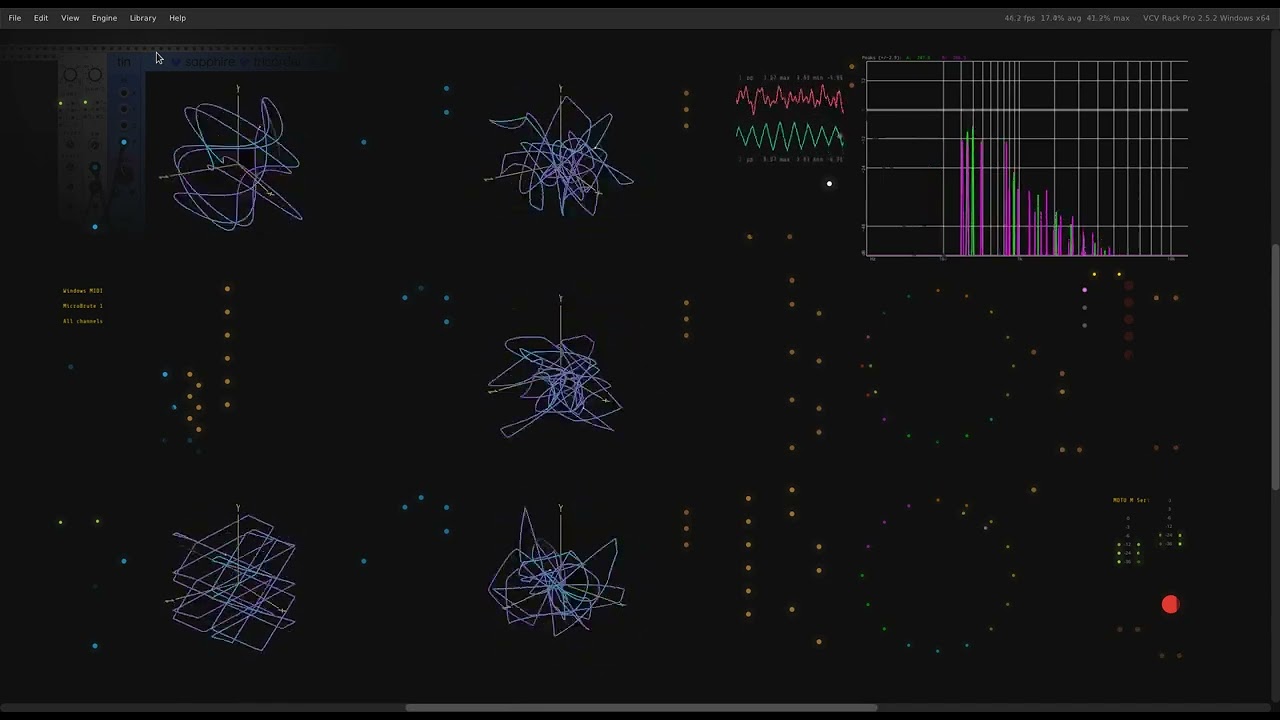
I started messing with this. I don’t really know what I am doing but it is fun.
I get some interesting vertical drops that seemed like they would be good sources for pitch. I ran them unquantized through a VCA and they fit nicely on top of something else I have that is loosely based on @DaveVenom 's video involving audio rate sine waves multiplied by Rotini.
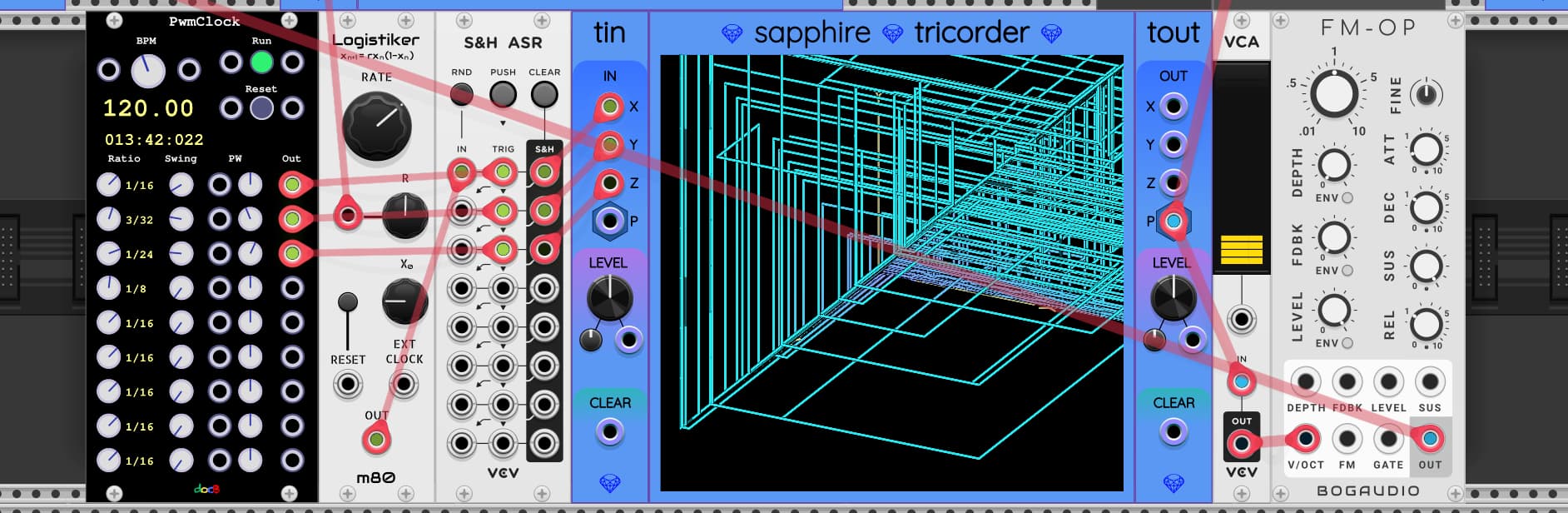
Very fun stuff.